
How Mutual Companies Support Wealth-Building Strategies
- Jib Hunt

- 6 days ago
- 10 min read

COMPLIANCE NOTE: For educational purposes only. Not financial, tax, or legal advice.
Mutual life insurance companies play a central role for entrepreneurs and investors using dividend-paying whole life policies: they return excess earnings to policyholders as dividends and support private banking through policy loans secured by accumulated cash value. The Society of Actuaries’ dividend mechanics research, AM Best financial strength ratings, and The Infinite Banker’s practitioner framework all point to the same conclusion: insurer structure, policy design, and realistic funding expectations matter more than any single carrier name.
The core mechanisms that make this work:
Policyholder ownership aligns the insurer’s earnings distribution with policyholders rather than outside shareholders
Participating dividends may return a portion of insurer surplus to policyholders annually, though they are never guaranteed
Cash-value accumulation creates a pool of capital accessible through policy loans without external underwriting
Policy loans let you borrow against your cash value, recapturing interest you would otherwise pay to commercial lenders
Dividends are non-guaranteed, policy loans accrue interest, and an underfunded or poorly structured policy can lapse. Treat every projection as an illustration, not a promise.
Key Takeaways
Mutual life insurance companies support IBC-style strategies by returning surplus earnings to policyholders as non-guaranteed dividends and providing policy loans secured by cash value, with policy design and insurer fundamentals determining long-term performance.
Point | Details |
Mutual ownership aligns incentives | Policyholders, not shareholders, receive surplus earnings, supporting long-term dividend consistency. |
Policy design drives performance | PUA allocation, loan recognition method, and MEC compliance matter more than carrier selection alone. |
Realistic timeline is 3–7 years | Meaningful borrowing capacity typically develops over years 3–7 depending on funding level and design. |
Dividends are never guaranteed | Annual dividend declarations can be reduced; always request sensitivity illustrations at lower scales. |
The Infinite Banker | Offers strategy sessions, policy design, and underwriting guidance for properly structured IBC policies. |
Table of Contents
How participating whole life policies build cash value and enable policy loans
What metrics should you check when evaluating a mutual insurer?
Policy design choices that matter for entrepreneurs and investors
How long does it take to develop meaningful borrowing capacity?
Practical use cases for entrepreneurs and real estate investors
How do mutual life insurance companies actually work?
A mutual life insurance company is owned by its policyholders, who elect the board of directors and share in the company’s financial results. There are no outside shareholders demanding quarterly returns. Premiums flow into the insurer’s general account, where they are invested conservatively, primarily in investment-grade bonds and mortgages, to match long-term policy liabilities.
Distributable earnings come from three sources: investment returns on reserves, favorable mortality experience (fewer claims than projected), and expense margins. When the insurer performs well across these three factors, the board may declare a dividend for participating policyholders. According to the SOA’s mechanics of dividends report, those dividends are determined annually and are non-guaranteed, meaning the board can reduce or eliminate them in any given year.
Statistic to know: According to MoneyGeek, only about 25% of U.S. life insurers are mutual companies. They represent a minority of the market yet account for a large share of the carriers commonly recommended for participating whole life and IBC-style strategies.
The governance structure matters for long-term policyholders. Because mutual companies answer to policyholders rather than equity markets, their investment philosophy tends toward capital preservation over short-term yield. That orientation supports the kind of multi-decade dividend consistency that IBC practitioners look for when selecting a carrier.
How participating whole life policies build cash value and enable policy loans
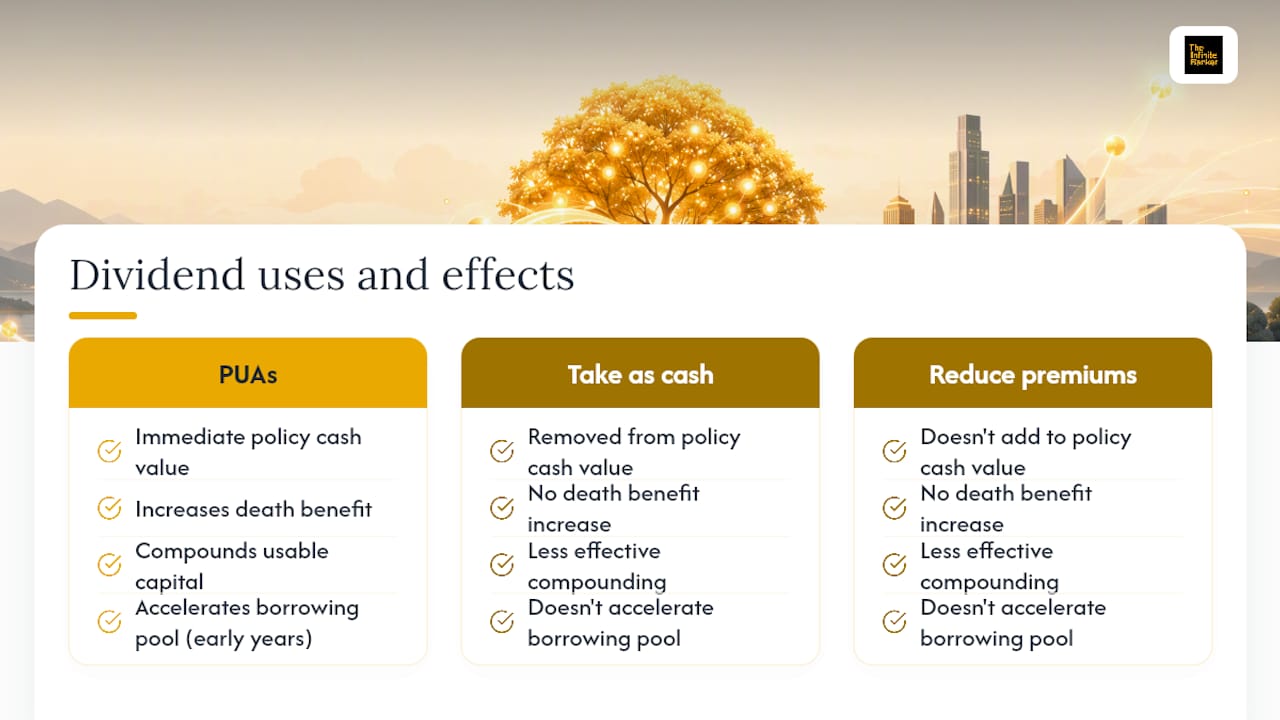
Cash value in a participating whole life policy grows from two components: a guaranteed base and potential dividends. The guaranteed base accumulates according to the policy’s contractual schedule regardless of insurer performance. Dividends, when declared, can be applied in several ways, but for IBC users the most effective option is purchasing paid-up additions (PUAs).
PUAs are small, fully paid-up increments of additional insurance that carry their own cash value immediately. Each PUA purchase adds to both the death benefit and the accessible cash value, compounding the policy’s usable capital over time. Allocating dividends to PUAs rather than taking them as cash or using them to reduce premiums accelerates the pool of capital available for borrowing, particularly in the early policy years when the base cash value is still modest.
Policyholders can borrow from the insurer using cash surrender value as collateral. Policy loans typically require no credit check and have predictable terms, but they accrue interest and reduce both cash value and death benefit if left unpaid.
Loan recognition method also affects performance. With non-direct recognition, the insurer credits dividends on the full cash value even when a loan is outstanding. With direct recognition, dividends on the borrowed portion are reduced. For owners who plan to carry frequent or large loan balances, non-direct recognition carriers tend to preserve more dividend crediting over time.
Pro Tip: Ask your advisor to run a side-by-side illustration showing dividend crediting under both direct and non-direct recognition at your expected loan utilization level. The difference compounds meaningfully over a 10-to-20-year horizon.
Why mutual companies are commonly chosen for IBC strategies
The alignment of incentives is the clearest reason. In a stock company, profits flow to shareholders; in a mutual, surplus returns to policyholders. That structural difference shapes how management allocates capital, manages risk, and sets dividend scales over decades. For someone funding a policy for 20 or 30 years, that orientation toward long-term policyholder value matters.
Practical benefits for IBC users include:
Dividend potential tied to insurer performance rather than equity market pressures
Conservative asset management that prioritizes reserve stability over yield chasing
Voting rights that give policyholders nominal governance participation
Long-term focus that aligns with the multi-decade horizon IBC strategies require
Consider a business owner who funds a participating whole life policy and, after several years, borrows against the cash value to finance a commercial real estate acquisition. The loan requires no bank approval, no personal financial statement, and no impact on existing credit lines. As the owner repays the loan with interest, that interest flows back into the policy’s economics rather than to a commercial lender. This recapture of interest is one of the defining features of the IBC approach.
Mutual status does not guarantee superior short-term liquidity or dividend performance. Dividend variability is real, and a mutual company with a weak surplus trend can underperform a well-run stock carrier. Structure and insurer fundamentals matter more than the ownership label alone.
What metrics should you check when evaluating a mutual insurer?
Before committing to a carrier for an IBC-style strategy, request and review these specific documents:
Document or Metric | What to Look For |
10+ year dividend history | Consistency of scale; any reductions and their stated cause |
AM Best financial strength rating | A or better; watch for negative outlook changes |
Statutory surplus trend | Growing or stable surplus signals reserve strength |
NAIC annual statement | Investment portfolio quality, liability matching |
Policy illustration | Historical scale vs. illustrated dividends; sensitivity testing |
Loan provision language | Direct vs. non-direct recognition; loan interest rate type |
PUA rider terms | Maximum PUA funding limits, flexibility provisions |
Demutualization/closed-block disclosures | Any language indicating conversion risk or ring-fenced blocks |
Red flags worth noting: aggressive early illustrated dividends that far exceed historical scales, missing sensitivity testing in illustrations, demutualization language in policy documents, and closed-block disclosures that limit future dividend adjustments. Dividend-scale increases across several mutual carriers entering 2025 improved short-term crediting for some policyholders, but those increases remain discretionary and tied to each insurer’s ongoing experience.
Policy design choices that matter for entrepreneurs and investors
Policy structure often determines IBC performance more than carrier selection. The three primary levers are PUA allocation, base-to-PUA premium split, and loan provision matching.
PUA allocation is the engine. A higher PUA rider funding level relative to base premium accelerates early cash value but must stay below the Modified Endowment Contract (MEC) threshold. A policy that crosses the MEC line loses its favorable loan tax treatment, so funding must be calibrated carefully.
Three sample funding profiles illustrate the tradeoffs:
The aggressive profile delivers the most usable cash value in years 3–7 but requires careful annual monitoring to avoid MEC classification. The conservative profile provides more margin but a slower ramp to meaningful borrowing capacity.
Pro Tip: Request a MEC corridor analysis from your advisor before finalizing premium splits. Knowing exactly how much additional PUA funding the policy can absorb each year without crossing the MEC threshold lets you fund to the limit safely.
How long does it take to develop meaningful borrowing capacity?
The honest answer: meaningful cash value for borrowing typically takes 3–7 years depending on funding level, policy design, and insurer dividend performance. Early policy years carry the highest internal costs, including commissions, cost of insurance, and administrative charges, which create a “funding lag” before cash value approaches total premiums paid.
Three narrative scenarios:
Conservative funding ($500/month): Cash value may reach a meaningful borrowing threshold around years 6–8. Lower annual outlay reduces opportunity cost but extends the ramp.
Moderate funding ($2,000/month): A balanced profile may reach usable borrowing capacity in years 4–6, with the PUA rider accelerating early accumulation.
Aggressive funding ($5,000+/month): Front-loaded PUA contributions can bring accessible cash value to a meaningful level by years 3–5, but MEC monitoring is critical at this level.
Front-loading premiums shortens the ramp but concentrates MEC risk. For a deeper look at integrating policy funding with business cash flow, the whole life cash flow strategy guide at The Infinite Banker walks through practical structuring approaches.
What are the principal risks and how do you manage them?
Dividend variability: Dividends are non-guaranteed and can be reduced. Mitigation: select carriers with 20+ year consistent dividend histories and request sensitivity illustrations at reduced scales.
Loan interest accrual: Unpaid loan interest compounds and reduces both cash value and death benefit. Mitigation: treat policy loan repayment as a disciplined cash-flow obligation, not an optional event.
Lapse risk: Insufficient premium funding or excessive unpaid loans can cause a policy to lapse, triggering a taxable event. Mitigation: maintain adequate base premium funding and monitor in-force illustrations annually.
MEC classification: Over-funding a policy in the first seven years can trigger MEC status, changing the tax treatment of loans and withdrawals. Mitigation: work with an advisor who runs annual MEC corridor analyses.
Demutualization and closed-block risk: A mutual company converting to stock status may ring-fence existing participating business in a closed block, potentially limiting future dividend adjustments. Request any closed-block disclosures before purchasing.
Dividends from participating whole life policies are generally treated by the IRS as a return of premium rather than taxable income, but amounts exceeding total premiums paid, or interest credited on dividends left with the insurer, may be taxable. Consult a qualified tax advisor before structuring policy distributions.
For a broader look at the tax considerations, the whole life tax treatment guide at The Infinite Banker covers the key planning considerations in detail.
Practical use cases for entrepreneurs and real estate investors
Use case 1: Real estate bridge financing. A real estate investor with an established policy borrows against cash value to fund a short-term acquisition while conventional financing is arranged. The loan closes quickly, requires no bank approval, and the investor repays it from the property’s refinance proceeds. The tradeoff: loan interest accrues during the bridge period and reduces the death benefit if not repaid promptly. See whole life insurance in real estate portfolios for structuring notes.

Use case 2: Recurring business capital needs. A business owner uses policy loans to smooth seasonal cash flow or fund inventory purchases, then repays the loans from operating revenue. The policy functions as a private line of credit. The discipline required: treating loan repayment as a fixed obligation prevents the loan balance from eroding the policy’s long-term performance.
Use case 3: Estate and business continuity planning. Over 20+ years, paid-up additions accumulate alongside the base policy, building a substantial death benefit and cash value pool. The policy serves dual purposes: a living capital reserve and a tax-efficient wealth transfer vehicle. This use case benefits most from the conservative funding profile, where MEC risk is low and the long time horizon allows compounding to work. The generational wealth guide at The Infinite Banker covers this application in depth.
How to choose an advisor and what to ask before you commit
Interview questions for any IBC advisor:
How many IBC-style policies have you designed and placed in the last three years?
Can you show me policy illustrations with sensitivity testing at reduced dividend scales?
Which carriers do you work with, and can you explain why you recommend them for this use case?
How do you handle MEC corridor monitoring after a policy is placed?
Are you an Authorized IBC Practitioner, and what does that designation require?
Documents to request before signing:
10+ year dividend history from the carrier
In-force illustration at current and reduced dividend scales
NAIC annual statement for the most recent year
Full loan provision language, including recognition method and interest rate type
PUA rider terms and maximum annual funding limits
Red flags to avoid:
Illustrations that show only the current dividend scale with no downside scenario
Advisors who cannot explain the difference between direct and non-direct recognition
Missing PUA rider detail or vague loan provision language
Projections that assume dividend scales remain flat or increase indefinitely
When does a mutual-company IBC approach actually fit?
Most articles about IBC focus on the mechanics. What gets less attention is the self-assessment question: does this strategy fit your actual cash-flow profile and planning horizon?
The mutual-company whole life approach tends to fit best when you have consistent, predictable income you can commit to policy funding for at least 10 years, when you have recurring capital needs that benefit from a private, underwriting-free credit facility, and when your planning horizon extends to estate transfer or long-term business continuity. It fits less well when your cash flow is highly variable, when you need liquidity within the first two or three years, or when you are primarily seeking short-term yield.
The advisor credential matters here. Working with an Authorized IBC Practitioner, like Jib Hunt at The Infinite Banker, signals that the advisor has studied the Nelson Nash methodology and is equipped to design policies specifically for capital efficiency rather than simply placing a standard whole life contract. That distinction shows up in the policy’s PUA allocation, loan provision selection, and MEC corridor management, not in the carrier name on the cover page.
For a clear-eyed look at who this strategy is designed for, the audience qualification page at The Infinite Banker is a useful starting point.
The Infinite Banker’s approach to IBC implementation
The Infinite Banker works with entrepreneurs, real estate investors, and high-income business owners to design and implement properly structured dividend-paying whole life policies for capital efficiency and long-term planning. The service covers strategy sessions, policy design, underwriting guidance, and ongoing education, with every policy built around PUA allocation, loan provision matching, and MEC compliance from the start.

If you are ready to evaluate whether a mutual-company whole life strategy fits your capital and planning needs, the practical next step is a strategy session with The Infinite Banker. Visit The Infinite Banker to schedule a consultation and request a policy illustration designed for your specific funding profile.
Sources
This post is educational only and not financial, tax, or legal advice. Consult qualified professionals before acting.
This article is general information, not a substitute for advice from a qualified financial advisor. Consult a qualified financial professional about your own circumstances before acting on anything here.
Recommended
Comments