
How to Store Wealth Outside Financial Institutions


COMPLIANCE NOTE: For educational purposes only. Not financial, tax, or legal advice.
The three most practical ways to store wealth outside financial institutions are dividend-paying whole life insurance structured for Infinite Banking, direct real estate ownership, and physical precious metals. Each serves a distinct purpose: whole life is designed for capital efficiency and cash-flow flexibility, real estate produces income from a tangible asset, and precious metals function as an inflation hedge and store of value. This guide is written for entrepreneurs, real estate investors, and high-income earners who want a multilayered, defensible plan rather than a single substitute for a bank account.
“Alternative asset storage is most effective as a complement to disciplined financial planning and an insurance-first defense, not as a standalone replacement for banking relationships.” This framing, consistent with guidance from U.S. Bank’s wealth preservation research, shapes every recommendation below.
The primary methods covered here draw on the expertise of The Infinite Banker, and reference carriers including MassMutual, Guardian Life, and New York Life for whole life products, and professional custodians including Brink’s for physical asset storage. Key disclosures up front: dividends on whole life policies are not guaranteed, and policy loans accrue interest and reduce both cash value and the death benefit if left unpaid. Policies can lapse if premiums are not maintained.
Dividend-paying whole life / Infinite Banking: capital efficiency and liquidity control
Direct real estate: income-producing tangible asset with entity-level structuring
Physical precious metals: inflation hedge with custody and tax trade-offs
Table of Contents
How dividend-paying whole life insurance stores capital outside banks
Why direct real estate ownership works as a non-bank capital store
How physical precious metals fit into an outside-the-bank strategy
How entity, trust, and insurance layering reduces creditor exposure
Comparing the three methods across control, liquidity, cost, and protection
How dividend-paying whole life insurance stores capital outside banks
The Infinite Banking Concept (IBC) places capital inside a life insurance policy’s cash value, which policyholders can then access through whole life policy loans while the insurer manages the underlying investments. Carriers such as MassMutual, Guardian Life, and New York Life offer participating whole life policies that credit non-guaranteed dividends, which can be directed toward paid-up additions (PUAs) to accelerate cash value growth.
How the mechanics work:
Cash value accumulation: premiums fund both the cost of insurance and a growing cash value component that compounds over time.
Dividends: credited annually by the carrier based on company performance; they are never guaranteed and should not be treated as a fixed return.
Policy loans: you borrow against the policy’s cash value at the carrier’s loan interest rate. The loan accrues interest, and if unpaid, it reduces both the cash value and the death benefit. Insufficient funding relative to the loan balance can trigger a policy lapse.
Paid-up additions rider: the engine of the Infinite Banking approach; PUAs accelerate early cash value and increase the dividend base.
Pros include control over capital access, potential creditor protection in many states, and the ability to recycle capital through loans for business or real estate use. Cons include premium commitments, the internal cost of insurance, and the complexity of proper policy design. Permanent life insurance offers cash-value accumulation and liquidity options unavailable in term coverage, but it is more expensive and requires careful structuring.
Questions to ask an Authorized IBC Practitioner before committing:
What is the projected premium schedule, and what happens if I miss a payment?
How is the policy designed to minimize the internal cost of insurance relative to cash value?
What is the anticipated funding lag before meaningful cash value is accessible?
How do policy loans interact with the dividend crediting mechanism?
Jib Hunt, an Authorized IBC Practitioner at The Infinite Banker, works with clients on whole life cash flow strategy and policy design coordinated with entity and real estate planning.
Pro Tip: Ask your practitioner to model a scenario where you miss two consecutive premium payments. The output tells you more about lapse risk than any marketing illustration.
Why direct real estate ownership works as a non-bank capital store
Real estate stores capital in an income-producing, tangible asset class, but it requires active management and deliberate legal structuring to function as genuine alternative wealth storage. Acquisition, holding costs, and the time required to convert property to cash are all meaningful constraints.

Common ownership structures include individual title, single-member LLCs, family LLCs, and layered landlord entities. An LLC alone is often only one layer of protection; creditors can sometimes pierce a single-entity structure if corporate formalities are not maintained. Encumbrance strategies such as placing legitimate liens or mortgages on a property reduce the equity visible to creditors and can deter claims, but they must be applied legitimately to avoid fraudulent-transfer exposure.
Ongoing costs to budget:
Property management fees (typically 8%–12% of gross rents, though this varies by market and manager)
Maintenance and capital reserves
Property taxes and landlord insurance
Entity formation and annual state filing fees
Pros and cons at a glance:
Pros: tangible income-producing asset, depreciation and other tax treatment, potential appreciation, and control over the asset
Cons: concentrated risk, illiquidity (months to sell), active management burden, and creditor exposure without additional legal layers
For estate planning, title matters as much as entity structure. Beneficiary designations, transfer-on-death deeds where available, and coordination with an estate attorney are all part of a complete plan. Implementing an entity-held property plan typically takes 1–3 months for entity formation and retitling, with ongoing formality requirements thereafter.
How physical precious metals fit into an outside-the-bank strategy
Precious metals provide a tangible store of value and portfolio diversification, but they do not generate income and carry distinct custody and tax implications. Investing in precious metals requires decisions about storage and insurance that directly affect cost and counterparty exposure.
Custody options:
Home storage: lowest cost, highest theft risk, and requires a separate homeowner or standalone policy rider to cover bullion.
Bank safe deposit boxes: accessible but not FDIC-insured and unavailable during bank closures.
Third-party professional depositories (e.g., Brink’s): higher security, auditable chain of custody, and allocated vs. unallocated account options; annual fees apply.
Allocated holdings: your specific bars or coins are segregated and titled to you; unallocated holdings expose you to the depository’s counterparty risk.
Tax treatment is a material consideration. Some physical metal investments are taxed as collectibles, which can lead to higher capital gains rates in certain circumstances compared to standard securities. ETFs that hold physical metals may carry their own tax treatment; confirm with a CPA before choosing a vehicle.
Dealer premiums, storage fees, and insurance costs can materially reduce the net economic benefit of holding physical metals. FINRA advises investors to get all fees and costs in writing before committing, and to request a risk disclosure statement from any dealer.
Custody checklist:
Confirm insurance coverage amount and what perils are included
Verify allocated (segregated) vs. unallocated status in writing
Obtain a third-party audit or assay certificate for provable chain of custody
Review redemption terms and liquidity timeline before depositing
How entity, trust, and insurance layering reduces creditor exposure
Effective protection is layering: liability insurance first, then entity structures such as LLCs, and trusts for separation and succession. No single structure is absolute, and the sequence matters as much as the components.
The typical layering sequence runs: (1) adequate liability insurance and an umbrella policy, (2) title and entity placement in an LLC, and (3) placing LLC interests in an irrevocable or dynasty trust where appropriate. Sophisticated practitioners often combine retitling, encumbrance, and trust placement so the asset remains usable while reducing its attractiveness to creditors. Timing and documentation are critical to avoid fraudulent-transfer exposure.
Questions to ask an asset-protection attorney:
What is the fraudulent-transfer lookback period in my state?
Does my state offer charging-order protection for single-member LLCs?
Is an irrevocable trust appropriate given my liquidity needs?
What are the ongoing formality requirements to maintain entity integrity?
Implementation typically runs 1–3 months for entity formation and initial insurance review, with trust drafting adding another 1–3 months. Retitling and funding follow. A multilayered approach consistently produces stronger protection than relying on any single alternative.
Comparing the three methods across control, liquidity, cost, and protection
Dimension | Dividend-paying whole life (IBC) | Direct real estate | Physical precious metals |
Control vs. convenience | High control; carrier manages investments | High control; owner manages asset | High control; custody choice drives convenience |
Liquidity / access to capital | Policy loans available; subject to loan terms | Months to sell; rental income is periodic | Depository: days to weeks; home storage: immediate |
Counterparty and custody risk | Carrier insolvency risk (state guaranty funds apply) | Title and entity risk; lender if mortgaged | Theft, depository solvency, unallocated risk |
Ongoing costs / fees | Premiums, cost of insurance, loan interest | Management, taxes, maintenance, entity fees | Storage, insurance, dealer premiums |
Legal / creditor protection | State-specific; often strong for death benefit | Depends on entity and encumbrance layering | Minimal without trust or entity placement |
Tax considerations (general) | Policy loans generally not taxable events; consult CPA | Depreciation, capital gains on sale | Collectibles rates may apply; varies by vehicle |
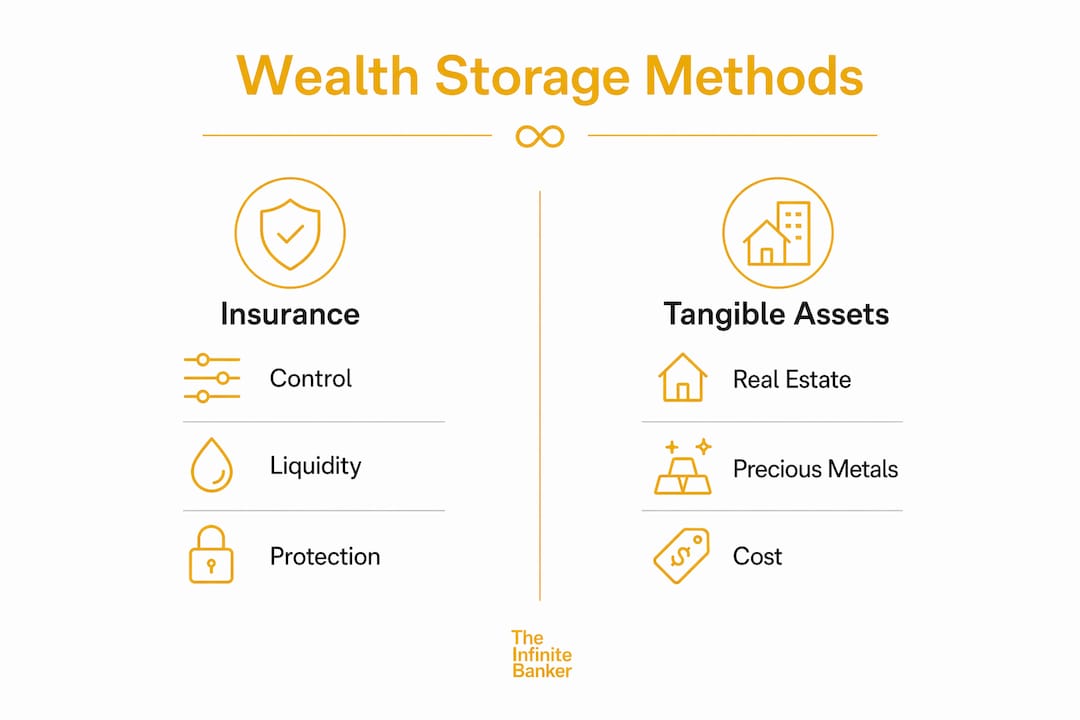
Entrepreneurs who need capital access and operational liquidity often find the IBC structure most compatible with their cash-flow patterns. Real estate investors seeking passive income and depreciation benefits tend to prioritize direct ownership with entity layering. High-income earners focused on inflation hedging and diversification may allocate a portion to physical metals as a complement to the other two.
Offshore accounts and foreign-held assets are a separate category that requires legal counsel, FBAR and FATCA reporting compliance, and jurisdiction-specific structuring. Frame any offshore discussion with a qualified international tax attorney before acting.
Reminder: dividends on whole life policies are not guaranteed, and policy loans reduce cash value and the death benefit if unpaid.
A practical checklist to design your multilayered plan
Immediate actions (weeks 1–4):
Document current cash flow, liquid reserves, and top objectives (liquidity, legacy, creditor protection).
Fund or confirm an adequate emergency liquid reserve before committing capital to illiquid structures.
Schedule a consultation with an Authorized IBC Practitioner to model policy design and premium schedule.
Short-term (months 1–3):
Consult an asset-protection attorney on entity formation, state-specific protections, and trust suitability.
Review and increase liability insurance and umbrella coverage to appropriate limits.
Form entities and open business accounts; follow all formality requirements from day one.
Medium-term (months 6–18):
Fund the whole life policy per the agreed schedule; avoid underfunding relative to the projected premium schedule, which increases lapse risk.
Retitle assets into entities and, where advised, place entity interests in trust.
Choose custody for physical metals; obtain written confirmation of allocated status and insurance coverage.
Long-term (ongoing):
Review the full plan annually or after any material life or business change.
Coordinate CPA, estate attorney, and IBC practitioner reviews so the layers remain aligned.
A wealth preservation checklist can help structure the annual review process.
Pro Tip: Set a calendar trigger 60 days before each policy anniversary to confirm premium funding and review any outstanding policy loans. A missed payment is far easier to address in advance than after a lapse notice arrives.
Common pitfalls that undermine outside-the-bank plans
Many failures trace to execution errors, underfunding, or poor coordination between advisers rather than flawed strategy.
Red flags to watch for:
Overconcentration: placing all capital in one method (e.g., real estate only) without liquidity reserves creates forced-sale risk.
Policy underfunding: a permanent life policy funded below its projected premium schedule faces elevated lapse risk and loses the liquidity benefits the IBC approach is designed to provide.
Unvetted storage providers: using a depository without verifying allocated status, insurance coverage, and third-party audit history exposes you to fraud and loss.
LLC informality: commingling personal and entity funds, or skipping annual filings, can allow a creditor to pierce the entity and reach personal assets.
Inadequate liability insurance: entity structures are a second line of defense; without sufficient umbrella coverage, the first claim can exhaust personal assets before entity protections engage.
Tax reporting obligations apply across all three methods. Physical metals sales, policy surrenders, and real estate transactions each carry reporting requirements. Improper asset transfers can trigger adverse tax consequences, including gift tax or fraudulent-transfer recapture. Coordinate with a CPA before any significant move. For high earners, common financial planning mistakes often involve skipping this coordination step.
Key Takeaways
Storing wealth outside financial institutions works best as a multilayered plan combining dividend-paying whole life insurance, direct real estate with entity structuring, and physical precious metals, each serving a distinct role in liquidity, protection, and diversification.
Point | Details |
Lead with insurance-first defense | Liability and umbrella insurance are the first line of protection before entity or trust structures are engaged. |
Whole life policy loans carry real costs | Policy loans accrue interest and reduce cash value and the death benefit if unpaid; dividends are never guaranteed. |
Entity layering requires ongoing formality | LLCs and trusts only protect if corporate formalities are maintained and assets are properly titled from the start. |
Physical metals custody drives net returns | Dealer premiums, storage fees, and insurance costs can materially reduce the economic benefit of holding physical metals. |
The Infinite Banker | Works with entrepreneurs and high earners on properly structured whole life strategies coordinated with entity and real estate planning. |
A practitioner’s perspective on what actually matters
Most clients who come to The Infinite Banker have already tried one piece of the puzzle in isolation. They own real estate but have no liquidity buffer. Or they hold bullion but have no entity structure around it. The conversation that changes things is not about which asset is best; it is about sequencing and coordination.
The Infinite Banking approach, as practiced by Jib Hunt, an Authorized IBC Practitioner, is not a product sale. It is a design process. The policy is structured around the client’s actual cash-flow patterns, premium capacity, and anticipated capital needs, whether for a real estate acquisition, a business opportunity, or a legacy goal. The whole life policy functions as a private capital reserve, not a savings account substitute.
What most guides understate is the coordination burden. A well-designed IBC policy sitting next to an LLC with no trust layer and no umbrella policy is an incomplete plan. The generational wealth potential of a properly structured policy is real, but it depends on the surrounding legal and tax architecture being equally deliberate. Tax and legal frameworks matter more than asset choice alone; EY’s wealth preservation guidance makes this point clearly, and it holds for clients at every asset level.
The clients who see the most durable results are the ones who treat this as a plan, not a product. They review annually, they maintain entity formalities, and they keep their advisers talking to each other.
How The Infinite Banker can help you implement this plan
The Infinite Banker works with entrepreneurs, real estate investors, and high-income earners to design and implement properly structured whole life strategies, coordinated with entity planning and physical asset custody decisions. Services include policy design, premium modeling, and coordination with CPAs and asset-protection attorneys so the layers of your plan align from the start.
Two concrete next steps: use the Infinite Banking Calculator to model how a dividend-paying whole life policy could fit your current cash flow, or schedule a discovery call through The Infinite Banker to discuss your specific situation with Jib Hunt, an Authorized IBC Practitioner. If you are earlier in the process, the how Infinite Banking works page walks through policy mechanics in plain language before you commit to a consultation.
Useful sources and further reading
The following sources informed this article. Each covers a distinct aspect of alternative wealth storage, and all are worth reading in full before making decisions.
5 Places to Keep Your Money When You Don’t Trust the Banks | Investopedia — overview of non-bank storage motivations including diversification and inflation hedging.
Strategies for Wealth Preservation | Investopedia — covers insurance-first layering and permanent life policy mechanics.
Investing in Gold and Silver: A Decision Guide | Morgan Stanley — custody options, fee trade-offs, and tax treatment for physical metals.
Should You Buy Gold and Silver Now? | Fidelity — vehicle comparison (physical, ETF, mining equities) and liquidity trade-offs.
Asset Protection Strategies | Fidelity — multilayered approach rationale and insurance-first defense.
10 Tips for Preserving and Growing Personal Wealth | EY — advanced layering techniques including retitling, encumbrance, and trust placement.
Simple Asset Protection Strategies That Defend Your Estate | Forbes — encumbrance tactics and fraudulent-transfer considerations for real estate.
Wealth Preservation: Key Strategies to Protect Wealth | U.S. Bank — integrated plan rationale and annual review recommendations.
4 Tips to Know Before Buying Physical Precious Metals | FINRA — fee disclosure requirements and risk considerations for physical metal purchases.
For deeper reading on policy mechanics, cash-flow strategy, and case studies, visit The Infinite Banker blog. For jurisdiction-specific rules on entity formation, trust drafting, and tax reporting, consult a qualified CPA and asset-protection attorney.
This post is educational only and not financial, tax, or legal advice. Consult qualified professionals before acting.
Recommended
Comments