
Investors: Use Cash Value Without Eroding the Death Benefit


COMPLIANCE NOTE: For educational purposes only. Not financial, tax, or legal advice.
A death benefit is the sum a life insurance company pays to your named beneficiaries when you die. Cash value is the savings-like account inside certain permanent policies that you, the policyholder, can access while still alive. The core trade-off is simple: cash value gives you liquidity now, while the death benefit protects the people who depend on you later. The IRS and firms like The Infinite Banker both treat these as distinct financial tools, not interchangeable features.
TL;DR:
Cash value generally takes several years to accumulate meaningfully, especially with universal and variable life policies, which expose the cash to market fluctuations.
Borrowing against cash value through policy loans can erode both the cash amount and death benefit if not managed properly, risking policy lapse.
Tax advantages include tax-deferred growth and tax-free withdrawals up to the cost basis, but overfunding may trigger Modified Endowment Contract status with less favorable tax rules.
Higher premiums are typical with cash-value policies, and surrender charges in early years can reduce cash value if the policy is canceled prematurely.
The right focus depends on individual goals: prioritizing death benefit for estate planning or liquidity needs, or emphasizing cash value for business or income supplement purposes.
Table of Contents
Cash Value vs Death Benefit: The Core Differences
The death benefit is the face amount of the policy, the number your beneficiaries receive after you pass, usually within weeks of a claim being filed. Cash value is different. It’s a portion of your premium that accumulates inside the policy, growing according to the insurer’s dividend performance or a market-linked formula, depending on the product.
Not every policy builds cash value. Term life insurance provides only a death benefit for a set period, with no savings component at all. Permanent policies, including whole life, universal life, and variable life, can include both a death benefit and a cash value account, though the mechanics differ:
Whole life typically offers guaranteed cash value growth plus the potential for non-guaranteed dividends.
Universal life allows more flexible premiums, with cash value tied to a credited interest rate that can change over time.
Variable life ties cash value to market-based subaccounts, meaning it can lose value.
Term life builds no cash value at all and simply expires at the end of the term.
Choosing a cash-value policy generally means paying higher premiums than a comparable term policy, since part of every payment funds the savings component rather than just the cost of coverage.
How Cash Value Grows and How You Access It
Every premium payment on a permanent policy gets split three ways: a portion covers the cost of insurance, a portion covers fees and insurer expenses, and the remainder funds cash value. In the early years, that third slice is small. Most policies need several years before the cash value balance becomes meaningful, which is why Northwestern Mutual frames cash-value policies as a long-term commitment rather than a short-term savings account.
Growth patterns vary by product. Whole life policies from mutual insurers often credit guaranteed minimum growth plus potential dividends, which are never guaranteed and can be reduced or suspended. Universal and variable products expose the cash value to interest rate changes or market performance, which introduces more volatility.
Once cash value has accumulated, you can access it a few ways:
Policy loans let you borrow against the cash value, with the insurer charging interest on the outstanding balance.
Withdrawals pull money directly from the cash value, generally tax-free up to your cost basis.
Surrendering paid-up additions converts smaller pieces of the policy to cash without fully canceling it.
Full surrender cancels the policy entirely in exchange for its cash surrender value, often reduced by surrender charges in early years.
Pro Tip: Unpaid policy loans accrue interest and reduce both cash value and death benefit dollar-for-dollar. Left unmanaged, an outstanding loan balance that grows faster than the policy’s cash value can cause the policy to lapse.
Tax Treatment: What the IRS Says About Each Component
The tax rules differ sharply between the two components, and the difference is one reason cash value appeals to entrepreneurs managing liquidity.
Death benefit proceeds are generally received by beneficiaries income-tax-free, according to IRS guidance.
Cash value grows tax-deferred while it stays inside the policy.
Withdrawals up to your cost basis are typically treated as a return of premium and are not taxed; amounts above basis can be taxable.
Policy loans are usually not taxable events while the policy remains in force, but they still accrue interest and reduce the death benefit if unpaid.
One trap worth knowing: if a policy is overfunded too quickly, it can become a Modified Endowment Contract (MEC), which changes the tax treatment of loans and withdrawals. Roughly speaking, insurers design premium schedules to avoid MEC status unless the policyholder deliberately structures for it, and surrender charges in early policy years can also erode cash value faster than expected.
Weighing Cash Value Against Death Benefit Priorities
Neither component is inherently better. The right emphasis depends on what problem you’re solving.
Death benefit first makes sense for income replacement, estate liquidity, or creditor protection, which varies by state.
Cash value first suits business owners who want a source of liquidity, supplemental retirement income, or a vehicle for tax-aware policy loans.
Higher premiums are the tradeoff for prioritizing cash value, since more of each dollar goes toward savings rather than pure protection.
Long accrual periods mean early cash value growth is slow, and surrender charges can apply if you cancel the policy in the first several years.
Reduced death benefit is the direct consequence of any unpaid loan or withdrawal, a fact every policyholder needs to plan around before borrowing.
A Short Checklist Before You Decide
Before choosing which component to emphasize, walk through a few questions with a licensed professional.
What’s the primary goal: legacy protection, liquidity, or a mix of both?
What’s the time horizon before you’d need to access cash value?
Can the budget support higher premiums long enough to build a useful cash value balance?
How complex a policy structure are you willing to manage, including loan repayment discipline?
How would a policy loan affect the death benefit your beneficiaries are counting on?
Ask any agent how long it typically takes for cash value to become meaningful, how loan interest compounds, and what the surrender charge schedule looks like in years one through ten; you can find helpful local resources at the Quality Insurance Agency in Las Vegas.
Pro Tip: Entrepreneurs and investors who expect to borrow repeatedly against a policy should ask specifically about paid-up additions riders, since these can accelerate early cash value growth compared to a base policy alone.
How The Infinite Banker Approaches Policy Structuring
Policy structuring for capital efficiency typically means designing a whole life contract with a base policy plus paid-up additions, balancing near-term cash value growth against long-term death benefit strength. Operational safeguards matter as much as the initial design: tracking loan balances against cash value growth, watching for MEC exposure during the funding years, and staging premium contributions rather than overfunding too quickly.
Dividends are not guaranteed. Policy loans accrue interest and reduce both cash value and death benefit if left unpaid, and a mismanaged policy can lapse. Structuring decisions should always account for these mechanics before funding begins.
Jib Hunt, an Authorized IBC Practitioner, works with clients to weigh these safeguards against each client’s liquidity needs and legacy goals.
Why Investors Get the Cash Value Question Backwards
Most articles on this topic treat cash value and death benefit as competitors, as though building one weakens the other. That framing misses how entrepreneurs and real estate investors actually use these policies. The real question isn’t which component is “better.” It’s which one solves the specific liquidity or protection problem in front of you this year, and which one you’ll need in ten years.
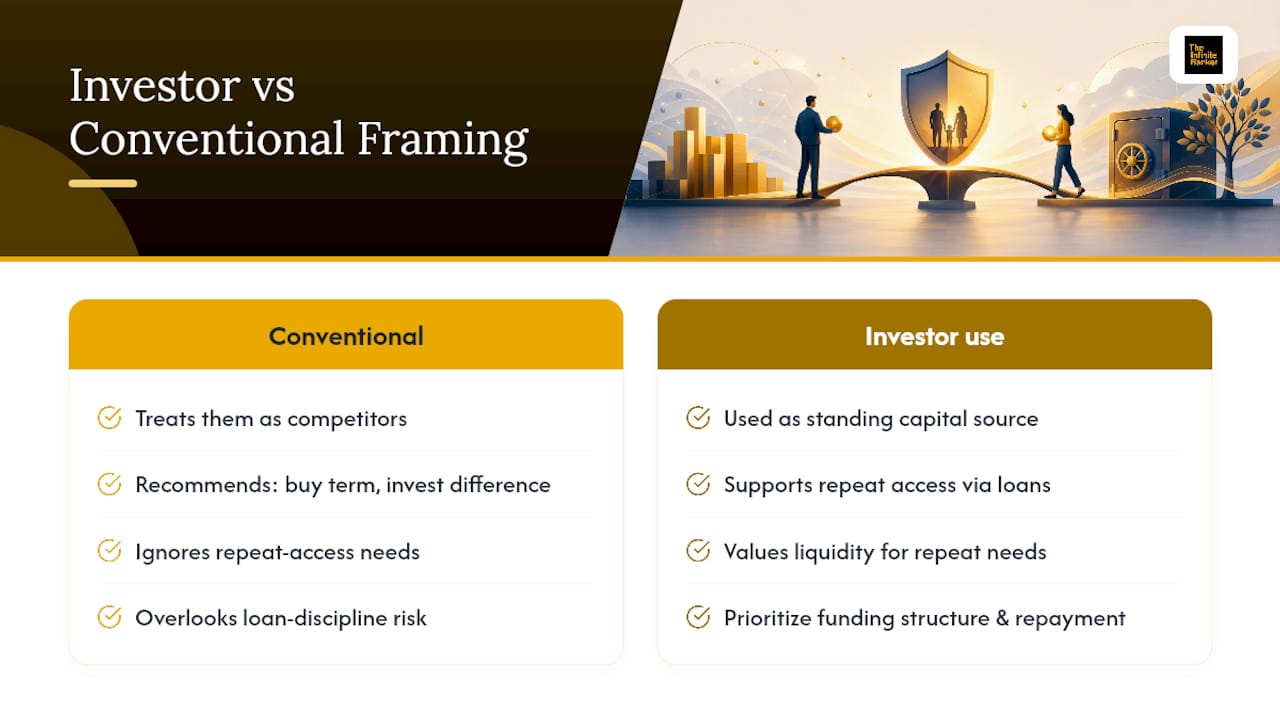
The conventional advice, buy term and invest the difference, ignores that a properly structured whole life policy can serve as a standing capital source for people who need repeat access to funds, not just a one-time payout. What gets underestimated is the discipline required to manage loans against a policy without eroding the coverage a family or business partner is counting on.
If you take one thing from this, prioritize the funding structure before you worry about optimizing the trade-off. A policy with paid-up additions and a sensible loan repayment plan resolves most of the tension between liquidity and legacy that this article has described.
— Jib Hunt
Get Help Structuring a Policy Around Your Cash Flow
Generic online explainers can tell you what cash value and death benefit are, but they can’t tell you how to structure a policy around your specific business cash flow, real estate acquisition timeline, or loan repayment habits. Consulting practices offer policy design, paid-up additions planning, and ongoing loan management, so the structure fits how you actually use capital, not a generic template.

Sessions start with an educational conversation about your goals, not a sales pitch, and cover how a dividend-paying whole life policy might fit your situation. If you want to see whether this approach fits your profile, review who Infinite Banking is designed for and schedule a consult to walk through policy design options with an Authorized IBC Practitioner.
Primary Sources and Further Reading
This article is general information, not a substitute for advice from a qualified financial advisor. Consult a qualified financial professional about your own circumstances before acting on anything here.
Sources
FAQ
Do You Get Both Death Benefit and Cash Value?
Yes, if you own a permanent policy like whole or universal life, you have both a death benefit and a cash value account simultaneously. Term life insurance, by contrast, provides only a death benefit with no cash value component at all.
What Is the Cash Value of a Life Insurance Policy? The amount varies widely depending on policy type, insured’s age, time in force, and premium payments.
There’s no fixed answer, since cash value depends on the policy type, the insured’s age, how long the policy has been in force, and the premium structure. A newly issued policy will have little to no cash value in year one, while a decades-old whole life policy with the same face amount could hold a substantial balance.
What Are the Downsides of Cash Value Life Insurance?
The main downsides are higher premiums compared to term insurance, a long accrual period before cash value becomes meaningful, and surrender charges if you cancel the policy in its early years. Loans and withdrawals also reduce the death benefit and can create tax consequences if the policy lapses with an outstanding loan.
What Is the Typical Range for Death Benefit Payouts? Death benefits vary widely and are individually set based on income, debts, and legacy goals; no single average applies.
Death benefit amounts vary widely based on the coverage a policyholder chose at issue, ranging from small final-expense policies to multi-million-dollar coverage for business or estate planning purposes. There’s no single “average” figure that applies across policy types, since face amounts are set individually based on income, debts, and legacy goals.
This post is educational only and not financial, tax, or legal advice. Consult qualified professionals before acting.
Recommended
Comments