
Whole Life Insurance Cash Value Explained for Investors


COMPLIANCE NOTE: For educational purposes only. Not financial, tax, or legal advice.
Whole life insurance cash value is a savings component embedded inside a permanent life insurance policy that grows on a tax-deferred basis throughout the policyholder’s lifetime. Unlike term insurance, which provides only a death benefit for a fixed period, whole life insurance combines lifelong coverage with an internal account that accumulates value you can access while still living. Understanding this dual structure is the foundation of what is cash value life insurance and why it attracts entrepreneurs, real estate investors, and high-income earners who want financial flexibility alongside protection. The Infinite Banker specializes in helping this audience apply these mechanics through properly structured Infinite Banking strategies.
What is whole life insurance cash value, and how does it work?
Whole life insurance is defined as a permanent life insurance policy that remains in force for the insured’s entire life, provided premiums are paid. Every premium payment serves two purposes at once. Part of it covers the cost of the death benefit and policy expenses. The remainder flows into the cash value account, where it accumulates over time.

Premiums are fixed for the life of the policy, which gives policyholders predictable costs and lifelong coverage. That predictability matters for long-term financial planning because you can model future cash flows without worrying about rising insurance costs. The death benefit is also fixed, meaning your beneficiaries receive a defined amount regardless of when you pass.
The cash value account earns a guaranteed rate of return, set by the insurer at policy issue. Growth inside the account is tax-deferred, meaning you owe no income tax on the accumulation each year. This tax treatment is one of the most cited whole life insurance benefits for high-income earners who want to shelter growth from annual taxation.
How does cash value in whole life insurance grow and accumulate?
Cash value growth follows a predictable but slow-starting pattern. In the early years of a policy, a larger share of each premium goes toward the cost of insurance and administrative fees. Less reaches the cash value account. This front-loading effect means the account balance builds slowly at first, then accelerates as the policy matures.
The core growth components work as follows:
Growth Component | How It Works |
Fixed interest rate | Set at policy issue; credited annually to the cash value account |
Tax-deferred accumulation | No annual income tax on growth while funds remain inside the policy |
Dividends (non-guaranteed) | Paid by the insurer on participating policies; may increase cash value |
Paid-up additions | Optional dividend use that purchases additional coverage and cash value |
Policy charges and fees | Deducted from premiums; reduce net cash value in early years |
Dividends on participating whole life policies are not guaranteed and depend on the insurer’s financial performance. When paid, they can be applied to increase cash value, reduce premiums, or purchase paid-up additions that compound the policy’s internal growth. Paid-up additions are particularly relevant to Infinite Banking strategies because they accelerate the cash value available for policy loans.
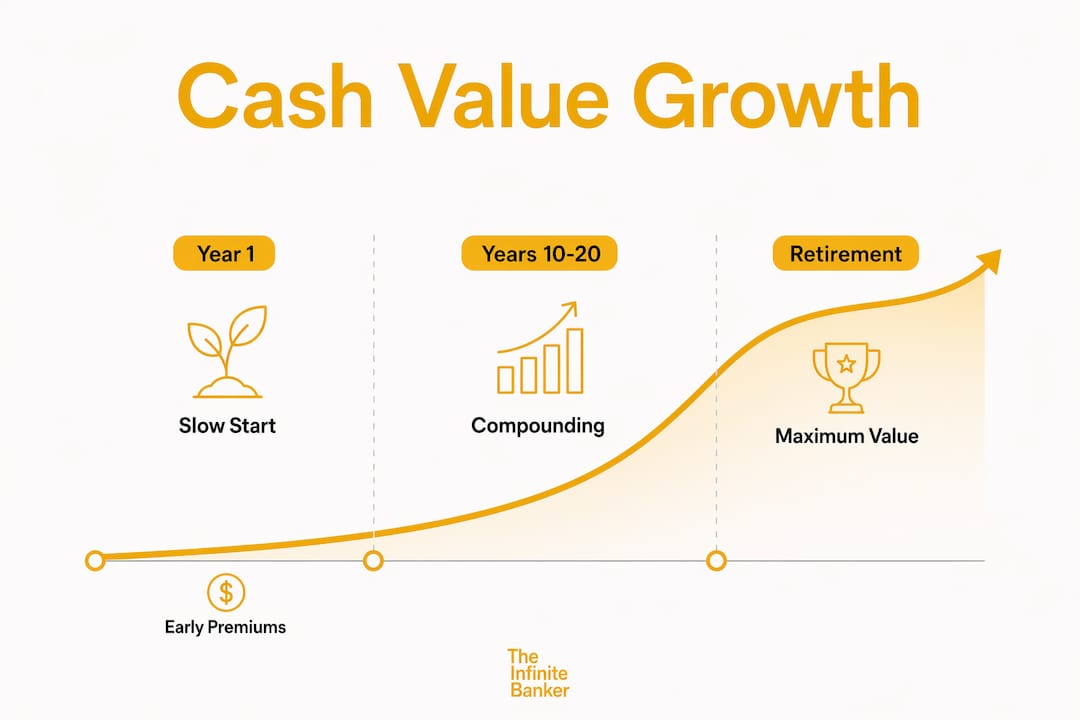
The growth curve resembles a slow engine warming up. By years 10–20, the compounding effect becomes more visible. By retirement age, a well-funded policy can carry substantial cash value relative to total premiums paid.
Pro Tip: Overfunding a whole life policy with paid-up additions, up to the IRS Modified Endowment Contract limit, is the most direct way to accelerate cash value accumulation in the early years.
What are the benefits and considerations of whole life insurance cash value?
Whole life insurance cash value offers several practical advantages for long-term financial planning. The most cited benefits include:
Lifelong coverage. The policy does not expire, so the death benefit remains in force regardless of age or health changes after issue.
Fixed premiums. Costs stay constant, making the policy easy to budget over decades.
Tax-deferred growth. The cash value account grows without annual income tax, which compounds the long-term accumulation.
Income-tax-free death benefit. The death benefit passes to beneficiaries free of income tax, provided the policy remains in force.
Liquidity through policy loans. You can borrow against cash value without a credit check, using the funds for any purpose.
Automatic premium payment. Cash value can pay premiums automatically under certain policy provisions, helping prevent lapse during financial hardship.
The considerations are equally real. Whole life insurance carries higher premiums than term coverage because it includes both lifelong protection and the savings component. For someone who only needs temporary coverage, the cost difference is significant.
Policy loans accrue interest and reduce the death benefit if left unpaid. If loan balances grow large enough relative to cash value, the policy can lapse, which may trigger a taxable event. Surrendering the policy early may also produce a taxable gain if the cash value exceeds total premiums paid.
Pro Tip: Treat policy loans as a formal obligation, not free money. Establish a repayment schedule at the time you borrow to prevent loan interest from compounding against your cash value over time.
How can you use cash value in whole life insurance for financial planning?
Cash value functions as a flexible financial reserve that you can access during your lifetime for a wide range of purposes. The most common applications include:
Supplementing retirement income. Withdrawals or loans from cash value can provide income in retirement without triggering the same tax treatment as IRA or 401(k) distributions, depending on how they are structured.
Funding education costs. Parents and business owners use cash value for education or other large expenses without disrupting other investments.
Business capital. Entrepreneurs borrow against cash value to fund operations, acquisitions, or real estate deals, then repay the loan on their own schedule.
Emergency reserves. Cash value serves as a liquid backstop that does not require selling investments at a loss during market downturns.
Paying future premiums. Accumulated cash value can cover premium payments automatically, keeping the policy active during periods of reduced income.
Policy surrender. If you no longer need coverage, you can surrender the policy and receive the net surrender value, though this ends the death benefit and may produce taxable income.
The Infinite Banking concept, as applied by The Infinite Banker, treats the cash value account as a personal banking system. You borrow against it, deploy the capital, then repay the loan to restore the policy’s financial position. This cycle can repeat throughout your lifetime, provided the policy is structured correctly from the start.
One practical example: a real estate investor funds a whole life policy for several years, accumulates meaningful cash value, then takes a policy loan to cover a down payment on a rental property. The policy continues earning interest on the full cash value, while the investor uses the loaned funds externally. Repaying the loan restores the policy’s position for the next opportunity.
How does whole life insurance compare to other life insurance types?
Understanding cash value in whole life insurance requires knowing what it is not. The table below compares the three most common policy structures.
Feature | Whole life | Term life | Universal life |
Coverage length | Permanent | Fixed term (10–30 years) | Permanent (flexible) |
Cash value | Yes, guaranteed growth | No | Yes, variable or indexed |
Premium structure | Fixed | Fixed for term | Flexible |
Death benefit | Fixed | Fixed | Adjustable |
Dividend potential | Yes (non-guaranteed) | No | No (most types) |
Cost relative to term | Higher | Lower | Moderate to high |
Term life provides pure death benefit protection for a defined period, with no cash value component. It is the lowest-cost option for temporary coverage needs. Whole life costs more because it bundles permanent coverage with a savings mechanism that builds over decades.
Universal life offers premium flexibility and permanent coverage, but the cash value growth is typically tied to market indexes or declared interest rates that can fluctuate. Whole life’s fixed interest rate and non-guaranteed dividend structure offer more predictability, which is why it serves as the foundation of Infinite Banking strategies. The trade-off is less flexibility in premium timing compared to universal life.
Key Takeaways
Whole life insurance cash value is a tax-deferred savings component that grows inside a permanent policy, providing liquidity, a death benefit, and a foundation for long-term financial planning.
Point | Details |
Cash value grows tax-deferred | Interest and dividends accumulate without annual income tax inside the policy. |
Premiums are fixed for life | Fixed costs make whole life predictable for long-term budgeting and planning. |
Policy loans reduce the death benefit | Unpaid loans accrue interest and can reduce the benefit paid to beneficiaries. |
Dividends are not guaranteed | Participating policy dividends depend on insurer performance and may not be paid. |
Cash value has multiple uses | Funds can supplement retirement, cover emergencies, or support business capital needs. |
What I’ve learned about cash value that most articles skip
Most articles on whole life insurance cash value focus on the mechanics and stop there. What they miss is the behavioral discipline the strategy demands.
I’ve worked with entrepreneurs and investors who understood the numbers perfectly but treated policy loans like a revolving credit line with no repayment plan. The loan interest compounded quietly, eroded cash value, and in a few cases pushed the policy toward lapse. The policy itself was not the problem. The habit of borrowing without a repayment structure was.
The other pattern I see regularly is impatience in the early years. Cash value grows slowly at first because of front-loaded costs. Policyholders who expect immediate returns often surrender policies in years two or three, locking in a loss and missing the compounding that builds in years ten through twenty. Whole life is a long-duration asset. Treating it like a short-term account produces short-term results.
The Infinite Banking concept works when the policy is structured correctly from day one and when the policyholder treats the cash value account with the same discipline they apply to any other capital allocation. If you are considering this path, working with an Authorized IBC Practitioner is not optional. The structure of the policy at issue determines everything that follows.
— Jib Hunt
How The Infinite Banker supports your cash value strategy
Whole life insurance cash value is a powerful financial tool when the policy is built correctly and used with discipline. The Infinite Banker works with entrepreneurs, real estate investors, and high-income earners who want to apply Infinite Banking principles using dividend-paying whole life insurance.

If you are evaluating whether this strategy fits your financial profile, The Infinite Banker’s resources explain the mechanics, the structure requirements, and the practical applications in detail. You can start by reviewing who benefits from Infinite Banking to see whether your situation aligns with the strategy. For a broader overview of how the concept works, the Infinite Banker overview covers the core framework and how properly structured policies support long-term capital efficiency.
FAQ
What is cash value in a whole life insurance policy?
Cash value is the savings component inside a whole life policy that grows tax-deferred at a fixed interest rate. It accumulates from a portion of each premium payment and can be accessed through loans or withdrawals during the policyholder’s lifetime.
How does cash value grow in a whole life policy?
Cash value earns a fixed interest rate set at policy issue, and participating policies may also receive non-guaranteed dividends. Growth is tax-deferred, meaning no income tax is owed on accumulation while funds remain inside the policy.
Can I borrow against my whole life insurance cash value?
Yes. Policy loans require no credit check and can be used for any purpose. Loans accrue interest and reduce the death benefit if not repaid, and large unpaid balances can cause the policy to lapse.
Is whole life insurance worth it compared to term life?
Whole life costs more than term life because it includes permanent coverage and a cash value component. Whether it is worth it depends on your financial goals. For long-term wealth planning and Infinite Banking strategies, the cash value accumulation and lifelong coverage provide value that term insurance does not.
What happens to cash value if I surrender the policy?
Surrendering the policy ends coverage and pays out the net surrender value, which is the cash value minus any surrender charges. If the surrender value exceeds total premiums paid, the gain may be subject to income tax.
This post is educational only and not financial, tax, or legal advice. Consult qualified professionals before acting.
Comments