
Prevent Taxable Buildup: Section 7702 Rules for U.S. Entrepreneurs


COMPLIANCE NOTE: For educational purposes only. Not financial, tax, or legal advice.
A life insurance contract must satisfy either the Cash Value Accumulation Test (CVAT) or the Guideline Premium Test plus a cash value corridor to qualify for favorable tax treatment under 26 U.S.C. §7702. Compliance is not a one-time check at issuance. It must hold for the life of the contract, and a failure typically converts the policy’s inside buildup into ordinary taxable income for that year.
TL;DR:
Policies funded with large single premiums or aggressive early contributions risk breaching NSP or guideline limits, risking disqualification from tax-favored status.
The compliance ceiling depends on factors like death benefit schedules, mortality assumptions, and minimum interest rates, which can vary based on issue date and contract terms.
Continuous compliance requires policies to satisfy the original testing method (CVAT or GPT) throughout their life, not just at issuance.
Overfunding through loans, death benefit alterations, or 1035 exchanges can push policies toward MEC status, impacting tax treatment of distributions.
Regular review of current actuarial computations, matching policy details to regulatory thresholds, is crucial to maintaining tax qualification and capital efficiency.
Table of Contents
Understanding Section 7702 Rules: CVAT vs. GPT at a Glance
Section 7702 gives insurers two statutory paths to qualify a contract as life insurance for federal tax purposes. The choice shapes how a policy can be funded for decades. The Cash Value Accumulation Test caps the policy’s cash surrender value against a net single premium benchmark. The Guideline Premium Test instead caps cumulative premiums against guideline limits and layers on a cash value corridor that keeps the death benefit meaningfully larger than the cash value at every age.
Neither test is inherently better. The choice affects funding flexibility, how quickly cash value can accumulate, and how much death benefit a given premium dollar buys.
CVAT tends to favor policies designed for faster cash value accumulation, since it does not cap cumulative premiums the way GPT does.
GPT tends to favor policies where a lower relative death benefit and more predictable premium schedule fit the client’s goals.
Whichever test an insurer selects at issuance, IRS guidance confirms the contract must continue satisfying that same test throughout its life, not just on day one.
For entrepreneurs and investors using dividend-paying whole life insurance for Infinite Banking style capital strategies, this distinction is not academic. It determines how much can be contributed, how fast, before the IRS treats the contract as something other than life insurance. A detailed comparison of CVAT and GPT tradeoffs is worth reviewing before locking in a policy design.
How the Cash Value Accumulation Test Works
The CVAT rule is deceptively simple in statutory language: the cash surrender value of the contract may not, at any point, exceed the net single premium required to fund the future benefits under that contract, according to 26 U.S.C. §7702. Translated into plain terms, the insurer calculates a theoretical lump sum, the net single premium (NSP), that would be needed today to guarantee all future benefits under the policy’s guarantees. The cash surrender value (CSV), meaning what the policyholder would receive if they surrendered the contract, must always stay at or below that NSP figure.
Three inputs drive the NSP calculation:
The death benefit schedule, since a higher guaranteed benefit raises the NSP ceiling and gives the cash value more room to grow.
The mortality and expense assumptions baked into the policy’s guarantees, which affect how much premium is theoretically required.
The statutory interest rate floor, which sets a minimum discount rate insurers must use when computing the NSP, directly shaping how much cash value the corridor allows.
IRS technical guidance released March 28, 2025 (WD 25-0003) reaffirms that a contract must satisfy either CVAT or GPT plus the corridor, and that this obligation is ongoing rather than a one-time issuance test.
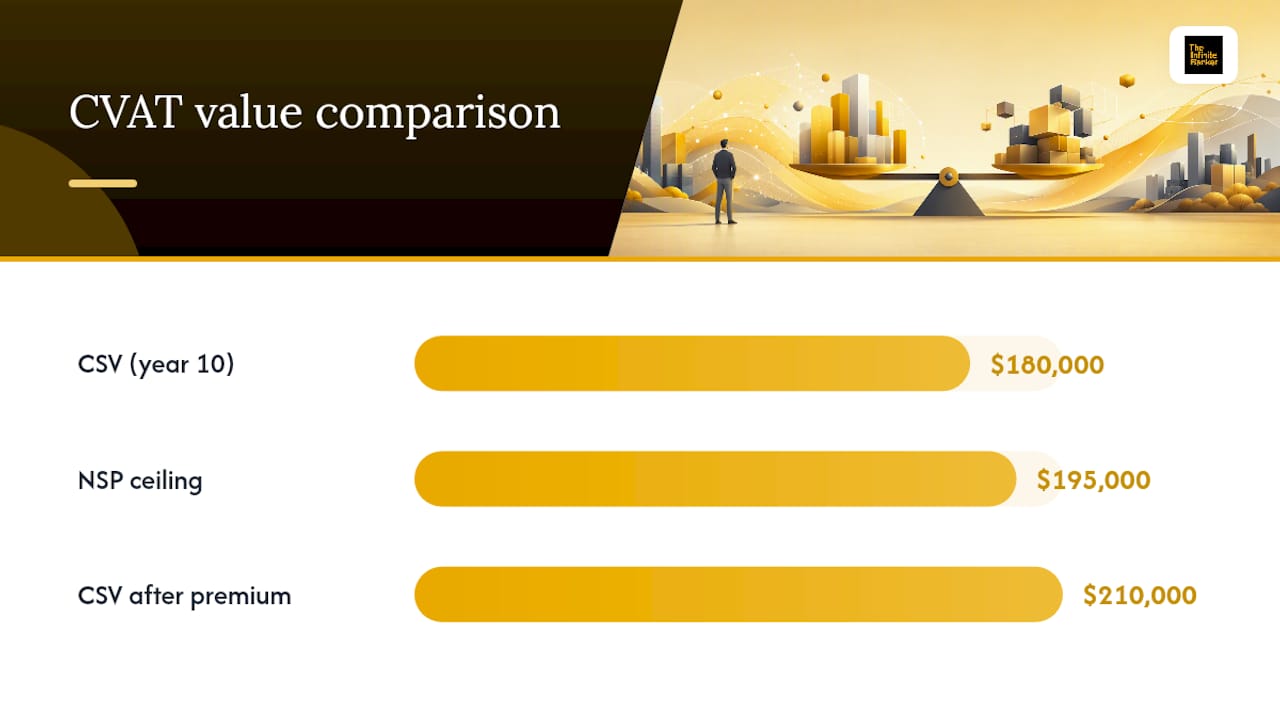
Consider a simplified scenario: a policy in year ten has a cash surrender value of $180,000. The insurer’s NSP calculation, based on the guaranteed death benefit and current mortality assumptions, produces a ceiling of $195,000. The policy passes CVAT with room to spare. If a large single premium payment pushed the CSV to $210,000 without a corresponding increase in the guaranteed death benefit, the contract would breach the NSP ceiling and risk disqualification as life insurance.
The Guideline Premium Test and the Cash Value Corridor
GPT works on a different mechanism: it limits how much premium can go into the contract rather than capping cash value directly against a benefit-driven ceiling. Under Section 7702, total premiums paid cannot exceed the greater of the guideline single premium (GSP) or the accumulated guideline level premiums (GLP). The GSP represents a theoretical lump sum funding limit; the GLP represents an annual funding limit accumulated over time. Whichever produces the higher allowable premium is the operative ceiling for that contract.
Alongside the premium cap, GPT policies must satisfy the cash value corridor, which requires the death benefit to remain at or above a specified percentage of cash surrender value, and that percentage declines as the insured ages. A policy on a 45 year old might need a death benefit several times the cash value, while a policy on a 75 year old needs a smaller multiple to satisfy the same corridor requirement.
The corridor exists specifically to preserve genuine insurance risk in the contract, since without it, a GPT policy could theoretically resemble an investment account wearing a thin insurance wrapper.
Corridor percentages are set by age bands in the statute and generally decline as the insured gets older, reflecting the shorter time horizon for mortality risk.
If cash value growth (through dividends, credited interest, or reduced cost of insurance) pushes the death benefit below the required corridor ratio, insurers typically increase the death benefit automatically to keep the contract compliant.
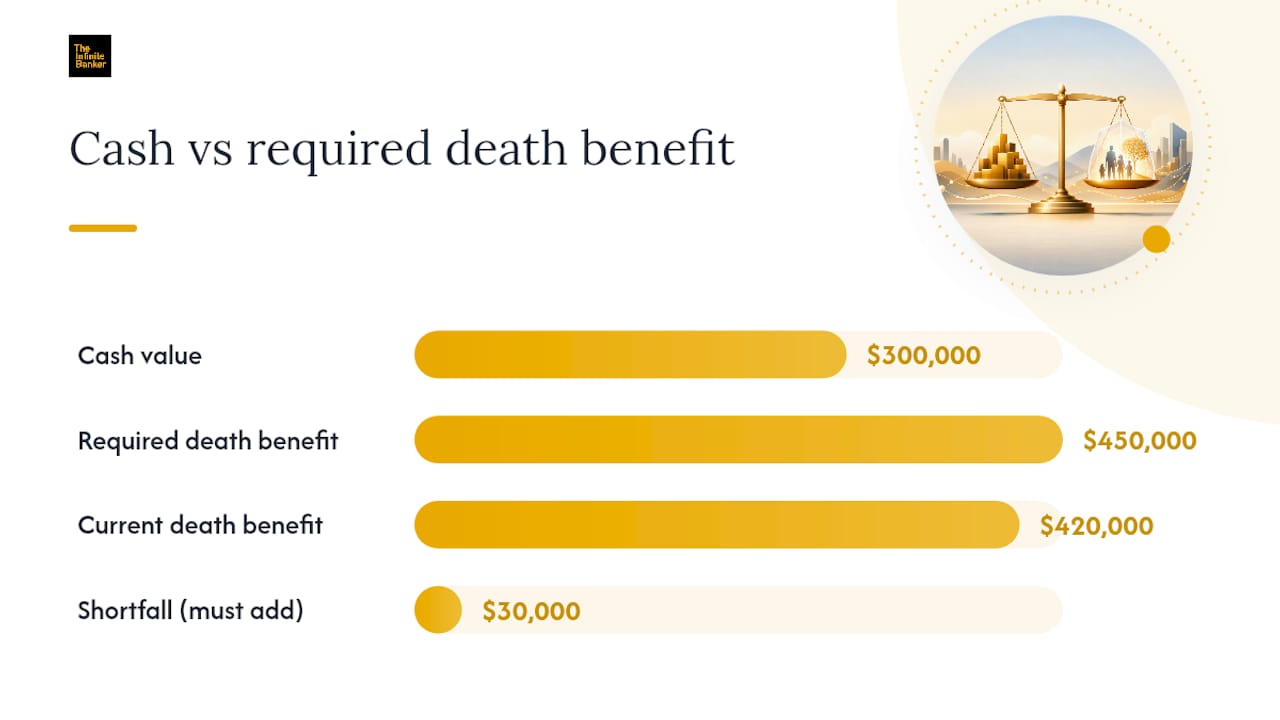
Picture a policy where cash value has grown to $300,000 and the applicable corridor percentage at the insured’s age requires a death benefit at least 1.5 times cash value. The policy needs a minimum death benefit of $450,000 to stay compliant. If the contract’s death benefit is only $420,000, the insurer must increase it, which also increases the cost of insurance charges going forward. This mechanical link between cash value growth and required death benefit is one reason GPT policy design differs meaningfully from CVAT design.
Section 7702A, MECs, and the 7-Pay Test
Satisfying Section 7702 is necessary, but it does not by itself protect a policy from Modified Endowment Contract status. Section 7702A layers on a separate requirement: the 7-pay test, which examines whether cumulative premiums paid in the first seven contract years exceed the amount that would be needed to fully pay up the policy in seven level annual payments.
A contract that passes CVAT or GPT at issuance can still fail the 7-pay test if it is funded too aggressively early on. Once a policy is classified as a MEC, it does not lose its life insurance status, but the tax treatment of loans and withdrawals changes significantly.
Distributions and loans from a MEC are taxed on a “gain first” basis, meaning any gain in the contract is taxed as ordinary income before basis is recovered, unlike distributions from a compliant, non-MEC policy.
Loans and withdrawals from a MEC taken before age 59½ can also trigger an additional penalty, similar to early retirement account withdrawals.
The most common overfunding behavior that triggers MEC status is a large single premium or a series of front-loaded premiums designed to accelerate cash value growth, exactly the instinct many entrepreneurs bring to policy funding.
Anyone structuring a policy for capital efficiency needs to understand both tests simultaneously, not sequentially. A closer look at how seven pay overfunding creates a MEC walks through the mechanics in more detail, and the 7-pay test computation itself is worth reviewing before finalizing a funding schedule.
Computational Rules and the 2021 Interest Rate Changes
The statute does not leave the math to guesswork. Section 7702’s computational rules specify how insurers must calculate NSP, GSP, and GLP, including standardized assumptions about maturity dates (commonly age 95 or 100, depending on the policy series) and required mortality tables. These assumptions matter because they determine how generous or restrictive the resulting premium and cash value ceilings turn out to be.
One of the most consequential recent changes involves the interest rate used in these calculations. The Consolidated Appropriations Act, 2021 (CAA) revised the minimum interest rate, often called the insurance interest rate, used in 7702 computations for contracts issued on or after January 1, 2021, according to an American Academy of Actuaries white paper.
The prior statutory floor, largely unchanged since 1984, had become mismatched with the low interest rate environment of recent decades, compressing how much cash value a policy could hold under either test.
CAA 2021 lowered the fixed floor for contracts issued in 2021 and transitioned to a dynamic floor formula for later years, tied to published corporate bond yield averages.
The Tax Cuts and Jobs Act of 2017 made separate, narrower adjustments affecting computational assumptions, distinct from the 2021 interest rate overhaul.
Because the floor rate is tied to the contract’s issue date, two otherwise identical policies issued a few years apart can have different guideline premium limits purely due to which floor rate methodology applied at issuance, per the Academy of Actuaries analysis.
This is why the issue date and the guaranteed rates baked into a contract are not just paperwork details. They determine the actual dollar ceilings that govern how the policy can be funded for its entire life.
Practical Compliance Checklist and Insurer Remedies
Most 7702 compliance problems trace back to a handful of predictable triggers, and catching them early is far easier than unwinding a failed contract after the fact.
Large or irregular single premium payments that push cash value or cumulative premiums close to the applicable ceiling.
Policy loans taken and never repaid, since accruing loan interest and unpaid balances reduce both cash value and death benefit, and can indirectly affect corridor compliance.
Death benefit reductions requested by the owner, which can inadvertently shrink the NSP or corridor ceiling below the existing cash value.
1035 exchanges into a new contract without confirming the receiving policy’s own 7702 test and 7-pay status carry over correctly.
If a contract does breach its limit, Section 7702(f)(1)(B) gives insurers a statutory remedy: returning the excess premium to the policyholder, typically with interest, within a defined window after the insurer discovers the violation. This remedy can preserve the contract’s tax-qualified status if executed correctly and promptly.
Pro Tip: Ask your insurer in writing which test, CVAT or GPT, governs your specific contract, and request the actuarial worksheet showing your current cushion against the applicable ceiling. A policy that is compliant today can drift closer to its limit after a large loan, a death benefit change, or several years of strong dividend performance.
An advisor working with a high-net-worth client should build a habit of requesting this documentation annually, not just at issuance, and should involve an independent actuary when the numbers look tight.
How to Check Your Own Policy for 7702 Compliance
Confirming compliance does not require a law degree, but it does require the right paperwork and the right questions.
Gather your documents: the most recent annual policy statement, the original policy illustration, the actual policy contract language defining which test applies, and any 1035 exchange paperwork if the policy replaced a prior contract.
Ask the insurer directly which test, CVAT or GPT, the policy uses, what interest rate basis was applied at issuance, and whether any excess premiums have ever been returned under §7702(f)(1)(B).
Request the actuarial computation, not just a summary, showing current cash value against the NSP or guideline limit, since a summary letter can obscure how close the contract sits to its ceiling.
Get an independent review if the policy has seen large premium payments, loans, or death benefit changes since issuance. Independent actuarial reviews typically take a few weeks depending on the complexity of the contract and the responsiveness of the carrier.
Understanding how cash value grows on a tax-deferred basis helps frame why this compliance work matters in the first place: the tax treatment only holds as long as the underlying contract keeps qualifying.
An Authorized IBC Practitioner’s View on Design Tradeoffs
Entrepreneurs often want to fund policies aggressively in the early years, which is exactly when 7702A and 7-pay risk peaks. The right design balances liquidity needs against compliance limits rather than maximizing cash value in year one. Every case is different, and funding decisions should involve both a licensed insurance professional and a qualified tax advisor before money moves.
— Jib Hunt
How The Infinite Banker Approaches a 7702 Compliance Review
A specialized consulting service works with entrepreneurs, real estate investors, and high-income earners who want a policy design reviewed against the actual statutory tests, not just an illustration summary. An initial engagement typically starts with a document checklist similar to the one above: current statements, actuarial worksheets, and the original policy contract, followed by a plain-language review of which test governs the contract and how much funding room remains before the corridor or guideline limit tightens.

Guidance is provided with a focus on capital efficiency and cash flow awareness rather than a sales-first pitch. Dividends on whole life policies are never guaranteed and depend on the insurer’s performance, and any policy loan accrues interest and reduces both cash value and death benefit if left unpaid. If you want to model funding scenarios before your next conversation with an advisor, the Infinite Banking calculator is a practical starting point, and the overview of who Infinite Banking tends to fit can help you decide whether a full design review makes sense for your situation.
This article is general information, not a substitute for advice from a qualified financial advisor. Consult a qualified financial professional about your own circumstances before acting on anything here.
Sources
FAQ
What Does IRS Section 7702 State?
Section 7702 requires a life insurance contract to satisfy either the Cash Value Accumulation Test or the Guideline Premium Test combined with a cash value corridor to receive favorable federal tax treatment. This requirement, confirmed in 26 U.S.C. §7702, applies continuously, not just when the policy is issued.
What Are the Key Differences Between a 7702 Plan and a 401(k)?
A “7702 plan” is industry shorthand for a properly structured, dividend-paying whole life insurance policy, not a qualified retirement plan like a 401(k). A 401(k) is funded with pre-tax or Roth dollars through an employer and is subject to IRS rules on annual contributions, while a life insurance contract’s funding limits come from the CVAT or GPT ceilings under Section 7702 rather than retirement plan contribution rules.
What Are the Benefits of Having a 7702 Compliant Policy?
A properly structured, 7702 compliant whole life policy is designed to allow cash value to accumulate on a tax-deferred basis and can offer policy loan access, though loans accrue interest and reduce both cash value and death benefit if unpaid. Policies can be designed around capital efficiency and long-term flexibility, always subject to the insurer’s claims-paying ability and the fact that dividends are never guaranteed.
What Are the Key Differences Between a 529 Plan and a 7702 Policy?
A 529 plan is a state-sponsored education savings account with tax treatment tied specifically to qualified education expenses. A 7702 compliant life insurance policy has no such use restriction on its cash value, but its funding is instead governed by the CVAT or GPT limits under Section 7702, and improper funding can trigger MEC status under Section 7702A.
This post is educational only and not financial, tax, or legal advice. Consult qualified professionals before acting.
Recommended
Comments