
U.S. Entrepreneurs: How Seven Pay Overfunding Creates an MEC


COMPLIANCE NOTE: For educational purposes only. Not financial, tax, or legal advice.
A modified endowment contract is a life insurance policy that has been overfunded relative to IRS limits, triggering a permanent tax reclassification under IRC §7702A. Once a policy becomes an MEC, withdrawals and loans are taxed as ordinary income on a gains-first basis, and distributions taken before age 59½ can trigger an additional 10% penalty. The death benefit generally remains income tax free to beneficiaries, but the cash value loses much of its flexibility.
TL;DR:
A policy that exceeds the seven-pay limit during the first seven years becomes an MEC, making withdrawals and loans taxable as gains first and potentially triggering penalties.
Most MECs result from overfunding in early years or significant modifications like adding riders, which can reset or deepen the MEC status.
Moving cash value from an MEC into another policy does not remove MEC classification; it carries forward through 1035 exchanges.
To avoid MEC status, owners should carefully plan premium payments, use the refund window within 60 days, and coordinate with the insurer on testing schedules.
MEC status is often a deliberate design choice for high-net-worth estate planning but reduces flexibility for lifetime cash access and can generate unexpected tax consequences.
Table of Contents
What Is a Modified Endowment Contract (MEC)?
A modified endowment contract is a cash-value life insurance policy that fails the seven-pay test defined in IRC §7702A. Congress created this rule through the Technical and Miscellaneous Revenue Act of 1988, closing a loophole where people bought life insurance almost entirely as a tax shelter, dumping in large premiums and treating the policy like a savings account with a death benefit attached.
The death benefit tax treatment does not change. What changes is everything that happens before death. A standard whole life policy lets you access cash value through withdrawals taxed on a first-in-first-out basis, meaning your own contributions come out before any gain does. An MEC strips that ordering away.
Picture a policyholder who makes a large initial premium payment in year one, expecting to add smaller amounts later, then decides to make another substantial payment in year two to accelerate cash value growth. That second payment can push the policy past its seven-pay limit and reclassify it as an MEC retroactively to the date the policy was issued.
How Does the Seven-Pay Test Work?
The seven-pay test asks a simple question: would this policy be fully paid up within seven years if the owner paid seven level annual premiums? The IRS calculates that hypothetical premium level for each contract, and if actual cumulative premiums paid in any of the first seven contract years exceed that cumulative limit, the policy becomes an MEC as of the date it was issued, not just the date of the overpayment.

IRC §7702A sets out the computational mechanics, including contract-year testing periods and a narrow escape hatch: if the insurer refunds an excess premium within 60 days of the policy anniversary, the payment generally does not count toward the seven-pay limit. That refund window is one of the few built-in corrections available once a mistake is caught quickly.
Material changes complicate the picture further. Increasing the death benefit, adding certain riders, or making other significant modifications to the contract can force a new seven-pay test using a new testing period, effectively restarting the clock under IRC §7702A©. A policy that passed comfortably at issue can fail years later because of a change nobody flagged as a tax event.
In practice, insurers do not wait for year seven to find out. Most carriers run MEC testing monthly as premiums are received, and many notify the policy owner when a payment approaches the seven-pay ceiling, giving them a chance to adjust before the limit is crossed.
Tax Implications: Withdrawals, Loans, and Penalties
Distribution ordering is the single biggest difference between an MEC and a standard policy, and it is where most policyholders get an unwelcome surprise. Non-MEC policies use FIFO treatment, so withdrawals count as a return of your own premium (tax free) until you have withdrawn more than you paid in. MECs use LIFO treatment under guidance tied to IRS Revenue Procedure 2001-42, meaning every dollar taken out is treated as taxable gain first, for as long as gain exists in the contract.
Policy loans get swept into the same rule once a contract is an MEC. A loan against a non-MEC policy is not a taxable event. A loan against an MEC is treated as a distribution to the extent of gain in the contract, and it can trigger the same 10% penalty as a withdrawal if the owner is under 59½.
Quick comparison:
Non-MEC withdrawal of $20,000 from a policy with $15,000 of gain: the first $5,000 (return of basis) is tax free, and only the remaining $15,000 is taxable.
MEC withdrawal of $20,000 from that same $15,000 of gain: the entire $15,000 of gain comes out first and is taxed immediately as ordinary income, with the 10% penalty applying to that portion if the owner is under 59½.
The core distinction: in a non-MEC policy, basis comes out first and gain comes out last. In an MEC, that order flips entirely, and gain comes out first, every time, until it’s exhausted.
MEC status is also sticky through a 1035 exchange. Moving cash value from an MEC into a new policy through a tax-free exchange does not cure the problem. The new contract inherits the MEC designation, so exchanging your way out of the classification is not an available strategy.
How to Avoid or Manage MEC Status
Premium discipline is the most reliable defense, and it starts before the first payment is made. Here is a practical sequence to follow:
Have the seven-pay limit calculated before funding. Ask your carrier or advisor to run the seven-pay premium for your specific policy design before you commit to a funding schedule.
Stagger large deposits. Instead of one large lump sum, spread planned contributions across multiple years to stay under the cumulative seven-pay ceiling.
Use paid-up additions and death benefit increases strategically. Adding paid-up additional insurance, or increasing the base death benefit, widens the corridor between cash value and death benefit, which can raise how much premium the policy can absorb without becoming an MEC.
Confirm the insurer’s pre-testing process. Many carriers test premiums monthly and flag a payment before it processes if it would trigger MEC status; ask directly rather than assuming.
Use the 60-day refund window if you catch it fast. An overpayment returned within 60 days of the relevant policy anniversary generally will not count toward the seven-pay limit.
If a policy is already an MEC, the practical question shifts from prevention to sequencing: timing distributions carefully, understanding which portion is taxable gain, and comparing whether other funding vehicles fit better going forward. Readers structuring larger policies for high cash value life insurance strategies often build this seven-pay math into the design from day one rather than retrofitting it later.
Pro Tip: Ask your carrier for a written seven-pay premium schedule before you fund a policy heavily in the early years. It takes a phone call, and it removes the guesswork that causes most accidental MEC conversions.
When an MEC Might Still Make Sense
MEC status is not automatically a mistake. It is a design tradeoff, and for some owners it is an acceptable one.
Where it can work:
The death benefit still passes to beneficiaries free of income tax, regardless of MEC status.
Some owners intentionally accept MEC status because their primary goal is death benefit and long-term cash accumulation, not near-term liquidity.
High-income owners focused on estate planning sometimes prioritize funding speed over withdrawal flexibility, since they may not plan to access cash value during their lifetime.
Where it usually falls short:
Reduced liquidity: loans and withdrawals become taxable events instead of tax-free access to basis.
The designation is permanent for the life of the contract and follows the policy through a 1035 exchange.
Entrepreneurs and real estate investors who rely on access to cash value for opportunities as they arise generally find MEC status works against the flexibility they are trying to build.
How Infinite Banking Advisers Monitor MEC Risk
Advisers working with entrepreneurs and real estate investors on capital-efficiency strategies treat the seven-pay test as a design constraint from the start, not an afterthought. Before recommending a large deposit, a qualified advisor typically requests the carrier’s seven-pay premium calculation for that specific policy and cross-checks planned contributions against it year by year.
Riders and death benefit increases get the same scrutiny. Because certain changes can force a new seven-pay testing period, advisers generally review any proposed policy change against IRC §7702A© material-change provisions before it is submitted, rather than discovering the consequence of the fact.
Coordination with the insurer matters as much as the math. Documentation of premium schedules, riders, and any refunded overpayments needs to be timely and specific, since a verbal understanding does not help if a carrier’s system flags a payment months later. This kind of ongoing tracking is part of why entrepreneurs and business owners often work with an Authorized IBC Practitioner rather than funding a high cash value policy without guidance.
Examples Illustrating MEC Status and Its Consequences
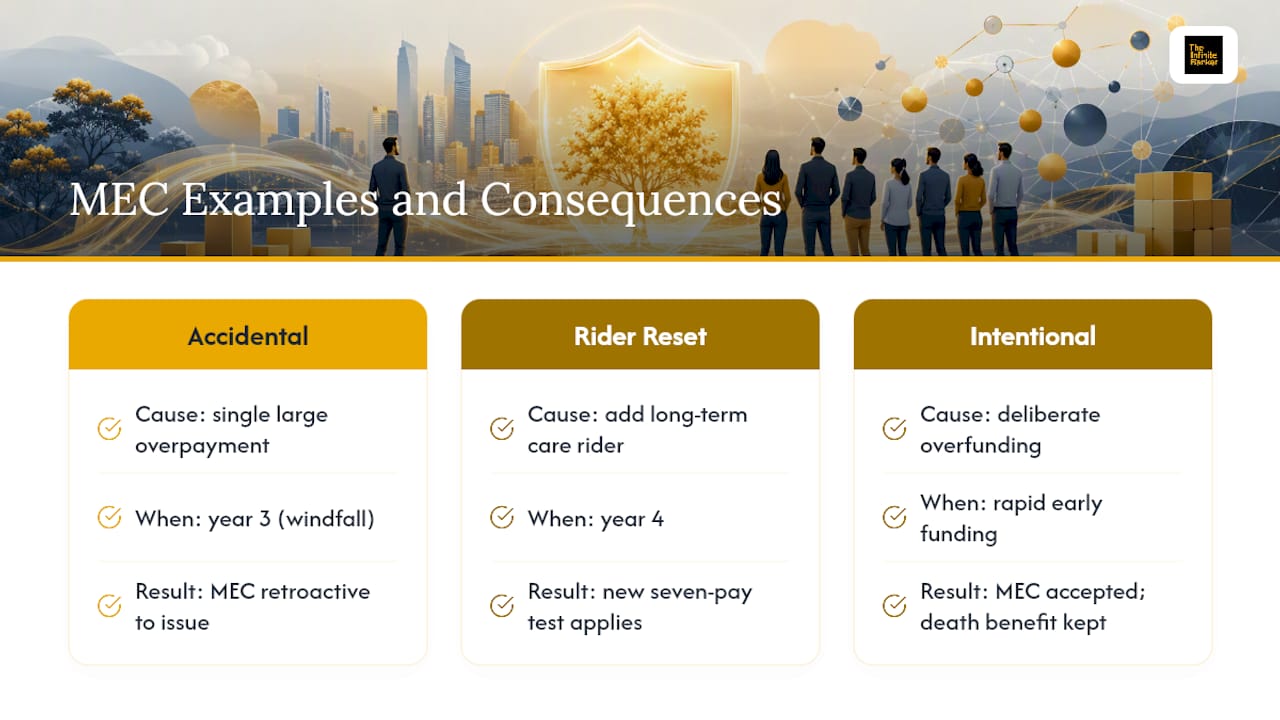
Example one: the accidental MEC. A business owner sets up a whole life policy with a calculated seven-pay limit per year. In year one, she pays up to the allowed premium limit for that year. In year three, she receives a windfall from selling a property and deposits an extra substantial amount on top of her scheduled premium. That single overpayment pushes cumulative premiums past the seven-pay ceiling, and the policy becomes an MEC retroactive to its issue date, even though the first two years were compliant.
Example two: the rider that reset the clock. A policyholder adds a long-term care rider to an existing policy in year four to increase coverage flexibility. That rider counts as a material change under IRC §7702A©, forcing a new seven-pay test based on the policy’s new benefit structure. Premiums that were fine under the original test now have to be measured against a different ceiling, and the owner did not realize the rider carried that consequence.
Example three: the intentional MEC. An estate planning client wants to move a large sum into a policy quickly because his priority is a larger death benefit for his beneficiaries, not lifetime access to the cash value. He funds the policy well past the seven-pay limit deliberately, accepts MEC status, and plans never to take a loan or withdrawal from the contract. In this case, the tax consequences of MEC classification never activate, because the death benefit itself remains untouched by the reclassification.
These three cases show the same rule producing different real-world outcomes depending entirely on intent and funding pace.
MECs, Estate Planning, and Beneficiary Taxes
The death benefit is where MEC status largely stops mattering. Beneficiaries who receive a death benefit payout from an MEC generally receive it income tax free, exactly as they would from a non-MEC policy. IRC §7702A reclassifies how the contract is taxed during the owner’s lifetime; it does not touch the tax treatment of the death benefit itself.
That distinction is why some estate planners are unbothered by MEC status, and in certain designs even accept it deliberately. A large single-premium policy intended purely to pass a death benefit to heirs, with no plan for lifetime withdrawals or loans, sidesteps most of what makes MEC taxation painful. The tax cost of MEC status is a cost of access, and if access was never the goal, the cost never comes due.
Where MEC status does complicate estate planning is in irrevocable life insurance trusts and other structures that anticipate using policy loans for liquidity, such as covering estate tax obligations before an estate settles. If the policy inside that trust is an MEC, any loan taken against it to generate liquidity gets taxed as a distribution of gain first, which can create an unplanned tax bill at exactly the moment the trust needs cash flow, not tax exposure. Estate planning documents and trust funding instructions should specify whether the underlying policy is or is not an MEC, since that single fact changes how loans from the trust should be modeled.
Beneficiary designations and ownership structure do not change based on MEC status either. The classification lives with the contract, not with who owns or who is named on it.
IRS Reporting Requirements for MECs
Carriers report taxable distributions from an MEC the same way they report other taxable life insurance distributions: on Form 1099-R. When a policyholder takes a withdrawal or loan from an MEC that generates taxable gain, the insurance company issues a 1099-R showing the taxable amount, and that figure gets reported on the policyholder’s Form 1040 as ordinary income.
If the distribution occurred before age 59½ and the 10% penalty applies, that additional tax is generally calculated on Form 5329, the form used to report additional taxes on early distributions from retirement plans and other tax-favored accounts, including MECs.
There is no separate annual filing requirement simply for owning an MEC. The reporting obligation is triggered by a taxable event, specifically a withdrawal or a loan that counts as a distribution of gain, not by the classification itself sitting quietly on the books. Carriers are generally required to track and disclose MEC status on policy statements, so it should never come as a surprise buried in fine print at tax time.
A Practitioner’s Take on MEC Risk
As an Authorized IBC Practitioner, I’ve walked enough entrepreneurs through funding schedules to know that MEC status is rarely the result of greed. It’s almost always the result of enthusiasm outrunning the paperwork. Before any consultation, bring your existing policy illustration, a summary of planned contributions for the next several years, and a clear answer to one question: do you need to access this cash value during your lifetime, or is the death benefit the priority?
— Jib Hunt
How The Infinite Banker Helps With Premium Planning
Staying under the seven-pay limit while still funding a policy aggressively enough to build meaningful cash value is a balancing act, not a formula you can eyeball. The Infinite Banker works with entrepreneurs, real estate investors, and high-income earners to design premium schedules against the actual seven-pay math for their specific policy, so funding decisions get made with the ceiling in view rather than discovered after the fact.

That process starts with a strategy session that reviews your funding goals, coordinates with underwriting on policy design, and maps out paid-up additions or death benefit adjustments that widen your funding room without forcing an unwanted MEC designation. Readers exploring alternative funding sources alongside policy design may also find value in Fordham Capital’s guide to low-impact capital raises, which addresses business funding strategies that can work alongside a properly structured policy. Keep in mind that policy loans accrue interest and reduce cash value and death benefit if left unpaid, and a policy can lapse if not adequately funded. Dividends, where applicable, are not guaranteed.
If you want a premium schedule reviewed before you fund it, visit Who Infinite Banking Is For to see whether this approach fits your situation and to request a consultation.
Sources
This article is general information, not a substitute for advice from a qualified financial advisor. Consult a qualified financial professional about your own circumstances before acting on anything here.
FAQ
Why Is a Modified Endowment Contract Considered Bad?
It is not inherently bad, but it removes the tax-free withdrawal-of-basis advantage that makes cash-value life insurance attractive for lifetime access, replacing it with gains-first taxation and a possible 10% penalty before age 59½.
What Happens to an MEC After Seven Years?
Nothing changes automatically after seven years; MEC status is determined by premiums paid during the testing period and, once triggered, it remains permanent for the life of the contract regardless of how many years pass afterward.
What Are the Main Disadvantages of an MEC?
The primary disadvantages are gains-first (LIFO) taxation on withdrawals and loans, a potential 10% penalty on distributions taken before age 59½, and permanent loss of the tax-favored access that makes non-MEC policies useful for lifetime liquidity.
What Happens When Life Insurance Becomes an MEC?
The policy is reclassified retroactively to its issue date under IRC §7702A, the death benefit tax treatment stays the same, but all future loans and withdrawals become taxable to the extent of gain in the contract.
Can an MEC Be Converted Back to a Non-MEC Policy?
No. MEC status is permanent for that contract and carries forward even through a 1035 exchange into a new policy.
This post is educational only and not financial, tax, or legal advice. Consult qualified professionals before acting.
Recommended
Comments