
Prevent a MEC and 10% Penalty: 7-Pay Rules U.S. Entrepreneurs Must Know


COMPLIANCE NOTE: For educational purposes only. Not financial, tax, or legal advice.
The 7-pay test is the IRS rule that decides whether a permanent life insurance policy becomes a Modified Endowment Contract, or MEC. Once a policy fails, distributions and loans get taxed on a last-in, first-out basis as ordinary income, and a 10% penalty can apply before age 59½ under the IRS guidance governing MECs. The death benefit itself generally still passes to beneficiaries income tax free. For anyone funding a policy aggressively, this test is the line between flexible access to cash value and a policy that behaves more like a taxable retirement account.
TL;DR:
Exceeding the cumulative 7-pay premium limit within the first seven years triggers MEC status, causing distributions and loans to be taxed as ordinary income at last-in, first-out basis.
Single-premium payments always result in MEC classification since they surpass the seven-year premium ceiling immediately, and dividend-funded paid-up additions count as premiums when testing.
Changes like benefit increases, adding riders, or policy exchanges can restart or alter the 7-pay testing period, especially if done after a policy lapses or beyond 90 days of reinstate.
Once a policy becomes a MEC, the status is typically permanent, but some carriers may refund excess premiums within a short window if caught early before the policy anniversary.
Building a funding strategy without understanding or modeling the 7-pay ceiling risks accidental MEC classification, which substantially changes how distributions and loans are taxed.
Table of Contents
What Is the 7-Pay Test in Life Insurance?
The 7-pay test traces back to the Technical and Miscellaneous Revenue Act of 1988, when Congress decided life insurance was being used too aggressively as a short-term tax shelter. The fix: cap how much premium a policyholder can pour into a policy during its first seven contract years relative to its death benefit.
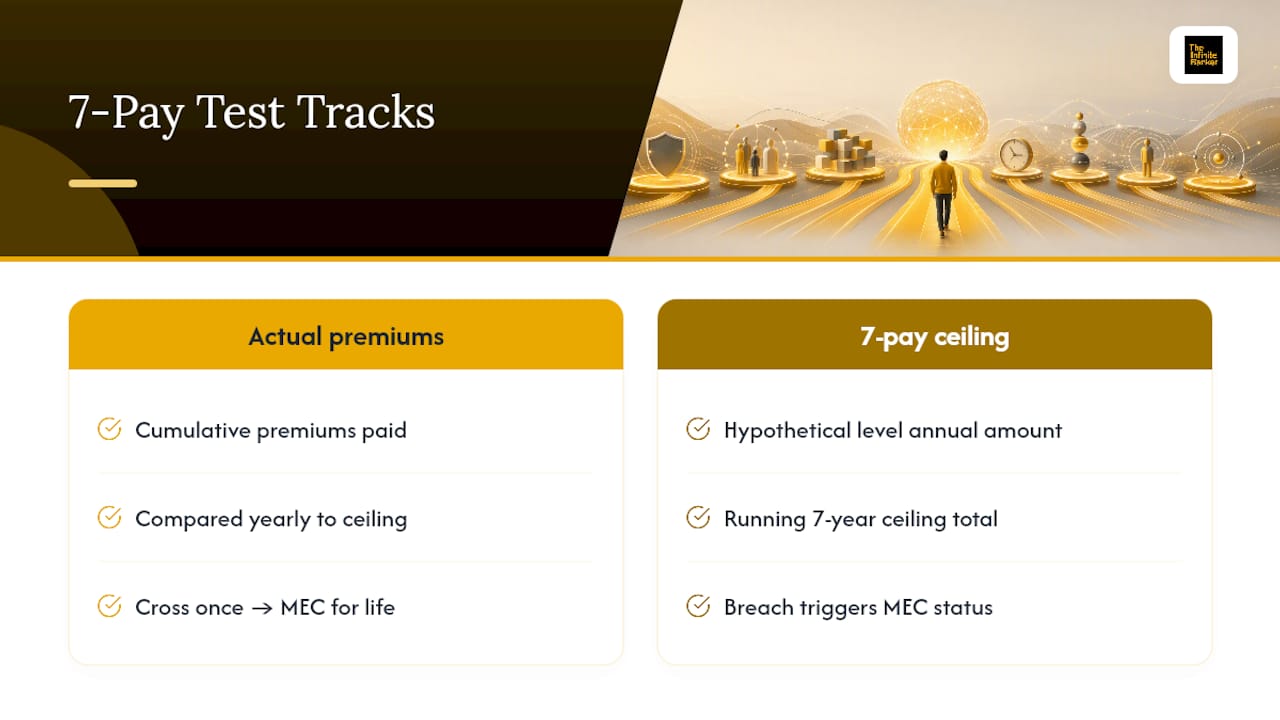
In plain terms, the insurer calculates a hypothetical “7-pay premium,” the level annual amount that would fully pay up the policy in seven years. Each year, cumulative premiums actually paid get compared against a running total of that 7-pay premium. Stay under the ceiling and the policy keeps its normal tax treatment. Cross it, even once, and the contract becomes a MEC for its entire life, not just the year of the violation.
This test applies to cash-value permanent contracts: whole life, universal life, and variable life. Term insurance has no cash value to test, so the rule never touches it. That distinction matters for entrepreneurs comparing term coverage against a whole life policy meant to double as a funding vehicle, since only the latter carries any MEC risk at all.
How to Calculate the 7-Pay Test, Step by Step
Insurers, not policyholders, run the actual math, but understanding the mechanics helps you sanity check what you are told. The calculation rests on three inputs: issue age, death benefit, and actuarial assumptions baked into the contract’s pricing. From those, the carrier derives an annual 7-pay premium figure, then builds a cumulative allowable schedule for years one through seven.
Here is how the comparison typically plays out:
Year 1: The insurer sets a 7-pay premium of, say, $20,000 for a policy with a given death benefit. You pay $18,000. You are under the limit, no issue.
Year 2: The cumulative allowable amount is now $40,000. You have paid a running total of $38,000 (adding another $20,000). Still fine.
Year 3: Suppose you decide to accelerate funding and pay $30,000 instead of $20,000. Your cumulative total is now $68,000 against a cumulative allowable ceiling of $60,000. The policy fails the test in year three and becomes a MEC retroactively for its full life.
That example shows why the test is cumulative rather than annual: a single oversized payment in any of the first seven years can undo years of careful funding. Single-premium policies, where the entire premium is paid at once, are always MECs by design since they blow through the seven-year ceiling on day one. Paid-up additions purchased with dividends count as premium too, which surprises a lot of policyholders who assumed dividend-funded riders were exempt.
What Resets or Changes the 7-Pay Testing Period?
A policy’s 7-pay status is not locked in forever at issue. Certain changes trigger what the industry calls a “material change,” which restarts the seven-year testing clock or forces a recalculated 7-pay premium going forward.
Common triggers include:
Death benefit increases, which raise the allowable premium ceiling but also open a new testing window tied to the increase.
Death benefit decreases within the first seven years, which can retroactively lower the 7-pay premium and cause a failure even without any new premium paid.
Adding riders that add benefits funded by premium, such as certain long-term care or accelerated benefit riders.
Reinstating a lapsed policy after more than 90 days, which can trigger a new material change determination.
1035 exchanges or policy combinations, which carry forward or reset testing depending on how the new contract is structured.
The 90-day reinstatement rule catches people off guard most often. Miss a premium, let the policy lapse, and reinstate quickly (within 90 days) and the original 7-pay schedule typically stays intact. Wait longer, and the insurer may treat reinstatement as a new material change requiring a fresh calculation. Anyone requesting a benefit increase, adding a rider, or exchanging a policy under IRC Section 1035 should ask the carrier in writing whether the change restarts the clock before signing anything.
Tax Consequences of Failing the 7-Pay Test
Failing the 7-pay test does not cancel the policy or its death benefit protection. It changes how the IRS treats money you take out while you are alive.
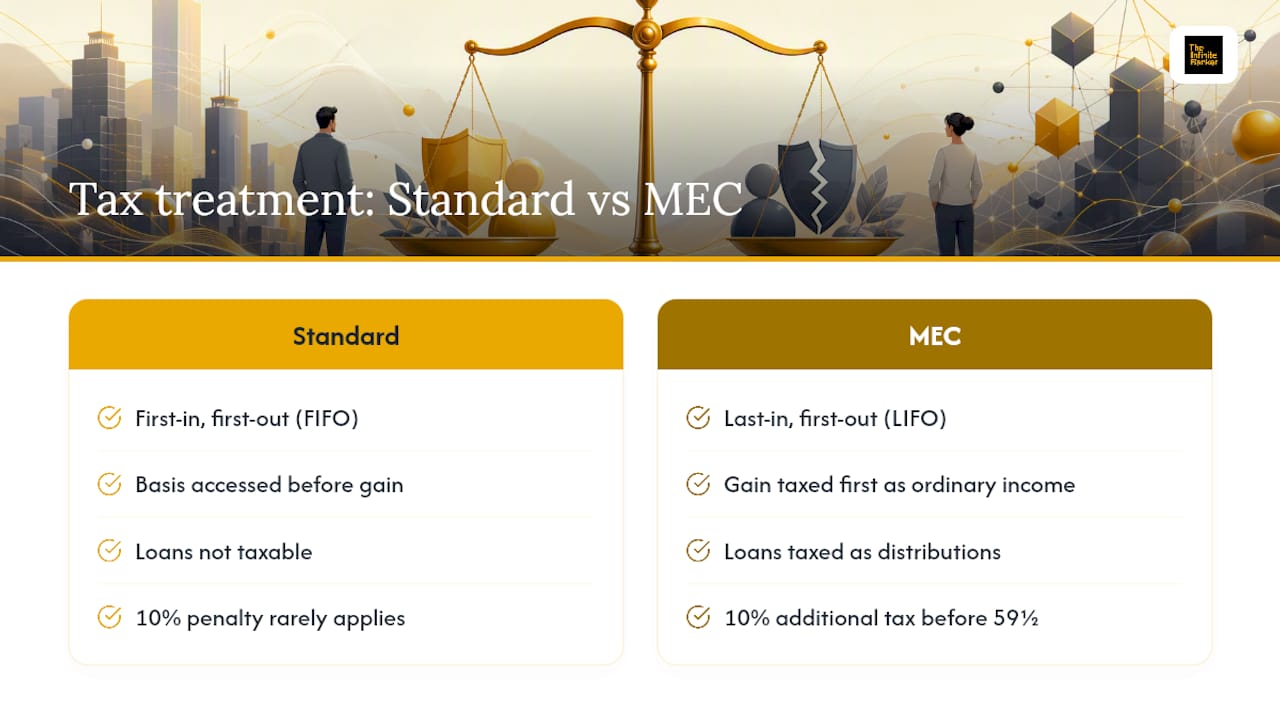
Under a standard, non-MEC policy, withdrawals typically come out on a first-in, first-out basis, meaning you access your own premium (cost basis) before touching any gain. A MEC flips that order. Distributions and loans are taxed last-in, first-out, which means gain comes out first and gets taxed as ordinary income before you ever touch your basis.
By the numbers: If a MEC has a cash value with a substantial portion representing gain over cost basis, the amount you withdraw or borrow against is taxed as ordinary income up to the gain. Only the remaining $20,000 comes out tax-free as basis.
Loans get the same treatment as distributions once a policy is a MEC, which is a meaningful departure from how policy loans normally work. In a standard policy, a loan is not a taxable event. In a MEC, borrowing against gain triggers immediate ordinary income tax, even though you technically still owe the loan balance back to the insurer with interest, and any unpaid loan balance reduces both cash value and the death benefit.
There is also a 10% additional tax on the taxable portion of distributions taken before age 59½, similar to an early retirement account withdrawal penalty. Exceptions exist for disability and for distributions taken as part of a series of substantially equal periodic payments (SEPP), but these carve-outs are narrow and situation-specific. The one piece of good news: death benefit taxation generally does not change. Beneficiaries still typically receive the payout income tax free, MEC status or not.
Practical Steps to Avoid an Accidental MEC
Most MEC failures are not intentional strategy choices. They are the result of enthusiastic overfunding without a written model to check against. A handful of habits keep policyholders on the right side of the line.
Request the written 7-pay schedule at issue. Every carrier calculates a specific 7-pay premium and cumulative allowable amounts for your exact policy. Get it in writing rather than relying on a verbal estimate from an agent, since insurer calculations are the actual legal benchmark.
Avoid single-premium funding unless a MEC is the goal. If liquidity and policy loans matter to your strategy, a single lump payment guarantees MEC status from day one.
Model paid-up additions carefully. Dividend-funded PUA riders count toward your cumulative premium total, so aggressive PUA funding in early years needs the same scrutiny as base premium.
Get a new calculation before any material change. Before increasing a death benefit, adding a rider, or running a 1035 exchange, ask the carrier for an updated 7-pay determination in writing.
Keep a running annual tally yourself. Do not rely solely on the carrier’s back office to catch an overpayment before it posts. Track your cumulative premium against the schedule every year.
Pro Tip: Ask your carrier directly what their administrative refund window looks like before you fund a policy aggressively. Some insurers will return an excess premium within roughly 60 days to prevent an accidental MEC, but this is a carrier-specific courtesy, not a guaranteed right, so confirm the policy in writing rather than assuming it applies.
If your funding strategy depends on high early cash value, pairing this checklist with a look at common policy loan mistakes helps you see how MEC status would compound any loan-related missteps down the line.
If Your Policy Becomes a MEC: What Actually Happens Next
Once a contract crosses the 7-pay ceiling, MEC status is generally permanent for the life of that policy. There is no annual “reset” and no simple form to file that undoes it. The IRS does not offer a routine remediation path for a policyholder who simply changed their mind about funding levels.
A few realistic options exist, with real limits attached:
Check for a carrier refund window. If the overpayment just happened and your carrier still has it flagged, some insurers will refund the excess within their administrative window (often cited around 60 days) rather than let the policy fail. This is not universal and depends entirely on the carrier’s own procedures.
Understand that 1035 exchanges usually carry MEC status forward. Exchanging a MEC into a new contract typically does not cure the classification; the new policy generally inherits MEC status under IRC rules.
Get the carrier’s written calculation. Before assuming the worst, request the exact figures that triggered the failure. Sometimes the fix is a documentation correction rather than a true violation.
Bring in a tax advisor before touching the policy again. Any loan, withdrawal, or exchange decision after a MEC failure has tax consequences that deserve professional review, not a guess.
Infinite Banking and the 7-Pay Test: Designing Around MEC Risk
Entrepreneurs and investors pursuing an Infinite Banking approach often want cash value to build quickly, which is exactly the funding pattern that risks tripping the 7-pay test. The tension is real: aggressive early funding builds usable cash value faster, but push too hard in the wrong year and the policy becomes a MEC, changing how loans against that cash value get taxed.
The practical answer is not to fund conservatively out of fear. It is to fund with a model. Before committing to a funding schedule, ask your insurer for a written 7-pay projection, and consider running your numbers through the Infinite Banking calculator to see how different premium and paid-up addition combinations affect your cumulative totals across all seven years. Anyone building toward high cash-value policy design should treat the 7-pay ceiling as a design constraint from day one, not an afterthought discovered after a large premium check has already cleared.
When MEC Status Is a Feature, Not a Failure
Some buyers want MEC status. A retiree funding a policy purely for a future income-tax-free death benefit, with no intention of ever borrowing against cash value, may not mind LIFO taxation on distributions they never plan to take. The problem arises when MEC status is accidental, and it happens inside an Infinite Banking-style plan built around living access to cash value. There, a surprise MEC classification undermines the entire point of the strategy: flexible, penalty-conscious liquidity. Before any large premium jump, benefit change, or exchange, get a written 7-pay projection and talk it through with a qualified advisor.
— Jib Hunt
Get a 7-Pay Modeling Session With The Infinite Banker
Reading about cumulative premium ceilings is one thing. Watching your own numbers run against them, year by year, before you fund a policy, is what actually prevents an accidental MEC. That is the gap The Infinite Banker’s consulting work is built to close: policy design, funding modeling, underwriting guidance, and implementation support tailored to entrepreneurs and investors who want cash value that moves quickly without crossing a line they never saw coming.

An Authorized IBC Practitioner can walk through your specific issue age, death benefit target, and funding timeline, then show you where the 7-pay ceiling actually sits for your policy design. Whole life dividends are not guaranteed, and any policy loan you take later will accrue interest and reduce both cash value and death benefit if left unpaid, so realistic modeling matters more than optimistic assumptions. If liquidity for real estate deals or business capital is part of your reasoning, a comparison against options like a cash-out refinance can also clarify what role a policy should and should not play in your broader capital stack. Start by reviewing who Infinite Banking is designed for and request a funding modeling session before you commit to a premium schedule.
This article is general information, not a substitute for advice from a qualified financial advisor. Consult a qualified financial professional about your own circumstances before acting on anything here.
Sources
FAQ
What is the 7-pay test?
The 7-pay test is the IRS calculation that caps how much premium can be paid into a permanent life insurance policy during its first seven contract years relative to a required death benefit, and exceeding that cumulative limit makes the policy a MEC.
What happens if a life insurance policy fails a 7-pay test?
The policy becomes a Modified Endowment Contract, meaning distributions and loans are taxed on a last-in, first-out basis as ordinary income up to the gain, with a possible 10% penalty before age 59½, while the death benefit generally remains income tax free.
How much is a $1,000,000 life insurance policy a month?
Monthly premium for a permanent policy varies widely based on issue age, health, and funding strategy, and carriers calculate a specific 7-pay premium ceiling for that death benefit that determines how aggressively you can fund without triggering MEC status.
What does 7-pay mean in life insurance?
“7-pay” refers to the hypothetical level annual premium that would fully pay up a policy in seven years; the test compares your actual cumulative premiums against that benchmark each year to check for MEC status.
Can a MEC be fixed once a policy fails the 7-pay test?
MEC status is generally permanent for that contract, though some carriers will refund an excess premium within a short administrative window, often cited around 60 days, if caught before the policy anniversary.
This post is educational only and not financial, tax, or legal advice. Consult qualified professionals before acting.
Recommended
Comments