
Whole Life vs Term Insurance for Entrepreneurs


COMPLIANCE NOTE: For educational purposes only. Not financial, tax, or legal advice.
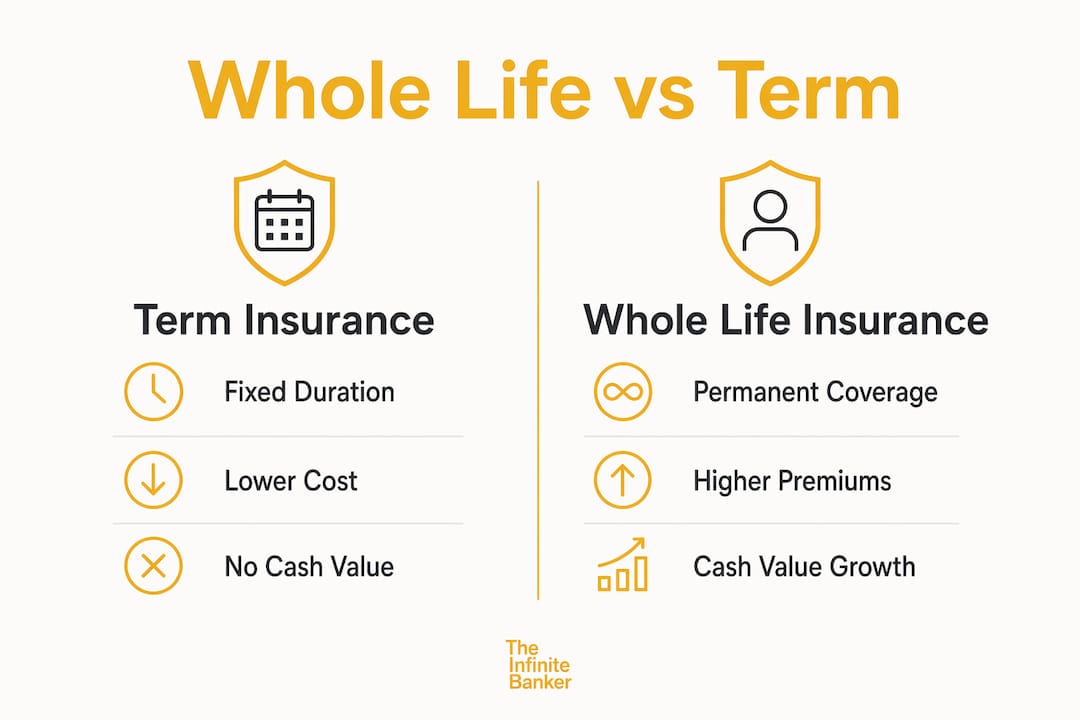
Whole life and term life insurance differ fundamentally in coverage duration, cost, and cash value accumulation, making the choice between them one of the most consequential financial decisions an entrepreneur faces. Term life insurance provides temporary coverage for a fixed period, typically 10, 20, or 30 years, with no cash value component. Whole life insurance provides lifelong coverage and accumulates cash value that entrepreneurs can borrow against as a private capital reserve. For entrepreneurs comparing whole life vs term insurance, the decision hinges on whether you need affordable income replacement now, permanent financial infrastructure, or both.
What are the cost differences between whole life and term insurance for entrepreneurs?
The premium gap between these two policy types is significant. Whole life premiums run 8 to 15 times higher than term premiums for the same initial death benefit. That spread exists because whole life policies carry guaranteed payouts, cash value accumulation, and level premiums for life.

To put that in concrete terms: a healthy 35-year-old purchasing $500,000 in coverage can expect to pay roughly $20–$35 per month for a 20-year term policy in 2026. The equivalent whole life policy would cost several hundred dollars per month. That cost difference is real, and for a founder in the early stages of a startup, it matters.
The higher whole life premium is not purely a cost. A portion of every payment builds cash value inside the policy. Over time, that cash value becomes a financial asset you own and control. Term premiums, by contrast, buy pure protection and expire with nothing to show if you outlive the policy.
Feature | Term life insurance | Whole life insurance |
Typical duration | 10, 20, or 30 years | Lifetime |
Monthly premium (35-year-old, $500K) | $20–$35 | Several hundred dollars |
Cash value | None | Accumulates over time |
Premium stability | Level for term period | Level for life |
Best for | Temporary obligations | Long-term capital strategy |
Pro Tip: If premium cost is the primary constraint right now, a 20-year level term policy with a conversion rider gives you affordable coverage today and the option to shift to whole life later without new medical underwriting.
How do policy features affect entrepreneurial financial planning?
Whole life insurance carries three core guarantees: a guaranteed minimum death benefit, guaranteed minimum cash value growth, and a guaranteed level premium for life. These guarantees are backed by state insurance reserves, not market performance. That predictability matters for entrepreneurs who need to model long-term cash flows.
Term insurance, by contrast, covers a fixed window. If you die during the term, your beneficiaries receive the death benefit. If you outlive the policy, coverage ends and premiums paid are gone. There is no residual asset.
The cash value inside a whole life policy functions differently from a savings account. It grows on a tax-deferred basis and can be accessed through policy loans without triggering a taxable event. Entrepreneurs who understand this use the cash value as a collateralized reserve, similar in function to a line of credit but without a bank’s approval process.
Key structural features that matter for entrepreneurs:
Conversion riders: Allow you to convert a term policy to whole life without new medical underwriting, preserving insurability even if your health changes.
Paid-up additions (PUAs): Optional premium payments that accelerate cash value growth inside a whole life policy, making it more capital-efficient.
Direct vs. non-direct recognition: Non-direct recognition carriers continue crediting dividends on the full cash value even when you have an outstanding policy loan. This preserves future growth while you use borrowed funds elsewhere.
Dividend participation: Dividends on whole life policies are not guaranteed, but participating policies issued by mutual insurers have historically paid them. Dividends can be used to purchase additional paid-up coverage, further compounding cash value.
The non-direct recognition distinction is particularly relevant for entrepreneurs who plan to borrow frequently. Choosing the wrong carrier structure can quietly erode the policy’s long-term performance.
Why do entrepreneurs use whole life insurance as a capital reserve?
The Infinite Banking Concept, formalized by Nelson Nash, describes using dividend-paying whole life insurance as a personal banking system. The core mechanic is straightforward: you fund the policy, cash value accumulates, and you borrow against it to finance business or personal needs. The policy loan requires no lender approval, no credit check, and does not appear on your credit report.
This matters for entrepreneurs because business credit profiles are often thin, especially in the early years. A founder who has been operating for two years may not qualify for a conventional line of credit at favorable rates. A properly funded whole life policy sidesteps that problem entirely.
Here is how entrepreneurs typically deploy policy loans:
Startup capital: Fund early-stage operating expenses or equipment purchases without diluting equity or approaching a bank.
Bridge financing: Cover payroll or inventory gaps between receivables cycles without disrupting business operations.
Executive bonus plans: Corporations can use whole life policies as part of executive compensation, moving wealth out of the business tax-efficiently using corporate dollars.
Buy-sell agreements: Fund a partner buyout provision with a permanent policy that does not expire if the triggering event is delayed.
Wealth transfer: The death benefit passes to heirs outside the probate process, preserving value across generations.
Two caveats apply here. First, policy loans accrue interest and reduce both the cash value and the death benefit if the loan and interest remain unpaid. Undisciplined borrowing can cause a policy to lapse, which would trigger a taxable event on any gains. Second, the cash value does not reach meaningful levels immediately. Entrepreneurs who begin funding whole life policies early typically see significant cash value accumulate over 5–7 years of consistent funding.
Pro Tip: Treat policy loan repayment with the same discipline you apply to a business credit line. Repaying loans promptly restores cash value and keeps the policy performing as designed.
What are the practical trade-offs when choosing between term and whole life?
The right choice depends on your current business stage, cash flow, and financial goals. Term insurance fits entrepreneurs with defined, temporary obligations. A 10-year term policy covering a business loan or a 20-year policy covering a mortgage are textbook applications. Term insurance for these purposes provides high coverage at low cost, which is exactly what a capital-constrained startup founder needs.
Whole life insurance fits entrepreneurs who think of insurance as a financial asset, not just a safety net. The policy serves as a multi-purpose tool: death benefit protection, tax-deferred cash value growth, and a private borrowing facility. The trade-off is cost and patience. The policy requires consistent funding over years before the cash value becomes a meaningful capital source.
A practical framework for deciding:
Scenario | Recommended approach |
Early-stage startup, tight cash flow | Term with conversion rider |
Established business, strong cash flow | Whole life with PUA rider |
Buy-sell agreement funding | Term or permanent, depending on timeline |
Executive benefit or retention planning | Whole life via corporate structure |
Long-term wealth transfer goal | Whole life as primary vehicle |
The two approaches are not mutually exclusive. Many entrepreneurs carry a term policy for income replacement and a whole life policy for capital strategy. The term policy handles the immediate protection need at low cost. The whole life policy builds the private reserve over time.
Key Takeaways
Whole life insurance functions as a permanent financial asset for entrepreneurs, while term insurance serves as affordable temporary protection. Choosing between them requires matching the policy structure to your business stage, cash flow, and capital access goals.
Point | Details |
Cost gap is substantial | Whole life premiums run 8 to 15 times higher than term for the same death benefit. |
Term fits temporary needs | Use term for defined obligations like business loans, mortgages, or buy-sell agreements. |
Cash value is the differentiator | Whole life builds a borrowable reserve; term provides pure protection with no residual asset. |
Policy loans carry real risk | Unpaid loan interest reduces cash value and death benefit and can cause the policy to lapse. |
Carrier structure matters | Non-direct recognition carriers preserve dividend crediting on borrowed cash value, protecting long-term growth. |
The case for building your own capital system early
I have worked with entrepreneurs at every stage, from pre-revenue founders to business owners managing eight-figure operations. The single most common mistake I see is treating life insurance as a commodity purchase rather than a financial architecture decision.
Most founders buy term because it is cheap and move on. That is not wrong. Term insurance is the right tool for many situations. But the entrepreneurs who build real financial resilience are the ones who start funding a whole life policy early, even at a modest level, while carrying term for income replacement. They are not waiting until the business is profitable to think about capital access. They are building the reserve now, so it is available when they need it.
The policy loan mechanic is genuinely different from anything a bank offers. No approval process, no credit impact, no fixed repayment schedule. That flexibility has real value when a business opportunity appears faster than conventional financing can move. The key is understanding that the policy must be properly structured from the start. An off-the-shelf whole life policy is not the same as a policy designed for the Infinite Banking Concept with paid-up additions and the right carrier.
My advice: consult an Authorized IBC Practitioner before purchasing any policy. The design decisions made at inception determine how the policy performs over decades.
— Jib Hunt
How The Infinite Banker can support your insurance strategy
Entrepreneurs who want to move beyond basic coverage and use life insurance as a financial tool need more than a policy. They need a properly structured design built around their cash flow, business stage, and capital goals.

The Infinite Banker specializes in helping entrepreneurs, real estate investors, and high-income earners implement dividend-paying whole life insurance strategies designed for capital efficiency and long-term flexibility. Whether you are evaluating your first policy or looking to restructure an existing one, the resources at The Infinite Banker cover the full mechanics of the Infinite Banking Concept, policy design principles, and executive benefit planning. For entrepreneurs who want to understand whether this approach fits their profile, the who it’s for page provides a clear breakdown of ideal candidates and use cases.
FAQ
What is the main difference between whole life and term insurance for entrepreneurs?
Term insurance provides temporary coverage for a fixed period with no cash value. Whole life insurance provides lifelong coverage and accumulates cash value that entrepreneurs can borrow against as a private capital reserve.
Are whole life policy loans tax-free?
Policy loans do not trigger a taxable event when taken, but they are not tax-free in all circumstances. If a policy lapses with an outstanding loan, the gain may become taxable. Consult a tax professional before borrowing.
How long does it take to build usable cash value in a whole life policy?
Entrepreneurs who fund whole life policies consistently typically accumulate meaningful cash value over 5–7 years. Policies structured with paid-up additions riders can accelerate this timeline.
Can I convert a term policy to whole life later?
Yes. Many term policies include a conversion rider that allows you to convert to a permanent policy without new medical underwriting. This preserves your insurability even if your health changes after the original purchase.
Is whole life insurance a good fit for early-stage startups?
Whole life insurance requires consistent premium funding and delivers its capital benefits over years, not months. Early-stage founders with tight cash flow often start with term insurance and convert to whole life as revenue stabilizes.
This post is educational only and not financial, tax, or legal advice. Consult qualified professionals before acting.
Comments