
1035 Exchange Rules: When Tax Deferral Actually Applies


COMPLIANCE NOTE: For educational purposes only. Not financial, tax, or legal advice.
A properly executed 1035 exchange lets you move certain life insurance, endowment, or annuity contracts into a qualifying replacement without triggering immediate income tax. That deferral holds only if the owner and the insured or annuitant stay identical across both contracts and the exchange follows a permitted direction under IRC §1035. Take cash, change who owns the policy, or swap the insured, and the IRS will generally treat the transaction as a taxable surrender instead.
TL;DR:
A 1035 exchange requires matching owner and insured details exactly, including trust names and trustee designations, to remain tax-deferred.
Only certain exchanges are permitted: life to life, life to non-qualified annuity, and annuity to annuity, but not annuity to life insurance.
Carryover basis and MEC status transfer automatically, but unpaid loans must be confirmed in writing to avoid unexpected taxable boot.
The 2026 regulations confirm routine exchanges generally do not trigger the transfer-for-value rule and carry over prior sale statuses.
Proper modeling of basis, MEC, and loans before initiating a 1035 exchange is critical to prevent costly tax surprises and achieve the desired policy outcomes.
Table of Contents
Core 1035 Exchange Rules: Eligibility Under IRC 1035 and Treasury Regulations
Section 1035 of the tax code says no gain or loss is recognized when a policyholder exchanges one qualifying contract for another, provided the transaction fits the statute’s narrow directional map. That is the legal backbone behind every 1035 exchange, and it is worth reading in its own terms rather than through a summary someone forwarded you.
26 U.S. Code §1035 authorizes nonrecognition treatment for exchanges among life insurance, endowment, and annuity contracts, subject to specific direction rules. Treasury Regulation §1.1035-1 narrows that authorization further: the exchanged contracts must relate to the same insured, and ownership must not change in the process. This is not a technicality you can paper over later. An advisor who lets a name mismatch slip through, even a minor difference between “John A. Smith” and “John Smith” on a trust-owned policy, risks having the entire exchange disqualified on audit.
A few points worth verifying before you sign anything:
The owner listed on the surrendering contract and the owner listed on the new contract must be the same legal person or entity, including matching trust names and trustee designations exactly.
The insured (for life insurance) or annuitant (for annuities) must remain identical across old and new contracts.
Exchanges involving foreign persons carry additional scrutiny under special rule language in the regulations, and international ownership structures should get dedicated tax counsel review before any transfer begins.
Community property and jointly owned contracts need extra care, since a change in ownership percentage can sometimes be read as a change in owner.
None of this is exotic. It is administrative discipline, and it is exactly where exchanges tend to fail.
Which Contract Exchanges Does Section 1035 Actually Allow?
The statute permits certain directions and blocks others, and the asymmetry catches people off guard. You can move value one way but not the other, and the reverse move is fully taxable even though it looks like the same category of transaction.
Life insurance to life insurance is permitted, and it is the most common exchange, usually driven by a search for better dividend performance, lower cost of insurance, or updated policy design.
Life insurance to a non-qualified annuity is permitted. This is a one-way door. Moving death-benefit protection into a lifetime income vehicle is allowed under the statute.
Annuity to annuity is permitted, and this is the most frequent transaction type in practice, often used to escape a high-fee contract or lock in a better rider.
Annuity to life insurance is not permitted. Attempting this reverse move triggers full taxation on any gain in the annuity, no exceptions built into the code.
Endowment contracts follow their own hierarchy: endowment to endowment, endowment to life insurance in limited circumstances, and endowment to annuity are addressed separately in the regulations, and older endowment contracts should get individual review since they are increasingly rare.
Switching life insurance into an annuity changes the tax character of what your beneficiaries eventually receive, since annuity death benefits do not carry the same income-tax-free treatment life insurance proceeds typically enjoy. Partial exchanges add another layer of complexity, particularly for annuities, and carriers vary widely in whether and how they will process them, so recordkeeping on cost basis allocation becomes critical from day one.
How Basis, Boot, and MEC Status Carry Over
The tax mechanics of a 1035 exchange come down to three concepts: basis carryover, boot, and MEC status. Get any one of them wrong and a transaction you believed was tax-deferred turns into a 1099-R surprise the following January.
Basis carryover is the simplest rule to state and the easiest to overlook in execution. Your cost basis in the old contract becomes your cost basis in the new contract, dollar for dollar. If you paid $80,000 in premiums into a whole life policy now worth $140,000 in cash value, that $80,000 basis transfers to the replacement contract regardless of what the new policy’s premium schedule looks like.
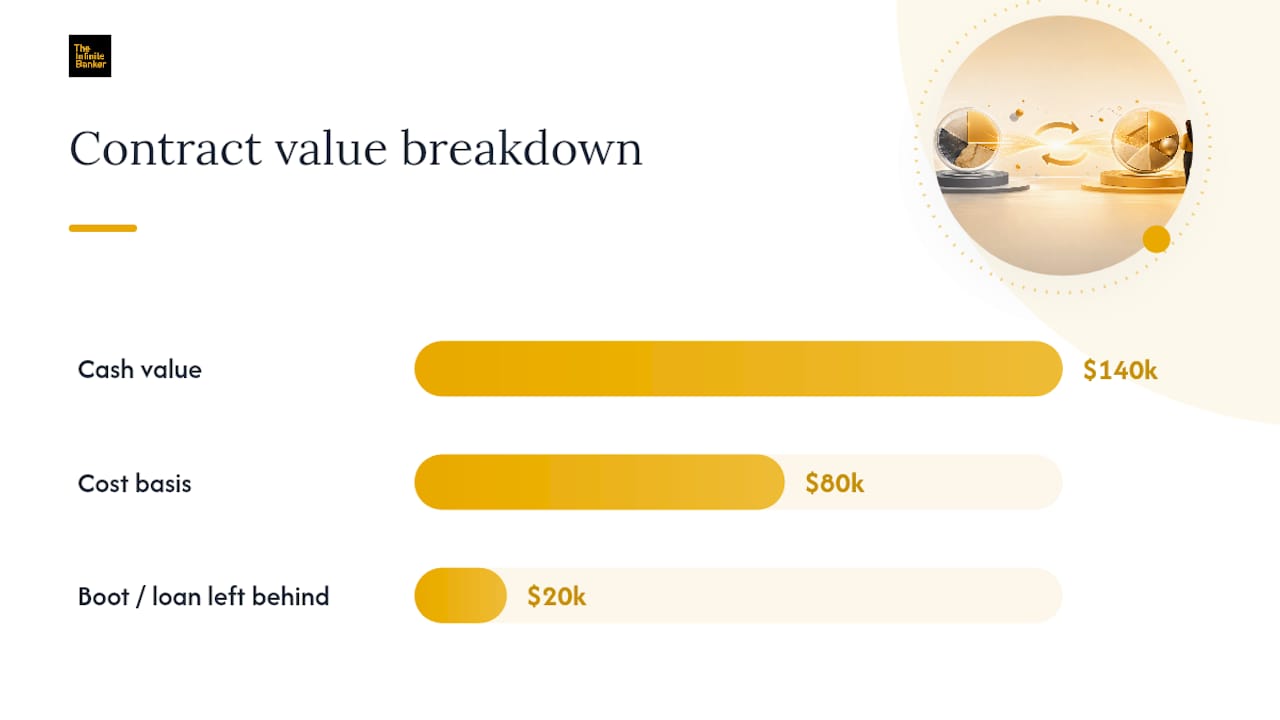
Boot is anything of value you receive outside the contract itself, most often cash, but also a discharged policy loan that does not carry over to the new insurer. Investopedia’s explanation of Section 1035 is direct on this point: any boot received is taxable to the extent of gain in the old contract, even inside an otherwise qualifying exchange. A $20,000 loan left behind at the old carrier does not just disappear. It is treated as money in your pocket, taxed up to whatever gain exists in the contract.
MEC status, meaning modified endowment contract classification under the 7-pay test, also carries over.
Basis in the surrendered contract becomes basis in the replacement contract.
Boot is taxed to the extent of gain, not to the full amount received.
A discharged loan not carried forward is treated as boot under guidance on exchange mechanics.
MEC status transfers with the contract and does not reset.
Pro Tip: Before you initiate anything, get written confirmation from the new carrier on whether it will accept a carryover loan. Verbal assurances from a sales desk are not the same as a documented commitment, and this single step prevents most boot surprises.
The 1035 Exchange Process: A Step-by-Step Checklist
Executing a compliant 1035 exchange is procedural, not creative. Miss a step and you either create a taxable event or lose weeks to a bounced application.
Confirm the exact legal names on both contracts match, including trust names, trustee titles, and any recent legal name changes.
Ask the new insurer directly whether it accepts 1035 exchanges from the old contract type and whether it will accept a carryover loan balance.
Complete the new carrier’s direct-transfer paperwork so funds move institution to institution. Never take a disbursement check yourself and forward it, since that can be read as constructive receipt.
Budget time for underwriting on the new policy. A 1035 exchange does not waive medical underwriting in most cases, and denial or a rating change can leave you temporarily uninsured if you have already surrendered the old contract.
Ask both carriers how they will report the transaction. Institution-to-institution transfers commonly generate a Form 1099-R even though no tax is owed, and you will need that form to reconcile your return.
If you plan to clear a loan through a partial surrender rather than carryover, separate that transaction in time from the exchange itself to reduce the risk the IRS treats them as one integrated, taxable event.
One detail advisors flag repeatedly: confirming loan carryover in writing before initiating the exchange is the single step that prevents the most common tax surprise in this entire process.
Common Pitfalls in 1035 Exchanges and How to Avoid Them
Most exchange failures are not exotic tax traps. They are administrative errors that could have been caught with a phone call.
Name and paperwork mismatches top the list. Insurers reject exchanges routinely over ownership discrepancies, particularly with trust-owned or business-owned policies where the legal entity name has drifted slightly over the years.
A new contestability and suicide period is often overlooked. Replacement contracts typically restart both, meaning your beneficiaries face a fresh two-year window before the insurer can contest a claim on grounds of misrepresentation. If health has declined since the original policy was issued, underwriting on the new contract can also result in a higher rate class or outright denial, leaving you without adjustable coverage mid-exchange.
Surrender charges deserve a full cost comparison, not a glance. Total cost analysis needs to include the new policy’s surrender schedule, rider differences, and any legacy guarantees you would be giving up, since older contracts sometimes carry guaranteed interest rates or waiver provisions no longer offered.
Verify legal names on both contracts before submitting paperwork.
Ask about contestability and suicide period reset in writing.
Model the new surrender schedule against the old one, not just the headline crediting rate.
Confirm loan carryover acceptance early, since many insurers will not accept a carried loan and you may need to repay it, perform a separated partial surrender, or accept taxable boot instead.
Pro Tip: Run the new policy’s in-force illustration side by side with your existing one before signing anything. A lower cost of insurance on paper does not always offset a longer surrender charge period.
What the 2026 Final Regulations Change for 1035 Exchanges
The IRS and Treasury finalized regulations in 2026 that resolve a long-standing concern among planners: whether a routine 1035 exchange could inadvertently trigger the transfer-for-value rule and strip a death benefit of its income-tax-free treatment. The final regulations confirm that a standard 1035 exchange generally will not, by itself, create that problem for an otherwise compliant contract.
The rules also address carryover of prior reportable policy sale status, meaning if a contract was previously flagged under reportable policy sale rules, that status follows the contract through a subsequent exchange rather than resetting. Issuers now carry clearer information-sharing obligations tied to that carryover.
These regulations took effect July 9, 2026, with retroactive election mechanics available in certain circumstances, a detail advisors and trustees handling older contracts should review individually.
Routine exchanges are not, by themselves, transfer-for-value events for an otherwise compliant contract.
Reportable policy sale status carries over rather than resetting at exchange.
Issuers have expanded reporting duties tied to that carryover status.
The effective date is July 9, 2026, with retroactive election options in some cases.
As one industry analysis put it, this restores much of what planners previously expected while keeping anti-avoidance protections intact for contracts with a reportable sale history.
Why 1035 Rules Matter for Infinite Banking and Whole Life Strategies
For entrepreneurs and investors using dividend-paying whole life as part of an Infinite Banking approach, 1035 rules intersect directly with policy design decisions. Basis carryover and MEC status do not reset just because you moved to a better-designed contract, so a policy already close to MEC limits needs careful premium pacing after exchange, not a fresh 7-pay clock.
Outstanding policy loans complicate this further. Loans accrue interest, and unpaid balances reduce both cash value and death benefit, so managing a loan through an exchange without triggering boot requires coordination with both carriers before any paperwork moves.
MEC exposure should be modeled against the new policy’s premium schedule, not assumed.
Loan carryover acceptance needs written confirmation before initiating the transfer.
Cash value behaves differently across carriers, and dividend scales are never guaranteed, so in-force illustrations matter more than marketing projections.
IRS Definitions and Eligibility Criteria for 1035 Exchanges
The IRS treats a 1035 exchange as a direct, carrier-to-carrier transfer of contract value between qualifying products, not a distribution followed by a new purchase. That distinction is the entire basis for nonrecognition treatment. The moment funds pass through your hands, even briefly, the IRS has grounds to treat the transaction as a taxable surrender followed by a new premium payment.
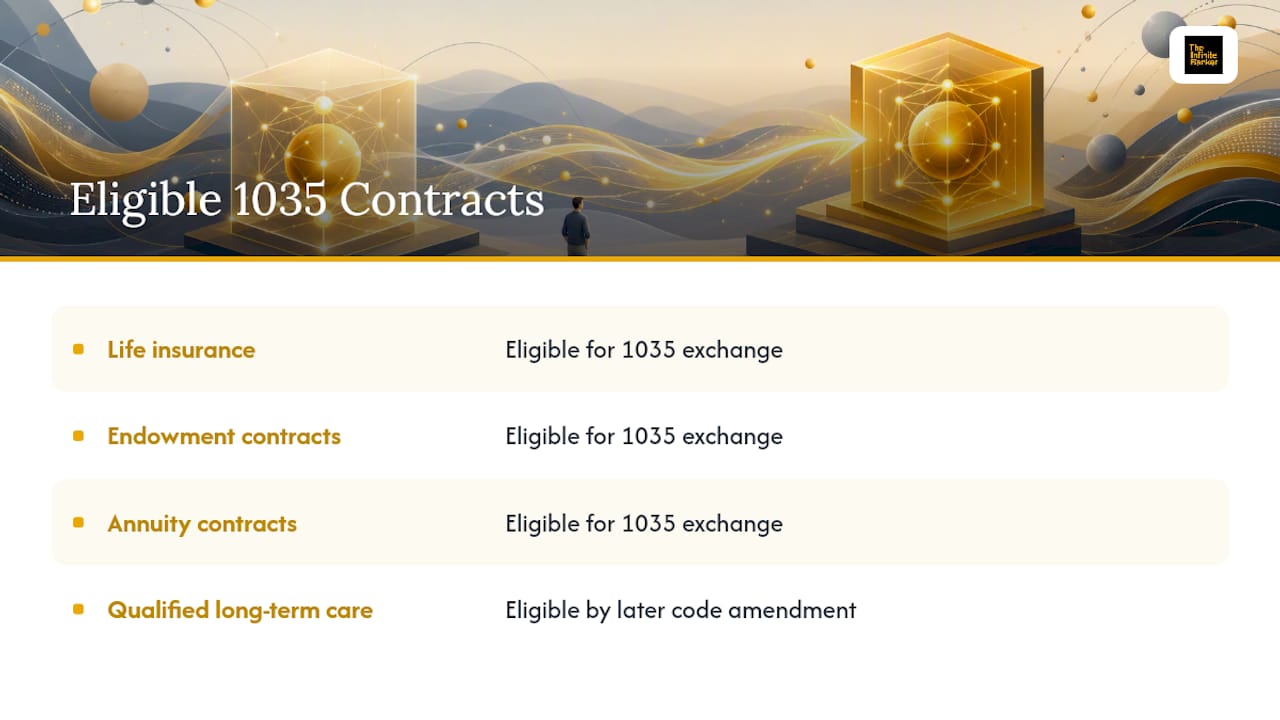
Eligible contracts fall into four categories: life insurance, endowment contracts, annuity contracts, and qualified long-term care contracts added in later amendments to the code. Each category has its own internal exchange rules, and eligibility depends on the contract type on both ends of the transaction, not just the one you are giving up.
The IRS also requires that the exchange be a genuine substitution of one contract for another, not a disguised sale. A policyholder cannot sell a contract to a third party and then claim 1035 treatment on a separate purchase. The transaction has to run directly between insurers, typically using each carrier’s standard exchange forms, with funds moving under an absolute assignment rather than a check made payable to the policyholder.
Age and health do not factor into 1035 eligibility itself, since the statute governs tax treatment, not insurability. But the new policy still requires its own underwriting approval, and an applicant with a health decline since the original policy was issued can find the exchange technically eligible under Section 1035 while practically blocked by the new carrier’s underwriting decision. That gap between tax eligibility and insurance approval is one of the most common points of confusion for readers researching this topic.
Reporting Requirements and Typical 1099-R Practice
Even a fully tax-deferred 1035 exchange generates paperwork with the IRS, and readers are sometimes alarmed to receive a Form 1099-R for a transaction that owes no tax. That reaction is understandable, but the form itself does not mean tax is due.
When a direct transfer moves between two different insurance companies, the surrendering carrier will often issue a 1099-R showing the gross distribution amount, with a distribution code identifying it as a 1035 exchange, most commonly code “6.” That code tells the IRS the transaction is not currently taxable despite the gross amount reported. In-house transfers within the same carrier sometimes skip 1099-R issuance entirely, since no funds leave the company’s own systems, though practice varies by insurer.
Keep every piece of exchange documentation: the absolute assignment form, both carriers’ transfer confirmations, and any 1099-R received. If a 1099-R arrives without the correct exchange distribution code, that is worth flagging to the issuing carrier before filing, since a coding error can trigger an unnecessary IRS inquiry treating the transaction as a taxable distribution. Your tax preparer will also want the basis carryover figure documented clearly, since the new carrier’s records may not automatically reflect the original contract’s cost basis without you providing it during the transfer.
Detailed Tax Consequences of Non-Qualified Exchanges
When an exchange falls outside the statute’s permitted directions or ownership requirements, the consequences are not partial. The entire gain in the surrendered contract becomes taxable as ordinary income in the year of the failed exchange, not capital gain, since life insurance and annuity cash value growth does not qualify for preferential capital gains rates.
A disqualified exchange can happen several ways: taking a disbursement check personally instead of using a direct carrier-to-carrier transfer, changing the owner or insured between contracts, or attempting a prohibited direction such as annuity into life insurance. Each of these triggers full recognition of gain up to the amount of cash value that exceeds your basis.
If the surrendered contract was a modified endowment contract, the tax consequences compound further.
There is also a subtler failure mode worth understanding: partial disqualification. If boot is received alongside an otherwise qualifying exchange, only the portion up to the amount of boot is taxed, not the entire gain. That is meaningfully different from a fully disqualified exchange, where directional or ownership rules were violated outright. Understanding which category a mistake falls into determines whether you are looking at a partial tax bill or full recognition of every dollar of gain in the old contract.
Impact on Policy Dividends and Cash Value
A 1035 exchange does not preserve the dividend history or crediting rate of the surrendered contract. Dividends on participating whole life policies are declared annually by each insurer’s board based on that company’s mortality experience, investment returns, and expense management, and they are never guaranteed. A policy that has paid consistent dividends for fifteen years carries no promise that a replacement contract at a different carrier will perform the same way, even if the new contract looks similar on illustration.
Cash value transfers at its current amount, minus any surrender charges the old contract imposes, and that net figure becomes the starting point for the new policy rather than a fresh $0 basis. This matters enormously for anyone using whole life for Infinite Banking purposes, since the exchanged cash value effectively restarts the policy’s early-year cost structure even though the dollar amount carried over.
Newer contracts also may carry different loan provisions, different dividend option structures, and different paid-up additions riders than the original policy. A policyholder who valued a specific loan interest rate or a particular dividend option, such as paid-up additions versus cash payout, needs to confirm the replacement contract offers comparable terms before finalizing an exchange, since carrier-specific illustrations and quotes are the only reliable way to compare outcomes rather than generic assumptions about how whole life products behave.
Examples Illustrating Different Types of 1035 Exchanges
A business owner holding an older whole life policy with a high cost of insurance and stagnant dividend performance decides to exchange it into a new contract with a stronger dividend history and more favorable loan provisions. Because the owner and insured remain identical and the exchange runs directly between carriers, the transaction preserves full tax deferral, and the original basis carries forward intact.
A retiree holding a life insurance policy she no longer needs for estate liquidity exchanges it into a non-qualified annuity to generate future income. This is a permitted one-way move under Section 1035, but it changes the tax character of what her beneficiaries eventually receive, since annuity death benefits typically do not carry the same income-tax treatment as life insurance proceeds.
An investor with two annuity contracts at different carriers consolidates them through an annuity-to-annuity exchange to access a better rider structure. Because both contracts are annuities held by the same owner, the exchange qualifies cleanly under the statute, and no reporting complication arises beyond routine 1099-R issuance.
A policyholder attempts to move value from an annuity into a new life insurance policy to gain death benefit coverage. This direction is not permitted under IRC §1035, and the full gain in the annuity becomes taxable immediately, illustrating why understanding the statute’s one-way restrictions matters as much as understanding what is allowed.
A Practitioner’s Note on Coordinating 1035 Exchanges
When I work with clients on a 1035 exchange, the process starts with modeling, not paperwork. I want to see how basis carryover and MEC exposure interact with the new policy design before anyone signs a transfer form, then coordinate directly with both carriers on loan handling and timing. Exchanges fail more often from rushed sequencing than from unclear tax law. Talk to your tax advisor and insurance professional before initiating anything, since your specific contract history determines what actually applies here.
— Jib Hunt
Working With The Infinite Banker on Your Next Exchange
Modeling a 1035 exchange correctly means running 7-pay testing, premium pacing, and surrender schedule comparisons before you touch a transfer form, and that is exactly where a dedicated policy design consultation earns its keep. The Infinite Banker works directly with entrepreneurs, real estate investors, and high-income earners who need a properly structured whole life policy that accounts for basis carryover, loan coordination, and MEC exposure from day one, not after a mistake surfaces on a 1099-R.

Consulting engagements through The Infinite Banker cover policy design, underwriting guidance, and coordination with carriers during an exchange, so loan carryover questions and surrender charge tradeoffs get resolved before paperwork moves rather than after. If you want to see how an exchange or a new policy might affect your funding pace and cash value trajectory, the Infinite Banking Calculator is a practical starting point for modeling numbers specific to your situation. For a broader look at whether this approach fits your financial picture, review who Infinite Banking is designed for, then schedule a consultation with an Authorized IBC Practitioner to walk through your specific contracts before you initiate any exchange.
This post is educational only and not financial, tax, or legal advice. Consult qualified professionals before acting.
This article is general information, not a substitute for advice from a qualified financial advisor. Consult a qualified financial professional about your own circumstances before acting on anything here.
Sources
Recommended
Comments