
7–10 Years to Liquidity With Split Dollar Life Insurance for Owners
- Jib Hunt

- 3 days ago
- 8 min read

COMPLIANCE NOTE: For educational purposes only. Not financial, not tax, or legal advice.
In this guide, “split dollar life insurance” refers to dividend-paying whole life engineered for Infinite Banking, not the employer-employee executive compensation arrangement that shares the same name. It’s designed for cash-rich business owners and investors who can commit to funding a policy for 7 years or more. The tradeoffs are real: Modified Endowment Contract (MEC) limits, loan interest, commissions, and the possibility of lapse if a policy isn’t managed carefully.
TL;DR:
Most policies require 7 to 10 years of funding before cash value allows meaningful borrowing, due to initial costs and commissions.
Funding 60% to 80% of premiums into paid-up additions maximizes cash value growth without exceeding MEC limits.
Selecting mutual carriers with strong dividend history and good ratings helps ensure consistent performance and dividend payments.
Unpaid policy loans can cause lapses if the balance surpasses cash value, so disciplined repayment plans are essential.
Proper design and funding strategy depend on your ability to commit long-term and maintain disciplined loan repayment.
Table of Contents
How Split Dollar Life Insurance Works for Infinite Banking
The engine behind this strategy is a participating whole life policy issued by a mutual insurance company. Mutual carriers pool profits from mortality, expense, and investment experience and may return a portion to policyholders as dividends. Dividends are never guaranteed, and a carrier can adjust or suspend them based on financial performance. That variability is the tradeoff for a policy structure that also carries a guaranteed minimum cash value schedule, which is why participating whole life tends to anchor this approach rather than universal or indexed products.
The paid-up additions (PUA) rider is what makes the strategy work. Instead of routing most of your premium into base coverage, a PUA rider lets you direct extra dollars into small chunks of fully paid-up insurance that carry their own cash value from day one. Overfunding through PUAs accelerates cash value buildup far faster than a standard policy design.
Once cash value has accumulated, you borrow against it through a policy loan, using the policy as collateral rather than liquidating it. The insurer charges loan interest, and depending on the carrier, uses direct or non-direct recognition, which affects whether the borrowed portion still earns dividends.
Year 1 to 3: heavy PUA funding builds a cash value base, largely offset by early costs.
Year 4 to 7: cash value crosses the funded-premium line and dividends compound on a larger base.
Year 8 and beyond: cash value typically supports meaningful loan capacity.
Most implementations need 7 to 10 years before cash value supports meaningful borrowing, largely because early commissions and policy charges absorb a chunk of initial premium.
Pro Tip: Ask any carrier illustration to show cash value net of loan interest under a repayment scenario, not just the gross accumulation number. That is the figure that tells you what the strategy actually does for you.
What Design Choices Keep a Policy From Becoming a MEC?
A policy becomes a Modified Endowment Contract when premiums paid in the first seven years exceed the IRS “7-pay test” limit relative to the death benefit. Cross that line and you lose tax-preferred access to policy loans, since withdrawals and loans from a MEC are taxed on a last-in-first-out basis and can trigger a 10% penalty before age 59½. Because banking-style policies deliberately overfund, staying below the MEC threshold is a design problem, not an accident to avoid after the fact.
Three levers determine how much room you have to fund aggressively without tripping MEC status:
PUA allocation percentage. Owners commonly direct 60% to 80% of total funding into paid-up additions; allocations below roughly 60% often fail to build banking capacity quickly enough to matter.
A low-cost term rider. Adding term coverage increases the death benefit corridor, which creates more room to fund PUAs before hitting the MEC ceiling.
Underwriting class. A healthier rating class generally means more insurance per premium dollar, which widens your funding room before MEC limits engage.
Pro Tip: Request quotes at two underwriting classes if your health profile is borderline. A step down in rating can meaningfully shrink how much you can fund each year.
Carrier selection matters as much as policy design. Favor mutual companies with multi-decade dividend payment histories and strong ratings from agencies like A.M. Best, since a carrier’s track record through past economic cycles is the closest thing to evidence of how it will behave in the next one.
Who Fits This Strategy and Who Should Wait
This approach tends to suit people who check most of these boxes:
You have discretionary capital left over after covering expenses, debt service, and an emergency reserve.
You can commit to funding on a 10-year-plus horizon without needing that specific capital back on short notice.
You’re in a high enough tax bracket that tax-deferred cash value growth and policy loan mechanics carry real weight.
You want liquidity you control directly, rather than routing every financing decision through a bank or lender.
Poor fit looks different: no emergency fund, unstable income, or capital you’ll likely need within two or three years. Compared with a high-yield savings account or a taxable brokerage account, a banking policy trades short-term liquidity and market-linked upside for contractual guarantees, dividend potential, and death benefit protection. A business line of credit offers faster access to capital but comes with variable rates and no cash value of its own.
What Risks Change the Outcome of This Strategy?
The most common failure mode is a large policy loan left unpaid while cash value growth stalls, which can push the loan balance past the policy’s cash value and cause a lapse. Unpaid loan balances reduce the death benefit and accrue interest indefinitely, so a policy without a repayment plan is a policy drifting toward that outcome.

Front-loaded commissions and surrender charges hit hardest in years one through three, which is why early cash value often looks disappointing next to total premium paid. Whole life costs meaningfully more than term coverage, and that gap has to be weighed against what the cash value, dividends, and loan flexibility deliver over a decade or more.
Loan interest is a real, explicit cost, and it typically runs a few percentage points depending on the carrier and whether the loan uses a fixed or variable rate. Some owners offset part of that interest against dividend credits, though dividends aren’t guaranteed and shouldn’t be counted on to fully cover borrowing costs.
Run estate and gift tax questions past a CPA or estate attorney, particularly if the policy will sit inside a trust structure.
Confirm state-specific insurable interest and free-look rules with your agent before signing.
Revisit MEC testing any time you change the funding schedule.
How Do You Set Up a Banking-Style Whole Life Policy?
Define your funding capacity. Look at discretionary cash flow over the next 12 months and commit only to what you can sustain through a slow year, not a strong one.
Model the numbers. Run a preliminary projection through a tool like The Infinite Banker’s Infinite Banking Calculator to see how funding level and PUA allocation affect early cash value.
Request full illustrations. Ask for year-by-year cash value for years one through ten, the PUA split, and the MEC test result for each proposed design.
Compare carriers. Weigh dividend payment history, loan provisions (direct versus non-direct recognition), and underwriting class quotes side by side.
Set riders and initial funding. Lock in the PUA rider and term rider combination that maximizes early cash value while keeping the policy below MEC limits.
Write an internal loan policy. Set your own repayment schedule and interest tracking before you take a first loan, so the discipline exists before the temptation does.
Pro Tip: Treat your internal loan policy like a real loan document, complete with a repayment date. Policies that lapse from unpaid loans almost always started as loans with no repayment plan at all.
An Authorized IBC Practitioner’s View on What Actually Works
Jib Hunt, an Authorized IBC Practitioner with The Infinite Banker, has walked entrepreneurs and investors through this design process across a range of situations: a contractor funding equipment purchases without touching a business line of credit, an investor using policy loans to bridge a down payment ahead of a refinance. The pattern that shows up again and again isn’t the size of the policy. It’s whether the owner treats loan repayment as a rule rather than a suggestion, since interest paid on a disciplined repayment schedule effectively recirculates inside the owner’s own system instead of leaking out permanently. Owners applying this inside a business context often look at it through the lens of treasury-style cash management rather than personal savings.
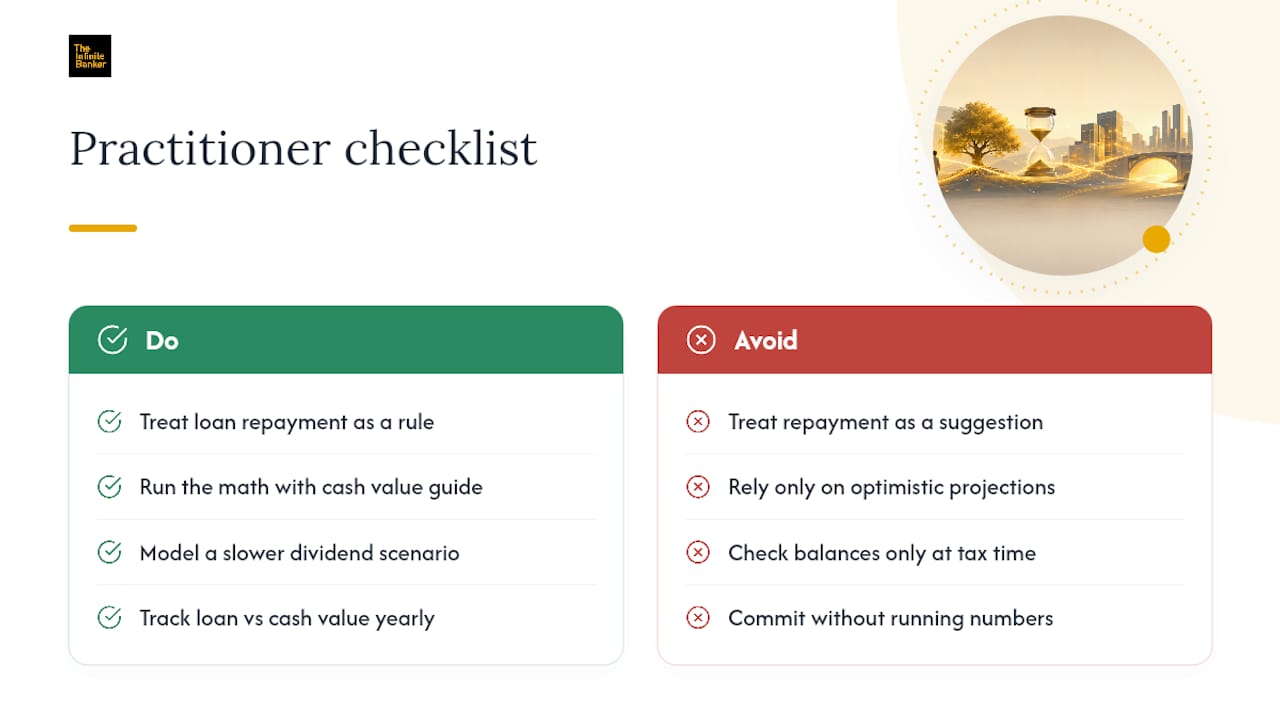
Before committing to a funding level, run the math yourself through The Infinite Banker’s cash value guide and see how the numbers behave under a slower dividend scenario, not just an optimistic one.
Pro Tip: Track your loan balance against your cash value every year, not just at tax time. A quick annual check catches drift before it becomes a lapse risk.
— Jib Hunt
How The Infinite Banker Helps You Design a Policy That Fits
There are other paths to liquidity for business owners, from bank credit lines to brokerage margin accounts, but none of them hand you direct control over the collateral, the repayment terms, and the underlying growth mechanics the way a properly structured whole life policy can. The Infinite Banker works through the entire design process with you: goal setting, carrier comparison, underwriting guidance, PUA and rider structuring, MEC testing, and a funding plan built around what you can sustain, not what an illustration makes look impressive.
Compensation for this work comes through commissions paid at policy placement, standard across the life insurance industry, and every proposal you receive includes full illustrations showing PUA allocation, MEC test results, and year-by-year cash value projections so you can evaluate the design on its own terms. If you want to see what a realistic funding level looks like for your situation, run the numbers through the Infinite Banking Calculator or check who this strategy tends to fit before booking a design consultation.
Sources
For a broader third-party primer on how Infinite Banking mechanics work in practice, see this outside guide to Infinite Banking and whole life insurance. If you’re weighing how a policy fits into a broader estate plan, this piece on common estate-planning mistakes with existing life insurance is worth a read before you finalize beneficiary or trust structures. For foundational background, start with The Infinite Banker’s explanation of Infinite Banking.
This article is general information, not a substitute for advice from a qualified financial advisor. Consult a qualified financial professional about your own circumstances before acting on anything here.
FAQ
Is split dollar life insurance the same as employer split-dollar plans?
No. This guide uses “split dollar” to describe dividend-paying whole life engineered for personal Infinite Banking, which is a different structure from the employer-employee executive compensation arrangement that shares the name.
How long before I can borrow meaningfully against my policy?
Most designs need 7 to 10 years of funding before cash value supports meaningful loan activity, largely due to early commissions and policy costs.
What happens if I don’t repay a policy loan?
Unpaid policy loans accrue interest and reduce your death benefit; if the balance exceeds cash value, the policy can lapse.
How much of my premium should go toward paid-up additions?
Owners commonly direct 60% to 80% of funding into PUAs to build cash value quickly while staying below MEC limits.
Can The Infinite Banker help me compare carriers and design a policy?
Yes. The Infinite Banker provides policy design, carrier comparison, underwriting guidance, and full illustrations including MEC testing as part of its consulting process.
This post is educational only and not financial, tax, or legal advice. Consult qualified professionals before acting.
Recommended
Comments