
Funding Operating Expenses With a Whole Life Policy


COMPLIANCE NOTE: For educational purposes only. Not financial, tax, or legal advice.
A properly structured dividend-paying whole life policy can fund operating expenses through policy loans or withdrawals, but only when the design, funding schedule, and record-keeping are handled correctly. This is the core mechanic behind what The Infinite Banker calls Infinite Banking: using cash value as a source of business liquidity rather than going to a bank each time cash is tight. Loans are advances made by the insurer against your cash value as collateral, and they generally are not taxed while the policy stays in force. That changes if the policy lapses, is surrendered, or fails the Internal Revenue Service’s Modified Endowment Contract (MEC) test.
A loan against cash value is not the policyholder’s own money coming back. It is capital the insurer advances, secured by the policy, and it accrues interest until repaid.
Before pursuing this strategy, keep these conditions in mind:
The policy must be properly designed and funded well before you need to borrow against it.
Loans reduce available cash value and, if unpaid, reduce the death benefit.
Dividends are declared annually and are never guaranteed.
Key Takeaways
Funding operating expenses with a properly structured dividend-paying whole life policy works because disciplined funding, correct policy design, and careful documentation preserve the tax treatment that makes the loans useful.
Point | Details |
Design before you need it | Build cash value for several years before relying on loans for operating expenses. |
Avoid MEC classification | Keep premium funding within seven-pay test limits to preserve favorable loan tax treatment. |
Document every loan | Record business purpose, date, amount, and repayment plan to support any interest deduction. |
Dividends are not guaranteed | Base repayment plans on committed cash flow, not assumed dividend performance. |
Work with The Infinite Banker | Consult on policy design, loan governance, and coordination with CPA and legal advisors before implementing. |
Table of Contents
How Policy Loans and Withdrawals Actually Work
When you take a policy loan, the insurer is not handing you your own savings back. It is advancing its own capital and using your cash value as collateral. That distinction matters because your cash value can keep earning dividends even while a loan sits outstanding, a mechanic unique to properly structured participating whole life insurance.

Most carriers cap loans below total cash value, leaving a buffer so an outstanding balance does not immediately threaten the policy. Insurer loan mechanics and caps vary, and every carrier discloses the running balance, accrued interest, and available borrowing capacity on annual statements.
A few distinctions worth separating clearly:
Policy loan: an insurer-funded advance secured by cash value; the cash value itself keeps working and the loan balance plus interest is settled later, often at death through the death benefit.
Withdrawal or surrender: a permanent reduction of cash value that can trigger a taxable gain if the amount withdrawn exceeds your basis in the policy.
Unpaid interest: compounds against the policy and, over time, can erode the cushion between the loan balance and total cash value.
Understanding how policy loans work before you fund a policy prevents surprises three or four years into the strategy.
What Are the Tax Rules and IRS Cautions?
Loans taken from a standard whole life policy that is not a Modified Endowment Contract are generally received without immediate income tax as long as the policy stays in force. If the policy lapses or is surrendered while a loan is outstanding, the loan balance can convert into taxable gain, since the IRS treats the unpaid amount as part of the proceeds received.
The MEC designation is the design risk that changes everything. The seven-pay test under TAMRA flags policies funded too aggressively in the early years, and a MEC loses the favorable loan tax treatment that makes this strategy work in the first place.
Front-loading premiums to build cash value faster feels efficient, but push too hard and the seven-pay test can reclassify the policy as a MEC, turning tax-advantaged loans into taxable distributions.
Two more items deserve a CPA’s attention:
Interest paid on a policy loan may be deductible when the proceeds fund a bona fide business purpose, but only with clear documentation tying the loan to that use.
Any loan proceeds mixed with personal funds jeopardize that deduction and complicate the tax position if the policy is ever surrendered.
Common Mistakes That Put a Policy at Risk
The strategy fails less often because of the insurance product and more often because of how owners manage it. The most frequent errors follow a predictable pattern.
Underfunding the policy. A policy designed for future loans needs adequate paid-up additions early; skimping on premiums slows cash value growth and can flirt with MEC thresholds if corrected too aggressively later.
Borrowing too much, too fast. When unpaid loans grow faster than cash value, the cushion narrows and the policy risks lapsing.
Commingling funds. Depositing loan proceeds into a personal account instead of a dedicated business account undermines any interest deduction and muddies documentation if the IRS ever asks.
Treating dividends as guaranteed income. Dividends are declared annually by the insurer based on its performance; they are never guaranteed and should never be the assumption behind a repayment plan.
Pro Tip: Keep a separate ledger for every policy loan the moment you take it, noting the date, amount, business purpose, and expected repayment source. That single habit does more to protect an interest deduction than any other step in this process.
How Do You Implement This Strategy Step by Step?
Getting from “I have a policy” to “I can reliably fund operating expenses with policy loans” takes a sequence, not a single decision.
Define the objective. Estimate your typical operating expense swings and the timing of cash shortfalls before choosing a policy structure.
Design the policy correctly. Work with an Authorized IBC Practitioner to balance base premium against paid-up additions, building usable cash value without tripping the seven-pay test.
Fund it on schedule. Consistent premium payments in the early years determine how much cash value is available to borrow against later; reviewing cash value mechanics helps set realistic expectations.
Document every loan. Keep a written record for each draw: business purpose, date, amount, interest rate, and intended repayment source.
Set governance rules. Decide in advance how much you will borrow against cash value, when repayment takes priority over new draws, and what happens if business cash flow slows.
Two habits separate owners who use this well from those who run into trouble:
Review annual statements every year, not just when you need to borrow, so loan balances and interest never surprise you.
Loop in a CPA whenever loan proceeds fund deductible business expenses, since documentation standards are strict and unforgiving.
What Do Real Funding Scenarios Look Like?
Two situations show how the mechanics play out differently depending on cash flow pattern.
Scenario | Loan Behavior |
Small business monthly operating draw | Predictable monthly loan draws against a well-funded policy; interest accrues steadily, and unpaid balances slowly reduce the death benefit if not repaid. |
Real estate investor renovation cycle | Seasonal borrowing timed to renovation costs, repaid from rental cash flow once units lease; loan balance cycles up and down rather than growing continuously. |
Loan rates, dividend performance, and insurer practices vary, so these are illustrative patterns rather than fixed outcomes. A real estate investor’s cash flow needs tend to favor the seasonal borrow-and-repay cycle, while a service business often prefers smaller, steadier draws.
How Long Does It Take to Build Usable Cash Value?
Most properly structured policies need several years before cash value reaches a level worth borrowing against for operating expenses. Early years carry a higher relative cost because a larger share of premium supports the death benefit and policy charges before cash value accumulates meaningfully.
Front-loading paid-up additions accelerates usable cash value but raises near-term premium commitment.
Large or prolonged loans reduce net available cash faster, since interest and charges compound against the outstanding balance.
Underwriting and policy issue typically take several weeks, and first meaningful loan access usually arrives only after multiple years of funding, not in year one.
When Should You Choose Policy Loans Over Other Financing?
Policy loans suit business owners who want privacy, flexible repayment, and no credit check tied to a draw. They fit best when you can fund the policy consistently for years before relying on it.
Choose policy loans when: cash flow is somewhat unpredictable, you value not reporting a new liability to a bank, and you can tolerate ongoing monitoring of loan balances.
Choose a bank loan, line of credit, or seller financing when: you need capital immediately, have not yet built cash value, or prefer fixed repayment terms without accruing compounding interest against a life insurance contract.
Why Entrepreneurs and Investors Turn to Infinite Banking
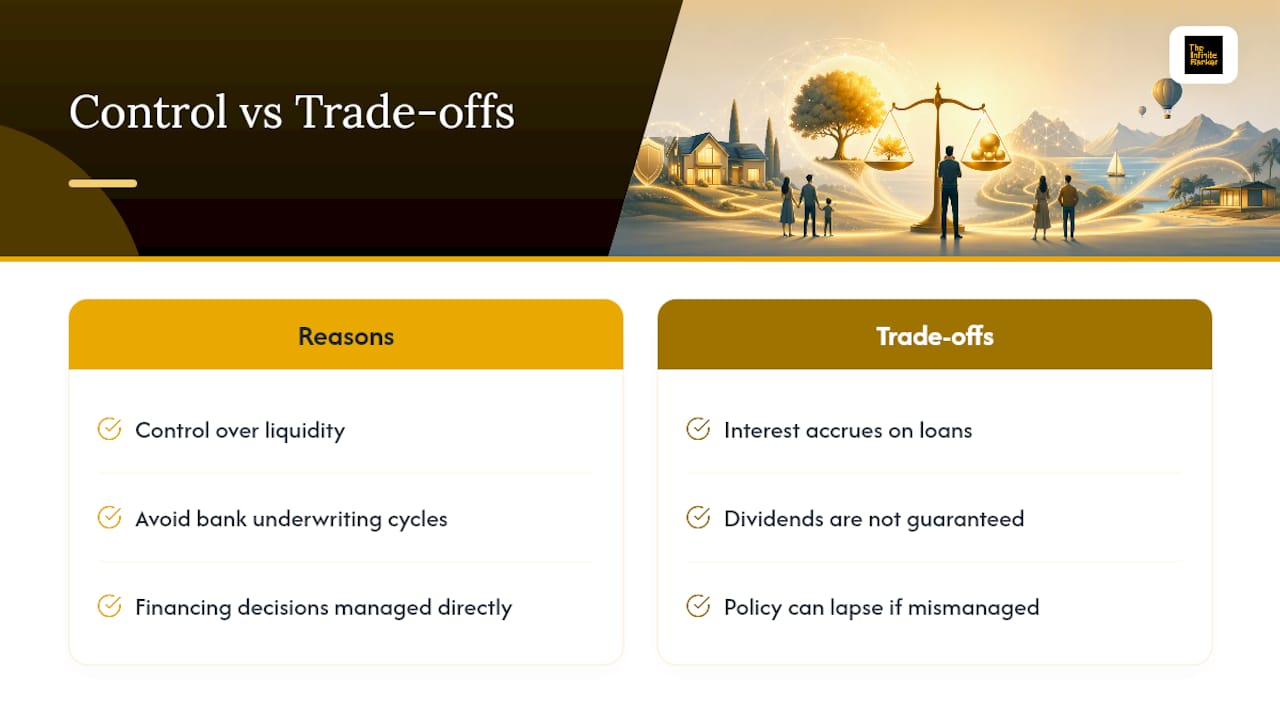
Clients who use this strategy well tend to share a trait: they want control over their own liquidity rather than depending on a bank’s underwriting cycle every time cash gets tight. Business owners and real estate investors gravitate toward using a policy this way because it puts financing decisions inside a system they manage directly.
That control comes with real trade-offs. Interest accrues on every loan, dividends are never guaranteed, and a mismanaged policy can lapse. Anyone considering this approach should weigh those realities before assuming the strategy fits their situation.
Getting Started With The Infinite Banker
Designing a policy that can reliably fund operating expenses years down the road takes more than picking a whole life product off a shelf. The Infinite Banker works through policy design, underwriting guidance, and loan governance so the structure supports business cash flow instead of working against it.

An initial consult typically covers a review of your business cash flow pattern, a look at funding timelines using Infinite Banking calculator tools, and coordination points where a CPA or attorney should weigh in before you commit to a funding schedule. The Infinite Banker does not replace those advisors; it works alongside them to keep the policy design aligned with your tax and legal position.
If funding operating expenses through policy loans looks like a fit for your business, start with a conversation. Visit The Infinite Banker to schedule a consult and review whether a properly structured policy makes sense for your cash flow needs.
Sources
This post is educational only and not financial, tax, or legal advice. Consult qualified professionals before acting.
This article is general information, not a substitute for advice from a qualified financial advisor. Consult a qualified financial professional about your own circumstances before acting on anything here.
Recommended
Comments