
What Is Participating Whole Life Insurance?


COMPLIANCE NOTE: For educational purposes only. Not financial, tax, or legal advice.
Participating whole life insurance is a permanent life insurance policy that gives policyholders the opportunity to share in the insurer’s financial surplus through dividends. The industry standard term is “participating policy,” and it stands apart from conventional whole life coverage through three core features: lifelong coverage, fixed premiums that never increase with age or health changes, and a guaranteed minimum death benefit paired with cash value accumulation. Dividends are not guaranteed. They depend entirely on the insurer’s annual financial performance. For entrepreneurs, real estate investors, and high-income earners exploring capital-efficient insurance structures, understanding how these policies work is the first step toward evaluating whether they fit a broader financial plan.
How do dividends work in participating whole life insurance?
Dividends in a participating policy come from the insurer’s annual financial surplus, not from investment markets. When a mutual insurance company collects more in premiums and investment income than it pays out in claims and expenses, the board of directors may declare a dividend and distribute a portion of that surplus to policyholders.

The ownership structure of a mutual insurer is what makes this possible. Mutual insurers are owned by policyholders, not shareholders. That means excess profits return to the people who hold policies rather than flowing to outside investors. Stock-based insurers, by contrast, prioritize shareholder returns and do not issue participating policies in the same way.
Dividends are most commonly paid annually, though some insurers issue them quarterly or biannually. The amount varies each year based on the company’s claims experience, operating costs, and investment returns. Because these variables shift, dividend amounts are never guaranteed and can change or be skipped entirely.
“Mutual insurers have historically missed dividend payments only twice: during the Great Depression and the 2008 housing crisis. That track record reflects the conservative financial management typical of mutual companies, but it does not make future dividends certain.”
That historical consistency matters for long-term planning. It does not, however, change the legal and contractual reality: dividends remain non-guaranteed. Any financial plan that treats them as fixed income carries meaningful risk.
What are the common ways to use dividends in participating whole life policies?
Policyholders have four primary options for applying dividends, and the choice has a significant effect on long-term policy performance.
Receive dividends as cash. The insurer sends a direct payment each year. This is the simplest option and provides immediate liquidity, but it does not increase the policy’s death benefit or cash value.
Apply dividends to reduce premiums. Dividends offset the annual premium due, lowering out-of-pocket costs. This option appeals to policyholders who want to reduce ongoing expenses without surrendering coverage.
Leave dividends to accumulate with interest. The insurer holds the dividend and credits interest on the balance. The accumulated amount grows inside the policy and can be withdrawn later. Interest credited this way is taxable in the year it is earned.
Purchase paid-up additions (PUAs). Dividends buy additional blocks of fully paid permanent coverage. Each PUA immediately increases both the death benefit and the cash value of the policy, with no additional premium required. PUAs also generate their own dividends in future years, creating a compounding growth effect.
The paid-up additions option consistently produces the strongest long-term results. PUAs create a compounding effect that surpasses simple cash dividend payouts over time. Each new block of coverage earns dividends, which can then purchase more PUAs, which earn more dividends. This is the mechanism that makes participating whole life the engine of the Infinite Banking Concept as practiced by The Infinite Banker.
A fifth option worth noting: dividends can also be applied to pay down outstanding policy loans. This reduces the loan balance and helps preserve both cash value and the death benefit.
Pro Tip: If your primary goal is long-term cash value growth, directing dividends toward paid-up additions from the start produces the most significant compounding effect over a 20-to-30-year horizon.
How does participating whole life compare to non-participating whole life?
The core difference between participating and non-participating whole life insurance is dividend eligibility. Non-participating policies do not share in insurer surplus. They offer a fixed death benefit and fixed premiums, but policyholders receive no dividends regardless of how well the insurer performs financially.
Feature | Participating whole life | Non-participating whole life |
Dividend eligibility | Yes, non-guaranteed | No |
Issued by | Mutual insurers | Stock or mutual insurers |
Initial premium cost | Higher | Lower |
Cash value growth | Fixed plus potential dividend additions | Fixed only |
Death benefit | Guaranteed minimum, may grow with PUAs | Fixed guaranteed amount |
Long-term value potential | Higher if dividends are paid | Predictable but limited |
Both policy types provide lifelong coverage and a guaranteed death benefit. The difference shows up in cost and growth potential. Participating policies cost more upfront due to dividend potential and conservative pricing assumptions built into the premium structure. That cost difference can narrow over time if dividends are paid consistently and directed toward PUAs, but it requires a long-term commitment and the financial capacity to sustain premiums.
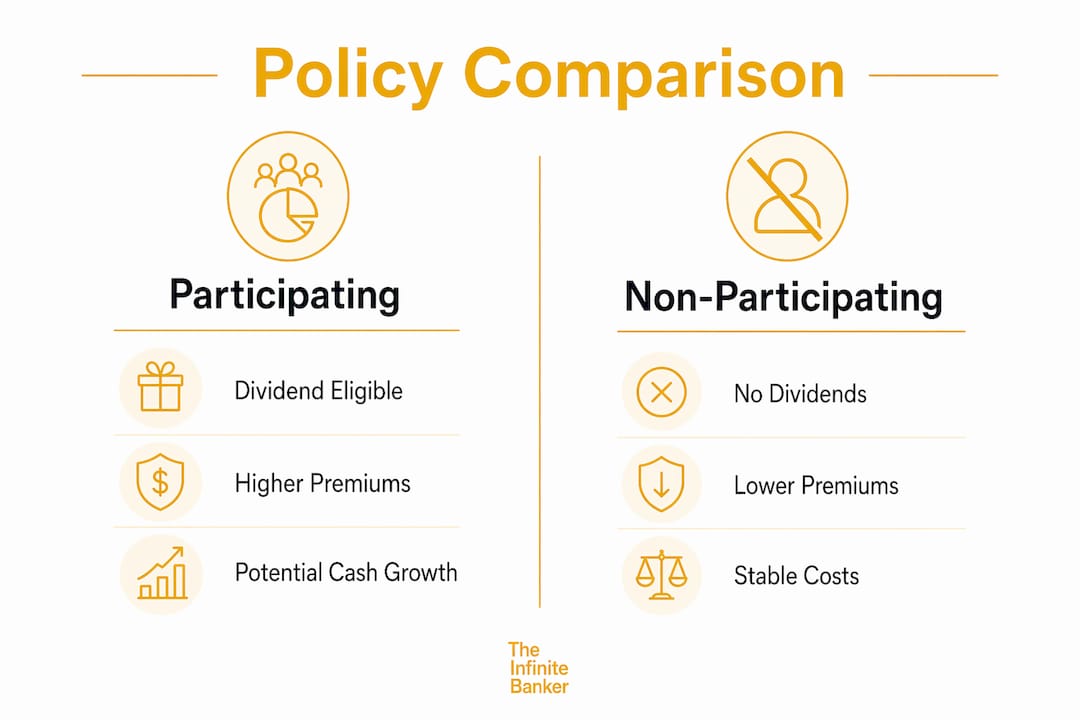
Non-participating policies suit buyers who want predictable, lower-cost permanent coverage without the complexity of dividend management. Participating policies suit those who want the potential for growing cash value and death benefit over time, and who can absorb higher initial costs.
What practical considerations matter when choosing a participating policy?
Participating whole life insurance carries specific requirements that buyers need to evaluate carefully before applying.
Minimum face amounts. Participating policies typically start at $100,000 in face value. Many mutual insurers set minimums higher. This is not a product designed for small coverage needs.
Underwriting standards. Mutual insurers apply conservative underwriting. Health history, age, and lifestyle factors all affect eligibility and premium rates. The process is generally more thorough than term or non-participating whole life applications.
Premium sustainability. Fixed premiums are a feature, not just a constraint. They simplify budgeting, but they must be paid consistently. Missing premiums can cause a policy to lapse, which eliminates coverage and may trigger tax consequences on accumulated gains.
Policy loan mechanics. Cash value is accessible via policy loans for business opportunities, debt management, or retirement funding. Policy loans accrue interest and reduce both cash value and the death benefit if left unpaid. Policies can lapse if loan balances grow unchecked.
Dividend reliance risk. Dividends are not guaranteed. A financial plan that depends on dividend income to cover premiums or fund other goals carries real exposure if the insurer reduces or skips a dividend payment.
Pro Tip: Before applying, model your budget with zero dividends. If the policy remains affordable at that baseline, you are in a position to benefit from dividends without depending on them.
Whole life insurance’s fixed premiums simplify long-term budgeting because the cost never rises with age or health changes. That predictability is a genuine structural advantage for high-income earners who want to lock in coverage costs early. For a deeper look at how cash value accumulates and how it can be deployed, The Infinite Banker’s guide on cash value for investors covers the mechanics in detail.
Key Takeaways
Participating whole life insurance offers permanent coverage, fixed premiums, and the potential for non-guaranteed dividends that can compound significantly when directed toward paid-up additions.
Point | Details |
Dividends are never guaranteed | They depend on the insurer’s annual financial performance and are declared by the board. |
PUAs produce the strongest growth | Directing dividends to paid-up additions creates a compounding effect on both death benefit and cash value. |
Higher upfront cost is real | Participating policies cost more than non-participating whole life, requiring long-term premium commitment. |
Policy loans carry risk | Loans accrue interest and reduce cash value and death benefit if unpaid; policies can lapse. |
Mutual insurer structure matters | Policyholders own mutual insurers, which is what enables profit sharing through dividends. |
My honest assessment of participating whole life insurance
I have worked with entrepreneurs and investors who come to participating whole life insurance expecting a simple product. It is not simple. The dividend mechanism, the PUA compounding effect, and the policy loan structure all interact in ways that reward careful planning and penalize short-term thinking.
What I find most underappreciated is the inflation-hedging quality of a well-structured participating policy. As dividends compound into PUAs over 20 or 30 years, the death benefit and cash value grow in ways that a non-participating policy simply cannot replicate. That growth is not guaranteed, but the structural potential is real and meaningful for long-term wealth planning.
The clients who struggle are those who buy participating whole life for the dividend income and then treat those dividends as reliable cash flow. Dividends are a bonus, not a paycheck. The policy has to make sense without them. If you can afford the premiums, qualify medically, and commit to a multi-decade horizon, participating whole life can be a genuinely powerful tool in a broader financial structure. If any of those three conditions are uncertain, the product may not be the right fit. Consult a qualified professional before making any decision.
— Jib Hunt, Authorized IBC Practitioner
How The Infinite Banker approaches participating whole life insurance
The Infinite Banker specializes in helping entrepreneurs, real estate investors, and high-income earners understand and apply dividend-paying whole life insurance as a capital management tool.

The site’s resources cover the full picture: how cash value accumulates, how policy loans work in practice, and how the Infinite Banking Concept uses participating whole life as a personal banking system. If you are evaluating whether this type of policy fits your financial goals, The Infinite Banker’s cash flow strategy guide is a practical starting point. The resources are educational and designed to help you ask better questions before speaking with a qualified professional.
FAQ
What is a participating whole life insurance policy?
A participating whole life insurance policy is a permanent life insurance contract issued by a mutual insurer that allows policyholders to receive non-guaranteed dividends from the company’s annual financial surplus, alongside a fixed death benefit and fixed premiums.
Are dividends from participating policies taxable?
Dividends received as cash or used to reduce premiums are generally not taxable up to the amount of premiums paid into the policy, because the IRS treats them as a return of premium. Dividends left to accumulate interest are taxable on the interest portion in the year it is credited.
How does participating whole life differ from term life insurance?
Term life insurance provides coverage for a fixed period and pays no dividends, builds no cash value, and expires at the end of the term. Participating whole life provides lifelong coverage, accumulates cash value, and may pay dividends based on insurer performance.
Can policy loans reduce my death benefit?
Yes. Policy loans accrue interest and, if left unpaid, reduce both the cash value and the death benefit. A policy can lapse if the loan balance grows to exceed the cash value, which may also trigger a taxable event.
Who issues participating whole life insurance policies?
Participating policies are almost exclusively issued by mutual insurance companies, which are owned by their policyholders rather than outside shareholders. That ownership structure is what enables the insurer to return surplus profits as dividends.
This post is educational only and not financial, tax, or legal advice. Consult qualified professionals before acting.
Recommended
Comments