
Whole Life in Business Financing: A 2026 Owner's Guide
- Jib Hunt

- Jul 6
- 9 min read

COMPLIANCE NOTE: For educational purposes only. Not financial, tax, or legal advice.
Whole life insurance is defined as a permanent life insurance contract that builds cash value over time, and its role in business financing is to give owners a private, owner-directed source of capital that operates outside the traditional banking system. Unlike term policies, dividend-paying whole life insurance accumulates cash value at contractual rates, which business owners can access through policy loans without credit checks or bank approval. The Infinite Banker works with entrepreneurs and high-income earners to structure these policies specifically for capital efficiency, not just death benefit protection. Understanding how this tool works mechanically, and where it fits in a broader business funding strategy, is the starting point for any owner considering it seriously.
How does whole life insurance generate cash value for business financing?
Dividend-paying whole life insurance builds cash value through two parallel mechanisms: a contractual guaranteed growth component and non-guaranteed annual dividends paid by the insurance carrier. The contractual growth rate on well-structured policies has projected in the 3–5% range through 2026. That growth is not tied to stock market performance, which means it does not drop during a market correction.
The engine of this accumulation is the Paid-Up Additions (PUA) rider. A PUA rider directs additional premium dollars into fully paid-up mini-policies that carry their own cash value and death benefit. This accelerates the growth of accessible cash value in the early years of the policy, which is critical for business owners who need liquidity sooner rather than later.
Key structural features of dividend-paying whole life policies include:
Cash value grows tax-deferred inside the policy and is separate from the death benefit
PUA riders accelerate early-year liquidity by directing premium dollars into paid-up coverage
Dividends are not guaranteed but, when paid, can be applied to purchase additional paid-up coverage
Contractual growth is stable and not correlated with equity market volatility
Policy loans allow access to cash value without surrendering the policy or triggering a taxable event
The distinction between cash value and death benefit matters for business owners. Cash value is the living asset you can borrow against. The death benefit is the amount paid to beneficiaries. A well-designed policy grows both, but the cash value is what drives the whole life business funding strategy.
What are the primary methods for using whole life insurance to finance business needs?
Business owners deploy whole life cash value through two primary channels: policy loans and collateral assignments. Each has different mechanics, timelines, and cost structures.
Policy loans. You borrow against your policy’s cash value directly from the insurance carrier. Policy loans require no credit check and no bank approval. The loan is secured by the cash value itself, not your personal or business credit score. Funds typically arrive within days, which is faster than most conventional business financing options. The interest accrues on the outstanding loan balance, and if the loan is not repaid, it reduces both the cash value and the death benefit. Policies can lapse if the loan balance grows to exceed the cash value.
Collateral assignments (Immediate Financing Arrangements). You assign the policy’s cash value as collateral to a bank, which then issues a separate loan. This approach is common in corporate structures and may allow interest deductions depending on jurisdiction and use of funds. The policy continues to grow while the bank loan is outstanding.
Direct cash value withdrawals. You can withdraw up to your cost basis (total premiums paid) without triggering income tax. Amounts above the cost basis are taxable. Withdrawals permanently reduce cash value and death benefit, so most business owners prefer policy loans over withdrawals.
Buy-sell agreement funding. Partners fund cross-purchase or entity-purchase agreements using policy cash value or death benefits, providing a clear, pre-funded exit mechanism.
Key person coverage with living benefits. The cash value in a key person policy can be accessed during the insured’s lifetime to fund operations or transitions if that person leaves the business.
Pro Tip: One structural advantage of policy loans is that cash value continues earning dividends even while funds are borrowed, provided the carrier uses non-direct recognition. This means your capital is working in two places simultaneously, inside the policy and in your business.
Repayment schedules for policy loans are flexible. There is no mandatory monthly payment, which aligns well with the uneven cash flow cycles many business owners experience. That flexibility is an advantage, but it also creates a discipline risk covered in a later section.
How does corporate ownership of whole life policies affect business financing strategies?
Corporate-owned life insurance (COLI) structures give incorporated business owners a materially different cost basis for funding premiums. Premiums paid through a corporation use after-tax corporate dollars, and small business tax rates in Canada run approximately 9–12% as of 2026. That is significantly lower than personal marginal tax rates, which reduces the effective cost of building cash value.
The tax advantages extend beyond premium funding. Cash value growth inside a corporate-owned policy is tax-deferred, which protects retained earnings from passive income rules that can trigger clawbacks on the small business deduction. This is a meaningful planning consideration for profitable corporations holding excess cash.
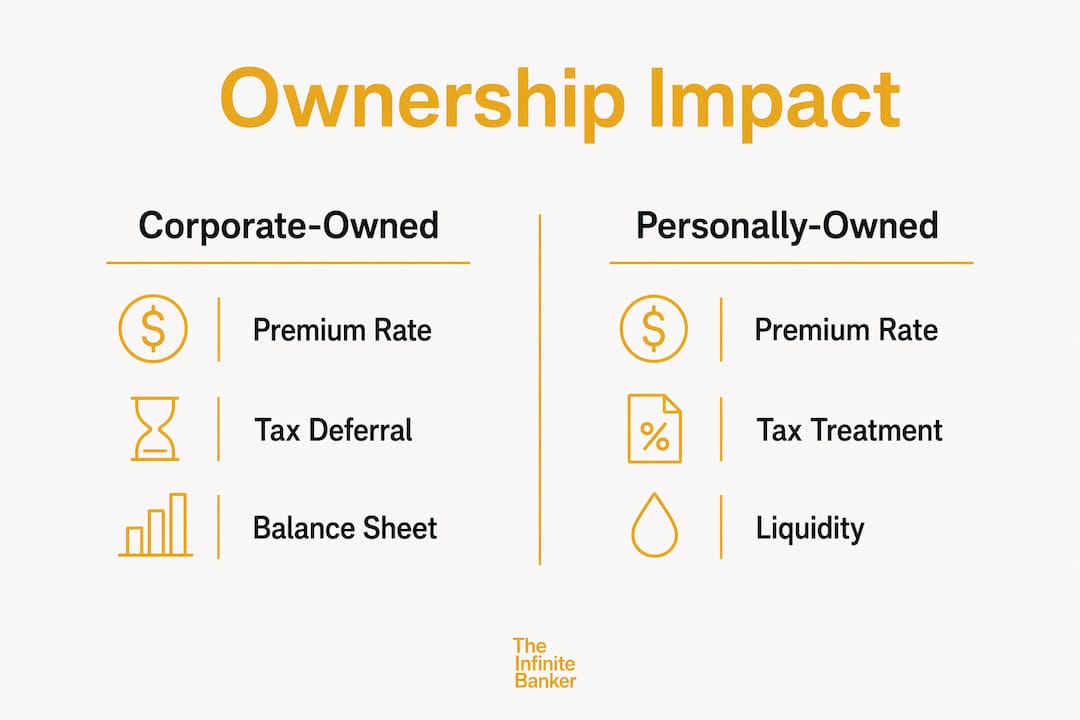
Feature | Corporate-owned policy | Personally-owned policy |
Premium funding rate | Corporate after-tax (9–12% in Canada) | Personal after-tax (higher marginal rate) |
Cash value growth | Tax-deferred inside corporation | Tax-deferred personally |
Death benefit distribution | Flows through Capital Dividend Account (CDA) | Paid to named beneficiary |
Balance sheet treatment | Appears as a liquid corporate asset | Personal asset |
Succession planning use | Buy-sell, shareholder agreements | Estate planning |
Upon the insured’s death, insurance proceeds flow through the Capital Dividend Account to shareholders tax-free, avoiding the double taxation that typically applies to corporate distributions. This estate planning advantage makes corporate-owned whole life a multi-purpose tool: business financing during life, and tax-efficient wealth transfer at death.
Corporate-owned policies also appear as liquid assets on the company’s balance sheet. This can strengthen the company’s financial position when seeking conventional credit, creating a complementary relationship between the policy and traditional banking rather than a replacement of it.

What policy design considerations enhance whole life as a business financing tool?
Policy design determines whether a whole life policy functions as a genuine business financing tool or simply as an expensive death benefit. The difference comes down to how premiums are allocated in the early years.
A policy designed primarily for death benefit coverage directs a large portion of early premiums toward insurance costs and agent commissions. This leaves minimal cash value accessible in years one through five, which defeats the purpose for a business owner who needs liquidity. Maximizing PUA riders early is the structural solution. By front-loading paid-up additions, the policy builds accessible cash value faster.
Key design and discipline considerations:
PUA weighting. The ratio of base premium to PUA premium should favor PUA for business-focused policies. This accelerates liquidity at the cost of a lower initial death benefit relative to total premium.
Carrier selection. The carrier matters less than the design. A well-structured policy from a mutual carrier with a strong dividend history outperforms a poorly designed policy from a top-rated carrier.
Non-direct recognition carriers. These carriers do not reduce your dividend rate when you have an outstanding policy loan. This preserves the “AND” asset concept where capital works in two places at once.
Loan repayment discipline. Treating policy loans like a revolving credit line without disciplined repayment erodes the strategy’s effectiveness over time.
Return hurdle. Capital deployed from the policy must earn a return that exceeds the policy loan interest rate. Otherwise, you are paying for access to your own money without a net gain.
Pro Tip: Work with an Authorized IBC Practitioner who specializes in business policy design. A policy built for a W-2 employee looks very different from one built for a business owner with irregular cash flow and specific capital deployment goals.
The funding lag is a real constraint. Most well-designed policies reach meaningful liquidity in years two through four. Business owners who need capital immediately should plan accordingly and not rely on a new policy as a short-term emergency fund.
What business scenarios illustrate whole life insurance financing in practice?
Whole life insurance supports several practical business scenarios that go beyond simple protection. Each scenario below reflects a real capital need that policy cash value can address without diluting ownership or adding conventional debt.
Business expansion without bank debt. A business owner with $200,000 in policy cash value can take a policy loan to fund equipment purchases, a new location, or a marketing push. The loan does not appear on a credit report, does not require a business plan submission, and can be deployed within days. The owner repays the loan on a schedule that matches revenue cycles.
Shareholder buyouts. When a business partner exits, the remaining owners need capital quickly. Pre-funded buy-sell agreements using whole life cash value provide a ready source of funds without forcing a fire sale of business assets or taking on bank debt at an inconvenient time.
Key person continuity. A policy on a key employee or founder provides both a living benefit (cash value accessible during their tenure) and a death benefit that compensates the business for the financial disruption of losing that person.
Capital flexibility during uncertainty. Whole life cash value does not fluctuate with market conditions. During periods of economic stress, when conventional credit tightens, policy cash value remains accessible at the same terms. This stability is a structural advantage that complements, rather than replaces, traditional banking relationships.
Shifting from bank-dependent capital to an owner-directed model does not mean abandoning conventional financing. It means adding a private, controlled capital layer that operates on your terms.
Key Takeaways
Whole life insurance functions as an owner-directed capital source when policies are properly designed with PUA riders, funded through corporate structures where applicable, and managed with disciplined loan repayment practices.
Point | Details |
Cash value is the working asset | PUA riders accelerate early liquidity, making cash value accessible for business use sooner. |
Policy loans bypass banks | Funds arrive within days with no credit check, secured only by the policy’s cash value. |
Corporate ownership lowers cost | After-tax corporate funding at lower small business rates reduces the effective cost of building capital. |
Design determines utility | A policy built for death benefit coverage limits early cash value access; PUA-weighted design solves this. |
Discipline is non-negotiable | Deployed capital must earn returns above the loan interest rate, or the strategy loses its financial logic. |
Why I think most business owners misread this tool
Most business owners who dismiss whole life insurance as a financing tool have seen a poorly designed policy. They looked at the cash value in year two, compared it to total premiums paid, and concluded the math does not work. They are right about that specific policy. They are wrong about the concept.
The version of whole life that functions as a business financing tool is not the same product a general insurance agent sells for estate planning. It is a specifically structured contract, weighted toward PUA riders, issued by a mutual carrier with a consistent dividend history, and managed with the same discipline you would apply to any capital account. The carrier’s dividend is not guaranteed, and that uncertainty is real. But the contractual growth floor, the credit-independent access, and the tax treatment inside a corporation create a combination that conventional business financing options do not replicate.
What I have observed working with business owners through The Infinite Banker is that the biggest risk is not the policy. The biggest risk is treating a policy loan like a business credit card. Owners who borrow, deploy capital into productive uses, repay the loan with discipline, and repeat the cycle build a genuinely useful private capital system. Owners who borrow and never repay simply erode their own asset. The tool is sound. The discipline requirement is real.
— Jib Hunt, Authorized IBC Practitioner
How The Infinite Banker can help you structure this strategy
Business owners who want to use whole life insurance as a financing tool need a policy built for that purpose from day one. A standard policy sold for death benefit protection will not perform the same way.

The Infinite Banker works with entrepreneurs, real estate investors, and high-income earners to design and implement whole life financing strategies built around capital efficiency and long-term flexibility. That includes policy design, corporate ownership structuring, and ongoing guidance on loan repayment discipline. If you are exploring whether this approach fits your business, the Infinite Banking overview on the website explains who this strategy is designed for and what a properly structured policy looks like in practice.
FAQ
What is a whole life business funding strategy?
A whole life business funding strategy uses the cash value of a dividend-paying whole life policy as a private capital source, accessed through policy loans without credit checks or bank approval. The strategy works best when the policy is designed with PUA riders to accelerate early liquidity.
Can I use a whole life policy as collateral for a business loan?
Yes. Business owners can assign a whole life policy’s cash value as collateral to a bank through an Immediate Financing Arrangement, which may allow interest deductions depending on jurisdiction and the use of loan proceeds.
How quickly can I access cash value for business financing?
Policy loans are typically funded within days because they require no credit check and no bank underwriting. The loan is secured by the policy’s cash value, not personal or business credit.
Are there tax advantages to owning a whole life policy inside a corporation?
Corporate-owned policies funded with after-tax corporate dollars benefit from lower small business tax rates. Upon the insured’s death, proceeds can flow through the Capital Dividend Account to shareholders without triggering additional personal tax, avoiding double taxation.
What happens if I do not repay a policy loan?
Unpaid policy loans accrue interest and reduce both the cash value and the death benefit. If the loan balance grows to exceed the cash value, the policy can lapse, which may trigger a taxable event. Repayment discipline is a core requirement of this strategy.
This post is educational only and not financial, tax, or legal advice. Consult qualified professionals before acting.
Comments