
Whole Life Insurance vs Hard Money Loans for Investors
- Jib Hunt

- 2 days ago
- 13 min read

COMPLIANCE NOTE: For educational purposes only. Not financial, tax, or legal advice.
If you need cash for a six-month rehab flip and your exit plan is solid, a hard money loan is usually the faster, more purpose-built tool. If you’re managing ongoing liquidity across multiple deals and already hold cash value in a dividend-paying whole life policy, borrowing against that policy often makes more sense for recurring, flexible funding needs.
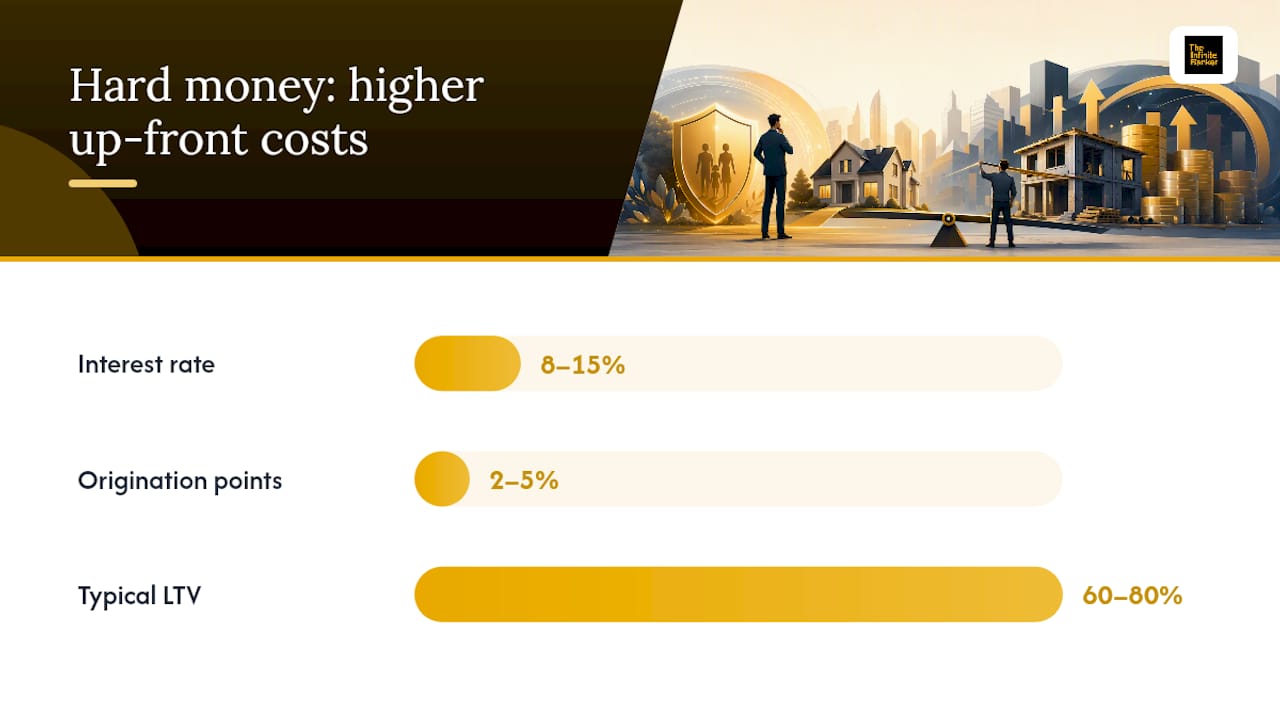
The math behind that split comes down to structure, not just rate. Hard money loans typically carry interest rates between 8% and 15% with loan-to-value caps often landing in the 60% to 80% range, plus origination points and a fixed repayment clock. A whole life policy loan works differently: you borrow against your own cash value with no credit check and flexible repayment, but the loan balance accrues interest and reduces your death benefit until it’s repaid.
Hard money: collateral-based underwriting, fast closings, higher cost, short fuse.
Whole life policy loans: no credit check, flexible repayment, interest accrues against your death benefit and cash value.
Neither is universally cheaper. The right choice depends on your timeline, your existing cash value, and how confident you are in your exit.
Key Takeaways
Hard money loans typically cost more upfront through interest and points but offer speed for short deals, while whole life policy loans offer flexible, no-credit-check access to capital at the cost of a reduced death benefit until repaid.
Point | Details |
Speed vs cost trade-off | Hard money closes in days but carries 8% to 15% interest plus 2% to 5% in points. |
Policy loans shift cost, not eliminate it | Unpaid loan balances plus interest reduce your death benefit and can cause lapse. |
Timeline drives the decision | Short, certain exits favor hard money; flexible timelines favor policy loans if cash value exists. |
Run your own numbers | Small shifts in ARV, LTV, or timeline change which option is actually cheaper. |
The Infinite Banker’s role | An Authorized IBC Practitioner can model policy illustrations and loan schedules to compare against hard money terms for your specific deal. |
Table of Contents
Whole Life Insurance vs Hard Money Loans: A Side-by-Side Look
The two financing tools solve different problems, and the numbers make that obvious once you line them up. Hard money is built for speed and short holding periods. A whole life policy loan is built for repeat access to capital you’ve already accumulated, without a lender’s involvement at all.
Dimension | Whole Life Policy Loan | Hard Money Loan |
Best for / ideal use case | Ongoing liquidity, repeat deals, owner-financing, bridge capital for investors with built-up cash value | Short-term flips, rehab projects, distressed acquisitions needing speed |
Cost: interest / fees | Insurer-set loan interest rate, no origination points, interest accrues against the policy | 8% to 15% interest, plus 2% to 5% in points |
Repayment term / timeline | Flexible, no fixed schedule, can extend indefinitely if you manage accrued interest | Typically 6 to 24 months with a balloon payment at the end |
Collateral / LTV | Your own cash value; no third-party collateral required | Property-based, often 60% to 80% LTV depending on ARV |
Speed of funding | Days, limited mainly by paperwork with the insurer | Often 5 to 15 business days once terms are set |
Qualification requirements | Requires an existing policy with sufficient cash value; no credit check | Property appraisal or BPO, proof of exit strategy, sometimes credit check |
Tax / estate impact | Loans are generally not taxed when taken; unpaid balances reduce the death benefit | Loan interest may be deductible as a business expense; no direct estate impact |
Effect on future borrowing / liquidity | Reduces available cash value until repaid; can affect policy performance long-term | No effect on other assets unless default triggers foreclosure |
Risk to principal / downside | Policy lapse if loan and interest exceed cash value; reduced death benefit | Foreclosure risk if exit plan fails; balloon payment exposure |
Three trade-offs stand out once you study that table closely:
Hard money’s cost is upfront and visible: rate, points, and term are locked in at closing.
A policy loan’s cost is deferred and cumulative: it grows quietly against your death benefit until you repay it.
The rows most sensitive to your assumptions are interest rate, LTV or cash-value ceiling, and your actual timeline. Get any of those wrong and the “cheaper” option flips.
How Does Borrowing From a Whole Life Policy Work?
Policy loans let you access your cash value directly from the insurer without a credit check, application, or approval process most lenders require. You’re not borrowing from a bank. You’re borrowing against an asset you already own, using the insurance company as the counterparty.

That convenience comes with structural limits. You need enough accumulated cash value to support the loan you want, loan interest accrues the entire time the balance is outstanding, and if you don’t manage the balance, it can eventually exceed your cash value and cause the policy to lapse.
Cash value in a dividend-paying whole life policy builds slowly in the early years and accelerates as the policy matures. Dividends, when declared, can add to that growth, but insurers do not guarantee dividends in any given year, and a policy’s guaranteed cash value figures should never be confused with dividend-enhanced projections. MoneyGeek’s research on cash value growth confirms this: usable cash value typically takes several years to build to meaningful levels, which is why policy design and funding pace matter more than most new policyholders expect.
The mechanics of the loan itself matter too. When you request a policy loan, the insurer doesn’t liquidate your cash value. It advances you funds using your policy as collateral, and your cash value continues to be credited with growth and dividends under most policy designs, even while a loan is outstanding. Repayment is flexible: you can pay interest only, pay down principal on your own schedule, or let the balance ride. Farm Bureau Financial Services notes that this flexibility is one of the loan’s biggest advantages over conventional financing, but the same flexibility is what makes unmanaged balances dangerous over time.
Using policy loans for real estate funding: pros and cons
No credit check or lengthy underwriting, which means funding can move as fast as your insurer processes the request.
Repayment terms are set by you, not by a lender’s amortization schedule.
Unpaid loan balances plus accrued interest reduce your death benefit, sometimes substantially over a multi-year hold.
Large or long-running loans can slow the compounding of cash value, since less of your policy’s value is working for you while a loan is outstanding.
If a loan balance grows faster than your cash value, the policy can lapse, and that can create a taxable event on the gain portion of the policy.
Pro Tip: If you’re planning to use a policy for real estate funding, work with your practitioner to structure premium funding so cash value becomes accessible on a timeline that matches your investing plans, rather than assuming it will be available exactly when you need it.
A policy loan doesn’t disappear when you stop thinking about it. Interest keeps accruing, and if the total loan balance ever exceeds your cash value, the policy can lapse, potentially triggering a taxable event and permanently reducing the death benefit your beneficiaries would have received.
Because exact loan interest methods and crediting rules vary by insurer and product, always confirm the specifics using your own policy illustration and contract language rather than general industry averages.
How Do Hard Money Loans Work for Real Estate Investors?
Hard money lenders care about the property, not your credit score. Underwriting centers on the after-repair value (ARV) and loan-to-value ratio, which is why these loans close faster than a conventional mortgage but cost noticeably more.
Interest rates typically run 8% to 15%, well above conventional mortgage pricing.
Origination points commonly add 2% to 5% of the loan amount as an upfront fee.
Loan-to-value caps often sit between 60% and 80%, depending on the lender’s appetite and the strength of the ARV estimate.
Terms are short, usually 6 to 24 months, structured around a specific exit: a sale, a refinance, or a construction completion.
Down payments are typically higher than conventional financing, often 20% to 30% of the purchase price.
Hard money loans commonly close in 5 to 15 business days, dramatically faster than a bank mortgage that can take 30 to 45 days or longer.
Because hard money terms are short and rates are high, lenders expect a credible exit plan before they fund. A stalled flip or a refinance that falls through can turn a fast, useful tool into a foreclosure risk fast, especially once the balloon payment comes due.
Hard money makes sense for urgent acquisitions, rehab flips where speed determines whether you win the deal, and distressed situations where a seller needs to close quickly. It’s a poor fit for anyone financing a primary residence or planning a long-term hold without a clear refinance or sale strategy, since the cost structure punishes extended timelines.
Comparing Real Numbers: A Flip vs a Bridge Loan Scenario
Numbers settle debates that opinions can’t. Here’s how the two financing methods compare across two common investor situations: a fast rehab flip and a longer buy-and-hold bridge.
Model assumptions for both scenarios:
Purchase price: $200,000
Rehab budget: $50,000
After-repair value (ARV): $320,000
Hard money loan: 75% LTV of ARV, 11% interest, 3 points, 9-month term
Policy loan: assumes $150,000 in available cash value, 6% loan interest, no points, flexible repayment
Step-by-step math for the flip scenario:
Total project cost: $200,000 purchase plus $50,000 rehab equals $250,000.
Hard money covers $240,000 at 75% of the $320,000 ARV, leaving $10,000 to fund out of pocket plus the $7,200 in points.
Interest at 11% annualized over 9 months runs roughly $19,800 on the outstanding balance.
Total financing cost for the hard money path: $27,000 before any extension fees.
A policy loan of $150,000 covers only part of the project, so the investor would need $100,000 from savings or another source to close the gap, but interest cost on the borrowed portion is roughly $6,750 over the same 9 months.
Sensitivity note: stretch the flip timeline from 9 months to 15 months and the hard money interest cost climbs proportionally, often triggering extension fees that lenders charge for missed deadlines. A policy loan’s cost also rises with time, but without a hard deadline or balloon payment, a longer hold doesn’t create the same default risk, only a larger drag on death benefit and cash value if left unpaid.
If the ARV comes in lower than projected, say $290,000 instead of $320,000, the hard money lender’s LTV cap shrinks the available loan amount, which can force the investor to bring more cash to closing or renegotiate terms altogether. A policy loan’s ceiling is fixed by your existing cash value, so ARV swings don’t change what you can access, only what the deal itself can absorb.

Pro Tip: Run these numbers against your own insurer’s policy illustration and your prospective hard money lender’s actual term sheet before committing. Small changes in points, LTV, or timeline can shift which option is genuinely cheaper.
These figures are illustrative and depend heavily on your specific policy design, lender terms, and local market conditions. Always model your own numbers with actual quotes before deciding.
When Should You Use Hard Money vs a Policy Loan?
Matching the right tool to the right situation comes down to timeline, existing assets, and how much certainty you have about your exit.
Fast rehab flip: Hard money fits when you need to close in days and repay within 6 to 12 months through a sale. Expect total financing cost in the range of 10% to 18% of the loan amount once points and interest are combined.
Ongoing buy-and-hold financing for experienced investors: A policy loan against accumulated cash value suits investors with sufficient built-up value who want repeat, flexible access without repeated credit applications.
Bridging between property sales: This is a conditional call. If the gap is under six months and you have a firm closing date on the other end, hard money can work. If the timeline is uncertain, a policy loan’s lack of a fixed deadline reduces the risk of a forced sale.
Funding owner-financing arrangements for buyers: Some investors use policy-based private lending to finance buyers directly, a strategy detailed in The Infinite Banker’s private lending guide, where the policy owner effectively becomes the lender on their own terms.
Pro Tip: Investors who use hard money for the acquisition phase sometimes refinance into a policy loan once cash value is sufficient, reducing carrying costs during a longer hold. This only works if the policy has enough available cash value at the right time, so confirm the numbers with your practitioner before counting on it.
What Are the Biggest Risks in Each Option?
Every financing tool has a cost beyond the headline rate. Knowing where the real risk sits is what separates a smart deal from a costly mistake.
Hard money risks:
High combined cost from interest plus points, often 10% to 18% of the loan amount total.
Balloon payment due at term end, creating pressure if the exit plan slips.
Foreclosure risk if you can’t sell, refinance, or repay on schedule.
Short timelines leave little room for market shifts or construction delays.
Whole life policy loan risks:
Unpaid loan balances plus accrued interest reduce your death benefit permanently until repaid.
Large loans early in a policy’s life, before cash value has built meaningfully, can strain the policy’s structure.
If the loan balance exceeds cash value, the policy can lapse, which may create a taxable event.
Using policy loans repeatedly can slow cash value compounding, since less capital works inside the policy while a loan is outstanding.
Watch for ambiguous points disclosures, prepayment penalties buried in loan documents, and policy illustrations that quietly assume non-guaranteed dividends as if they were guaranteed. Both hard money contracts and insurance illustrations can obscure real cost behind optimistic assumptions.
Pro Tip: Before relying on a policy for future liquidity, ask your practitioner for a full policy illustration and a modeled loan repayment schedule. This shows exactly how much cash value would realistically be available at the point you’d need it, rather than a generic projection.
How Do You Decide Between These Two Options?
A structured checklist beats gut instinct when real money and a mortgage-sized decision are on the line.
Confirm your deal math: purchase price, rehab budget, ARV, and expected timeline to sale or refinance.
Define your exit plan clearly and stress-test it against a delay of three to six months.
Get actual hard money quotes: interest rate, points, LTV cap, and prepayment terms in writing.
Request a full policy illustration from your insurer showing guaranteed cash value, non-guaranteed dividend projections, and a modeled loan repayment schedule.
Compare total financing cost across both options using your real numbers, not industry averages.
Ask your hard money lender for a written ARV justification, not just a verbal estimate.
Ask your insurer or practitioner how loan interest is calculated and whether it’s fixed or variable under your specific contract.
Confirm how a policy loan would affect your death benefit if left unpaid for the full projected timeline.
Red flags that should give you pause:
A hard money lender who won’t put points, fees, and prepayment terms in writing before closing.
No independent appraisal or BPO backing the stated ARV.
A policy illustration that presents dividend scenarios as guaranteed income rather than a projection.
Any lender or insurer unwilling to walk you through a worst-case scenario.
As a general rule of thumb: when your timeline is short and certain, and you don’t yet have meaningful cash value, hard money is typically the more appropriate tool despite its higher headline cost. When your timeline is flexible and you have qualified cash value already in place, a policy loan is often the lower-cost, lower-pressure option, provided you actively manage the balance.
How Do Advisors Typically Combine These Two Tools?
Client patterns tend to cluster around a handful of recurring profiles. Real estate investors who are new to a market often start with hard money because they haven’t built policy cash value yet, while investors who’ve been implementing Infinite Banking for several years increasingly lean on policy loans for repeat deals because the process is faster and doesn’t involve a new underwriting cycle every time.
A common integrated strategy looks like this: an investor uses hard money to move quickly on an acquisition, then refinances into a conventional mortgage or pays down the hard money balance using a policy loan once cash value is sufficient. This sequencing can lower total carrying costs on longer holds, though it depends entirely on the investor having built adequate cash value in advance, which is why policy design and funding pace matter years before the capital is actually needed.
Advisors generally discourage hard money for investors without a clearly documented exit plan, since the short terms and balloon structure punish uncertainty far more severely than a policy loan does. The inverse is also true: recommending a policy loan to someone who hasn’t built sufficient cash value yet just shifts the funding problem rather than solving it.
Jib Hunt is an Authorized IBC Practitioner who typically works with clients on policy design, underwriting guidance, and implementation of dividend-paying whole life strategies built for capital efficiency in real estate and business funding contexts.
How Can a Practitioner Help You Decide?
Choosing between these two tools isn’t a one-time decision. It’s a recurring question every time a new deal comes up, and the answer changes as your cash value grows and your investing plans evolve. An Authorized IBC Practitioner can help by building a policy design suited to your funding timeline, producing loan-schedule illustrations that show exactly how much cash value would be available at different points, and walking through the deal math alongside your hard money options so the comparison is based on your actual numbers, not general ranges.

This kind of planning suits a specific group:
Entrepreneurs looking to add a flexible funding source alongside traditional bank credit.
Active real estate investors who want repeat access to capital without repeated underwriting.
High-income earners exploring policy-based financing as part of a broader capital strategy.
If you want to see how a properly structured policy might fit into your own real estate funding plan, The Infinite Banker’s Infinite Banking Calculator lets you model loan availability and funding pace before you talk to a practitioner. From there, you can schedule a strategy conversation to review your specific numbers. This is educational information only, not a recommendation that a policy loan or hard money loan is right for your situation.
Sources
Insurer illustrations vary by carrier and policy design, and hard money terms vary by lender and market. Verify current rates, points, and loan provisions directly with your insurer and lender, and confirm any state-specific rules with a qualified tax or legal advisor before making a decision.
This post is educational only and not financial, tax, or legal advice. Consult qualified professionals before acting.
This article is general information, not a substitute for advice from a qualified financial advisor. Consult a qualified financial professional about your own circumstances before acting on anything here.
Recommended
Comments