
Entrepreneur Cash Reserve Best Practices for 2026


COMPLIANCE NOTE: For educational purposes only. Not financial, tax, or legal advice.
The most effective approach to entrepreneur cash reserve best practices using the Infinite Banking Concept (IBC) is a purpose-built, dividend-paying whole life policy funded on a planned cadence and governed by disciplined loan management rules. This is not a checking account substitute. It is a structured financing tool that, when designed correctly, can provide loan liquidity while the policy’s cash value continues to accrue credited growth per policy terms.
Three immediate steps to take before anything else:
Schedule a policy design consultation with an Authorized IBC Practitioner to model premium, paid-up additions (PUAs), and early cash value projections.
Establish a funding cadence you can sustain for at least 7 to 10 years without interruption.
Draft a loan governance policy before the first loan is taken: document the purpose, repayment schedule, and review frequency.
Key Takeaways
A properly designed, consistently funded dividend-paying whole life policy, governed by disciplined loan management, is the foundation of a policy-based entrepreneur cash reserve under the Infinite Banking Concept.
Point | Details |
Policy design drives early liquidity | PUA-heavy designs show meaningfully higher cash value by year 3 than base-premium-only structures. |
Meaningful loan capacity takes time | Practical loan access for most well-funded policies typically develops between years 5 and 10. |
Loan governance is non-negotiable | Unpaid loan interest capitalizes, erodes cash value, and can push a policy into lapse with tax consequences. |
Dividends are not guaranteed | Carrier dividend scales vary annually; size your reserve plan around the guaranteed illustration column. |
The Infinite Banker supports implementation | Policy design, illustration review, underwriting guidance, and governance support are available through a consultative engagement. |
Table of Contents
How should you design a policy for cash-reserve functionality?
How do you size your reserve and what do the numbers look like?
What should you expect from underwriting, costs, and early liquidity?
What commonly goes wrong, and what red flags should you watch for?
The Infinite Banker supports your implementation from design to governance
What does “entrepreneur cash reserve” mean in this context?
In this article, “entrepreneur cash reserve” refers specifically to the cash value accumulated inside a dividend-paying whole life insurance policy, accessed through insurer-issued policy loans. It does not mean operating cash held in a bank account or a money market fund.
Policy loans work as collateralized advances from the insurer’s general account. The insurer holds your cash value as collateral and issues a loan against it. Critically, policy loans are not literally borrowing your own money; the insurer’s capital funds the advance, and the loan terms reflect the insurer’s rates, not your own. With many carriers, the policy’s cash value continues to receive credited interest and participating dividends while a loan is outstanding, per the policy’s terms.
Risks to keep in mind from the outset:
Dividends are not guaranteed and vary with carrier performance.
Unpaid loan interest capitalizes, reducing available cash value and the death benefit; if the loan balance plus accrued interest exceeds cash value, the policy can lapse.
A lapsed policy with outstanding loans may trigger a taxable event.
This article does not cover traditional operating cash reserves held in liquid bank instruments.
How should you design a policy for cash-reserve functionality?
Design choices made at policy inception have a larger effect on early loan capacity than any subsequent decision. Four principles govern a reserve-focused design.
Participating whole life with a strong dividend history. Choose a mutual carrier or a stock carrier with a long, documented dividend-crediting record. Dividends are not guaranteed, but historical consistency signals financial strength and reserve management discipline.
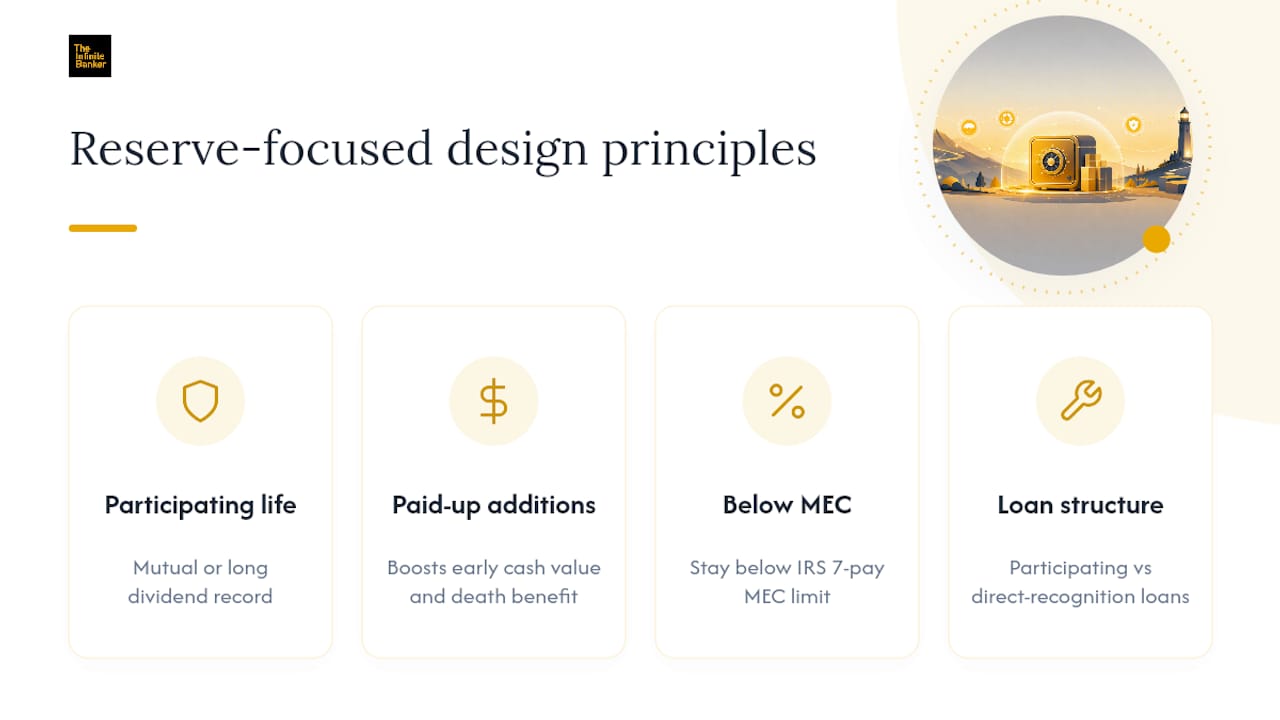
Maximize paid-up additions. PUAs are the engine of early cash value accumulation. They purchase additional paid-up insurance immediately, adding to both the death benefit and the cash value base that can support loans. A policy weighted heavily toward PUAs in the early years will show meaningfully higher cash value by year 3 than a base-premium-only design.

Fund below the Modified Endowment Contract (MEC) threshold. Overfunding a policy past the IRS’s 7-pay limit converts it to a MEC, which eliminates the favorable loan and withdrawal tax treatment. Your illustration should show the MEC corridor and your planned premium relative to it.
Carrier selection matters for loan rate structures. Some carriers offer participating loan provisions, where the policy continues to earn dividends on the full cash value even while a loan is outstanding. Others use direct recognition, which adjusts the dividend on the loaned portion. Understand which structure your carrier uses before signing.
Pro Tip: Ask your agent to run a side-by-side illustration showing a base-premium-only design versus a PUA-heavy design at the same total outlay. The difference in year-3 and year-5 cash value is often the deciding factor for entrepreneurs who need early loan capacity.
Whole life policies carry high early premium loads and may have surrender considerations that make early liquidity expensive. A PUA-heavy design reduces but does not eliminate this drag in the first two to three years.
How do you size your reserve and what do the numbers look like?
Sizing rules differ by business type. Three practical heuristics:
Entrepreneurs with variable monthly burn: Target a policy loan capacity equal to 3 to 6 months of average operating expenses by year 5, funded through consistent annual premiums.
Real estate investors: Size the policy around a specific deal reserve, such as one acquisition’s down payment or renovation budget, rather than a monthly burn multiple. Cash flow vehicles for real estate investors using whole life policies often ladder multiple policies across deal cycles.
High-income business owners: Consider laddering two or three policies issued in different years to create staggered cash value maturity windows and avoid concentrating all liquidity in a single policy’s early years.
The table below shows two conservative illustration scenarios. These are illustrative only; actual results depend on carrier, age, health class, and dividend performance.
These figures are illustrative estimates based on conservative non-guaranteed assumptions. They are not projections or promises.
Meaningful loan capacity, defined as a loan-to-value ratio of 70 to 90 percent of net cash surrender value for seasoned policies, typically becomes practical between years 5 and 10 depending on funding level and carrier. Newer policies may not carry sufficient cash value to serve as meaningful collateral.
How do policy loans work, and what risks should you manage?
Policy loans are processed quickly because they are secured by cash value rather than your credit score or business plan. Most carriers can fund a loan within a few business days of a written request.
Interest accrues from the date the loan is issued. If you do not make interest payments, the unpaid interest is added to the loan balance, compounding the outstanding amount. Over several years of non-payment, this sawtooth pattern of capitalized interest can erode cash value faster than dividends replenish it.
Three repayment approaches, in order of policy health impact:
Interest-only payments preserve the principal loan balance and prevent capitalization. This is the minimum viable repayment strategy for a policy you intend to keep.
Scheduled principal amortization mirrors a conventional loan repayment and restores full loan capacity over time. Entrepreneurs who use policy loans for project financing often align repayment with project cash flows.
Lump-sum repayment from business profits works well for deal-driven investors but requires discipline; without a documented repayment plan, loans tend to remain outstanding indefinitely.
Recommended guardrails: cap outstanding loans at 80 percent of current cash value, conduct a quarterly loan audit, and make at least annual out-of-pocket interest payments even when cash flow is tight. If loan interest is used for a bona fide business purpose and properly documented, it may be deductible, but this requires CPA coordination and cannot be assumed.
What does day-to-day governance look like?
Operational discipline separates a functioning policy reserve from one that quietly deteriorates. A lean governance cadence covers:
Ownership structure: Decide at inception whether the policy is personally owned, owned by a business entity, or held in trust. Each structure carries different tax and creditor-protection implications. Corporate-owned participating whole life policies can offer jurisdiction-specific balance-sheet and tax benefits, but the rules vary materially by jurisdiction and require professional review.
Collateral assignment documentation: If using the policy as collateral for a third-party lender, execute a formal collateral assignment agreement and keep a copy in your policy file.
Loan authorization process: Require a written loan request memo for every draw, stating the purpose, amount, and planned repayment timeline. This prevents casual borrowing and supports tax documentation.
Bookkeeping entries: Record policy loans as liabilities on your personal or business balance sheet. Do not commingle policy loan proceeds with operating accounts without a clear paper trail.
Review frequency: Monthly cash value balance check, quarterly loan audit, annual illustration update from your advisor.
Pro Tip: Set a calendar reminder on the first business day of each quarter to pull your policy’s in-force illustration and compare the current loan balance to the cash value. A 10-minute review prevents the compounding surprises that derail otherwise sound policies.
What should you expect from underwriting, costs, and early liquidity?
Underwriting for a dividend-paying whole life policy typically takes 4 to 8 weeks from application to policy issue, depending on the face amount, age, and health class. Larger face amounts often require a paramedical exam and attending physician statements.
Cost elements to budget for:
Modal premium load: Paying premiums monthly rather than annually adds a modal factor, typically 4 to 8 percent annually. Annual payment is more capital-efficient.
First-year commission effects: Agent commissions are front-loaded in year one, which is one reason early cash value is lower than total premiums paid. A PUA-heavy design partially offsets this by directing a larger share of premium to paid-up additions, which carry lower commission loads.
Dividend variability: Carriers declare dividends annually based on mortality, investment returns, and expense experience. Dividends are not guaranteed and have varied across interest rate cycles.
Timeline Window | Typical Loan Capacity Status |
Policy issue to year 2 | Limited; early premium loads reduce net cash value |
Years 3 to 4 | Modest capacity; PUA-heavy designs show earlier access |
Years 5 to 7 | Meaningful capacity for most well-funded policies |
Years 8 to 12+ | Substantial capacity; policy matures as a durable reserve |
What commonly goes wrong, and what red flags should you watch for?
Frequent mistakes that erode reserve utility:
Reviewing only the non-guaranteed illustration column and ignoring the guaranteed column, which shows the floor scenario.
Overfunding past the MEC threshold, which eliminates favorable tax treatment on loans and withdrawals.
Treating policy loans as cost-free cash and skipping repayment planning entirely.
Ignoring dividend variability when projecting future loan capacity.
Failing to document loan purpose, which undermines any potential interest deductibility argument.
Red flags on carrier proposals: illustrations that show only non-guaranteed projections, dividend assumptions above the carrier’s current declared rate, and loan rate schedules that are vague or subject to change without notice. A policy that lapses with an outstanding loan balance may trigger income tax on the gain inside the policy, converting a planning tool into an unplanned tax event.
For broader context on high-income financial planning mistakes that compound these policy-level errors, the patterns are consistent: poor documentation, inadequate review cadence, and overconfidence in non-guaranteed projections.
How do you move from plan to funded policy?
A sequential implementation checklist:
Define your reserve sizing target: monthly burn multiple, deal reserve, or income replacement window.
Request a policy design brief from an Authorized IBC Practitioner specifying PUA weighting, target premium, and MEC corridor.
Review both the guaranteed and non-guaranteed illustration columns; ask for a lapse scenario with 5 years of unpaid loan interest.
Confirm the carrier’s loan rate structure (participating vs. direct recognition) and current dividend scale.
Complete the application and paramedical exam; budget 4 to 8 weeks for underwriting.
Upon policy issue, fund the first premium and set up the annual or semi-annual payment schedule.
Establish your loan governance document before the first loan request.
Schedule a 12-month policy review with your advisor to compare actual cash value to the illustration.
Questions to bring to your advisor:
Show me the early cash value line with maximum PUAs versus base premium only.
What is the MEC limit at my planned funding level?
What is your carrier’s current loan interest rate, and is it participating or direct recognition?
Run a lapse scenario assuming I take a loan in year 5 and make no repayments for 7 years.
What happens to my death benefit and cash value if dividends drop by 20 percent from the current scale?
The financial independence strategies checklist from The Infinite Banker covers funding cadence and reserve sizing in a broader planning context and is a useful companion document for your first advisor meeting.
Why this is a planning tool, not a product pitch
Infinite Banking is a financing discipline, not a product. The policy is the vehicle; the discipline is what determines whether it functions as a durable reserve or becomes an expensive liability. Entrepreneurs who approach this strategy expecting immediate liquidity or passive growth without active loan management consistently underperform those who treat it as a structured internal financing system requiring the same rigor as any other capital allocation decision.
Jib Hunt, an Authorized IBC Practitioner, works with entrepreneurs, real estate investors, and high-income business owners to design and implement policies structured for capital efficiency. The guidance in this article reflects the implementation realities of that work: dividends are not guaranteed, policy loans accrue interest and reduce cash value and the death benefit if unpaid, and policies can lapse if loan balances are not managed. No outcome is promised.
The Infinite Banker supports your implementation from design to governance
Structuring a policy-based reserve correctly requires more than a good illustration. It requires a design brief aligned to your cash flow profile, an underwriting process that fits your timeline, and an ongoing governance framework that keeps loans from quietly compounding into a lapse risk.

The Infinite Banker offers policy design consultations, illustration review, underwriting guidance, and ongoing advisory support for entrepreneurs and investors implementing the Infinite Banking Concept. Services are provided through a consultative engagement that leads to a properly structured policy placement. The Infinite Banker earns commissions on placed policies, and that relationship is disclosed at the outset of every engagement.
To explore whether this approach fits your situation, learn who Infinite Banking is for and schedule an exploratory consultation. No outcomes are promised, and all content is educational in nature.
Sources
Internal resources from The Infinite Banker:
Life Insurance Policy Loans for Business: What Small Owners Should Know - The DailyMoss
Life Insurance as Business Loan Collateral: COLI Loans Explained - Crestmont Capital
Is Term or Whole Life Better for Business Owners? (w/Examples) + FAQs - TaxSharkInc
Whole Life Insurance as a Canadian Corporate Asset - Venture First Advisory
External background sources used in this article:
This post is educational only and not financial, tax, or legal advice. Consult qualified professionals before acting.
This article is general information, not a substitute for advice from a qualified financial advisor. Consult a qualified financial professional about your own circumstances before acting on anything here.
Recommended
Comments