
Privatized Banking Startup Funding Strategy: 2026 Guide


COMPLIANCE NOTE: For educational purposes only. Not financial, tax, or legal advice.
A privatized banking startup funding strategy is a capital approach that uses dividend-paying whole life insurance policies as a personal lending source, combined with modern private banking platforms, to fund a business without surrendering equity or relying solely on traditional debt. The Infinite Banking Concept (IBC), the recognized industry term for this approach, was formalized by Nelson Nash in his foundational work on recapturing interest paid to outside lenders. Entrepreneurs who apply IBC to startup financing gain access to policy loans, maintain control over their capital structure, and can layer this strategy alongside SBA loans, revenue-based financing, and equity rounds. This article covers the core components, a step-by-step execution sequence, common pitfalls, and how to integrate this privatized banking startup funding strategy with other startup funding options in 2026.
What are the core components of a privatized banking startup funding strategy?
The engine of any IBC-based funding approach is a properly structured, participating whole life insurance policy from a mutual insurance company. “Participating” means the policy is eligible to receive dividends, though dividends are never guaranteed. The cash value inside the policy grows on a tax-deferred basis and serves as collateral for policy loans, which you can use to fund business operations, equipment, or working capital.
Two structural elements determine how much liquidity a policy generates. First, the base premium builds the guaranteed cash value. Second, a paid-up additions (PUA) rider accelerates cash value growth by front-loading additional paid-up insurance. A policy designed primarily for PUA riders produces more usable cash value in the early years than a standard whole life contract. This distinction matters because cash-value growth takes time, often 1–3 years before the policy holds enough liquidity to fund meaningful business activity.
Modern private banking platforms have changed how entrepreneurs access and manage these strategies. AI-native private banks like Flex have scaled rapidly, with Flex reaching a $1.2 billion valuation and annualized payment volume exceeding $10 billion. That growth signals genuine institutional demand for private banking tools among middle-market business owners. Entrepreneurs who pair IBC policies with these platforms gain faster access to treasury management, cross-border payments, and business credit infrastructure.

The table below summarizes the key tools and readiness requirements for this strategy.
Component | Requirement |
Policy type | Participating whole life with PUA rider |
Policy age for meaningful liquidity | Typically 1–3 years |
Business revenue stage | Post-revenue preferred; pre-revenue possible with strong personal income |
Credit readiness | Clean personal credit; business banking history helpful |
Banking relationship | Dedicated business account; ideally with a private or AI-native bank |
Professional guidance | Authorized IBC Practitioner for policy design |
How do entrepreneurs execute this strategy step by step?
Execution follows a clear sequence. Skipping steps, particularly the policy design phase, produces a contract that underperforms as a funding vehicle.
Acquire a properly structured whole life policy. Work with an Authorized IBC Practitioner to design a policy with a high PUA rider ratio. The goal is maximum early cash value, not maximum death benefit. A policy designed for death benefit first will have far less usable liquidity in years one through five. You can review whole life in business financing to understand how policy structure affects capital access.
Establish a dedicated business banking relationship. Open a business account with a bank that understands entrepreneur cash flow patterns. AI-native banks with federal charters offer faster service and greater trust than fintech models using partner banks. This account becomes the operational hub that receives repaid policy loans and manages business cash flow.
Take a policy loan against accumulated cash value. The insurance company lends against your policy’s cash value at a stated interest rate. The cash value itself continues to grow as if the loan were not taken, because the loan is collateral-backed, not a withdrawal. Policy loans accrue interest and reduce the cash value and death benefit if left unpaid, so treat each loan as a formal obligation.
Deploy capital and repay with discipline. Use the loan for a specific, measurable business purpose: equipment, inventory, a marketing campaign, or a bridge to a revenue milestone. Set a repayment schedule before you draw the loan. Repaying the loan restores your borrowing capacity and preserves the compounding effect inside the policy.
Layer with other funding sources as the business matures. Startup funding is stage-dependent: pre-revenue founders rely on bootstrapping, while businesses with 6–12 months of revenue can access SBA loans and alternative debt. Policy loans work best as a non-dilutive bridge or supplement, not as the sole capital source.
Pro Tip: Structure your policy repayment schedule to mirror the cash flow cycle of your business. If your revenue peaks quarterly, align loan repayments to those peaks. This keeps the policy healthy and prevents the “sawtooth pattern” of chronic underfunding that erodes long-term cash value.
What are the common pitfalls in privatized banking startup funding?
The most damaging mistake entrepreneurs make is treating a policy loan like a business credit card. Undisciplined borrowing without a repayment plan creates a compounding liability inside the policy. Failure to repay policy loans reduces policy benefits and can trigger a lapse or tax penalties, particularly if the policy becomes a Modified Endowment Contract (MEC) due to overfunding in the wrong structure.
The second major risk is the cost of carry. Every policy loan carries an interest rate, typically in the 5–8% range depending on the carrier and policy type. Business ROI must outpace the cost of borrowing from the policy for the strategy to produce net-positive capital growth. Deploying a policy loan into a business activity that returns less than the loan’s interest rate destroys value rather than creating it.
Common pitfalls to watch for:
Mixing personal and business finances. Policy loans taken for personal use and then redirected to business accounts create accounting complexity and reduce financial clarity.
Neglecting premium payments. Missing premiums during a cash-flow crunch can cause the policy to underperform or lapse. Build premium payments into your fixed business expenses.
Overleveraging the policy. Borrowing against the maximum available cash value leaves no buffer for unexpected business needs or policy interest accrual.
Ignoring policy statements. Review your annual policy statement to track cash value, outstanding loans, and projected growth. Surprises in year five are almost always avoidable with annual reviews.
Policy discipline is not optional in this strategy. The whole life policy is both the funding vehicle and the long-term asset. Treating it carelessly as a short-term cash source eliminates the compounding benefit that makes the Infinite Banking Concept worth implementing in the first place.
Pro Tip: Set a calendar reminder every quarter to review your policy loan balance against your business cash flow projection. If the loan balance is growing faster than your business revenue, pause new draws and prioritize repayment.
How does privatized banking funding integrate with other startup financing options?
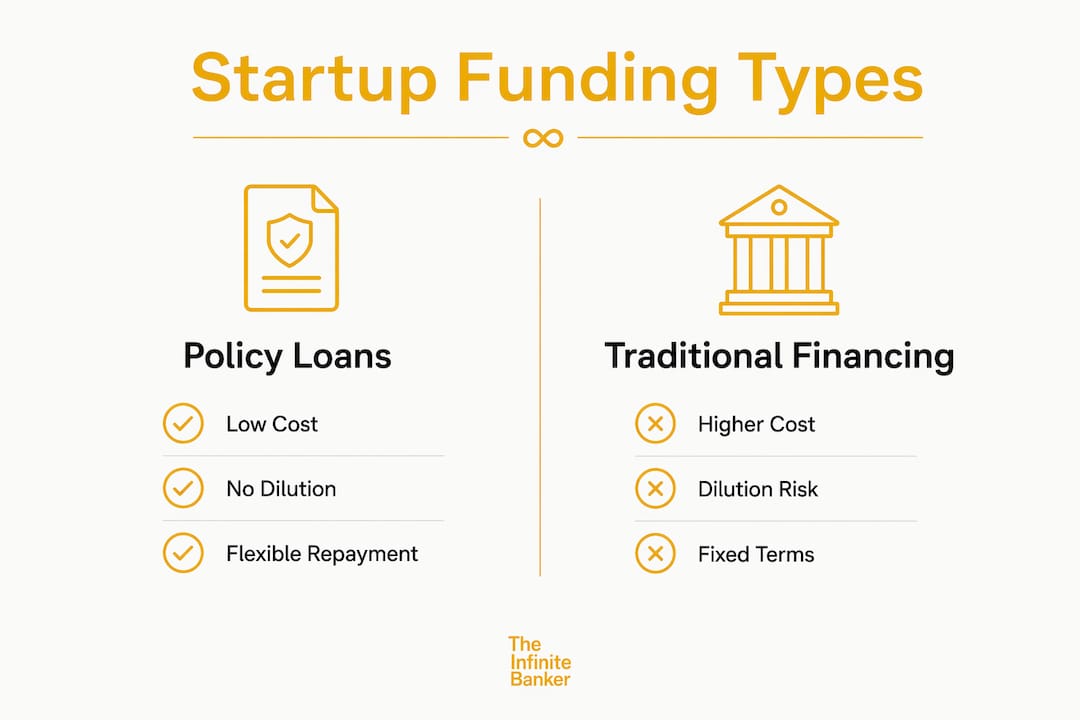
No single financing method fits every stage of a startup’s growth. Founders commonly combine debt, equity, and revenue-based financing to manage capital efficiency, with revenue-based financing charging 2–8% of monthly revenue and equity financing targeting 10x–100x returns. Policy loans sit in a distinct category: they are non-dilutive, do not require a credit application, and do not impose a fixed repayment schedule on the business. That flexibility makes them particularly useful at the pre-seed and seed stages, when external capital is scarce and equity is most expensive to give away.
The table below compares the primary startup funding options across four dimensions relevant to early-stage entrepreneurs.
Funding type | Cost | Dilution risk | Repayment terms | Best stage |
Policy loan (IBC) | Policy interest rate (5–8% typical) | None | Flexible; set by borrower | Pre-seed to growth |
SBA loan | Prime rate plus margin | None | Fixed monthly payments | Post-revenue |
Revenue-based financing | 2–8% of monthly revenue | None | Tied to revenue percentage | Growth stage |
Venture debt | 10–15% interest plus warrants | Minimal | Fixed term with covenants | Post-Series A |
Equity (angel/VC) | 10x–100x return expectation | High | No repayment; ownership given | High-growth stage |
The synergy between policy loans and traditional debt is straightforward. A policy loan can fund the business through the period needed to qualify for an SBA loan, which requires demonstrated revenue history. Once the SBA loan closes, the entrepreneur repays the policy loan and restores borrowing capacity. This cycle, repeated across business milestones, creates a private capital flywheel that reduces dependence on any single external lender.
AI-native private banking platforms are accelerating this integration by enabling near-instant cross-border payments and treasury management for middle-market owners. Entrepreneurs who combine IBC policies with these platforms gain both a capital source and a modern banking infrastructure. You can explore how to shift banking to a whole life policy as a practical starting point for this transition.
The key principle, supported by financial planning consensus, is that funding should align with business maturity and cash flow predictability. Policy loans are most powerful when the business generates enough cash flow to repay them on a defined schedule. Equity rounds make sense when growth velocity justifies the dilution cost. Layering these sources intentionally, rather than reactively, produces a capital structure that supports long-term resilience.
Key Takeaways
A privatized banking startup funding strategy works best when whole life policy design, repayment discipline, and stage-appropriate external financing operate together as a coordinated system.
Point | Details |
Policy design determines liquidity | A high PUA rider ratio produces more usable cash value in years one through five. |
Cash value takes time to accumulate | Plan for a 1–3 year funding lag before the policy holds meaningful borrowing capacity. |
Repayment discipline is non-negotiable | Unpaid policy loans accrue interest and reduce cash value and death benefit over time. |
Cost of carry must be managed | Business ROI must exceed the policy loan interest rate for the strategy to create net value. |
Layer funding sources by stage | Combine policy loans with SBA debt, revenue-based financing, or equity as the business matures. |
Why I think most entrepreneurs misread the timeline on this strategy
The most consistent pattern I see as an Authorized IBC Practitioner is entrepreneurs who expect a whole life policy to function like a business line of credit in year one. It does not work that way, and that expectation leads to frustration and early abandonment of a strategy that would have performed well with patience.
Cash value in a properly structured policy grows gradually. The first year, a significant portion of your premium covers the cost of insurance and policy fees. By years two and three, the PUA rider begins to compound meaningfully. By year five, a well-funded policy can hold substantial liquidity relative to total premiums paid. The entrepreneurs who succeed with this approach treat the policy as a long-term capital asset, not a quick-access fund.
The AI-native banking platforms entering this space are genuinely useful, but they do not replace the policy itself. They improve the banking infrastructure around the strategy. The policy remains the core asset, and its performance depends entirely on consistent premium payments and disciplined loan management.
My practical advice: start the policy before you need the capital. The best time to establish a whole life policy for business funding is when your personal income is stable and your business is generating positive cash flow. Waiting until a funding crisis arrives means waiting another 1–3 years for meaningful liquidity. The financial independence roadmap for 2026 covers this timing question in detail for entrepreneurs at different income stages.
— Jib Hunt
How The Infinite Banker supports your funding strategy
The Infinite Banker works with entrepreneurs, real estate investors, and high-income earners who want to implement properly structured whole life insurance strategies designed for capital efficiency and long-term flexibility.
If you are evaluating whether this approach fits your business stage and income profile, the who Infinite Banking is for page outlines the specific audience criteria in plain terms. For a deeper look at the mechanics, how Infinite Banking works covers the full concept from policy structure to loan cycles. You can also run your own numbers using the Infinite Banking Calculator to model cash value growth scenarios based on your premium capacity. Consultation with an Authorized IBC Practitioner is the recommended next step before committing to a policy design.
FAQ
What is a privatized banking startup funding strategy?
A privatized banking startup funding strategy, formally known as the Infinite Banking Concept, uses the cash value of a dividend-paying whole life insurance policy as a personal lending source to fund business operations without diluting equity.
How long does it take to access capital through a whole life policy?
Cash value typically takes 1–3 years to accumulate enough liquidity for meaningful business funding. Entrepreneurs should establish a policy well before a capital need arises.
What happens if I do not repay a policy loan?
Unpaid policy loans accrue interest and progressively reduce both the cash value and the death benefit. If the loan balance grows to exceed the policy’s cash value, the policy can lapse and trigger a taxable event.
Can I combine policy loans with SBA loans or venture capital?
Yes. Policy loans work well as a non-dilutive bridge to SBA qualification or as a supplement to equity rounds. Founders commonly combine debt, equity, and alternative financing to manage capital efficiency across growth stages.
Is this strategy only for established businesses?
Pre-revenue founders with strong personal income can fund a policy and begin building cash value. However, the strategy produces the most capital efficiency for post-revenue businesses that generate consistent cash flow to repay policy loans on schedule.
This post is educational only and not financial, tax, or legal advice. Consult qualified professionals before acting.
Recommended
Comments