
Shift Banking to a Whole Life Policy: 2026 Guide

Updated: Jun 29

COMPLIANCE NOTE: For educational purposes only. Not financial, tax, or legal advice.
Shifting your banking to a whole life policy is defined as redirecting the financial functions of saving, borrowing, and cash management from a traditional bank to a dividend-paying whole life insurance policy. This strategy, formally known as the Infinite Banking Concept, uses the policy’s cash value as a personal capital reserve. Policy loans against that cash value are generally tax-free under IRS guidelines as long as the policy stays active. The Infinite Banker helps entrepreneurs, real estate investors, and business owners implement this structure to build liquidity, control, and long-term financial stability outside the conventional banking system.
What does it mean to shift banking to a whole life policy?
The Infinite Banking Concept treats a participating whole life insurance policy as a private banking system. Instead of depositing savings into a checking or savings account, you fund the policy’s cash value. That cash value grows tax-deferred, meaning you pay no annual taxes on the gains as they accumulate. When you need capital, you borrow against the cash value rather than applying for a bank loan.
This approach works because whole life insurance provides guaranteed lifetime coverage with fixed premiums that never increase. That predictability is the foundation of the strategy. You know exactly what you owe each month, which makes long-term cash flow planning far more reliable than variable-rate banking products. The policy also carries a death benefit, so the financial protection function runs in parallel with the banking function.

The term “shift banking to whole life policy” is an informal description of what the industry calls the Infinite Banking Concept or private family banking. Both phrases describe the same mechanics. Understanding the formal terminology helps when working with licensed insurance professionals and evaluating policy illustrations.
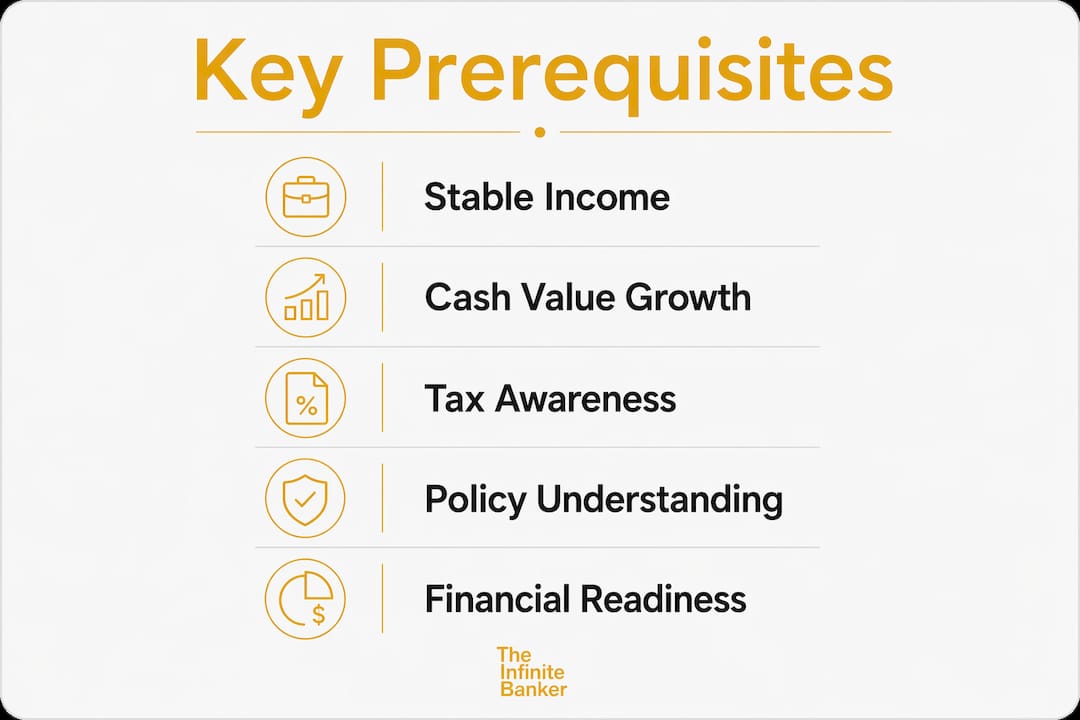
Key prerequisites before making the shift
Not every financial profile is ready for this strategy. The table below summarizes the core prerequisites you need to evaluate before committing to a policy.
Prerequisite | What to assess |
Stable income | Premiums are higher than term life; you must sustain payments long-term |
Financial goals | Policy design should align with liquidity, estate, or business capital goals |
Risk tolerance | Whole life carries low investment risk but requires patience for cash value to build |
Tax awareness | Understand tax-deferred growth and the IRS rules governing policy loans |
Premium discipline | Underfunding the policy reduces cash value and risks lapse |
Stable income is the single most critical factor. Whole life premiums run significantly higher than term life premiums for the same death benefit. That cost reflects the cash value accumulation and the guaranteed coverage. If your income is inconsistent, the premium commitment can become a liability rather than an asset.
You also need a clear understanding of how cash value builds over time. In the early years, a large portion of each premium covers the cost of insurance. The cash value grows slowly at first, then accelerates as the policy matures. This funding lag is normal, but it means the strategy rewards patience. Expecting immediate liquidity in year one is a common and costly misconception.
Tax awareness matters because the advantages of this strategy are tied to IRS compliance. Policy loans do not trigger taxation unlike traditional investment withdrawals. However, if the policy lapses with an outstanding loan, the loan amount becomes taxable income. Knowing this rule before you borrow is not optional.
How to shift your banking operations to whole life insurance
The implementation process follows a clear sequence. Skipping steps, especially the early design and funding phases, is the most common reason the strategy underperforms.
Select a participating whole life policy from a mutual insurer. Mutual insurers are owned by policyholders, not shareholders. This structure allows the insurer to pay dividends to policyholders, which can be used to increase cash value or offset premiums. Dividends are not guaranteed, but mutual insurers with long dividend-payment histories provide a reliable track record.
Design the policy for cash value, not just death benefit. A policy optimized for banking purposes uses a paid-up additions (PUA) rider. This rider directs extra premium dollars directly into cash value, accelerating the growth curve. A policy designed purely for death benefit coverage will accumulate cash value far more slowly.
Set a premium schedule you can sustain. The premium amount should be high enough to build meaningful cash value but not so high that it strains your monthly cash flow. Work with a licensed professional to model multiple funding scenarios before committing.
Fund the policy consistently for the first several years. The early funding phase is the engine of the Infinite Banking Concept. Cash value builds on a compounding basis, so consistent early contributions have an outsized long-term effect. Missing payments in years one through five creates a funding lag that takes years to recover.
Borrow against the cash value when capital is needed. Once sufficient cash value has accumulated, you can request a policy loan from the insurer. These loans do not require credit checks or bank approval. The insurer uses the policy as collateral. The full cash value continues to earn dividends and interest even while the loan is outstanding.
Repay the loan on your own schedule. There is no mandatory repayment timeline for policy loans. You set the repayment terms. Repaying promptly restores your borrowing capacity and keeps the policy in good standing.
Stage | Key activity | What to watch |
Policy selection | Choose a mutual insurer with a dividend history | Verify financial strength ratings |
Policy design | Add PUA rider for accelerated cash value | Confirm the design meets IRS MEC limits |
Funding phase | Pay premiums consistently | Avoid underfunding in years 1–5 |
Borrowing phase | Request policy loans for capital needs | Track outstanding loan balance |
Repayment phase | Repay loans to restore borrowing capacity | Monitor cash value after repayment |
Pro Tip: Work with a financial professional who specializes in policy design for banking purposes, not general life insurance sales. The difference in policy structure between a standard whole life policy and one designed for the Infinite Banking Concept is significant and directly affects your results.
How does whole life improve cash flow and financial management?
The cash flow advantages of this strategy come from three distinct mechanisms: tax treatment, loan accessibility, and premium predictability.
Tax-deferred cash value growth compounds without annual tax drag. In a taxable savings account, interest income is reported each year. In a whole life policy, the cash value grows without that annual tax cost, which means more capital stays in the policy and compounds over time.
Loan accessibility is the second major advantage. Traditional bank loans require credit applications, income verification, and approval timelines that can stretch days or weeks. Policy loans bypass all of that. The funds are available quickly, and the insurer does not report the loan to credit bureaus. For business owners managing irregular cash flow, this speed and privacy matter.
Fixed premiums support budgeting in a way that variable-rate products cannot. Whole life premiums never increase, regardless of age or health changes after the policy is issued. That stability lets you build a multi-year cash flow plan with confidence.
Common use cases for policy loans include:
Emergency reserves: The cash value functions as a liquid reserve without the opportunity cost of holding cash in a low-yield savings account.
Business capital: Business owners use policy loans to fund equipment purchases, inventory, or operating expenses without bank involvement.
Real estate investing: Investors borrow against cash value for down payments or bridge financing, then repay the loan after a property transaction closes.
Large personal purchases: Vehicles, education costs, or home improvements can be financed through the policy, with repayment terms set by the policyholder.
The strategy also aligns with estate planning and legacy goals. The death benefit passes to beneficiaries generally income-tax free, which adds a wealth transfer dimension that traditional banking accounts cannot replicate.
Common mistakes that undermine the strategy
Most failures in this strategy trace back to a small set of predictable errors. Recognizing them before they happen is far more effective than correcting them after the fact.
Underfunding the policy. Paying the minimum premium keeps the policy active but starves the cash value. Reduced cash value means reduced borrowing capacity. The strategy only works when the policy is funded aggressively within IRS limits.
Allowing the policy to lapse with an outstanding loan. If the policy lapses, the outstanding loan becomes taxable income. This is the most financially damaging mistake in the strategy and is entirely avoidable with consistent premium payments.
Treating the policy as a pure investment. Whole life is not designed to compete with equity market returns. Its value lies in guaranteed growth, tax treatment, loan access, and protection. Evaluating it against stock market performance misses the point entirely.
Ignoring policy statements. Cash value, loan balances, and dividend credits change each year. Reviewing annual statements keeps you informed and prevents surprises.
Overlooking surrender charges and policy terms. Early surrender of a whole life policy typically results in a cash value that is lower than total premiums paid. The strategy requires a long-term commitment, generally a minimum of 10–15 years, to realize its full benefits.
Pro Tip: Schedule an annual policy review with your licensed professional. Review the cash value balance, outstanding loans, dividend credits, and premium schedule together. This one habit prevents the majority of policy management errors.
Key takeaways
Shifting your banking to a whole life policy works when the policy is properly designed, consistently funded, and managed with discipline over the long term.
Point | Details |
Tax-free loan access | Policy loans are generally income-tax free when the policy stays active and IRS-compliant. |
Premium discipline is non-negotiable | Underfunding the policy reduces cash value and risks a taxable lapse event. |
Mutual insurer selection matters | Participating policies from mutual insurers pay dividends that accelerate cash value growth. |
Loans bypass credit approval | Policy loans require no credit check or bank approval, giving faster access to capital. |
Long-term commitment required | The strategy delivers its strongest results after 10 or more years of consistent funding. |
What I’ve learned from watching this strategy succeed and fail
The most consistent pattern I’ve observed is this: the strategy works exactly as described when the policy is designed correctly and funded with discipline. It fails almost every time when someone treats it as a shortcut to quick liquidity or a substitute for an emergency fund they haven’t built yet.
The misconception I encounter most often is that whole life insurance is a bad investment compared to index funds. That comparison is a category error. The policy is not competing with your investment portfolio. It is replacing the banking function in your financial life, specifically the savings, borrowing, and cash management functions. When you evaluate it on those terms, the advantages are clear and well-documented.
The second pattern I’ve seen is that people underestimate the importance of policy design. A standard whole life policy sold for death benefit purposes and a policy designed for the Infinite Banking Concept look similar on the surface but perform very differently. The paid-up additions rider, the premium-to-death-benefit ratio, and the insurer’s dividend history all determine whether the policy actually functions as a banking tool. Getting that design right from the start is not a detail. It is the entire foundation.
My honest advice: approach this strategy with a 10-year minimum horizon and a willingness to work with a professional who understands both the insurance mechanics and the cash flow application. The patience required is real, but so are the results for those who commit to it.
— Jib Hunt
The Infinite Banker: a resource for implementing this strategy
The Infinite Banker specializes in helping entrepreneurs, real estate investors, and high-income earners structure whole life policies for capital efficiency and long-term financial control. The focus is on policy design that actually functions as a banking alternative, not generic life insurance sales.

If you are evaluating whether this strategy fits your financial profile, The Infinite Banker offers guidance on policy structure, funding schedules, and loan management. The platform also helps you identify whether your income, goals, and risk tolerance align with the strategy before you commit. Visit The Infinite Banker to learn more, or review the ideal candidate profiles to assess your fit before taking the next step.
FAQ
What is the Infinite Banking Concept?
The Infinite Banking Concept is a financial strategy that uses a participating whole life insurance policy as a personal banking system, allowing policyholders to save, borrow, and manage cash flow outside the traditional banking system.
Are policy loans from whole life insurance taxable?
Policy loans are generally income-tax free as long as the policy remains active and complies with IRS guidelines. If the policy lapses with an outstanding loan, the loan amount becomes taxable income.
How long does it take to build usable cash value?
Cash value builds slowly in the first few years due to the cost of insurance and policy fees. Most policyholders see meaningful borrowing capacity develop after five to seven years of consistent, properly structured premium payments.
Can business owners use whole life insurance as a banking alternative?
Business owners are well-suited for this strategy because policy loans provide fast access to capital without credit checks or bank approval, which supports irregular cash flow and opportunistic investment needs.
What happens if I stop paying premiums?
Stopping premium payments can cause the policy to lapse, especially if there are outstanding loans. A lapsed policy with an outstanding loan triggers a taxable event, so maintaining premium discipline is critical to the strategy’s success.
This post is for educational purposes only and does not constitute financial, tax, or legal advice. Individual circumstances vary. Consult with qualified professionals before making any decisions regarding insurance or capital strategy.

Comments