
Grow Borrowing Power: 6 Whole Life Dividend Options for Founders


COMPLIANCE NOTE: For educational purposes only. Not financial, tax, or legal advice.
Insurers that pay dividends on participating whole life policies typically offer six elections: take the cash, reduce your premium, leave dividends to accumulate with interest, purchase paid-up additions (PUAs), buy one-year term coverage, or apply dividends toward a policy loan. Each choice trades one form of value for another, shifting money between immediate cash, lower premium cost, cash value growth, or death benefit. Dividends are never guaranteed, and the right election depends on whether you’re optimizing for liquidity, cost relief, or long-term capital efficiency.
TL;DR:
Dividends are based on the insurer’s actual performance, with a long history of consistent payout indicating strong risk management rather than guaranteed income.
Choosing paid-up additions typically offers the best long-term growth and borrowing capacity, especially for entrepreneurs and investors focused on capital efficiency.
The dividend scale can fluctuate annually, affecting payouts, and aggressive PUAs may risk triggering a Modified Endowment Contract if overfunded.
Many policyholders underestimate the benefit of switching from default accumulate options to PUAs, which can significantly boost cash value and death benefits over time.
Regular review of dividend assumptions and funding strategies is essential to ensure the policy remains aligned with your evolving financial goals.
Table of Contents
What Are Whole Life Dividends and How Do Insurers Set Them?
A whole life dividend is not investment income. It’s a return of a portion of the premium you overpaid, based on how the insurer’s actual experience compared to what it assumed when it priced your policy. Only participating policies, typically issued by mutual insurance companies owned by policyholders rather than shareholders, are eligible to receive them.
Each year, the insurer’s board sets a dividend scale, an internal rate that determines how much surplus gets distributed. Three factors drive that number:
Investment returns on the insurer’s general account portfolio compared to what was priced into premiums
Mortality experience, meaning whether policyholders lived longer than the actuarial tables assumed
Expense management, or how efficiently the company operates relative to its cost assumptions
Because dividends depend on performance rather than contract, they can rise, fall, or disappear entirely in a difficult year. That’s why insurer dividend history matters as a due-diligence signal. A carrier that has declared dividends every year for a century, through the Great Depression, multiple recessions, and 2008, demonstrates underwriting discipline that a newer or smaller carrier hasn’t had the chance to prove. It’s still not a promise about next year’s scale, but it tells you something about how the company manages risk. Understanding participating whole life insurance structure is the starting point before comparing any dividend election.
How Do the Standard Dividend Election Options Work?
Participating policies generally offer the same menu of elections, though the exact list and rules vary slightly by carrier. Here’s how each one functions in practice.
Cash payment. The insurer sends you a check or direct deposit for the dividend amount each year. This is the most straightforward option and the least useful for building cash value, since the money leaves the policy entirely. It works for policyholders who want a small supplemental income stream and don’t need the dividend to compound inside the contract.
Premium reduction. The dividend applies directly against your next premium bill, lowering your out-of-pocket cost. If the dividend is large enough relative to the premium, it can eventually cover the full bill. This helps policyholders managing tight cash flow, though it does nothing to grow cash value beyond what the base policy already provides.
Leave to accumulate. Dividends sit in an interest-bearing account inside the policy, similar to a savings account attached to the contract. You retain access to withdraw the balance without touching the policy’s core cash value. The tradeoff: interest credited on that accumulated balance is taxable in the year it’s credited, even if you never withdraw it, per 26 USC 72.
Paid-up additions (PUAs). The dividend purchases a small increment of fully paid-up whole life insurance, added to your existing policy. That increment increases both your death benefit and your cash value immediately, and it carries no new premium obligation. Better still, PUAs don’t require new underwriting: the amount you receive is based on your age at the dividend date, not a fresh medical exam. Because each PUA is itself a small paid-up policy, it can earn its own dividends in future years if the insurer continues paying them, a compounding effect that makes this the option most often used inside Infinite Banking strategies.
One-year term. The dividend buys a block of term insurance that lasts exactly one year, typically capped at some multiple of the policy’s cash value under carrier rules. This option maximizes near-term death benefit without adding permanent cash value, and it tends to appeal to policyholders in a temporary window where coverage matters more than accumulation.
Apply to loan repayment. If you’re carrying an outstanding policy loan, dividends can be directed to pay down the loan principal or interest instead of accumulating elsewhere. This preserves more of your cash value and future growth than letting the loan balance compound against you unpaid.
Pro Tip: Ask your carrier whether you can split a single dividend across two elections, such as directing part toward loan repayment and the rest toward PUAs. Many carriers allow this, but it’s rarely advertised and almost never the default setup on a new policy.
How Do Dividends Get Taxed, and What Happens to Loans?
The federal tax treatment of dividends hinges on a cost-basis rule. Dividends are generally treated as a return of premium, not taxable income, until your cumulative dividends received exceed your cumulative premiums paid into the policy. That threshold rarely gets crossed early in a policy’s life, which is one reason dividend cash flow feels tax-favorable in the early and middle years.
That treatment changes once you leave dividends to accumulate. The interest credited on that accumulating balance is taxable in the year it’s credited, regardless of the dividend itself. This is a distinct tax event from the dividend payment.
A few other mechanics matter here:
Policy loans are not taxable income when taken, but they accrue interest, and if that interest and principal go unpaid, both reduce your cash value and death benefit.
An unpaid loan that grows large enough relative to cash value can cause a policy to lapse, which can trigger taxable gain if the loan balance exceeds your cost basis.
Aggressively funding PUAs, whether through dividends or a dedicated rider, can push a policy into Modified Endowment Contract (MEC) status if premiums exceed IRS limits under the seven-pay test, changing how loans and withdrawals are taxed going forward.
One useful benchmark: carriers structure PUA riders and dividend elections specifically to stay under MEC thresholds, which is why Western & Southern and most mutual insurers recommend professional MEC testing before increasing paid-up funding beyond the base policy design.
How Should You Choose a Dividend Election?
Start with what you actually need the policy to do for you, not which option sounds the most sophisticated. If you want supplemental income now, cash or premium reduction fits. If you’re focused on long-term capital efficiency and borrowing capacity, PUAs typically do more work, since leaving dividends to accumulate creates a taxable interest stream while PUAs build tax-advantaged cash value that compounds through future dividends.
Before locking in an election, ask your carrier or adviser:
How long has this carrier paid dividends without interruption, and what has the dividend scale done over the past decade?
What are the PUA rider’s funding limits, and what fees or loads apply to additional paid-up premium?
How will this election affect my policy’s cash-surrender value if I need to access money early?
What’s the process to change my election later, and how often can I revise it? (Most carriers accept changes via a simple form or phone request, reflected on your next annual statement.)
Does this funding level risk MEC status under the seven-pay test?
Pro Tip: Pull your policy’s annual statement and check which election is currently active. Many policyholders discover they’ve defaulted into “accumulate” for years without realizing PUAs would have compounded faster and grown their death benefit at the same time.
Watch for a few red flags: any agent who frames dividends as a guaranteed income stream, any illustration that assumes the current dividend scale holds indefinitely, or any financial plan that depends on dividends to cover essential monthly expenses. Dividends can be reduced or suspended in a weak year for the insurer, and a plan built on the assumption they won’t be is a fragile plan.
What Do Infinite Banking Practitioners Watch for With Dividends and PUAs?
Entrepreneurs and real estate investors who prioritize liquidity and borrowing power tend to gravitate toward aggressive PUA funding, and there’s a practical reason for that. Every dollar routed into paid-up additions increases cash value immediately, which increases the base against which future policy loans can be taken. That’s the mechanism that makes PUAs central to how cash value functions as a borrowing resource inside an Infinite Banking approach.
Good policy design separates base premium from PUA funding on purpose, rather than letting the dividend election default to whatever the carrier sets initially. A few habits distinguish disciplined policyholders from passive ones:
Model loan scenarios against conservative, not optimistic, dividend assumptions before relying on borrowing capacity
Review your dividend election annually rather than assuming last year’s choice still fits this year’s goals
Track MEC exposure any time you increase PUA funding or add a rider, since crossing that threshold changes how future loans are taxed
Run illustrations under multiple dividend scenarios, including a flat or reduced scale, before committing to an aggressive funding schedule
The point isn’t to chase the highest current dividend scale. It’s to build a policy structure where the dividend election matches how you actually plan to use the cash value and borrowing capacity over the next decade, not just this year’s statement.
What Dividend Elections Do Most Clients Actually Choose?
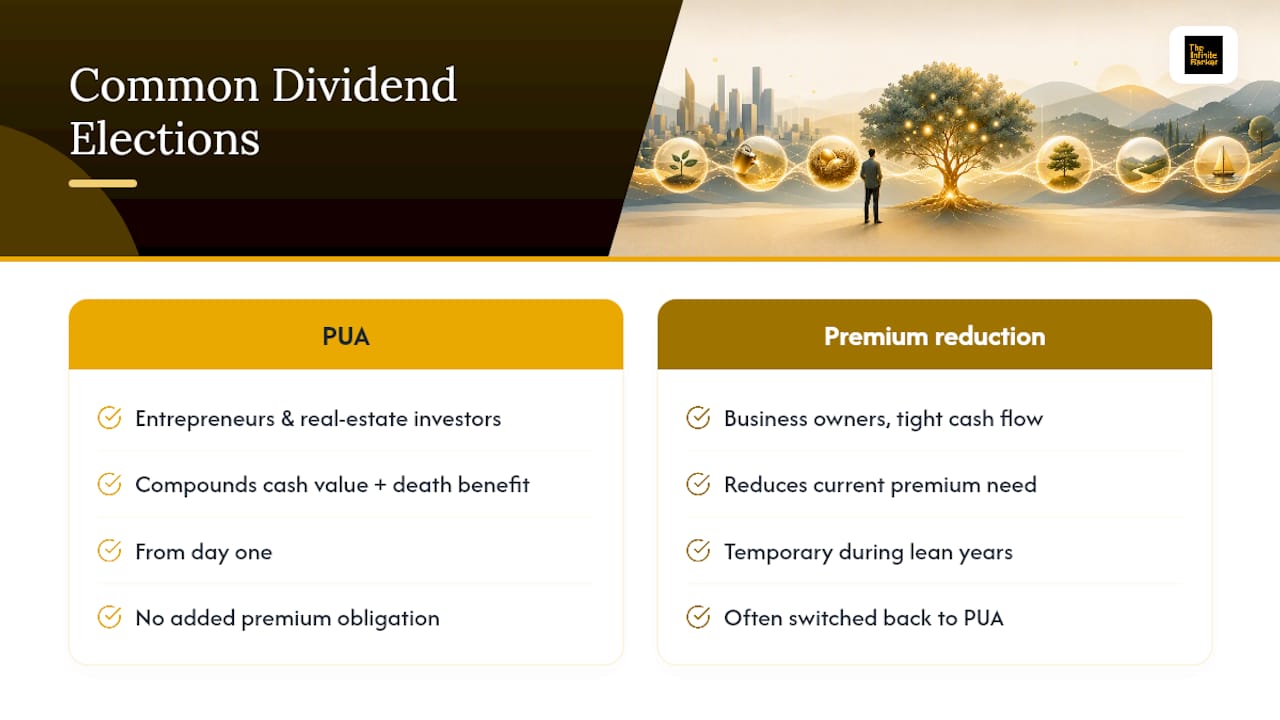
In practice, two profiles show up most often. Entrepreneurs and real estate investors building borrowing capacity tend to favor paid-up additions from day one, since it compounds cash value and death benefit together without adding premium obligation. Business owners in a tight cash-flow year sometimes shift toward premium reduction temporarily, then move back to PUAs once revenue stabilizes.
Both choices are reasonable. What I watch closely is whether a client is treating the dividend scale as fixed rather than variable, and whether an outstanding loan is quietly eroding death benefit because nobody’s applying dividends against it. Run your illustrations under more than one dividend assumption, and have a qualified professional review the design before you commit to a funding schedule.
— Jib Hunt
How The Infinite Banker Helps You Design a Dividend Strategy
Choosing between six dividend elections on a single illustration is straightforward. Designing a policy where base premium, PUA funding, and loan strategy all work together over 20 years is a different problem, and it’s the one that actually determines whether your policy performs the way you expect it to.

The Infinite Banker works with entrepreneurs, real estate investors, and high-income earners to build policy structures around specific capital goals rather than a generic illustration. That starts with a strategy session and policy review, where an Authorized IBC Practitioner models your funding schedule under multiple dividend scenarios, not just the carrier’s current projection, so you can see how premium reduction, PUA funding, and loan repayment elections interact with your borrowing plans over time. From there, the process moves into policy design, underwriting guidance, and ongoing education so your election choices stay aligned as your goals change. If you want a policy built around how you actually plan to use it, start with a policy strategy session to see how a properly structured design compares to a default illustration.
Sources
This article draws on carrier and consumer-finance explainers covering dividend mechanics, PUA structure, and federal tax treatment under 26 USC 72. For deeper reading on related mechanics, see The Infinite Banker’s guide to paid-up additions and its explainer on participating whole life insurance.
This article is general information, not a substitute for advice from a qualified financial advisor. Consult a qualified financial professional about your own circumstances before acting on anything here.
FAQ
What Does Warren Buffett Say About Whole Life Insurance?
Buffett has publicly favored low-cost term insurance and separate investing over cash-value life insurance for most consumers, arguing that combining insurance and investment products tends to cost more than buying each separately. That view centers on general portfolio efficiency, not on the specific mechanics of participating dividends or Infinite Banking strategies covered here.
What Are the Pros and Cons of Dividend-Paying Whole Life Insurance?
The advantages include a share in insurer performance, flexible elections like PUAs that compound cash value and death benefit together, and a long track record of payouts among established mutual carriers. The drawbacks are that dividends are never guaranteed, premiums run higher than term insurance, and policy loans reduce cash value and death benefit if left unpaid.
Why Does Dave Ramsey Say No to Whole Life Insurance?
Ramsey generally recommends term insurance paired with separate investing, arguing whole life premiums cost more than most buyers need for coverage alone. That critique targets buying whole life as a pure insurance-versus-term cost comparison, not the dividend election strategies or capital-efficiency use cases entrepreneurs and investors pursue through Infinite Banking design.
Can I Change My Dividend Election After My Policy Is Issued?
Most carriers allow you to change your election by submitting a form or calling your insurer directly, and your current election appears on your annual policy statement. There’s typically no need to requalify or undergo new underwriting to switch.
Do Paid-Up Additions Require a New Medical Exam?
No. Paid-up additions purchased with dividends are added based on your age at the dividend date, without new underwriting or a medical exam, which is part of why they compound efficiently over time.
This post is educational only and not financial, tax, or legal advice. Consult qualified professionals before acting.
Recommended

Comments