
Borrowing Against Whole Life Cash Value: 2026 Guide


COMPLIANCE NOTE: For educational purposes only. Not financial, tax, or legal advice.
Borrowing against whole life cash value means taking a loan from your insurance company using the accumulated cash inside your permanent life insurance policy as collateral. You can typically access up to 90% of your cash value, with no credit check, no income verification, and no mandatory repayment schedule. Loan proceeds are generally not treated as taxable income while the policy stays in force. That said, interest accrues on the outstanding balance, and unpaid loans reduce the death benefit paid to your beneficiaries. If the loan balance plus interest grows beyond your total cash value, the policy can lapse, which may trigger a taxable event on any gains above your cost basis.
Key facts at a glance:
Loans are secured by your cash value, not your credit history
Most insurers lend a large portion of accumulated cash value, keeping a buffer against lapse
Interest rates commonly fall in the 5%–8% range, with many mutual insurers charging around 5%–6%
Repayment is flexible, but unpaid interest compounds and erodes both cash value and death benefit
Policy lapse with an outstanding loan exceeding your cost basis can create taxable income
Table of Contents
How borrowing against a whole life insurance policy works
The mechanics are straightforward. When you request a policy loan, your insurer advances funds from its own reserves and designates your cash value as collateral. You do not actually withdraw money from the policy itself, which is why the cash value can continue earning dividends in many participating policies even while a loan is outstanding.
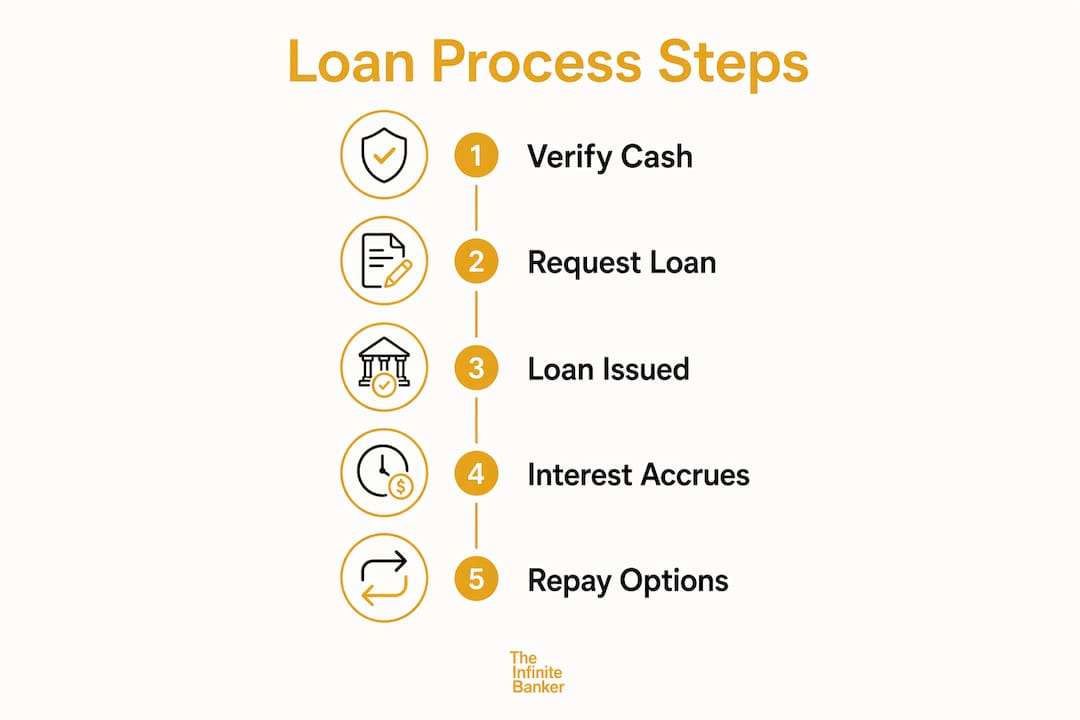
The process typically involves contacting your insurer or agent, verifying your available cash value, submitting a loan request, and receiving funds, often within a few business days. There is no formal approval process because you are borrowing against an asset you already own. The loan requires no credit check and does not appear on your credit report.

Interest accrues on the outstanding balance from the day the loan is issued. You are not required to make payments on any schedule, but the interest compounds if left unpaid. On many participating whole life policies, dividends continue to be credited on the full policy value, not on the reduced net-of-loan amount. This creates the possibility of a “wash loan,” where dividend credits partially or fully offset the interest charged, though dividends are never guaranteed and this outcome depends on the insurer’s current dividend scale.
Pro Tip: Before requesting a loan, ask your insurer specifically whether dividends are credited on the gross cash value or the net-of-loan value. The answer directly affects your real borrowing cost.
How much can you borrow, and when?
The maximum loan amount is typically 90% of accumulated cash value, with the remaining 10% held as a buffer to prevent the policy from lapsing if interest accrues unpaid. The exact percentage varies by insurer, so reviewing your policy contract is the most reliable step.
Cash value builds gradually. In the early policy years, most of your premium covers the cost of insurance, so the cash component grows slowly. Policies often need 5–10 years before the cash value is large enough to support a meaningful loan. The table below shows general benchmarks, though actual figures vary by insurer, age at issue, and premium amount.
Years in force | Approximate cash value as % of premiums paid |
5–10 years | 10%–20% |
5–10 years | 30%–50% |
— | — |
— | — |
Several factors influence how quickly your borrowing power grows:
Policy age: Older policies have had more time to accumulate cash value
Premium payments: Consistent, on-time payments accelerate growth
Paid-Up Additions (PUA) riders: These allow extra premium payments beyond the base policy, boosting cash value and loan availability sooner
Policy riders: Certain riders can affect how cash value is credited or allocated
Reviewing your current cash value statement with your insurer or agent gives you the clearest picture of what is available today.
Repayment options and what happens if you don’t repay
Repayment is optional in the sense that no lender will call the loan due on a fixed date. That flexibility is one of the genuine whole life loan advantages. However, the absence of a required schedule does not mean the loan is consequence-free if left unaddressed.
Your repayment options include:
Periodic principal and interest payments: Reduces the balance and preserves more of the death benefit
Interest-only payments: Keeps the loan balance stable without reducing it
Deducting interest from cash value: The insurer applies interest charges directly to the policy, which slowly reduces cash value over time
Lump-sum repayment: Pay off the full balance at any point
Unpaid loans compound. Consider a $50,000 loan at 6% annual interest left untouched for five years: the balance grows to roughly $67,000. If your cash value grows faster than the loan interest, the policy remains healthy. If it does not, the gap closes, and eventually the loan plus interest can exceed the cash value, causing the policy to lapse. At that point, your beneficiaries lose the death benefit, and you may face a tax bill on any gains above your cost basis.
Every dollar of outstanding loan balance reduces the death benefit dollar for dollar. Loan amounts not repaid reduce the death benefit paid to beneficiaries. That reduction can be significant, particularly for policies held as the primary financial protection for a family.

Tax implications of policy loans
Policy loans are generally not treated as taxable income as long as the policy remains in force. You are borrowing against your own asset, not receiving a distribution, so the IRS does not count the proceeds as income up to your cost basis, which is the total amount you have paid in premiums. This is one of the more meaningful tax advantages of policy loans compared to withdrawing from a retirement account.
A few important distinctions apply:
No early withdrawal penalty: Unlike a 401(k) or IRA, accessing cash value before age 59½ does not trigger a 10% penalty
Tax-deferred growth continues: The cash value keeps growing on a tax-deferred basis even while a loan is outstanding
Policy lapse risk: If the policy lapses with an outstanding loan that exceeds your cost basis, the excess becomes taxable income in the year of lapse
Modified Endowment Contracts (MECs): If your policy was classified as a MEC, different rules apply. Loans and distributions from a MEC are taxable to the extent of any gains, and policyholders under age 59½ also face a 10% early withdrawal penalty
The MEC classification typically results from funding a policy too quickly relative to the death benefit. If you are unsure whether your policy is a MEC, check the policy documents or ask your insurer directly. Consulting a qualified tax professional before taking a loan is always advisable, particularly if the loan amount is large relative to your cost basis.
Advantages and trade-offs of using whole life cash value
Policy loans offer a genuinely different borrowing experience compared to conventional credit. No application, no underwriting, no impact on your credit score. For entrepreneurs and real estate investors who need capital quickly and want to preserve their credit profile, that combination is practical rather than merely convenient.
Advantages:
No credit check or income verification required
Funds typically available within days
Flexible repayment with no mandatory schedule
Loan proceeds are generally not taxable income while the policy is in force
Potentially more competitive rates than personal loans or credit cards
Cash value may continue earning dividends even with a loan outstanding (not guaranteed)
No impact on your credit report
Trade-offs and risks:
Interest accrues and compounds if unpaid, increasing total debt over time
Outstanding loan balance reduces the death benefit paid to beneficiaries
Excessive borrowing can cause policy lapse and loss of coverage
Policy lapse with a loan exceeding cost basis triggers taxable income
Dividends are never guaranteed and may not fully offset loan interest
Overreliance on policy loans can undermine the policy’s primary purpose: protecting your beneficiaries
Policy loans work well for specific situations: bridging a short-term cash flow gap, covering an unexpected expense, funding education costs, or supplementing income during a business transition. They are less suited as a long-term substitute for a savings strategy or as a way to fund discretionary spending without a clear repayment plan.
For those interested in how whole life insurance fits a broader cash flow strategy, the structure of the policy itself matters as much as the loan mechanics.
What an Authorized IBC Practitioner says about managing whole life loans
Jib Hunt, an Authorized IBC Practitioner, emphasizes that the primary purpose of a whole life policy is to protect beneficiaries, and that purpose should anchor every borrowing decision.
“You need to be cautious about running up a big loan bill in retirement. Paying for college or medical expenses are excellent reasons to take out a life insurance loan, but you have to be sure you compare the interest rates available on alternative sources of cash or credit. You don’t want to become too reliant on borrowing your cash value.” — James Hunt, retired life insurance actuary, Consumer Federation of America
Within the Infinite Banking Concept framework, policy loans are a deliberate tool, not a fallback. The strategy works best when the policy is structured from the outset with PUA riders to accelerate early cash value growth, giving the policyholder meaningful borrowing power within the first few years rather than waiting a decade. Wash loans, where dividends on a participating policy offset the interest charged on an outstanding loan, can reduce the net borrowing cost significantly. However, because dividends are never guaranteed, this outcome requires active monitoring rather than passive assumption.
Jib Hunt recommends reviewing your loan balance and policy performance at least once a year. If the loan balance is growing faster than the cash value, that is a signal to either make interest payments or reassess the borrowing strategy before the gap becomes a lapse risk. For those using whole life as part of a business financing approach, this annual review is especially important because business cash flows can change quickly.
Pro Tip: Ask your insurer for an in-force illustration showing projected cash value and death benefit at your current loan balance. This single document tells you exactly how much runway you have before the loan becomes a lapse risk.
When borrowing against your policy is not advisable
Not every financial situation calls for a policy loan, and recognizing the wrong scenarios is as useful as knowing the right ones.
Avoid borrowing when:
You have no realistic repayment plan. If a cash flow shortfall caused the need for the loan, and that shortfall is unlikely to resolve, the interest will compound unchecked. A policy that lapses due to an unpaid loan negates the entire purpose of owning it.
The loan would fund discretionary spending. Using cash value to cover lifestyle expenses without a plan to repay is one of the fastest ways to erode a policy built over years of premium payments.
You are approaching retirement with a large existing loan balance. Carrying a heavy loan into retirement, when income typically decreases, raises the risk that interest outpaces cash value growth and triggers lapse at the worst possible time.
Your policy is classified as a MEC. The tax treatment changes entirely, and the advantages that make policy loans attractive largely disappear.
The policy is relatively new. In the first few years, cash value is limited. Borrowing early can leave an insufficient buffer against lapse, particularly if premiums become difficult to maintain.
You have not compared rates. Policy loan rates of 5%–8% are often competitive, but not always. Home equity lines of credit or other secured borrowing may carry lower rates in certain rate environments. Comparing options before committing is straightforward and worth the time.
Borrowing from a whole life policy can be a sound financial move in the right circumstances. The key is that the circumstances, not the convenience, should drive the decision.
The Infinite Banker approach to whole life policy loans
Entrepreneurs and investors who want to use whole life insurance as a personal capital system, rather than just a death benefit, need a policy structured specifically for that purpose from day one. A standard whole life policy purchased without Infinite Banking principles in mind often has limited early cash value and loan availability, which limits its usefulness as a liquidity tool.

The Infinite Banker works with entrepreneurs, real estate investors, and high-income earners to design dividend-paying whole life policies built for capital efficiency. That means policies structured with PUA riders to accelerate cash value growth, positioned so that borrowing against the policy is a deliberate, repeatable part of a broader financial strategy rather than a one-time emergency measure. The difference between a policy designed for Infinite Banking and a standard policy is meaningful: earlier access to cash value, a clearer repayment framework, and a structure that keeps the death benefit intact over time.
If you are already holding a whole life policy and want to understand whether it is structured to support the kind of borrowing strategy described in this guide, or if you are considering a new policy with these goals in mind, The Infinite Banker offers a consultation to walk through your specific situation. The starting point is understanding what your current policy can actually do, and what a properly structured one could do instead.
Key Takeaways
Policy loans against whole life cash value offer genuine flexibility and potential tax advantages, but unpaid interest compounds and can reduce the death benefit or cause policy lapse.
Point | Details |
Loan limit | You can typically borrow up to 90% of accumulated cash value, with 10% held as a lapse buffer. |
Interest rate range | Policy loan rates commonly fall in the 5%–8% range, with many mutual insurers charging around 5%–6%; unpaid interest compounds and erodes the death benefit. |
Tax treatment | Loan proceeds are generally not taxable income while the policy stays in force; lapse with a loan exceeding cost basis can trigger taxes. |
Repayment flexibility | No mandatory schedule exists, but monitoring the loan balance annually is critical to avoiding lapse. |
The Infinite Banker | Structures dividend-paying whole life policies with PUA riders for earlier cash value access and capital-efficient borrowing. |
This post is educational only and not financial, tax, or legal advice. Consult qualified professionals before acting.
Recommended

Comments