
How U.S. Entrepreneurs Verify the SBA Life Insurance Requirement


COMPLIANCE NOTE: For educational purposes only. Not financial, tax, or legal advice. In this article, the term refers to Infinite Banking policy design, not SBA loan collateral rules. The core requirement is straightforward: you need a properly structured, dividend-paying whole life policy with accessible cash value, clear loan provisions, and paid-up addition options built into the contract from day one. Dividends are not guaranteed, and skipping this design step is the most common reason an Infinite Banking plan underperforms expectations.
TL;DR:
Infinite Banking requires a participating dividend-paying whole life policy issued by a mutual insurer, with dividends that are not guaranteed and may fluctuate.
Proper design includes paid-up additions, a clear funding plan, and specific loan provisions, with illustrations showing guaranteed and dividend-dependent values separately.
Policy placement speeds up when medical exams are scheduled early, funding plans are decided before approval, and ownership structures are coordinated with professionals.
Suitability depends on long-term cash flow, patience, and alignment with broader financial goals, especially since cash value accumulates slowly in early years.
Watch out for contract issues like lapse risk, collateral assignment terms, and unrealistic illustrations, and request detailed documentation before signing any policy.
Table of Contents
What Policy Design Features Does Infinite Banking Require?
A handful of contract features separate a policy built for Infinite Banking from an ordinary whole life purchase. Miss one of these, and the strategy either stalls or costs more than it should. Here is the checklist worth confirming before you sign anything.
Participating, dividend-paying whole life as the base contract. Only participating policies issued by mutual insurers pay dividends, and even then dividends reflect the carrier’s actual mortality, expense, and investment experience each year. They are never guaranteed, and a carrier can lower or suspend its dividend scale.
Paid-up additions (PUAs) or an accelerated rider. PUAs convert extra premium into small chunks of guaranteed, dividend-eligible whole life coverage, which is what speeds up early cash-value growth compared to a base-only policy.
A realistic premium funding plan. Decide upfront how much goes to base premium versus PUAs, and whether you’re funding annually, quarterly, or monthly.
Ownership and titling that match your goals. Personal ownership, entity ownership, and trust ownership each carry different control and creditor implications, which matters more once the policy is used in business financing.
Loan provisions spelled out in the contract. Policy loans accrue interest and reduce both cash value and death benefit if left unpaid, so know the loan interest rate method before you need the cash.
Pro Tip: Ask for an illustration that separates guaranteed cash-surrender values from dividend-dependent projections, and request the carrier’s historical dividend scale, not just next year’s assumed rate.
How Do You Get a Policy Underwritten and Placed?
Placement moves faster when you sequence the steps instead of rushing underwriting to hit an arbitrary start date.
Schedule medical exams early. Underwriting timelines stretch when exam results, attending physician statements, or lab work trickle in slowly. Book the exam in the first week whenever possible.
Answer health and financial questions completely. Incomplete applications are the single biggest cause of underwriting delay, more than any health condition itself.
Plan first-year funding before approval, not after. Decide your base premium and PUA allocation while underwriting is pending so funding starts the moment the policy is placed.
Loop in your CPA or attorney for entity or trust ownership. Business owners funding a policy through a corporation or trust need that coordination done before the application, not after.
Keep every illustration, application copy, and amendment on file. You’ll need them for future funding decisions and any lender coordination.
Is Infinite Banking Suitable for Your Business or Portfolio?
Suitability comes down to cash flow, patience, and how the policy fits your broader financing picture. A whole life policy is not a short-term parking spot for capital.
Premium capacity matters more than net worth. You need consistent, surplus cash flow you can commit for years, not a one-time windfall you might need back in eighteen months.
Time horizon changes the math. Cash value typically builds slowly in the early years, so meaningful loan capacity usually takes several years of funding to develop.
Business financing timing should align with policy funding. If you expect to need capital for a deal in year two, that changes how aggressively you fund PUAs versus keeping cash elsewhere.
Exit plans within a few years argue for caution. Selling the business or liquidating real estate holdings soon can conflict with a strategy designed around sustained funding.
Corporate versus personal ownership changes the analysis. Entity-owned policies interact with buy-sell agreements and business valuation in ways personal policies don’t.
What Contract Details and Pitfalls Should You Watch For?
Most Infinite Banking disappointments trace back to a handful of avoidable contract issues rather than the strategy itself.
Lapse risk from overcommitted premiums. Funding a policy at a level you can’t sustain during a slow business year is the fastest way to undermine the whole plan.
Collateral assignment terms. When a policy is assigned to a lender as security, the lender’s claim on proceeds takes priority up to the secured amount, which can reduce what beneficiaries receive.
Direct versus non-direct recognition. Some carriers adjust dividends on the loaned portion of cash value (direct recognition), while others don’t. This changes the real cost of an outstanding loan.
Overly rosy illustrations. An illustration using an above-average dividend scale for thirty years is a sales aid, not a forecast.
No written funding schedule. Without one, funding tends to drift downward over time, which slows cash-value growth more than most owners realize.
Pro Tip: Have an attorney or CPA read the loan provision and collateral assignment language before you sign, not after you’ve funded three years of premiums.
What Should You Request Before You Sign?
A short document request list, handed to your advisor or the carrier, closes most of the gaps that cause regret later.
Current and in-force illustrations, including at least one scenario showing a policy loan in use under conservative dividend assumptions.
Written loan terms, covering the interest rate method, whether it’s fixed or variable, and direct versus non-direct recognition treatment.
Collateral assignment forms, if the policy will ever secure a business loan, along with an explanation of how release works once the debt is paid.
The carrier’s published dividend history, not just its current declared rate, so you can see how the scale has moved through different economic cycles.
A written funding schedule and review cadence, ideally an annual check-in comparing actual cash value against the original illustration.
Do Any SBA Loan Programs Reference Life Insurance Collateral?
This article’s focus is Infinite Banking policy design rather than SBA lending, but the phrase “SBA life insurance requirement” often sends readers toward SBA guidance, so it’s worth a brief clarification. Certain SBA-guaranteed loan programs, including some 7(a) loans, allow lenders to require life insurance as collateral when other assets don’t fully secure the loan. That framework lives in SBA SOP 50 10 8, which governs how participating lenders evaluate collateral shortfalls and when they can ask a borrower to assign a policy.
That is a separate conversation from what this article covers. An SBA lender’s insurance requirement is about closing a collateral gap on a specific loan, tied to term coverage sized to the loan balance and structured through a collateral assignment in the lender’s favor. Infinite Banking is about designing a permanent, dividend-paying policy for your own long-term use of cash value, whether or not you ever borrow from a bank.
If you already hold a policy that’s been assigned to secure a business loan, the mechanics of that assignment (what it does to your death benefit, how release works once the loan is repaid) are worth understanding regardless of which type of “requirement” brought you here. The collateral assignment guide walks through those mechanics in plain terms.
How Much Coverage Does an Infinite Banking Policy Actually Need?
There’s no single minimum coverage figure for an Infinite Banking policy, and that surprises readers who come from a lending context where minimums are spelled out in loan documents. The right death benefit and premium level depend on what you’re solving for: how much cash value you want available in five, ten, or twenty years, and how much premium your cash flow can sustainably support.
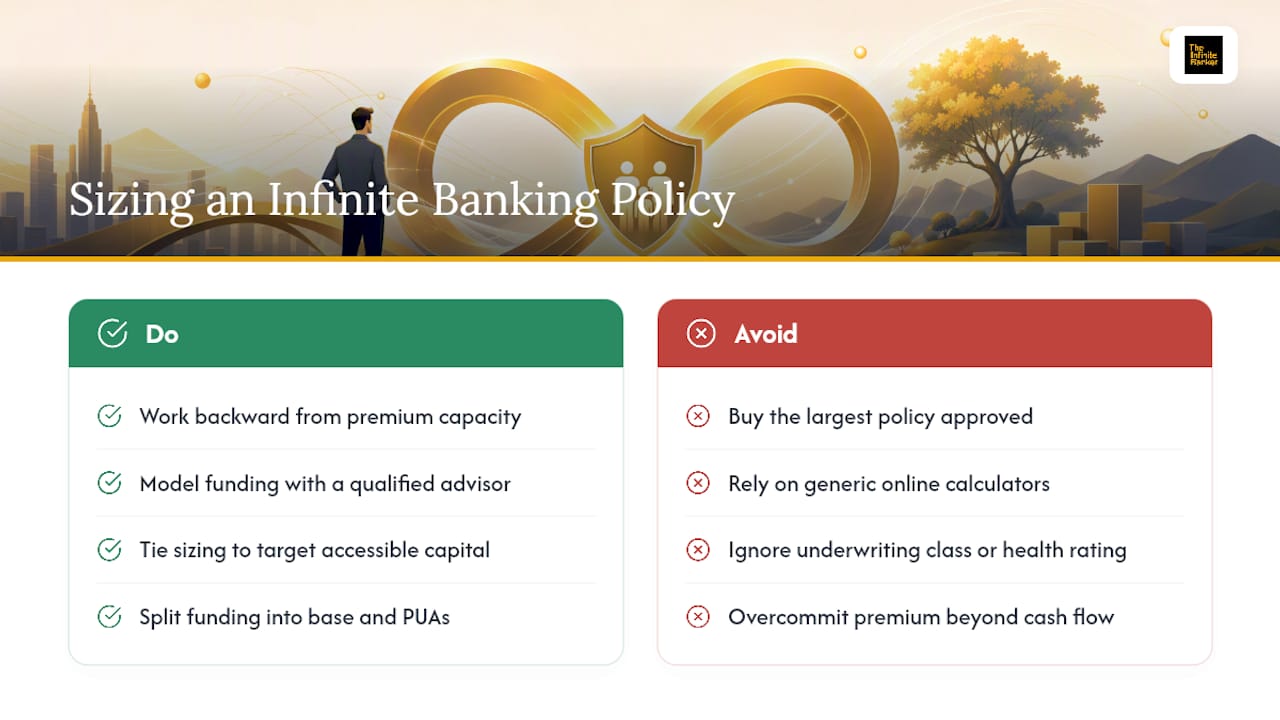
A useful starting exercise is working backward from premium capacity rather than forward from a coverage target. If you can commit $25,000 to $50,000 a year without straining your business’s operating cash, your advisor can model how that funding level, split between base premium and paid-up additions, translates into projected cash value and death benefit over time. Entrepreneurs sometimes make the mistake of buying the largest policy underwriting will approve, which locks up more premium than their cash flow can support in a lean year.
For real estate investors layering multiple policies across different entities or family members, sizing usually ties back to a target amount of accessible capital for future deals, not a single blanket figure. Working through that calculation with a qualified advisor, rather than a generic online calculator, accounts for your actual underwriting class, health rating, and funding timeline.
How Do You Verify a Policy Meets Its Own Design Requirements?
Verification here means confirming the contract in your hands actually matches what you were told it would do, not checking a lender’s compliance box. Three documents do most of the work.
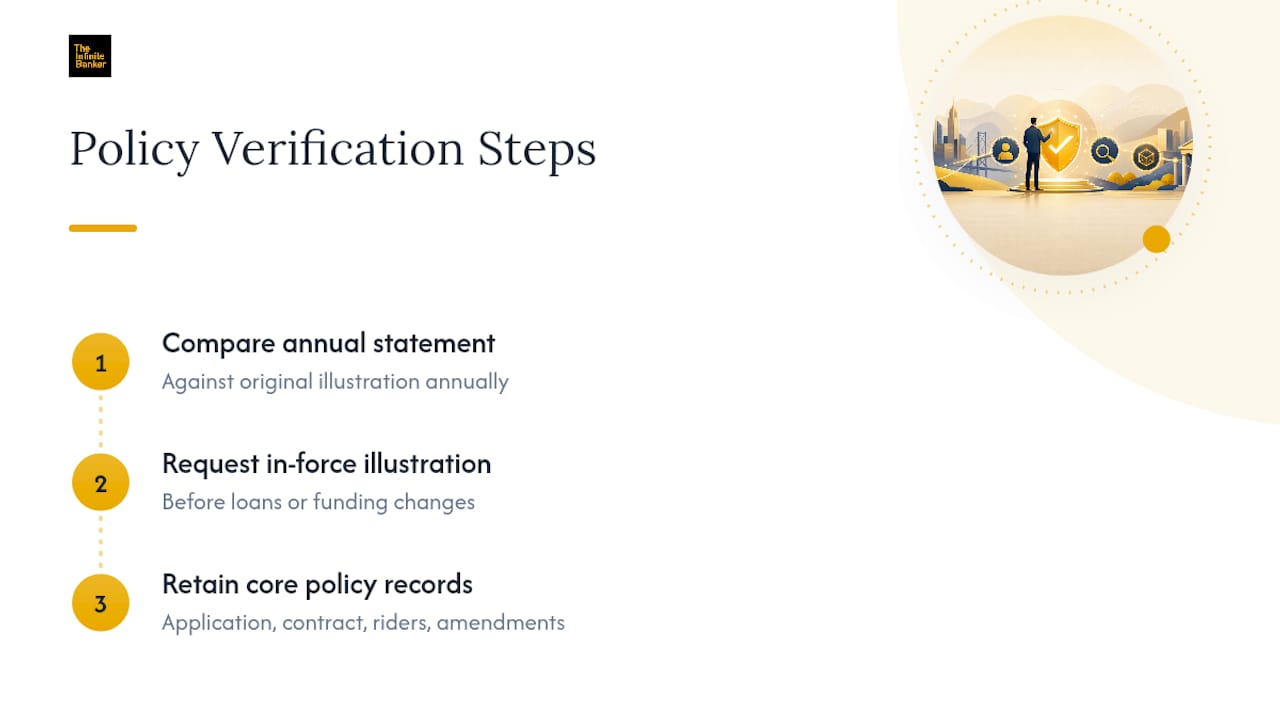
Start with the annual statement your carrier sends. It shows actual dividend credited, current cash value, and any outstanding loan balance, and you should compare it against the original illustration each year. A widening gap between illustrated and actual cash value is worth a conversation with your advisor, not a reason to panic, since dividend scales move with the carrier’s broader financial results.
Second, request an in-force illustration whenever you’re considering a policy loan or a change to funding. This forward-looking projection, built from your policy’s actual current values, tells you more than the original sales illustration ever will. Third, keep your application, policy contract, and any riders or amendments together in one file. The Infinite Banker’s cash value resource outlines what documentation to request and retain throughout the life of the policy.
What Happens If a Policy Isn’t Structured Correctly?
The consequences of poor policy design surface gradually, which is part of why they catch owners off guard years into a plan. An under-funded policy, one with too little PUA allocation relative to base premium, builds cash value more slowly than illustrated, which delays the point at which policy loans become a meaningful funding source.
A more acute risk is lapse. If premiums go unpaid and there isn’t enough cash value or dividend to cover the shortfall, the policy can lapse, terminating coverage and potentially creating a taxable event on any gain inside the contract. Unpaid policy loan interest compounds the problem, since accumulating loan balances continue reducing both cash value and death benefit until the loan is repaid or the policy lapses.
For entrepreneurs using a policy inside a broader business financing strategy, a lapsed or under-funded policy can also disrupt timing on a deal that assumed a certain amount of available cash value. This is why funding discipline and periodic reviews matter more than any single product feature.
Does the Requirement Change by Loan Type or Lender?
Within the Infinite Banking context, “requirements” aren’t set by a lender or loan program at all. They come from your own goals and the carrier’s contract terms, which do vary meaningfully from one insurer to the next. Some carriers offer more generous PUA riders, allowing a higher percentage of total premium to flow into paid-up additions. Others cap PUA contributions more conservatively, which slows early cash-value growth even with strong funding.
Loan provisions also differ by carrier. Some use a fixed policy loan interest rate; others use a variable rate tied to a published index. Some carriers practice direct recognition, adjusting the dividend on any loaned portion of cash value, while others credit the full dividend regardless of outstanding loans. That distinction can materially change the net cost of using policy loans over time.
If you’re evaluating multiple carriers, the comparison that matters isn’t which one has the lowest premium. It’s which combination of PUA flexibility, loan terms, and dividend history best fits how you intend to use the policy. An advisor who works across multiple carriers, rather than one captive to a single company, can walk through those contract differences side by side.
How The Infinite Banker Approaches These Requirements
Jib Hunt, an Authorized IBC Practitioner, built The Infinite Banker’s process around one idea: a policy should be understood before it’s funded. That starts with a discovery conversation about your cash flow and goals, moves into policy design with illustrations you can actually interpret, continues through underwriting support, and doesn’t stop at placement. Annual reviews compare actual performance against the original plan.
Dividends are never guaranteed, and every design conversation accounts for that. Conservative planning means modeling on guaranteed values first, treating dividend projections as a possibility rather than a promise, and building funding schedules with room for a slower year.
— Jib Hunt
Ready to Design a Policy That Fits Your Business?
If you’ve read this far, you already understand why a generic whole life quote from a captive agent rarely produces a policy built for Infinite Banking. The gap between “a whole life policy” and “a whole life policy engineered for cash-value access” comes down to the design decisions covered above, and getting them right the first time avoids years of course-correcting later.
The Infinite Banker works with entrepreneurs, real estate investors, and high-income business owners specifically on this kind of policy design. That includes illustration review across multiple carriers, PUA and funding-schedule structuring around your actual cash flow, underwriting coordination, and ongoing annual reviews once the policy is in force. If you’re weighing whether Infinite Banking fits your situation or you already have a policy that doesn’t seem to be performing as illustrated, see who Infinite Banking is designed for and request a discovery call. That first conversation covers your cash flow, timeline, and financing goals, then leads into an illustration built around your numbers rather than a generic template.
Selected Sources and Further Reading
This article is general information, not a substitute for advice from a qualified financial advisor. Consult a qualified financial professional about your own circumstances before acting on anything here.
FAQ
Is “SBA Life Insurance Requirement” About SBA Loans?
Not in this article. Here, it refers to the policy design requirement for Infinite Banking: a dividend-paying whole life contract with accessible cash value and clear loan provisions, separate from any SBA lending collateral rule.
What’s the Minimum Coverage for an Infinite Banking Policy?
There’s no fixed minimum. Coverage and premium level are sized to your funding capacity and cash-value goals, typically worked out with an advisor who models multiple scenarios against your actual cash flow.
Can a Policy Lapse If I Take a Loan Against It?
Yes. Unpaid policy loans accrue interest and reduce cash value and death benefit over time, and a policy can lapse if the loan balance grows larger than available cash value.
Does The Infinite Banker Help With Policy Design and Underwriting?
Yes. The Infinite Banker, led by Authorized IBC Practitioner Jib Hunt, works with entrepreneurs and investors through discovery, illustration review, underwriting coordination, and ongoing reviews. Learn more on who Infinite Banking is for.
Are Dividends on a Whole Life Policy Guaranteed?
No. Dividends depend on the insurer’s mortality, expense, and investment results each year, and a carrier can lower or suspend its dividend scale at any time.
This post is educational only and not financial, tax, or legal advice. Consult qualified professionals before acting.
Recommended

Comments