
Keep Cash Value Control: Policy Ownership Structures for Entrepreneurs


COMPLIANCE NOTE: For educational purposes only. Not financial, tax, or legal advice.
The policy owner, not the insured, holds every meaningful right over a life insurance contract, from naming beneficiaries to accessing cash value. Choosing among the main ownership structures (individual, spousal or joint, trust based through an ILIT, or business owned through an LLC or corporation) comes down to one tradeoff: how much control you want to keep during your lifetime versus how much you need the death benefit removed from your taxable estate.
TL;DR:
Most policies are owned by the insured, but control and estate tax treatment vary significantly depending on whether the policy is owned outright, by a spouse, trust, or business.
Transferring existing policies into a trust within three years of death can bring the death benefit back into the estate, undermining estate removal strategies.
Policy ownership determines control, surrender decisions, and tax liabilities, making proper structuring essential before application and during policy lifetime.
State laws on creditor protection and community property rules can influence ownership choices and asset protection, requiring up-to-date local legal guidance.
Correctly drafting ownership and control instructions from the start simplifies management and prevents costly fixes later, especially with complex arrangements like ILITs or corporate-owned policies.
Table of Contents
Understanding Policy Ownership Structures: Owner, Insured, and Beneficiary
A life insurance contract involves four distinct parties, and confusing them is the single most common mistake entrepreneurs make when they first structure a policy. The insurer issues the contract. The insured is the person whose life or health the policy covers. The beneficiary receives the death benefit. The owner (sometimes called the policyholder) is the party who actually controls the contract, and this role can belong to someone entirely separate from the insured.
That distinction matters because rights follow ownership, not coverage. According to LegalClarity’s breakdown of insured versus policyholder roles, the owner typically holds the authority to:
Change or add beneficiaries at any time, unless a designation has been made irrevocable
Surrender the policy for its cash value
Assign the policy as collateral or transfer ownership outright
Take policy loans against accumulated cash value
Name or change a contingent or successor owner
A policyholder is generally the party responsible for paying premiums and directing policy decisions, which is why employer-owned or trust-owned policies often separate the payer role from the insured entirely. The declarations page is the authoritative record for all of this. It lists who owns the policy, who is insured, and who is named as beneficiary, and any dispute about rights or intent gets resolved by what that page and the policy’s endorsements actually say, not by informal family understanding.
Common Ownership Structures and Their Tradeoffs
Most policies fall into one of four ownership categories, each with a different balance of control, tax exposure, and administrative complexity.
Self-owned. The insured owns the policy outright, pays the premiums, and retains full control over beneficiaries, loans, and surrender decisions. This is the simplest structure and the most common for personal cash-value strategies, but it carries a real cost: the death benefit is generally includable in the insured’s taxable estate because the owner retained what the IRS calls incidents of ownership.
Spousal or joint ownership. One spouse owns a policy insuring the other, or both are named as joint owners. In community property states, this arrangement can trigger consent requirements and complicate premium-source tracing, since community funds used to pay premiums may affect how the policy is characterized in divorce or probate.
Trust ownership through an ILIT. An Irrevocable Life Insurance Trust owns the policy instead of the insured. Done correctly, this removes the death benefit from the insured’s taxable estate, because the insured never held ownership rights to begin with. The most frequent setup mistake is funding the trust incorrectly or having the insured retain informal control over trust decisions, which can undo the estate benefit entirely.
Business, LLC, or corporate ownership. Companies commonly own policies on key employees, partners, or owners to fund buy-sell agreements or informal executive benefits. This requires demonstrable insurable interest between the business and the insured, meaning the company must show a legitimate financial stake in that person’s continued life or health.
Split-dollar and premium-finance arrangements. These advanced structures split premium costs or use third-party financing to fund large policies. They involve intricate tax and regulatory rules and should never be attempted without a specialist who understands the current split-dollar regulations.
Incidents of Ownership: The Estate Tax Trap Nobody Explains Well
An “incident of ownership” is any right the insured retains over a policy, and retaining even one can pull the entire death benefit back into the taxable estate, regardless of who technically holds the title on paper. The IRS looks at substance over form here.
Common incidents of ownership include the right to change a beneficiary, the power to surrender or cancel the policy, the ability to assign or borrow against it, and the authority to select payment options for the beneficiary. If the insured can do any of these things, even informally, the estate tax exposure the ILIT was designed to eliminate may still apply.
Timing matters just as much as structure. Transferring an existing policy into an ILIT within three years of the insured’s death generally pulls the death benefit back into the estate under longstanding IRS rules governing transfers made in contemplation of death. New policies purchased directly by the trust avoid this problem entirely, which is why practitioners almost always recommend the trust apply for and own the policy from day one rather than transferring an existing contract later.
A quick industry reality check: most U.S. life insurers are organized as stock companies, which make up the majority of the market, alongside mutual companies owned by policyholders. That structural difference affects dividend philosophy and long-term policy performance, and it’s worth confirming which type of company you’re working with before finalizing any ownership design.
A practical checklist before finalizing any trust-owned structure:
Confirm who pays premiums, and whether the trust has independent funds or relies on gifted contributions
Verify who signs the application and owns the policy from inception
Name a successor owner in case the initial trustee cannot continue
Document that Crummey withdrawal notices (a mechanism that lets beneficiaries briefly access gifted funds, keeping trust contributions eligible for the annual gift tax exclusion) are issued on schedule
Changing Ownership or Beneficiaries: What You Can and Can’t Do
Changing an owner or beneficiary typically involves submitting the insurer’s official change form signed by the current owner and awaiting written confirmation. It’s important to verify if any beneficiary designation is irrevocable, as such designations require the beneficiary’s written consent to change. Additionally, some policies subject to collateral or legal settlements may need approval from lenders or courts before changes take effect. Consulting an advisor regarding tax implications before transferring ownership is advised.
Practitioner Guidance for Control-First Ownership Design
For entrepreneurs building a cash-value strategy, control is the asset that makes the strategy work. If you can’t access loans on your own timeline or direct premium decisions without a committee, the flexibility that draws people to dividend-paying whole life insurance in the first place starts to erode.
Practitioners who work with entrepreneurs and investors commonly see two patterns hold up over time:
Individual ownership when liquidity and loan access are the priority, since the owner controls the cash value directly
ILIT ownership paired with a documented third-party premium-funding plan or corporate backstop, when estate removal matters more than personal liquidity
Applications and ownership forms should explicitly designate the premium payer and name a successor owner in writing, not leave it assumed.
Policy loans accrue interest, and any unpaid loan balance reduces both cash value and the death benefit. Policies can lapse if premiums go unpaid. Every ownership decision should be coordinated with estate counsel before it’s finalized, not after.
How Ownership Affects Surrender Options and Penalties
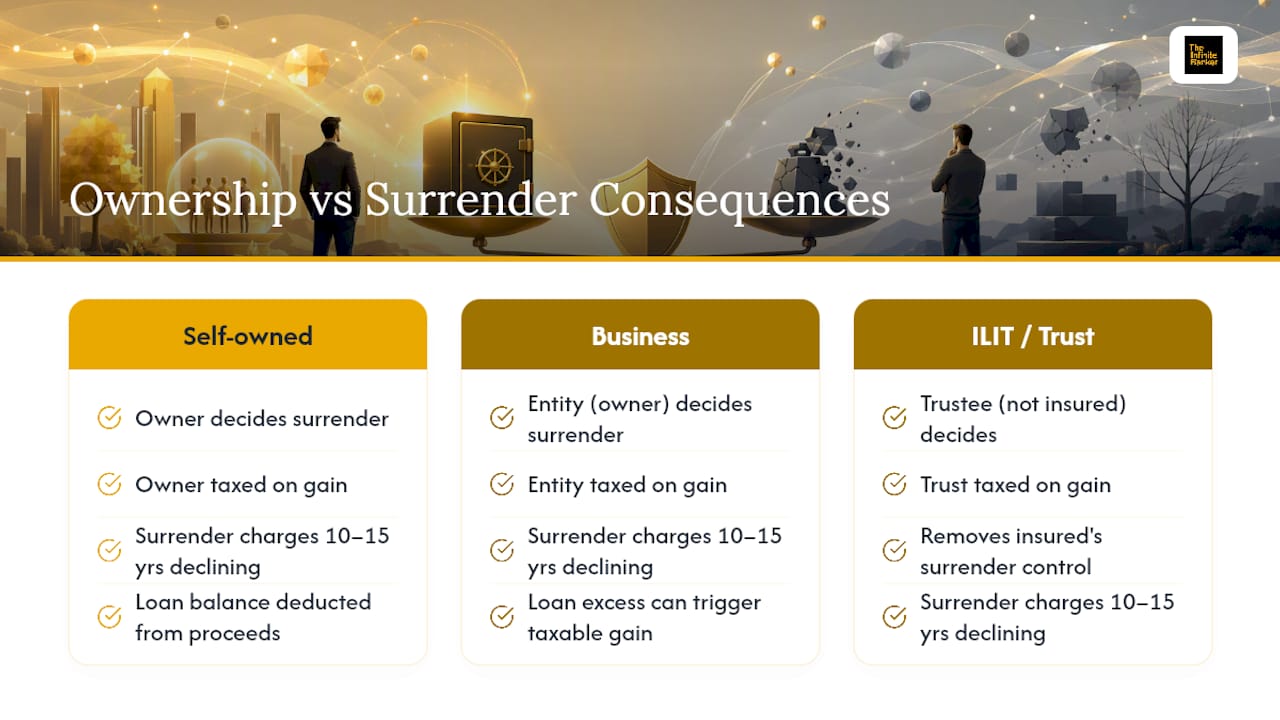
Only the owner can surrender a policy, and this single fact has consequences that ripple through every other ownership decision. If a trust owns the policy, the trustee, not the insured, decides whether to surrender it, which is exactly the point of using an ILIT: it removes that lever from the insured’s hands entirely.
Surrender charges typically apply during the early years of a policy, often the first ten to fifteen years, and they decline gradually as the contract matures. The exact schedule varies by carrier and product, so the illustration provided at issue is the only reliable source for those numbers, not general industry assumptions.
Ownership structure also determines who bears the tax consequences of a surrender. If the policy has grown cash value beyond total premiums paid, the gain portion is generally taxable as ordinary income to whoever owns the policy at the time of surrender. For a self-owned policy, that’s straightforward. For a business-owned policy or one held in an ILIT, the tax liability lands on the entity or trust, which can create planning complications if the trust has no independent income source to cover it.
One frequently overlooked detail: surrendering a policy that has an outstanding loan means the loan balance is deducted from the cash value before proceeds are paid out, and if the loan exceeds the surrender value, the difference can generate a taxable gain even though no cash actually reaches the owner. This is a real risk for heavily leveraged policies, and it’s a reason to review outstanding loan balances before considering surrender rather than after.
State-Specific Rules That Shape Ownership Structures
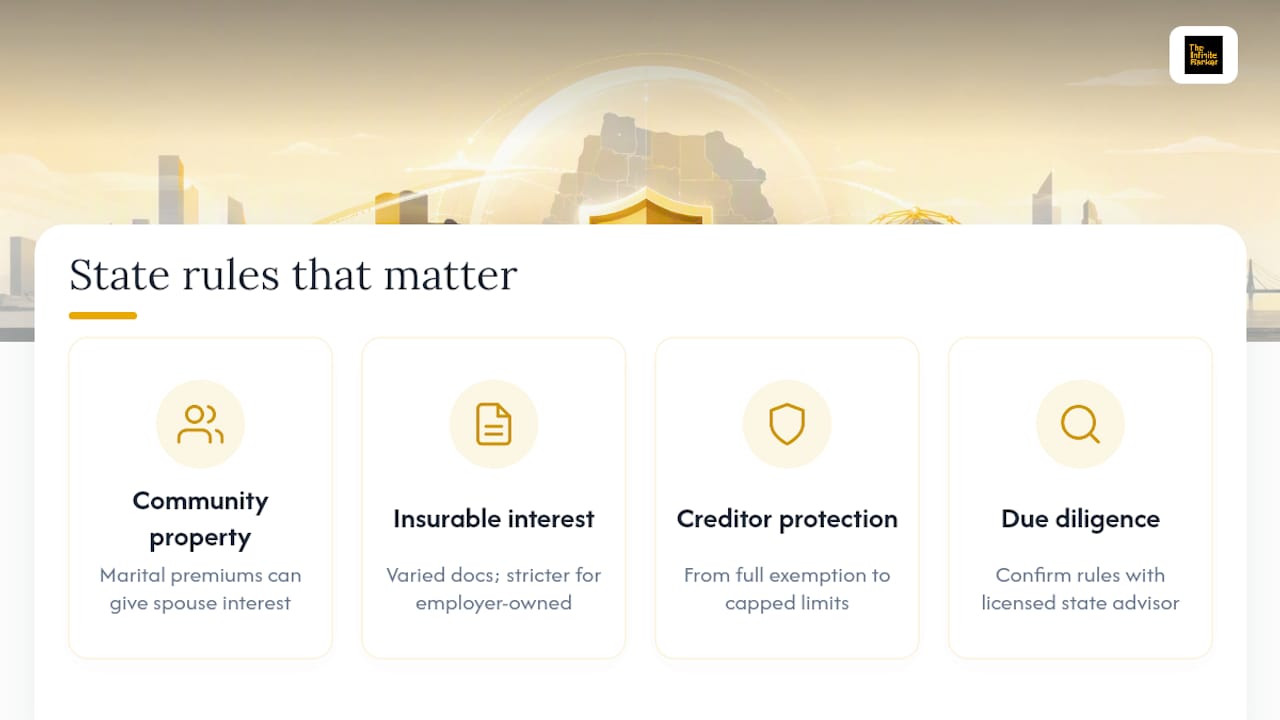
Life insurance is regulated at the state level, and that affects ownership decisions more than most people realize before they run into it. Community property states, including California, Texas, and Arizona among others, treat premiums paid with marital funds as community property, which can give a spouse an interest in a policy even when only one spouse is named as owner.
Insurable interest requirements also vary somewhat by state, particularly around how much documentation a business needs to justify owning a policy on a key employee or partner. Some states apply stricter scrutiny to employer-owned life insurance, partly in response to past controversies over companies insuring rank-and-file employees without their knowledge or consent.
Creditor protection for cash value and death benefits is another area where state law diverges sharply. Some states exempt life insurance cash value from creditor claims almost entirely, while others cap the exemption at a modest dollar amount or apply it only to policies naming a spouse or dependent as beneficiary. This matters directly for real estate investors and business owners who view cash value as a liquidity reserve, since the protection that reserve carries depends entirely on where the owner resides and how the policy is titled.
Because these rules shift by state and change periodically, confirming current treatment with a licensed advisor in your state before finalizing an ownership structure is not optional due diligence. It’s the only way to know whether the protection you’re counting on actually applies to you.
What I See Clients Get Wrong Most Often
The most common error is treating “insured” and “owner” as interchangeable when filling out an application, which sets the entire ownership structure on the wrong foundation before the ink dries. A close second is transferring an existing policy into a trust without checking the three-year lookback rule first, which can quietly defeat the estate-planning purpose entirely.
Successor-owner planning gets neglected almost as often. Clients name a beneficiary and stop there, leaving no instructions for who takes over ownership if the original owner becomes incapacitated or dies before the insured. My recommendation is always the same: settle on your control priorities first, then bring in estate counsel before the application is signed, not after.
— Jib Hunt
Design Your Ownership Structure With Practitioner Guidance
Getting ownership structure right at the application stage is far easier than fixing it years later, and that’s exactly where The Infinite Banker’s consulting work starts. As an Authorized IBC Practitioner, Jib Hunt works with entrepreneurs, real estate investors, and high-income earners to design policies where premium-payer designations, successor-owner instructions, and control points are documented from day one, not left to assumption.

Consulting engagements often cover strategy sessions, policy design, and underwriting guidance, paired with ongoing education about how cash value in a whole life policy works and how ownership choices may shape long-term access to it. For estimates of how loan capacity and cash value may develop under different funding levels, the Infinite Banking Calculator is a practical first step before scheduling a consult to discuss ownership structure options.
This article is general information, not a substitute for advice from a qualified financial advisor. Consult a qualified financial professional about your own circumstances before acting on anything here.
Sources
FAQ
What are the four main forms of policy ownership?
The four common forms are self-owned, spousal or joint ownership, trust ownership through an ILIT, and business or corporate ownership through an LLC or company entity.
Can a policy owner change the beneficiary at any time?
Yes, unless the beneficiary designation has been made irrevocable, in which case the owner needs the named beneficiary’s written consent before making any change.
What are the “seven pillars” of insurance sometimes mentioned online?
There’s no single standardized “seven pillars” framework recognized across the insurance industry, so definitions vary by source; the core concepts that matter most for policy ownership are the owner, insured, beneficiary, insurable interest, incidents of ownership, premium responsibility, and control rights covered throughout this article.
Who is considered the policy owner?
The policy owner is whoever is named as such on the declarations page, whether that’s the insured individual, a spouse, a trust like an ILIT, or a business entity, and that party holds all control rights over the contract.
Does owning a policy through an LLC affect insurable interest?
Yes. A business must demonstrate a legitimate financial interest in the insured’s life, such as a key-person or buy-sell arrangement, before it can lawfully own and maintain the policy.
This post is educational only and not financial, tax, or legal advice. Consult qualified professionals before acting.
Recommended

Comments