
Stop Crossing the Seven Pay Test: Paid Up Additions for Entrepreneurs


COMPLIANCE NOTE: For educational purposes only. Not financial or tax, or legal advice.
A paid up addition is a small, fully paid increment of whole life insurance purchased inside an existing participating policy. It raises cash value and death benefit immediately, with no new premium obligation attached to it. PUAs can be funded by policy dividends or through a dedicated PUA rider, and they suit entrepreneurs and investors who want a long horizon and surplus cash to deploy, but they carry real Modified Endowment Contract risk if funded too aggressively.
TL;DR:
PUAs increase cash value and death benefit immediately and can earn dividends themselves, but dividend amounts are not guaranteed and depend on insurer performance.
Funding PUAs through riders or dividends can push policies into MEC status if aggressive, which alters tax treatment and increases risk.
PUA cash value pools with the base policy, enabling higher borrowing capacity, but excessive funding risks MEC classification and possible loss of liquidity benefits.
Carrier differences in contribution limits, dividend history, and flexibility impact long-term growth and risk of MEC, making carrier selection crucial.
Proper modeling of seven-pay limits and dividend scenarios is essential before funding, to avoid MEC risk and ensure sustainable growth.
Table of Contents
Key Takeaways on Paid Up Additions
A few facts cut through most of the confusion around this feature.
PUAs are fully paid increments of insurance that raise cash value and death benefit the moment they’re purchased.
They compound because the additions themselves become eligible to earn future dividends, not just the base policy.
Dividends are not guaranteed. Insurers declare them annually based on company performance, and a scale can be revised.
Rider-funded PUAs let you accelerate growth with out-of-pocket contributions, but overfunding can trigger MEC status.
As PUA cash value accumulates, it expands how much you can eventually borrow against the policy.
How Do Paid Up Additions Work Inside a Whole Life Policy?
A PUA behaves like a miniature whole life policy sitting on top of your base contract. It has its own small death benefit, its own cash value, and once purchased, it requires no further premium to stay in force. That “paid up” status is the whole point: you buy the increment once, and it’s fully funded for life.
There are two distinct ways a PUA gets purchased:
Dividend-funded PUAs. If your policy is participating and the insurer declares a dividend, you can elect to apply that dividend toward buying additional paid-up insurance rather than taking it as cash or using it to offset premium.
Rider-funded PUAs. A paid-up additions rider lets you make additional out-of-pocket payments, within carrier-set limits, specifically to buy more paid-up insurance beyond what dividends alone would fund.
Once purchased, each PUA becomes its own participating block of coverage. It can earn its own dividends in future years, and those dividends can, in turn, buy still more PUAs. That layering effect is why practitioners describe PUA accumulation as compounding rather than simply additive growth, as Investopedia explains.
PUAs are generally only available on participating whole life policies, most commonly issued by mutual insurance companies. If you’re evaluating a policy for this purpose, confirm it’s structured as a participating whole life contract before assuming a PUA rider is even on the table.
A Simple Example of Paid Up Additions in Year One
Numbers make the mechanics concrete faster than any description can. Consider a 45-year-old business owner with a base whole life policy carrying a $500,000 death benefit.
In year one, the insurer declares a dividend, and the owner elects to buy several thousand dollars of paid-up additional insurance with it.
That $8,000 PUA purchase adds roughly $8,000 in immediate cash value and a modest incremental death benefit on top of the $500,000 base, depending on the insured’s age and the PUA’s own internal cost structure.
No further premium is owed on that increment. It’s paid up permanently.
In year two and beyond, that same $8,000 block becomes eligible to earn its own dividend, which can buy yet another (smaller) PUA.
Repeated year after year, this creates a rolling stack of paid-up increments, each one a small compounding engine layered on the last.
What Are the Pros and Cons of Paid Up Additions?
PUAs are popular in Infinite Banking design for good reason, but they come with tradeoffs that deserve equal attention before you commit meaningful capital.
Benefits:
Accelerated cash-value growth compared to a policy that takes dividends as cash.
Increased future borrowing capacity, since PUA cash value pools with the base policy’s cash value.
No new underwriting required to purchase dividend-funded PUAs, unlike buying a new policy or increasing face amount through other means.
Incremental death benefit added automatically with each purchase.
Drawbacks:
Dividends fluctuate and are never guaranteed. A weaker dividend scale means smaller or no PUA purchases in a given year.
Rider-funded PUAs often carry contribution minimums, and some carriers apply a modest cost to elect the rider.
Aggressive rider funding can push a policy into MEC status, changing how loans and withdrawals are taxed.
Capital directed into PUAs is capital not deployed elsewhere, which matters to investors weighing opportunity cost against real estate or business reinvestment.
Pro Tip: Before committing to a large rider-funded PUA schedule, ask your practitioner to run a seven-pay test projection alongside a dividend-scale sensitivity analysis, not just a single “current assumptions” illustration.
How Are Paid Up Additions Taxed, and What Is MEC Risk?
Cash value inside a properly structured life insurance contract grows tax-deferred as long as the policy retains its status as life insurance under 26 U.S.C. § 7702. That’s the federal statute that actually defines what qualifies as a life insurance contract for tax purposes, and it’s the foundation everything else in this section rests on.
If a policy is not a Modified Endowment Contract, withdrawals up to your basis (the total premium you’ve paid in) typically come out without triggering income tax, and policy loans are generally not treated as taxable income while the policy is in force. If a policy is classified as a MEC, distributions are taxed on a last-in-first-out, earnings-first basis, meaning gains come out before basis and get taxed as ordinary income, often with an additional penalty if withdrawn before age 59 and a half.
The seven-pay test measures whether cumulative premiums paid in the first seven years exceed the amount that would have been needed to pay up the policy in seven level annual payments. Cross that threshold, and the contract becomes a MEC.
Here’s the detail that catches people off guard: a material increase in death benefit can restart seven-pay testing on an existing policy, not just on a brand-new one. This is governed by 26 U.S.C. § 7702A, and the IRS has issued specific revenue procedure guidance addressing how these distinctions get applied in practice. Large, front-loaded PUA purchases are exactly the kind of funding pattern that can trip this wire if the policy design didn’t anticipate it.
How Do Paid Up Additions Affect Policy Loans?
PUA cash value doesn’t sit in isolation. It pools with the base policy’s cash value, and that combined figure is what generally determines how much you can borrow.
As PUAs accumulate year over year, the total loanable cash value in the policy rises correspondingly, giving you more borrowing room than the base policy alone would provide.
Any policy loan you take accrues interest, and unpaid interest capitalizes into the loan balance, which reduces available cash value and shrinks the net death benefit if the loan is never repaid.
Entrepreneurs and investors commonly use policy loans as a working capital source or bridge for a real estate purchase, but a disciplined repayment plan matters, since an unpaid loan balance that grows unchecked can eventually cause the policy to lapse.
Treat policy loans as a liquidity tool with real cost attached, not a distribution.
Who Should Consider Paid Up Additions?
PUAs tend to fit a specific kind of policyholder profile, and mismatched expectations are where most disappointment comes from.
Good fit: a long time horizon (typically 10+ years), consistent surplus cash beyond emergency reserves, and a preference for adding coverage now rather than re-underwriting a new policy years later at an older age and possibly worse health.
Poor fit: a short time horizon, inconsistent cash flow, or no willingness to have an advisor monitor MEC exposure as funding increases.
Before funding a PUA schedule, ask your advisor: What’s the carrier’s dividend history over the last decade? What’s the rider’s minimum and maximum contribution band? How close is this funding plan to the seven-pay limit, and what happens if I front-load in year one?
How Do You Implement Paid Up Additions Without Common Mistakes?
Getting PUA funding right is a design exercise, not a one-time purchase decision.
Confirm the policy is participating and review the carrier’s dividend history, since PUA compounding depends entirely on a track record of dividend declarations, not just current projections.
Model seven-pay impacts before funding, especially for any lump-sum or heavily front-loaded rider payment, so you know your margin against MEC status ahead of time rather than after the fact.
Elect the rider at application when you already know you intend to fund it heavily. Adding it later often requires new underwriting and may be restricted by the carrier’s age or issue rules.
Common mistakes: front-loading a large PUA payment without running a MEC projection first, assuming next year’s dividend will match this year’s, and neglecting to plan for loan repayment before borrowing against accumulated PUA cash value.
Pro Tip: Ask your practitioner to show you a carrier-level dividend history for at least the past 10 years, not just a hypothetical illustration. Past performance doesn’t guarantee future dividends, but a consistent record tells you far more than a single projected number.
Do PUA Features Vary by Insurance Company?
They vary more than most buyers expect. Contribution bands differ substantially, some carriers allow rider funding up to several times the base premium, while others cap it much closer to the base premium itself. Minimum funding requirements, the age at which the rider terminates (usually late middle age or early retirement years, though this varies by carrier), and whether evidence of insurability is required to add the rider after issue are all carrier-specific decisions.
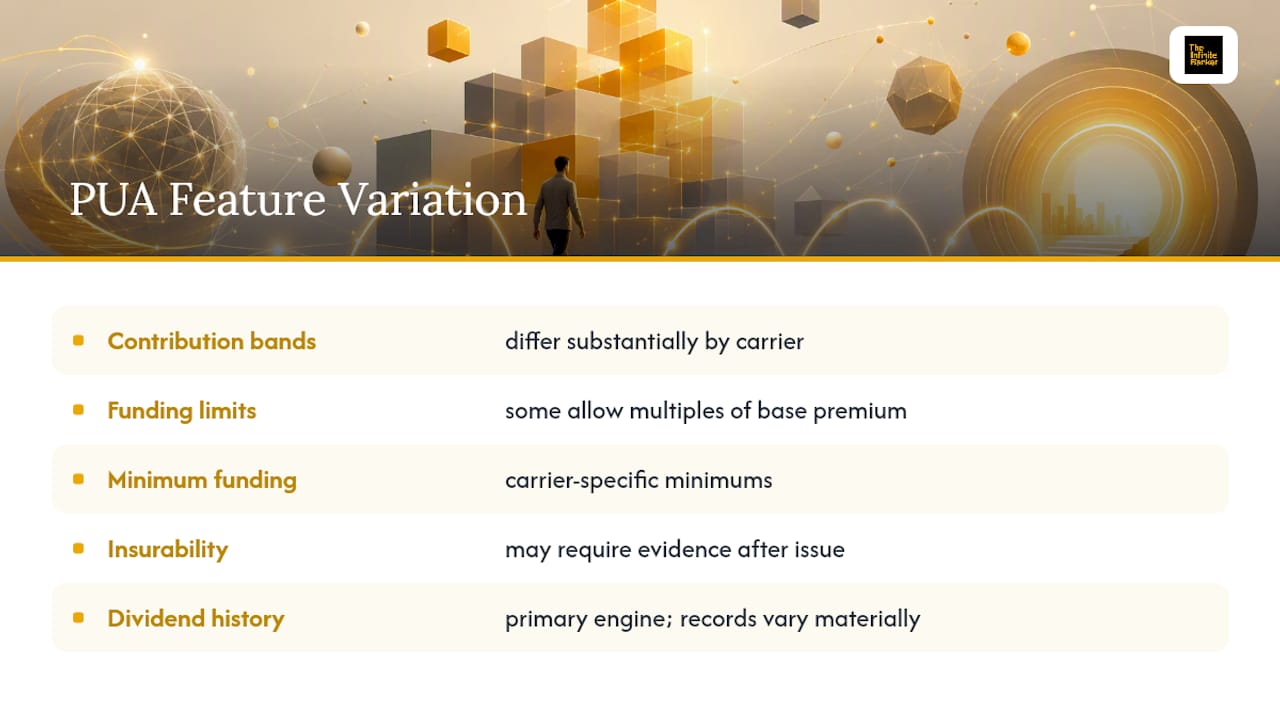
Dividend history is arguably the most consequential difference, since it’s the primary engine behind dividend-funded PUA growth. Two carriers can offer structurally similar riders and still produce very different long-term outcomes because one has a materially stronger record of dividend declarations than the other. This is exactly why carrier-level dividend and MEC stress testing matters before committing to a funding schedule, rather than assuming all participating whole life carriers are interchangeable.
Some carriers also differ in how flexible they are about skipping or reducing rider payments in a given year without penalty, which matters if your cash flow as a business owner or investor is uneven year to year. Others enforce stricter minimums that assume steady, predictable funding. Reviewing the specific contract language, not just a sales illustration, is the only reliable way to know which structure you’re actually buying into.
How Do Paid Up Additions Interact With Dividend Scales?
Dividend scales are declared annually by the insurer’s board, based on the company’s actual mortality experience, investment returns, and expenses relative to what was assumed when policies were priced. A dividend scale can rise, hold steady, or be reduced, and insurers have adjusted dividend scales downward in periods of sustained low interest rates.
PUAs sit downstream of that decision. When a carrier declares a stronger dividend, dividend-funded PUA purchases in that policy year are correspondingly larger, and the compounding effect described earlier accelerates. When a scale is reduced, the reverse happens: smaller dividend-funded PUA purchases that year, though existing PUAs already in force keep their paid-up status regardless of what happens to future dividends.
This is precisely why illustrations showing decades of projected PUA growth at a single, unchanging dividend rate deserve skepticism. A long, consistent dividend-paying history is a reasonable signal of carrier discipline, but it’s not a promise about what any specific future year will bring. Anyone modeling a multi-decade PUA strategy should stress-test the illustration against a materially lower dividend scale, not just the current one, to understand how sensitive the projected outcome really is.
Do Surrender Charges Apply to Paid Up Additions?
Surrender charges typically attach to the base policy structure, particularly in the earlier policy years, and they generally do not apply the same way to PUA cash value. Because a PUA is a fully paid, standalone increment of insurance, most carriers allow PUA cash value to be surrendered or accessed with little to no penalty, distinct from surrendering the base policy itself.
That distinction has practical weight for liquidity planning. If you need to access funds and are weighing whether to surrender part of a policy versus taking a loan, understanding which portion of your cash value carries surrender penalties and which doesn’t changes the math considerably.
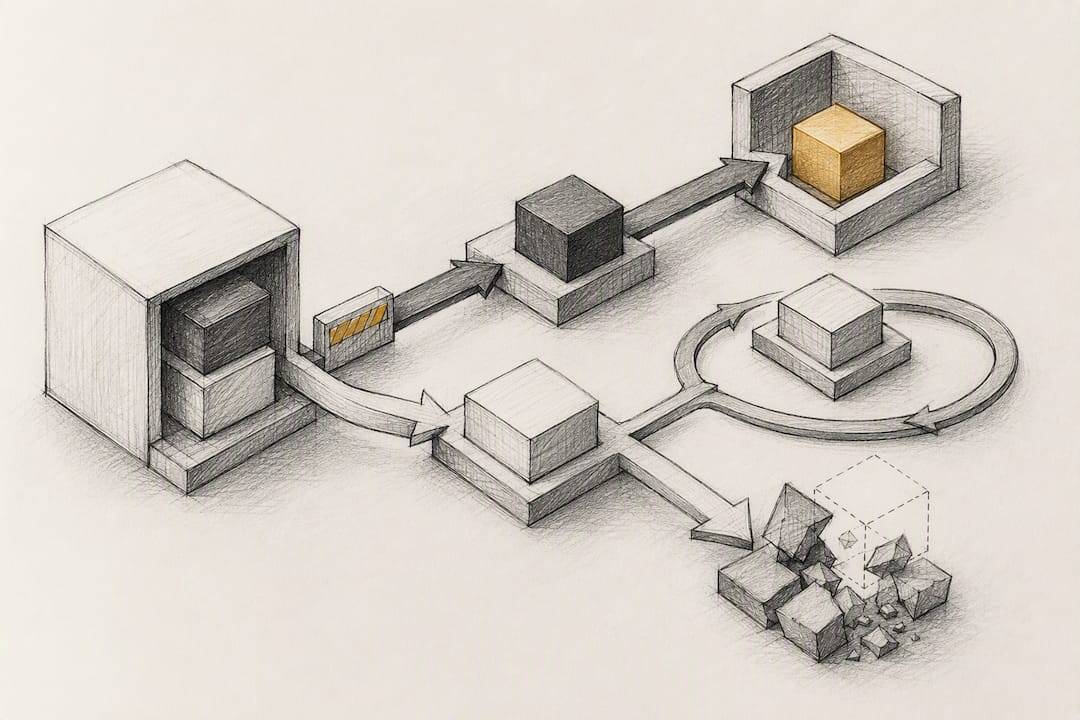
That said, surrendering PUAs reduces both future cash value growth and the death benefit permanently, since you’re unwinding paid-up coverage rather than merely borrowing against it. Unlike a loan, a surrender isn’t reversible by repayment. Carrier contract language on this point varies, so confirming the specific surrender treatment of PUA cash value in your policy, rather than assuming it mirrors the base policy’s surrender charge schedule, is worth doing before you count on that liquidity being penalty-free.
Jib Hunt’s Perspective on Paid Up Additions
In practice, PUAs are the real engine behind Infinite Banking design, not a footnote feature. What I emphasize with clients is discipline over enthusiasm: model the seven-pay math before funding aggressively, and never treat a projected dividend scale as a promise. The practitioners who get this right build funding schedules with margin against MEC status, not schedules that assume every dividend lands exactly as illustrated. Start with a policy review, not a funding decision.
— Jib Hunt
How The Infinite Banker Helps You Structure Paid Up Additions
Designing a PUA funding schedule that balances growth against MEC risk isn’t a spreadsheet exercise you want to run alone. The Infinite Banker works directly with entrepreneurs, real estate investors, and high-income earners to model rider funding against seven-pay limits, review carrier dividend history, and design a policy structure meant to support long-term liquidity rather than accidentally cross into MEC territory.

That process starts with a strategy session where an Authorized IBC Practitioner walks through your cash flow, your time horizon, and your funding goals before recommending a specific policy design. If you’re weighing advanced funding structures alongside other tax-sensitive planning, it’s also worth reviewing strategies like a private unincorporated association as a complementary piece of the broader picture. For readers who want to see the full mechanics before committing to a call, The Infinite Banker’s step-by-step guide to how Infinite Banking works is a solid next stop. When you’re ready, scheduling a strategy session is the most direct way to see how a PUA-funded design might fit your specific numbers.
Primary Sources on Paid Up Additions and MEC Rules
The following sources back the tax and mechanics claims made throughout this article.
26 U.S.C. § 7702 — federal definition of a life insurance contract.
26 U.S.C. § 7702A — Modified Endowment Contract classification and seven-pay rules.
IRS Revenue Procedure RP-01-42 — guidance on MEC versus non-MEC tax treatment.
Investopedia’s explainer on paid-up additional insurance — mechanics and compounding behavior.
This article is general information, not a substitute for advice from a qualified financial advisor. Consult a qualified financial professional about your own circumstances before acting on anything here.
Sources
FAQ
Are Paid Up Additions a Good Idea?
For policyholders with a long time horizon and consistent surplus cash, PUAs can be a reasonable way to build cash value and death benefit without new underwriting, but the fit depends on your funding capacity and tolerance for monitoring MEC risk.
Can I Cash Out Paid Up Additions?
Yes, PUA cash value can generally be surrendered or accessed with little to no penalty since each addition is a standalone, fully paid increment, though doing so permanently reduces both future cash value growth and death benefit.
What Does “Paid Up” Mean in Insurance?
“Paid up” means no further premium is owed to keep that coverage in force. It’s fully funded and permanent from the moment of purchase.
Are Paid Up Additions the Same as Dividends?
No. A dividend is a cash payment an insurer may declare based on company performance, while a PUA is additional insurance you can choose to buy using that dividend, or through separate rider payments, so the dividend is the funding source and the PUA is what it buys.
For educational purposes only, tax, or legal advice. Consult qualified professionals before acting.
Recommended
Comments