
Entrepreneurs: 5 Carrier Checks for Non Direct Recognition Policies


COMPLIANCE NOTE: For educational purposes only. Not financial, tax, or legal advice.
Yes, non-direct recognition companies generally pay the same dividend rate on your entire cash value, even the portion securing an outstanding policy loan. This structure tends to favor policyholders who borrow often, since their money keeps working while it works elsewhere too. But recognition type is just one variable in carrier selection, not the deciding one. The evaluation section below walks through what actually matters more over the life of a policy.
TL;DR:
Carrier choice should prioritize long-term dividend payment stability and strong financial ratings over recognition type, especially for conservative, long-term policies.
Non-direct recognition pays dividends on the full policy cash value regardless of loans, benefiting frequent borrowers but risking dividend pool strain during high-rate periods.
Loan interest rates can be variable or fixed; understanding the specific formula and how rates adjust over time is crucial to assessing borrowing costs.
Running scenario tests with varying borrowing patterns and rate environments reveals more about a carrier’s suitability than the recognition method alone.
Confirm recognition details and loan-rate formulas in writing before policy issuance to avoid surprises and ensure transparency in borrowing impacts.
Table of Contents
What Is Non-Direct Recognition and How Does It Differ From Direct Recognition?
How to Evaluate and Choose a Carrier When Recognition Type Matters
The Infinite Banker’s Approach to Policy Design and Recognition
What This Explainer Gets Right That Most Carrier Roundups Miss
Getting Help Structuring a Policy Built Around How You Actually Borrow
What Is Non-Direct Recognition and How Does It Differ From Direct Recognition?
Non-direct recognition describes how a mutual insurance company treats dividends when a policyholder has an outstanding loan against their whole life policy. Under this approach, the insurer calculates and pays the dividend on the full cash value figure on the books, regardless of how much of that value is currently pledged as loan collateral. Companies commonly cited as taking this approach include Lafayette Life and similar carriers, according to industry rankings of infinite banking companies.
Direct recognition works differently. Insurers using this method adjust the dividend rate applied to the portion of cash value that has been borrowed against, often crediting a lower rate on collateralized funds while the loan is outstanding.
That contrast sounds simple, but it has real consequences for anyone who plans to use policy loans repeatedly, which is the operating model behind Infinite Banking. If you are running money through your policy the way a business owner runs money through a line of credit, the recognition method changes how your cash value behaves while it is out on loan.
You will not find the term “non-direct recognition” printed in bold on a policy’s cover page. It usually surfaces in three places:
The loan provisions section of the policy contract, which spells out how dividends interact with outstanding loan balances
The annual dividend illustration, where a column may show identical dividend crediting whether or not a loan is active
Agent-provided comparison illustrations that model borrowed versus unborrowed cash value side by side
Ask directly. Some illustrations bury this detail in footnotes, and a policy’s recognition method rarely changes after issue, so getting it confirmed before you sign matters more than catching it later.
How Dividends, Loans, and Rate Formulas Actually Interact
Dividends on a participating whole life policy come from three sources: the insurer’s actual mortality experience versus what it assumed, investment returns above what was priced into premiums, and expense savings versus projections. None of that is promised. Dividends are not guaranteed, and a carrier’s board can reduce or suspend them based on how the underlying business performs in a given year.
Here is the part most explainers skip. When you take a policy loan, you are not withdrawing your cash value. You are borrowing from the insurer’s general account, using your cash value as collateral. The insurer still holds and invests the full cash value amount. That is precisely why non-direct recognition companies can afford to keep paying dividends on the whole balance: the money backing your policy has not left the building.
Dividend consistency and company financial strength (measured through AM Best and S&P ratings) are the two most reliable signals of how a policy will actually perform decades from now, more reliable than the recognition label alone.
Loan interest rates on whole life policies typically follow one of two structures:
Variable indexed formulas, often tied to a published benchmark like a Moody’s corporate bond index, which adjust periodically but are constrained by how the policy’s charter allows rate changes to happen.
Fixed-rate loans, set at issue and unchanged for the life of the policy, which trade flexibility for predictability.
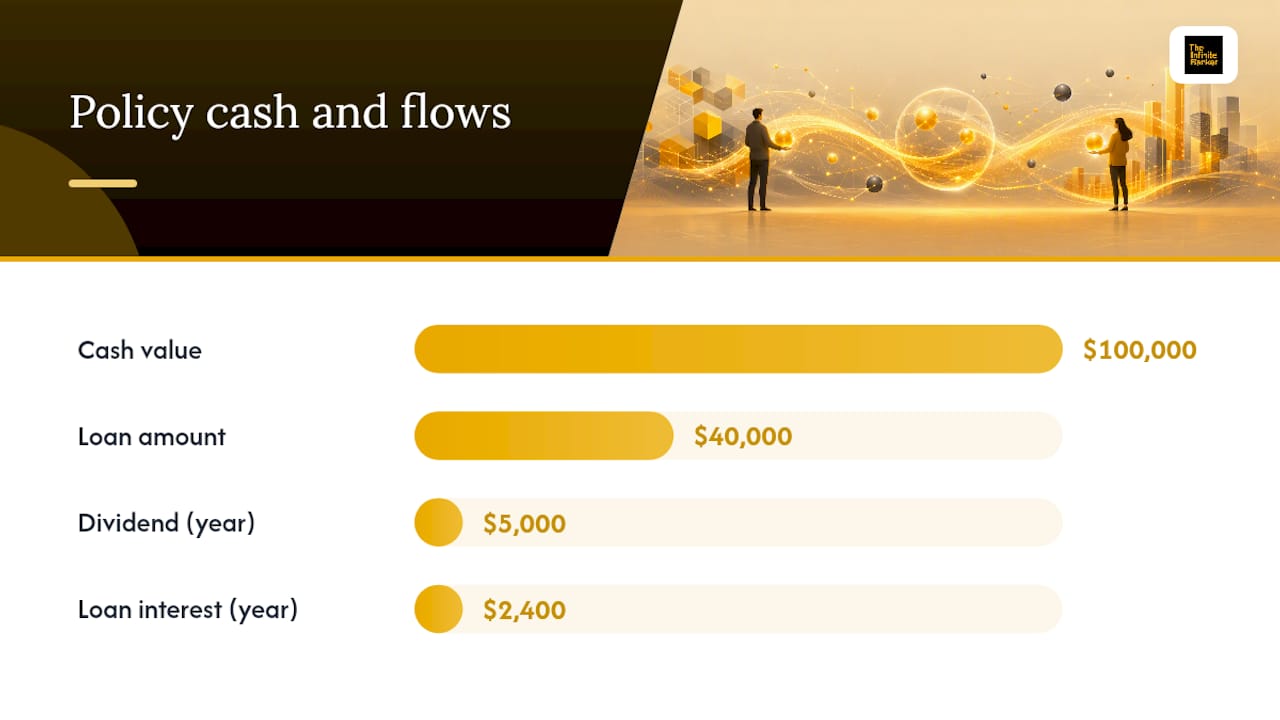
The interaction between these two forces (recognition type and loan rate structure) is where most of the practical complexity lives. Consider a simplified example. Say a policy holds $100,000 in cash value earning a 5% dividend rate. Without a loan, that entire balance grows by roughly $5,000 for the year, before considering guaranteed cash value growth and other credits. Now assume you borrow $40,000 against it at a 6% loan interest rate.
Under non-direct recognition, the full $100,000 still earns the 5% dividend, generating that same $5,000 credit. Meanwhile, you owe 6% interest on the $40,000 loan, or $2,400. Your net cost of borrowing, in this simplified view, is the spread between what the loan costs and what the collateral portion of your cash value would have earned anyway. Under direct recognition, the insurer might instead credit a lower rate, sometimes at or near the loan rate itself, only on that borrowed $40,000 portion, which changes the arithmetic meaningfully if you borrow often.
Remember that policy loans accrue interest continuously, and if that interest goes unpaid, it compounds and reduces both your available cash value and your death benefit. A policy can lapse if a loan balance combined with accrued interest ever exceeds the cash value backing it.
Weighing the Pros and Cons for Frequent Borrowers
Anyone using a policy the way Infinite Banking intends it, cycling capital in and out for real estate deals, business expenses, or opportunistic purchases, has a direct stake in how recognition type plays out over dozens of loan cycles rather than one.
Advantages of non-direct recognition for active borrowers:
Dividends continue crediting on the entire cash value base, including the collateralized portion, which supports uninterrupted compounding while funds are deployed elsewhere
The arithmetic is simpler to model, since you are not tracking two different dividend rates depending on loan status
It tends to suit policyholders who borrow and repay repeatedly as part of an ongoing capital strategy
Disadvantages worth weighing:
Loan rates on non-direct policies are often variable and index-linked, and those formulas can lag behind fast-moving market conditions, according to practitioner analysis of recognition structures
Because the insurer pays full dividends regardless of loan activity, heavy aggregate borrowing across a large book of policyholders can create pressure on the overall dividend pool during high-rate environments
Smaller or less capitalized carriers may have less room to absorb that pressure than larger, better-rated companies
Direct recognition is not without its logic either. Some industry commentary argues it is more equitable to non-borrowing policyholders in high-rate periods, since it segregates the cost of loans rather than spreading it across the entire dividend pool, a point raised in comparative analysis of the two structures. Non-direct recognition tends to look better on paper during periods of stable or falling interest rates. Direct recognition can sometimes produce better net outcomes when rates spike quickly, because the collateralized dividend adjustment reacts faster than a charter-constrained loan formula can.
Pro Tip: Run the same illustration twice, once assuming you borrow $0 for ten years and once assuming you borrow and repay $30,000 every other year. The gap between those two outcomes tells you far more about a carrier’s real-world fit than the recognition label by itself.
How to Evaluate and Choose a Carrier When Recognition Type Matters
Recognition type deserves a place on your checklist. It does not deserve the top spot. Analysts who track infinite banking carrier performance consistently point out that over a multi-decade horizon, dividend track record and company strength drive more of the outcome than which recognition method a carrier uses.
Work through these five checks before committing to a carrier:
Pull the dividend history. A carrier that has paid dividends consistently for 50, 75, or 100+ years without interruption, even through recessions, tells you something a marketing brochure cannot.
Check financial strength ratings. AM Best and S&P ratings reflect an insurer’s claims-paying ability and capital reserves, both of which matter more in a downturn than any single year’s dividend rate.
Ask for the exact loan-rate formula in writing. If an agent cannot name the index or benchmark the loan rate ties to, or hedges on how often it adjusts, treat that as a warning sign.
Confirm paid-up additions flexibility. A policy designed with strong PUA riders lets you accelerate cash value growth and adjust funding as your income fluctuates, which matters more to entrepreneurs than a fixed premium schedule.
Stress-test the illustration yourself. Ask for at least three scenarios: no loans, moderate periodic borrowing, and a rising-rate environment where the loan formula adjusts upward.
Questions worth asking any agent before you sign:
“Is this a non-direct recognition company, and can you show me that language in the actual policy contract, not just the illustration?”
“What index or formula sets the loan rate, and how has it moved over the past 15 years?”
“What does this illustration look like if I borrow $50,000 in year five and don’t repay it for three years?”
Red flags in an illustration include dividend rates held flat for 30 straight years with no sensitivity analysis, loan provisions described only in general terms, and an agent unable to explain how PUAs interact with the base policy’s cash value schedule. Insuranceopedia’s comparison of the two recognition approaches makes the same point from a different angle: numerical scenario testing beats arguing about which method sounds better in theory.
Common Misconceptions About Non-Direct Recognition
Three myths circulate constantly in Infinite Banking circles, and each one deserves a closer look before you build a strategy around it.
Myth: Non-direct recognition is always better. It is better for a specific use case, frequent borrowing, but a policyholder who rarely takes loans gains little advantage from it and may be better served focusing on other design features entirely.
Myth: The dividend and loan spread is a safe, predictable arbitrage. Loan rates on non-direct policies often move with a bond index, and if rates climb faster than the insurer’s formula allows it to adjust, the spread you were counting on can shrink or reverse.
Myth: All non-direct companies behave identically. Charter rules governing how fast a carrier can adjust its loan rate vary by company, and some formulas are explicitly tied to instruments like Moody’s corporate bond averages, which move on their own schedule regardless of your policy’s needs.
The practical takeaway echoes throughout every credible source on this topic: total policy performance over 20, 30, or 40 years is shaped far more by consistent dividend payment and disciplined underwriting than by which recognition label sits in the contract’s fine print.
The Infinite Banker’s Approach to Policy Design and Recognition
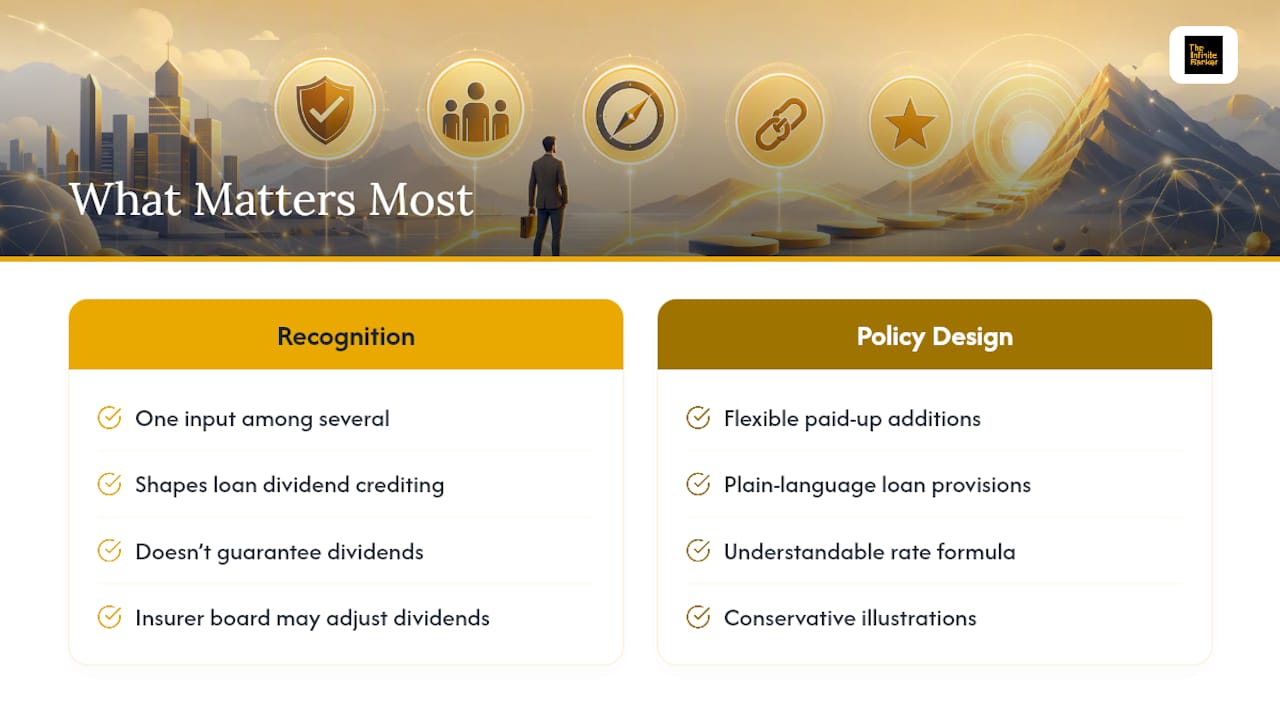
Recognition type is one input among several when structuring a policy for Infinite Banking. Carriers should not be selected based on a single feature, and no particular dividend outcome can be promised, because dividends are never guaranteed and every insurer’s board retains the discretion to adjust them.
What we prioritize instead is design. A policy built for someone who intends to borrow against it regularly needs flexible paid-up additions so cash value can accumulate efficiently in the early years. It needs loan provisions written in plain language, with a rate formula the client actually understands before they sign anything. And it needs illustrations that are conservative rather than optimistic, so a client’s expectations match what the policy is actually likely to do under a range of interest-rate and borrowing scenarios.
For entrepreneurs and real estate investors, that discipline usually matters more than which recognition category a carrier falls into. A policy that supports the broader benefits of Infinite Banking still comes with real trade-offs: policy loans accrue interest, and if that interest and principal are left unpaid, they reduce available cash value and the death benefit, with the potential to cause a lapse if left unmanaged. Recognition type shapes how a loan affects dividend crediting. It does not remove the obligation to manage the loan responsibly.
What This Explainer Gets Right That Most Carrier Roundups Miss
Most articles on this topic want to crown a winner. Non-direct recognition sounds better on a sales call, so it gets treated as the obvious answer, and dividend history, ratings, and loan-formula transparency get pushed into a footnote. That ordering is backwards.
The research here supports a different priority. Recognition type matters most to a narrow group: policyholders who borrow frequently and expect to carry loan balances for years at a time. For everyone else, it is a minor detail next to a carrier’s decades-long dividend record and its capital strength.
If you take one thing from this piece, let it be this: ask for the loan-rate formula in writing before you ask about recognition type. The formula tells you how exposed you are when rates move. The label alone tells you almost nothing about that.
— Jib Hunt
Getting Help Structuring a Policy Built Around How You Actually Borrow
Reading about non-direct recognition companies and modeling borrow-and-repay cycles across a 30-year illustration are two very different exercises. The Infinite Banker works with entrepreneurs, real estate investors, and high-income earners who want a policy designed around how they actually intend to use it, not a generic template pulled from a carrier’s default illustration.

Our process starts with a strategy session focused on your borrowing pattern: how often you expect to access cash value, for what purposes, and over what time horizon. From there, we help stress-test illustrations against variable loan-rate scenarios, walk you through underwriting, and support implementation once a policy is issued. We also help clients think through complementary considerations, like how deposit insurance coverage through NCUA or FDIC compares to policy cash value when they are weighing where to hold liquid reserves.
If you want to see whether this approach fits your situation, start by reviewing who Infinite Banking is designed for and how the overall strategy works, then reach out to schedule a strategy session.
Sources
Tax treatment of life insurance contracts is governed by 26 U.S.C. § 7702, the statutory reference for how a policy must be structured to qualify for its tax treatment under federal law. Beyond that legal foundation, this article drew on comparative industry explainers covering direct versus non-direct recognition mechanics, practitioner commentary on loan-rate formulas, and carrier rankings within the infinite banking space. Always confirm current policy language, loan-rate formulas, and dividend history directly with a carrier or licensed agent before making a decision, since illustrations and rate structures can change between printings.
This article is general information, not a substitute for advice from a qualified financial advisor. Consult a qualified financial professional about your own circumstances before acting on anything here.
FAQ
Who Is the Most Trusted Life Insurance Company?
Trust is best measured through decades of consistent dividend payments and strong AM Best or S&P ratings rather than a single “most trusted” label, since different carriers excel on different metrics depending on your priorities.
What Are Nonadmitted Insurance Companies?
Nonadmitted insurers are companies not licensed in a particular state and therefore not backed by that state’s guaranty fund protections, which is a separate issue entirely from whether a carrier uses direct or non-direct recognition on its whole life policies.
Why Do Some People Avoid Whole Life Insurance?
Critics point to higher early-year premiums and slower initial cash value growth compared to term insurance, though this overlooks how paid-up additions and long-term dividend crediting can shift that picture considerably over a multi-decade horizon.
What Is a Nonparticipating Company Called?
A nonparticipating company sells policies that do not pay dividends at all, distinct from the participating carriers discussed throughout this article, where dividend treatment and recognition type are central to how the policy performs for a borrower.
Does Non-Direct Recognition Guarantee Better Loan Outcomes?
No. Dividends are never guaranteed under any recognition structure, and loan rates on non-direct policies can rise, so the outcome depends heavily on the specific carrier’s dividend history and loan-rate formula, not the recognition label alone.
This post is educational only and not financial, tax, or legal advice. Consult qualified professionals before acting.
Recommended
Comments