
Avoid Lapse: Policy Loan Repayment Plan for Entrepreneurs


COMPLIANCE NOTE: For educational purposes only. Not financial, tax, or legal advice.
Repaying a policy loan starts with one call to your carrier: request the current payoff balance and a fresh in-force illustration. Policy loans against permanent life insurance typically carry no fixed repayment schedule, but interest accrues the entire time the loan is outstanding, and an unpaid balance can reduce the death benefit or push the policy toward lapse. If you can only do one thing this week, pay the accrued interest so the loan stops growing while you decide on a fuller repayment plan.
TL;DR:
Paying accrued interest immediately prevents the loan from growing via capitalized interest, which can significantly reduce the death benefit.
Loan-to-value ratios approaching or exceeding 90-95% of the cash value increase the risk of policy lapse and potential taxable gains if the policy lapses.
Regularly updating and reviewing an in-force illustration, loan ledger, and dividend history helps track the true cost and risk of outstanding policy loans.
Interest can capitalize into the principal, compounding silently, so monitoring how interest accrues and is billed is crucial for proper repayment planning.
Flexibility exists in repayment options, but only interest payments are quick and simple, while principal paydown or lump-sum payoffs require more intentional planning.
Table of Contents
How Policy Loan Repayment Works
A policy loan is not a loan from a bank. It is an advance from the insurance carrier, collateralized by the cash value inside a permanent life insurance policy such as dividend-paying whole life. Term insurance does not build cash value, so it cannot support this kind of borrowing at all. Once a policy has enough cash value, usually after several years of premium payments, the owner can request a loan against it without underwriting or a credit check.
Repayment schedules on these loans are usually optional, which is both the appeal and the trap. The carrier charges interest on the outstanding balance from the day the loan is disbursed, and if you do not pay that interest out of pocket, most carriers simply add it to the loan principal. This is capitalized interest, and it compounds: next year’s interest is charged on a larger balance than the year before. Protective explains that the policyowner can choose to repay some, all, or none of the loan, but the tradeoff is that unpaid balances quietly erode the policy’s death benefit over time.
Tax treatment follows a similar logic. While the policy stays in force, the loan itself is not taxable income, because it is technically a borrowing against your own asset, not a withdrawal of gain. That changes if the policy lapses or is surrendered with a loan still outstanding.
The loan amount is not income while the policy remains active.
If the policy lapses or is surrendered, any gain above premiums paid can become taxable.
Interest that capitalizes into the loan principal increases the balance used in that gain calculation.
Dividends, where declared, are not guaranteed and can be applied toward the loan but do not eliminate the underlying obligation.
Repayment Options and the Steps to Take Right Now
Insurance loan repayment is flexible by design, but flexible does not mean automatic. You have four realistic paths, and each carries a different cost profile.
Interest-only payments keep the loan balance from growing but never reduce the principal. This is the minimum viable move and the fastest to set up.
Scheduled principal-and-interest payments work like a conventional loan amortization and steadily shrink the balance, which is usually the healthiest long-term approach for anyone using the policy as a planning tool.
Lump-sum payoff clears the loan in one transaction, often funded by a liquidity event such as a property sale or a business distribution.
Dividend application directs any declared dividend toward the loan balance instead of taking it in cash or using it to buy paid-up additions, though this only works where dividends are actually credited and are never assured.
Here is the sequence to follow for repaying insurance loans correctly:
Call the carrier’s service line or your agent and request the exact payoff amount as of a specific date, not a rough estimate.
Ask whether interest is billed annually, quarterly, or continuously, and confirm the current loan interest rate.
Choose a payment method (check, electronic transfer, or dividend redirection) and confirm the carrier’s minimum payment rules.
Request an updated in-force illustration reflecting the new balance, since Investopedia notes that illustrations model how the loan affects long-term policy performance.
Save the payment confirmation and cross-check it against your next policy statement to confirm the ledger updated correctly.
Pro Tip: Ask the carrier to send the payoff quote in writing with an explicit expiration date. Verbal quotes over the phone drift as interest accrues daily, and a written figure protects you from paying a stale number.
What Happens If You Don’t Repay
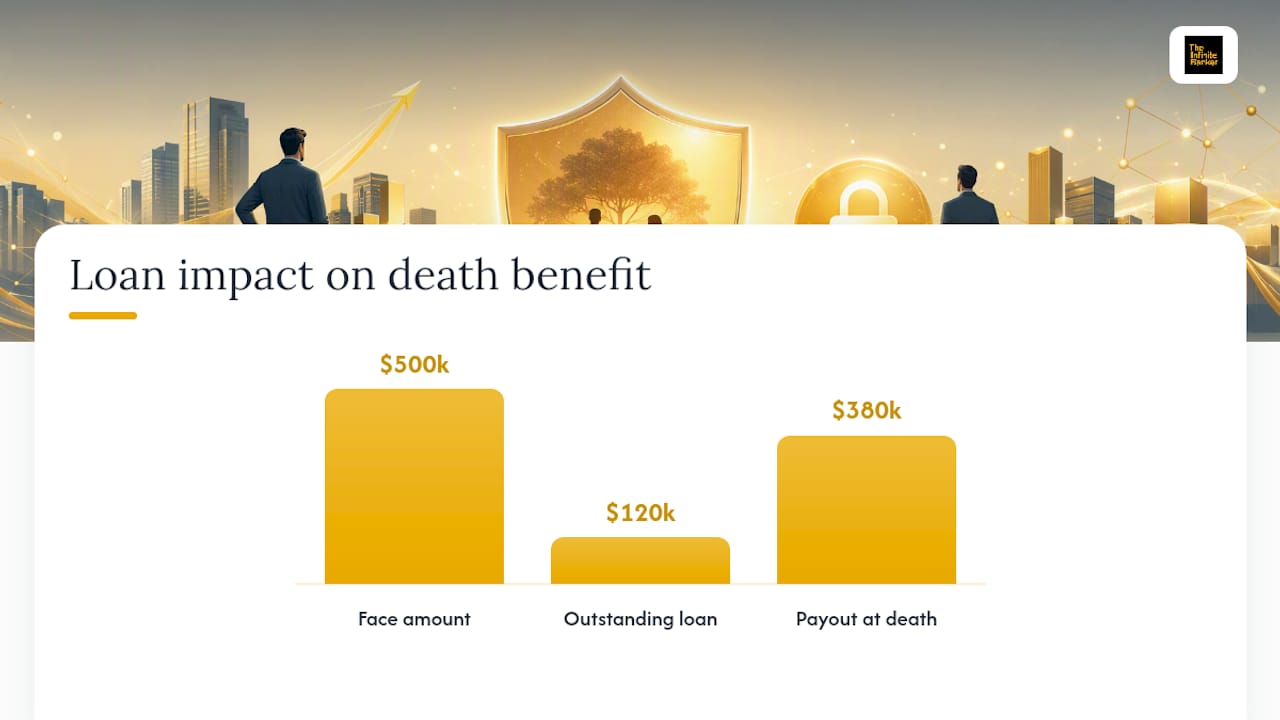
Unpaid policy loans do not sit quietly. Every dollar of accrued, capitalized interest adds directly to the balance owed, and that growing balance is subtracted from the death benefit your beneficiaries would otherwise receive. A $500,000 policy with a $120,000 outstanding loan pays out $380,000 at death, not the full face amount, and that gap widens every year the loan goes unaddressed.
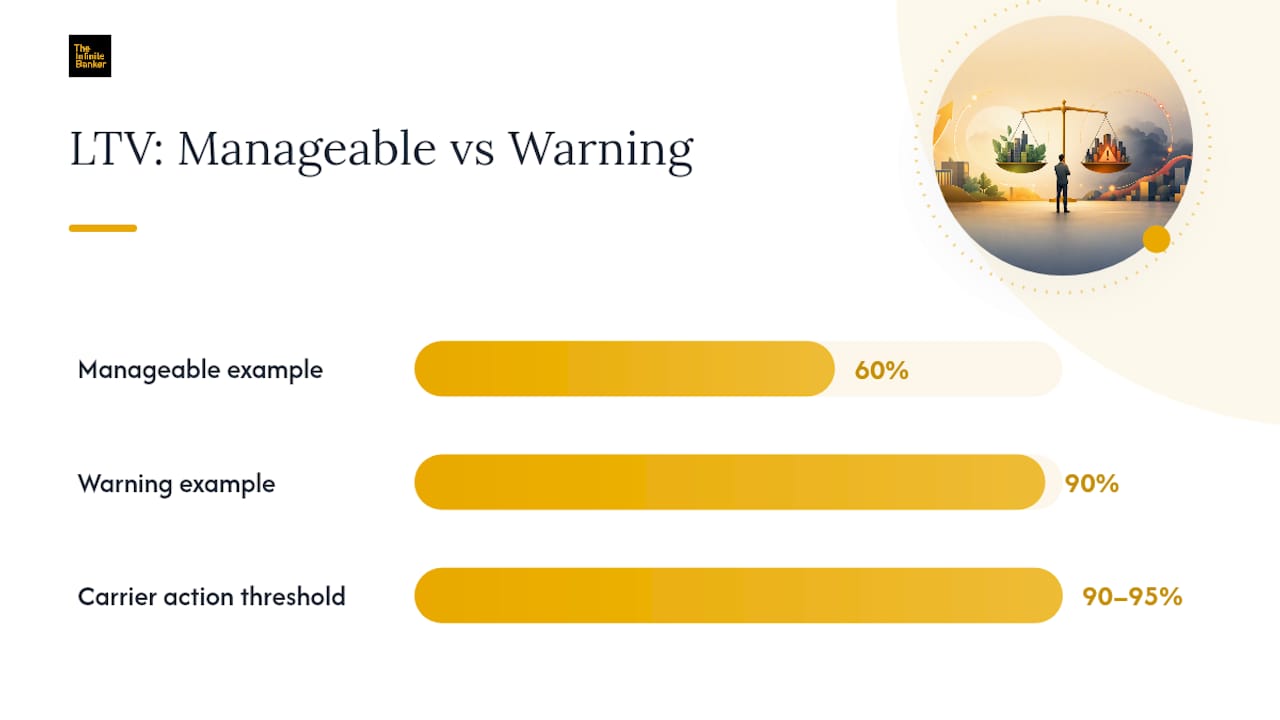
The more serious risk is a forced lapse. Carriers monitor the ratio between the loan balance and available cash value, and once the loan approaches the value of the cash securing it, the carrier can terminate the policy. Money’s reporting on policy loan risk points out that many carriers cap loans around 90% to 95% of cash value, and crossing that line significantly raises the odds of a lapse notice arriving in your mailbox.
A lapse with a loan still outstanding is where the real financial damage happens. NerdWallet’s analysis confirms that if the policy lapses, the IRS treats it similarly to a surrender: any gain, meaning cash value above the premiums you paid in, becomes taxable income in the year of the lapse, even though you never received that money as cash.
Watch for these warning signs that repayment urgency is rising:
Your loan-to-value ratio has climbed noticeably over the past 12 months.
You have received any lapse warning or grace-period notice from the carrier.
Unpaid interest has been capitalizing for more than one policy year without a payment.
Dividend credits have declined or stopped, removing a source of informal repayment.
Tracking the Numbers: LTV, Interest, and Illustrations
Loan-to-value is the single number that tells you how close a policy is to trouble. The formula is simple: outstanding loan balance divided by current cash value, expressed as a percentage. A $90,000 loan against $150,000 of cash value puts you at a 60% LTV, a manageable position. That same $90,000 loan against $100,000 of cash value puts you at 90%, right at the edge most carriers treat as a warning zone.
Carrier practices vary, but the pattern is consistent enough to plan around.
Metric | Typical range or practice | Why it matters |
Maximum LTV before carrier action | Roughly 90% to 95% of cash value | Crossing this threshold raises lapse risk sharply |
Interest accrual method | Usually daily or monthly, billed annually | Determines how fast unpaid interest capitalizes |
Recommended illustration refresh | Every 1 to 2 years while a loan is outstanding | Confirms whether the policy is on track or drifting |
Monitoring cadence | Annual at minimum, semiannual if LTV exceeds 50% | Catches capitalized interest before it compounds significantly |
Carriers generally use one of two interest accrual methods: capitalized interest, where unpaid interest is added to the loan principal and then itself accrues interest, or simple interest, billed separately and expected to be paid in cash each period. Capitalized interest is the more dangerous of the two because it compounds quietly, often without a monthly statement calling attention to it.
An in-force illustration requested from the carrier will show projected cash value, death benefit, and loan balance under current assumptions, letting you see years ahead of time whether the policy is heading toward a comfortable payoff or a lapse risk. For a deeper look at how LTV benchmarks work across lending generally, CR Equity AI’s primer on loan-to-value ratios offers a useful outside comparison, since the underlying math is the same discipline lenders apply to real estate collateral.
Building a Repayment Plan Around Your Goals
Repayment strategy should match why the loan exists in the first place, not a generic formula.
If the loan covered a short-term emergency, pay the accrued interest immediately and set a 3 to 6 month window to restore the principal. Only consider a low-cost external bridge loan if a careful comparison of after-tax cost and lapse risk actually favors it over continuing to carry the policy loan.
If the loan is funding a medium-term need, schedule regular principal payments rather than letting the balance drift. Prioritize repaying whichever loan carries the highest net cost first, and avoid tapping cash value withdrawals to cover the balance unless the math clearly requires it, since a withdrawal can trigger a taxable event that a loan repayment would not.
For readers using policy loans as part of a broader Infinite Banking approach, sequencing matters more than speed. The goal is preserving capital velocity, meaning the ability to redeploy the same dollars into another opportunity once repaid, while tracking the real net cost of each loan: the interest rate charged minus any dividend credit the carrier still applies to loaned funds.
Model net cost using your carrier’s actual loan rate and dividend scale, not a generic average.
Document what each loan funded and its expected return before assuming the deployment paid for itself.
Revisit the repayment sequence whenever a new opportunity or a new loan changes the picture.
Pro Tip: Keep a simple running ledger, even a spreadsheet, tracking each loan’s origination date, rate, and purpose. Practitioners who skip this step are the ones most often surprised by how much capitalized interest has accumulated by year three.
How Recognition Rules Shape Real Repayment Urgency
The detail most policyholders miss is how their carrier treats dividends on loaned cash value. Carriers using direct recognition reduce the dividend credited to the portion of cash value that is loaned out, which raises the effective net cost of carrying that loan. Carriers using non-direct recognition credit the full dividend regardless of an outstanding loan, which can make patience more affordable. Neither method is guaranteed to produce a specific dividend outcome, since dividends themselves are not guaranteed and depend on the insurer’s financial performance.
Common tracking mistakes that create unnecessary urgency later:
Not tracking capitalized interest separately from the original principal, which hides how fast the true balance is growing.
Ignoring loan-to-value until a carrier notice forces the issue.
Assuming dividend crediting works the same way across carriers, when direct recognition and non-direct recognition produce meaningfully different net costs.
Failing to request a current loan ledger that itemizes interest capitalization events.
Ask your carrier or advisor for three specific documents: a current in-force illustration, a loan ledger showing exactly when and how interest capitalized, and a dividend history for the policy. Those three pieces, read together, tell you the true cost of the loan far better than the balance shown on a single statement.
A Practical Checklist to Use This Week
Start with a phone call, not a spreadsheet. Contact the carrier and request the exact payoff amount and a fresh in-force illustration, both dated to the same snapshot day so the numbers line up. Set up at least one annual interest payment immediately, even if a fuller repayment plan is still being worked out, and put a follow-up review with a qualified advisor on the calendar. From there, track loan-to-value and interest capitalization monthly until the balance sits comfortably below your carrier’s threshold, then shift to a quarterly check.
— Jib Hunt
Where The Infinite Banker Fits Into Your Repayment Plan
There are consulting services available designed to help you model what repaying a policy loan actually costs versus what carrying it costs.

Working through an in-force illustration, a loan ledger, and a dividend history on your own is doable, but modeling repayment sequencing against multiple loans, multiple carriers, or a broader Infinite Banking strategy is where an Authorized IBC Practitioner like Jib Hunt adds real value. The Infinite Banker’s consulting work includes policy review, in-force illustration modeling, repayment sequencing, and implementation support for entrepreneurs, real estate investors, and business owners managing cash value across one or more policies. Results vary by carrier, policy design, and individual circumstances, and dividends are never guaranteed. If you want a second set of eyes on your repayment plan before you commit to a schedule, start by reviewing who Infinite Banking is designed for and request a strategy session to walk through your specific numbers.
This article is general information, not a substitute for advice from a qualified financial advisor. Consult a qualified financial professional about your own circumstances before acting on anything here.
Sources
FAQ
How do I repay a policy loan?
Contact your carrier for the current payoff balance, choose interest-only, principal-and-interest, or a lump sum, and confirm the payment against an updated in-force illustration.
Do I have to pay back a loan against my life insurance policy?
No fixed schedule usually applies, but unpaid interest capitalizes into the balance, and an outstanding loan reduces the death benefit and can cause the policy to lapse.
What is the cash value of a $15,000 life insurance policy?
Cash value depends entirely on the policy’s design, age, and premiums paid rather than the face amount, so a policy with a low death benefit could have little to no accessible cash value in early years.
What happens if I never repay a policy loan?
Unpaid interest keeps capitalizing into the balance, the death benefit shrinks by the outstanding amount, and if the loan approaches the policy’s cash value, the carrier can lapse the policy and trigger a taxable event on any gain.
This post is educational only and not financial, tax, and or legal advice. Consult qualified professionals before acting.
Recommended
Comments