
Loan Repayment Strategies for Borrowers in 2026


COMPLIANCE NOTE: For educational purposes only. Not financial, tax, or legal advice.
For most borrowers, the right loan repayment strategy comes down to one question: do you want to minimize total interest paid or do you need early wins to stay motivated? If minimizing interest is the priority, the avalanche method wins. If momentum matters more, start with the snowball. Federal student loan borrowers should layer in Income-Driven Repayment (IDR) or Public Service Loan Forgiveness (PSLF) before committing to either.
Three things you can do in the next 72 hours:
Assemble your loan list. Write down every loan’s balance, interest rate, loan type (federal vs. private), and servicer contact. This is the foundation of any debt repayment plan.
Run the Federal Student Aid Loan Simulator. It compares monthly payments, total interest, payoff dates, and forgiveness amounts across every federal repayment plan, including IDR options.
Enroll in autopay. Many federal and private servicers reduce your interest rate by 0.25 percentage points when you authorize automatic debits, a small but compounding advantage over a multi-year term.
Key Takeaways
The most effective loan repayment strategy aligns your payoff method with your cash flow, loan mix, and behavioral tendencies, then automates it so consistency does the work.
Point | Details |
Match method to motivation | Avalanche minimizes interest; snowball builds momentum. Pick the one you will follow for years. |
Autopay first | Enrolling in autopay commonly reduces your rate by 0.25 percentage points with no budget change required. |
Federal borrowers: use the Loan Simulator | Run the Loan Simulator at studentaid.gov before choosing a repayment plan or refinancing any federal loan. |
Instruct your servicer on extra payments | Always specify that surplus payments apply to principal; otherwise servicers may advance your next due date instead. |
Keep a small emergency buffer | Maintain at least one month of expenses in reserve while accelerating payments to avoid forced forbearance. |
The Infinite Banker | Entrepreneurs and high-income earners may consider a properly structured whole life policy as a liquidity tool alongside a repayment plan; consult a qualified professional before acting. |
Table of Contents
The top loan repayment methods and when each fits your situation
Snowball vs. avalanche: which method actually saves you more?
Refinancing, consolidation, and autopay: how to lower your interest rate
How to use IDR, PSLF, and the Loan Simulator to shape your federal repayment plan
Practical payment tactics that free up cash for extra principal payments
When forbearance, deferment, or professional help is the right call
What actually keeps a repayment plan working over years, not just weeks
A structured alternative worth understanding: Infinite Banking for entrepreneurs
The top loan repayment methods and when each fits your situation
A clear menu of approaches helps you match a method to your actual cash flow and loan mix rather than defaulting to whatever your servicer set up at origination.
Pay more than the minimum. Every dollar above the minimum hits principal directly, reducing the balance on which interest accrues. Best for: any borrower with even modest discretionary cash flow.
Debt avalanche. Target the highest-interest loan first while paying minimums on all others. Mathematically optimal for minimizing total interest paid; best for borrowers who are disciplined and motivated by numbers.
Debt snowball. Target the smallest balance first. Psychologically rewarding; best for borrowers who need visible progress to stay consistent.
Biweekly payments. Split your monthly payment in half and pay every two weeks. Because there are 26 two-week periods in a year, you effectively make 13 full payments instead of 12, shaving months off a standard amortizing loan without a dramatic budget change.
Autopay enrollment. A 0.25-percentage-point rate reduction is modest, but over a 10-year federal loan term it reduces total interest paid. Set it and forget it.
Refinancing (private market). Replaces your existing loan with a new private loan at a lower rate. Best for: borrowers with strong credit, stable income, and no reliance on federal IDR or PSLF. Warning: refinancing federal loans into private loans permanently removes access to federal protections.
Direct Consolidation (federal). Combines multiple federal loans into one with a weighted-average interest rate. Does not lower your rate, but simplifies repayment and can restore PSLF eligibility for some loan types.
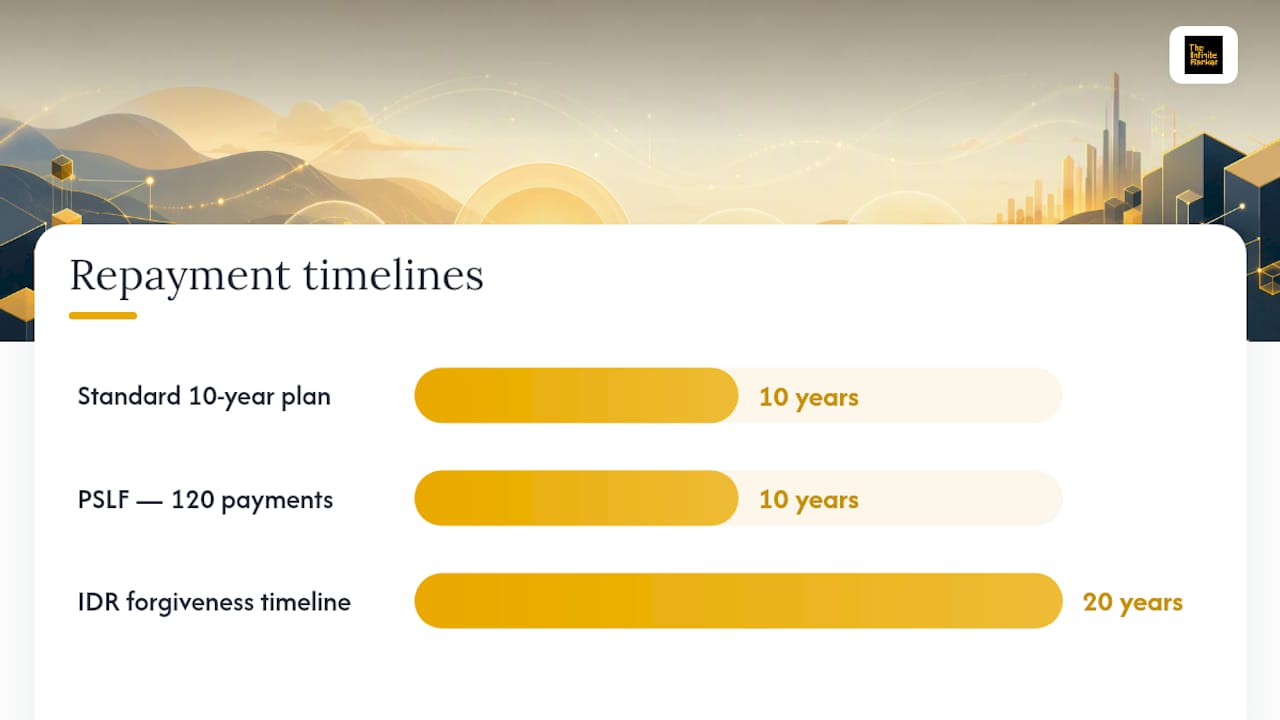
Income-Driven Repayment (IDR). Caps monthly payments at a percentage of discretionary income. Best for: federal borrowers with high debt-to-income ratios or those pursuing PSLF. Remaining balances may be forgiven after 20–25 years.
PSLF. After 120 qualifying payments on an IDR plan while working full-time for a qualifying employer, remaining federal loan balances may be forgiven. Best for: government and nonprofit employees.
Windfall payments toward principal. Tax refunds, bonuses, and inheritances applied directly to principal can compress a 10-year payoff into 7 or 8 years. Requires explicit servicer instruction to apply funds to principal rather than advancing the next due date.
Snowball vs. avalanche: which method actually saves you more?
Both methods work. The real question is which one you will follow for years without quitting.
Definitions:
Avalanche: Pay minimums on all loans; direct every extra dollar to the highest-interest loan first. Repeat until paid off.
Snowball: Pay minimums on all loans; direct every extra dollar to the smallest-balance loan first. Repeat.
Worked example with the same total debt
Assume three loans totaling $30,000 and $300/month available above minimums:
Avalanche order: C first, then B, then A. Approximate total interest paid: $7,200 over roughly 38 months to full payoff.
Snowball order: A first, then B, then C. Approximate total interest paid: $8,400 over roughly 41 months to full payoff.
The avalanche saves roughly $1,200 in interest and three months of payments in this scenario. The snowball eliminates Loan A in about four months, delivering a concrete psychological win that many borrowers need to stay on track.
Decision checklist:
Pick avalanche if your highest-rate loan is also a large balance and you track progress with spreadsheets or apps.
Pick snowball if you have struggled to stick with a debt repayment plan before, or if your smallest balance is close to payoff already.
Consider a hybrid: pay off one small loan first for the motivational boost, then switch to avalanche order. Navy Federal’s guidance makes the point plainly: the best method is the one you will actually follow consistently.
Pro Tip: Mark each loan payoff on a calendar or tracking app. The act of crossing off a loan, even a small one, triggers a completion signal that makes the next payment feel less abstract. Pair that with avalanche math and you get both the behavioral win and the interest savings.
Refinancing, consolidation, and autopay: how to lower your interest rate
Reducing the rate itself is the highest-leverage move available, but each route carries different trade-offs.
Option | Interest impact | Effect on federal benefits | Fees / costs | Best suited for |
Private refinancing | Can lower rate significantly | Permanently removes IDR and PSLF eligibility | Origination fees vary; some lenders charge none | Borrowers with strong credit, private loans, or federal loans they will never need IDR/PSLF for |
Federal Direct Consolidation | Weighted-average rate (no reduction) | Preserves federal benefits; may restore PSLF eligibility for some loan types | No fee | Borrowers with multiple federal loan types needing simplification |
Autopay enrollment | Typically 0.25 pp reduction | No effect | None | All borrowers; easiest first step |
Balance-transfer card | 0% intro APR for 12 months | N/A (credit card debt) | Transfer fee usually 3–5% | Credit card debt only; requires discipline to pay off before promo period ends |
The critical warning on refinancing: the Loan Simulator flags this directly. Refinancing federal loans into a private loan is irreversible. You permanently lose access to IDR plans, PSLF, and federal forbearance options. Run the Loan Simulator first and confirm you have no realistic path to forgiveness before refinancing a single federal dollar.
Questions to ask any lender or servicer before changing your loan structure:
What is the new interest rate, and is it fixed or variable?
What are the origination fees and total cost of refinancing?
Are there prepayment penalties?
How does this change affect my eligibility for IDR or PSLF?
How will extra payments be applied, to principal or to the next scheduled payment?
That last question matters more than most borrowers realize. Instruct your servicer explicitly to apply any surplus payment to principal; otherwise the servicer may simply advance your next due date, which does not reduce the interest-bearing balance.
How to use IDR, PSLF, and the Loan Simulator to shape your federal repayment plan
Federal student loan borrowers have access to tools and programs that private borrowers do not. Using them correctly can mean the difference between paying off a loan in 10 years and having a significant balance forgiven after 20.
Step-by-step process:
Gather your servicer information. Log in to Studentaid to see all your federal loans, their servicers, and current repayment plan.
Run the Loan Simulator. The Loan Simulator compares monthly payment, total interest, payoff date, and forgiveness amount for every available plan. It can also model what happens if you make extra payments or pause payments temporarily.
Compare the outputs. Look for the plan tagged “Lowest Total Payment Over Time” versus the one with the lowest monthly payment. The gap between those two numbers is the cost of cash-flow relief.
Evaluate PSLF eligibility. If you work full-time for a federal, state, local, or tribal government entity, or a qualifying 501©(3) nonprofit, you may qualify.
Enroll in a qualifying IDR plan. PSLF requires payments made under an IDR plan (or a few other qualifying plans). Standard 10-year plan payments also qualify, but the loan is typically paid off before 120 payments are reached.
Submit the PSLF Employment Certification Form annually. Do not wait until you have 120 payments. Annual certification catches errors early and confirms your employer qualifies.
Consolidate if necessary. FFEL loans and Perkins loans generally need to be consolidated into a Direct Consolidation Loan to qualify for PSLF. Be aware: consolidation resets your qualifying payment count to zero for the consolidated loan.
PSLF eligibility checklist:
Full-time employment at a qualifying employer
Federal Direct Loans (not FFEL or Perkins unless consolidated)
Enrolled in a qualifying repayment plan
120 on-time, full payments (does not need to be consecutive)
Employer certification submitted and on file
Preserve every record. Keep copies of employer certification forms, payment confirmation emails, and servicer correspondence. Forgiveness disputes are far easier to resolve when documentation is complete.
Practical payment tactics that free up cash for extra principal payments
Knowing which method to use is only half the work. The other half is finding the cash to fund it.
Budgeting framework:
Calculate your monthly after-tax income.
List fixed essential expenses (rent, utilities, minimum loan payments, insurance).
Identify discretionary categories where cuts are realistic (dining, subscriptions, entertainment).
Target a starter extra payment of $20–$200 per month, depending on what the budget reveals. Even $50/month extra on a $20,000 loan at 6% cuts roughly 18 months off a 10-year term.
Sample monthly allocation (illustrative, not a prescription):
After-tax income: $5,000
Essential expenses: $3,200
Emergency fund contribution (until 1-month buffer is funded): $100
Minimum loan payments: $350
Discretionary: $200
Extra principal payment: $150
That $150 is the engine. Small, consistent, and sustainable.
Automation sequence:
Set autopay for your minimum payments to capture the interest-rate reduction.
Schedule a second automatic transfer on the same day (or the day after payday) to your loan servicer, designated for principal only.
Contact your servicer to confirm how they handle overpayments. Put the instruction in writing: apply surplus to the highest-rate loan’s principal.
Biweekly payments follow the same logic. Split your monthly payment in half and schedule it every two weeks. The result is 26 half-payments per year, which equals 13 full payments instead of 12.
Pro Tip: Treat every tax refund, work bonus, or unexpected windfall as a scheduled principal-paydown event rather than discretionary income. Pre-commitment removes the in-the-moment negotiation that erodes most payoff plans.

Making payments during a grace period or while still in school prevents interest capitalization, which otherwise adds accrued interest to your principal and compounds from a higher base. If you have any cash flow before repayment formally begins, even small payments matter.
For high-income earners, the risk is not finding the cash; it is avoiding the planning mistakes that come from accelerating debt payoff at the expense of liquidity and income protection.
When forbearance, deferment, or professional help is the right call
Forbearance and deferment are tools, not solutions. Used correctly, they buy time. Used carelessly, they add months of capitalized interest to a balance that was already difficult to manage.
Forbearance and deferment: risks and benefits
Benefit: Temporarily suspends or reduces required payments during financial hardship, medical leave, or job loss.
Risk: Interest typically continues to accrue during forbearance (and for unsubsidized federal loans during deferment). That interest capitalizes when the pause ends, increasing your principal.
Better alternative for federal borrowers: An IDR plan often produces a lower payment than forbearance without the capitalization risk, and IDR months count toward PSLF.
When to call your servicer immediately:
You have missed a payment or are about to miss one.
Your income has dropped significantly.
You believe you may qualify for IDR or PSLF but have never enrolled.
You are considering refinancing and want to understand the full impact first.
Nonprofit debt management plans (DMPs) are a structured option for borrowers with multiple high-interest debts, particularly credit card balances. Money Management International and similar nonprofit agencies negotiate reduced interest rates with creditors, consolidate payments into one monthly amount, and typically complete the plan within five years. DMPs do not create a new loan and differ materially from for-profit debt settlement, which charges fees and can damage credit.
Checklist for engaging professional help:
Seek a nonprofit credit counselor affiliated with the National Foundation for Credit Counseling (NFCC) or accredited by the CFPB.
Ask upfront about fees (nonprofit DMPs typically charge modest monthly fees, often under $50).
Avoid any service promising to “settle” federal student loans for less than owed; federal loans are not eligible for settlement in the way private debts sometimes are.
Verify the counselor’s credentials and check for complaints through your state attorney general’s office.
Pro Tip: If you are considering forbearance, ask your servicer specifically whether an IDR plan would produce a lower payment first. For federal borrowers, IDR almost always preserves more long-term options than a general forbearance.
What actually keeps a repayment plan working over years, not just weeks
Most borrowers do not fail because they chose the wrong method. They fail because the plan stops feeling real after month three.
The behavioral architecture of a durable debt repayment plan has three components: a visible tracking system, a pre-committed response to setbacks, and a periodic review date. A spreadsheet with a running balance, a simple app like Undebt.it, or even a paper chart on a wall all work. What matters is that progress is visible and updated regularly. When a payment posts, the number changes. That feedback loop is what sustains effort over a multi-year horizon.
Setbacks are predictable: a car repair, a medical bill, a month where the extra payment simply does not happen. The borrowers who recover fastest are those who decided in advance what “getting back on track” looks like, specifically, one missed extra payment does not change the plan, two consecutive misses trigger a budget review. That pre-commitment removes the shame spiral that causes many people to abandon a plan entirely after one imperfect month.
As an Authorized IBC Practitioner, I have seen high-income earners and entrepreneurs carry significant loan balances not because they lack the income to pay them down, but because their liquidity is tied up in business assets or real estate. In those cases, a properly structured dividend-paying whole life insurance policy may function as an alternative liquidity tool, allowing policy loans to be used for debt management or business needs while the cash value continues to grow. Dividends are not guaranteed, and policy loans accrue interest; if unpaid, they reduce cash value and the death benefit, and a policy can lapse. These are real risks that require careful structuring and ongoing review. The concept is worth understanding as one option in a broader financial independence strategy, not as a replacement for a disciplined repayment plan.
A structured alternative worth understanding: Infinite Banking for entrepreneurs
Entrepreneurs and high-income earners managing significant loan balances often face a liquidity problem: accelerating debt payoff depletes the cash reserves needed for business operations or investment opportunities. A properly structured dividend-paying whole life insurance policy, implemented through The Infinite Banker’s consulting process, may offer an alternative approach to liquidity management.
Policy loans drawn against accumulated cash value can be used for debt payoff, business capital, or real estate down payments, while the underlying cash value continues to grow (dividends are not guaranteed and vary by insurer). The trade-off is real: policy loans accrue interest and reduce both cash value and the death benefit if left unpaid. Policies can lapse if the loan balance grows beyond the cash value. These are not theoretical risks.
The Infinite Banker works with entrepreneurs, real estate investors, and high-income earners to design policies structured for capital efficiency rather than pure death benefit. To understand whether this approach fits your situation, visit The Infinite Banker or explore how Infinite Banking works before scheduling a consultation.
Authoritative resources to consult next
Federal Student Aid Loan Simulator — Compare every federal repayment plan, model extra payments, and estimate forgiveness amounts in one tool.
Studentaid — Official source for IDR enrollment, PSLF application, servicer contact information, and loan history.
Pay Off Student Loans Faster (Federal Student Aid) — Official guidance on early payments, interest capitalization, and accelerated payoff tactics.
National Foundation for Credit Counseling (NFCC) — Locate a nonprofit credit counselor for DMPs, budget counseling, and debt management guidance.
Consumer Financial Protection Bureau (CFPB) — Regulatory guidance on student loan servicer rights, complaint filing, and repayment options.
Money Management International — Nonprofit DMP provider with structured repayment plans typically completing within five years.
This post is educational only and not financial, tax, or legal advice. Consult qualified professionals before acting.
This article is general information, not a substitute for advice from a qualified financial advisor. Consult a qualified financial professional about your own circumstances before acting on anything here.
Sources
Recommended
Comments