
Life Insurance in BRRRR Strategy: A 2026 Investor Guide


COMPLIANCE NOTE: For educational purposes only. Not financial, tax, or legal advice.
Permanent life insurance is a liquidity tool that real estate investors use to manage carrying costs and recycle capital within the BRRRR strategy. The role of life insurance in BRRRR strategy centers on one core function: providing accessible, policy-backed capital during the renovation and holding phases, without triggering credit checks or liquidating other assets. The Infinite Banker works with investors who treat dividend-paying whole life insurance as a base-layer banking system, not a passive savings product. Understanding how insurance affects both your financing costs and your refinance eligibility is the first step toward using it well.
How does permanent life insurance build cash value for BRRRR investors?
Permanent life insurance, specifically dividend-paying whole life insurance, accumulates cash value over time on a tax-deferred basis. That cash value is not idle. Investors can borrow against it through policy loans, which are not taxed as income and carry no mandatory repayment schedule. The Infinite Banker describes this as the engine of the Infinite Banking Concept (IBC): capital that compounds inside the policy while simultaneously serving as collateral for loans outside it.

The tax treatment of policy loans is one of the most misunderstood advantages in real estate finance. Unlike withdrawals from a 401(k) or IRA, policy loans are not taxed as income, and no mandatory distribution age applies. That distinction matters when you need capital during a renovation and cannot afford a taxable event.
Policy loans also require no credit checks or underwriting. Immediate capital access without approval delays gives investors a meaningful edge when a BRRRR deal requires fast action. Traditional bank lines of credit and hard money loans both involve underwriting timelines that can cost you a deal.
The key benefits of using permanent life insurance for BRRRR liquidity include:
Tax-deferred growth: Cash value compounds without annual tax drag.
No credit check required: Policy loans use your cash value as collateral, not your credit score.
Flexible repayment: No fixed repayment schedule, which aligns well with unpredictable renovation timelines.
Non-correlated liquidity: The policy’s cash value does not drop when equity markets fall, giving you a stable capital source during downturns.
Pro Tip: Structure your whole life policy with a Paid-Up Additions (PUA) rider to accelerate cash value growth in the early years. Faster accumulation means more capital available when your next BRRRR deal appears.
What is the impact of insurance costs on BRRRR carrying costs and refinancing?
Insurance is not just a risk management expense in BRRRR investing. It directly affects your holding costs, your Debt Service Coverage Ratio (DSCR), and your ability to refinance. Investors who ignore insurance costs during budget planning often find their numbers broken by the time they reach the refinance phase.
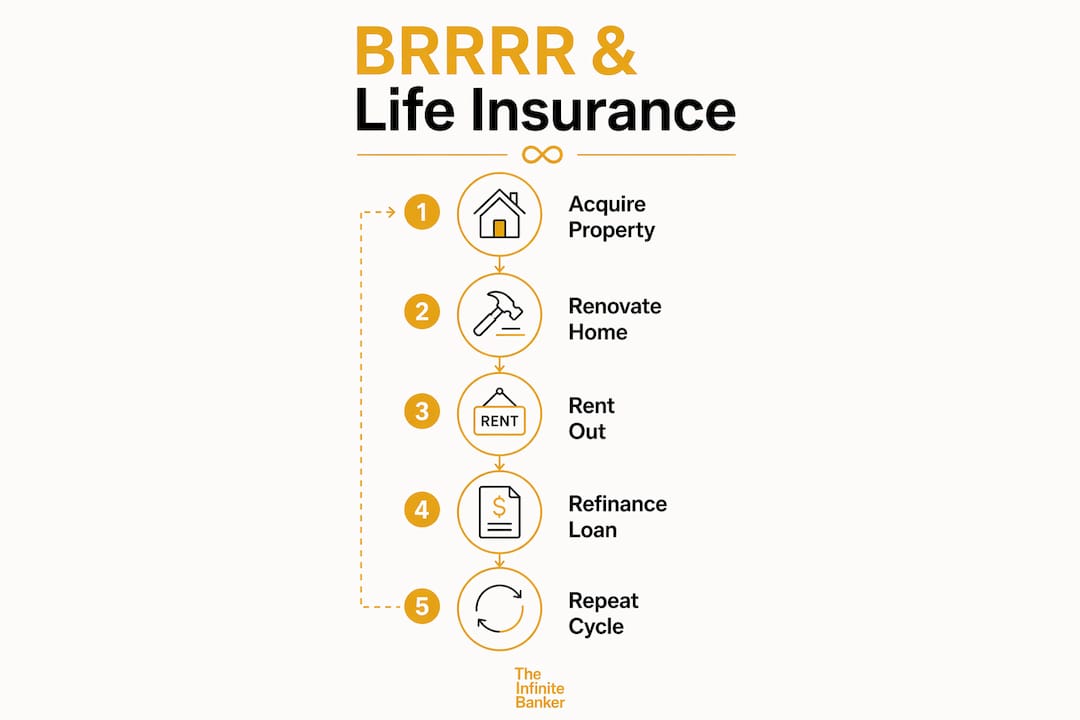
BRRRR success requires keeping all-in costs, including insurance, under 75% of After Repair Value (ARV) for refinance eligibility. In high-cost markets, insurance alone can consume a significant portion of that budget. In South Florida, for example, annual insurance on a property under renovation can run $5,000–$7,000. That figure compounds across a six-month holding period and must be factored into your total acquisition cost.
Refinancing adds another layer of insurance compliance. Lenders require that properties pass a 4-point insurance inspection covering the roof, plumbing, and electrical systems before a refinance will close. A failed inspection does not just delay your timeline. It can block the refinance entirely, trapping your capital in the deal.
The table below shows how insurance costs interact with DSCR calculations and refinance thresholds:
Factor | Impact on BRRRR refinance |
Annual insurance premium | Increases total PITI, reducing DSCR |
DSCR lender requirement | Typically 1.20 to 1.25 for rental property refinance |
4-point inspection failure | Blocks refinance regardless of equity position |
Insurance cost as % of ARV | Counts toward the 75% all-in cost ceiling |
Higher insurance premiums increase your total Principal, Interest, Taxes, and Insurance (PITI) payment. That directly reduces the DSCR ratio lenders use to approve your refinance. A deal that looks profitable at acquisition can fall below the 1.20 DSCR threshold once accurate insurance costs are applied.
Pro Tip: Get insurance quotes before closing on a BRRRR acquisition, not after. In high-premium markets, a $2,000 difference in annual insurance can shift your DSCR below lender minimums and kill the refinance.
How do investors use life insurance loans to execute BRRRR deals?
The practical application of life insurance in BRRRR investing follows a clear sequence. You borrow from your policy’s cash value to cover carrying costs during the renovation and holding period. After the refinance closes, you repay the policy loan with refinance proceeds. The cash value inside the policy continued compounding throughout that cycle, even while the loan was outstanding.
This approach addresses one of the most common cash flow problems in BRRRR investing: the funding lag between acquisition and refinance. During that window, investors must cover insurance premiums, property taxes, and renovation costs without rental income. Paying those costs with policy loans avoids high-interest short-term debt and preserves rehab capital for value-add work that drives forced appreciation.
A practical framework for integrating policy loans into a BRRRR deal looks like this:
Acquire the property using your primary financing source (hard money, private money, or cash).
Draw a policy loan to cover insurance premiums, property taxes, and any carrying costs during renovation.
Complete the rehab with your full rehab budget intact, since carrying costs are funded separately.
Rent the property and stabilize income to meet DSCR requirements.
Refinance into a long-term loan and use a portion of the cash-out proceeds to repay the policy loan.
Repeat the cycle with the replenished cash value on the next acquisition.
The compounding effect inside the policy continues during steps 2 through 5. Borrowing against the policy does not pause the internal growth of the cash value, which is the core mechanic that makes this approach more capital-efficient than liquidating assets or drawing on taxable accounts.
High earners who treat their policies as base-layer banking systems use this cycle to scale portfolios without repeatedly returning to traditional lenders for short-term capital. Recycling capital through the policy rather than through bank credit lines keeps more of the compounding effect inside a tax-deferred structure.
What are the risks and best practices when using life insurance in BRRRR?
Life insurance is a liquidity tool, not a standalone investment. Treating it as a replacement for sound deal analysis or adequate rehab budgeting creates real financial risk. The strategy works when the underlying BRRRR deal works. It does not rescue a bad deal.
Policy loans carry interest, and that interest accrues whether or not you make payments. Unpaid loan interest reduces available cash value and the policy’s death benefit. If the loan balance grows large enough relative to the cash value, the policy can lapse. A lapsed policy triggers a taxable event on any gains, which eliminates the tax-deferred advantage entirely.
The investors best positioned to use this approach share a specific profile. Permanent life insurance fits best for those with maxed-out tax-advantaged retirement accounts who need additional tax-deferred growth and flexible liquidity for capital-intensive investments. It supplements traditional investment structures rather than replacing them.
Practical best practices for managing this risk include:
Budget insurance carrying costs before acquisition. Failing to include insurance costs in your rehab budget can damage the project’s internal rate of return and refinancing outcome.
Keep premiums current. A lapsed policy eliminates your liquidity source and may trigger taxes.
Repay policy loans promptly after refinance. Treat the refinance cash-out as the scheduled repayment event, not an optional one.
Monitor your loan-to-cash-value ratio. Borrowing too close to your full cash value leaves no buffer if the deal extends beyond its projected timeline.
Key Takeaways
Permanent life insurance functions as a capital recycling tool within BRRRR investing, providing tax-deferred liquidity that preserves rehab budgets, supports DSCR compliance, and avoids high-interest short-term debt.
Point | Details |
Policy loans fund carrying costs | Borrow against cash value to cover insurance and taxes during renovation without depleting rehab capital. |
Insurance affects DSCR directly | Higher premiums increase PITI and can push your ratio below the 1.20–1.25 lender threshold. |
4-point inspection gates refinance | Roof, plumbing, and electrical must pass inspection before a lender will close a BRRRR refinance. |
Loan interest accrues and compounds | Unpaid policy loan interest reduces cash value and death benefit; policies can lapse if unmanaged. |
Best fit for high earners | Investors with maxed retirement accounts benefit most from the added tax-deferred liquidity layer. |
What I’ve learned from watching investors misuse this tool
I’ve worked with real estate investors who came to The Infinite Banker after a BRRRR deal went sideways, not because the strategy failed, but because they treated the policy loan as free money. It is not. The interest is real, the lapse risk is real, and the tax consequences of a lapsed policy are real.
The investors who use this well share one habit: they plan the repayment before they take the loan. They know the refinance timeline, they know the cash-out amount, and they treat the policy loan repayment as a line item in the deal budget. That discipline is what separates a capital-efficient investor from one who slowly erodes their policy’s value over several deals.
The other thing I’ve seen consistently is that investors underestimate how much insurance costs affect their DSCR. They model the deal with a rough insurance estimate, then get the actual quote after closing and find their numbers no longer work. Getting accurate insurance quotes before acquisition is not optional in high-premium markets. It is part of underwriting.
Life insurance is not the most exciting part of a BRRRR deal. But it may be the most underused capital tool available to investors who have already maxed their tax-advantaged accounts and need a flexible, non-correlated liquidity source. Used with discipline, it changes how you think about capital allocation across a growing portfolio.
— Jib Hunt, Authorized IBC Practitioner
How The Infinite Banker supports BRRRR investors
Real estate investors who want to use dividend-paying whole life insurance as a capital management tool need a policy structured for that purpose from day one. A policy designed for death benefit alone will not accumulate cash value fast enough to serve as a meaningful liquidity source during active BRRRR cycles.

The Infinite Banker works with investors and entrepreneurs to design whole life policies built around cash flow, liquidity, and capital recycling. The Infinite Banking Concept, as implemented through properly structured policies, is designed to give investors a personal banking system that grows tax-deferred and stays accessible when deals require fast capital. If you are actively running BRRRR deals or planning to scale your portfolio, explore who benefits most from this approach and whether it fits your investment profile.
FAQ
What is the role of life insurance in BRRRR strategy?
Permanent life insurance provides a policy loan facility that investors use to cover carrying costs during the renovation and holding phases of a BRRRR deal. The cash value grows tax-deferred and can be accessed without credit checks or mandatory repayment schedules.
How do policy loans affect cash value and death benefit?
Policy loan interest accrues on the outstanding balance and reduces both the available cash value and the death benefit if left unpaid. Policies can lapse if the loan balance grows beyond the cash value, which may trigger a taxable event.
What DSCR do BRRRR lenders typically require?
Most BRRRR lenders require a Debt Service Coverage Ratio of 1.20 to 1.25. Insurance premiums factor directly into the PITI calculation, so higher insurance costs reduce the ratio and can affect refinance eligibility.
Can a failed insurance inspection block a BRRRR refinance?
Yes. Lenders require properties to pass a 4-point insurance inspection covering the roof, plumbing, and electrical systems before closing a refinance. A failed inspection can block the refinance regardless of the property’s equity position.
Who benefits most from using life insurance in BRRRR investing?
Investors with maxed-out tax-advantaged retirement accounts who need additional tax-deferred liquidity for capital-intensive deals benefit most. Permanent life insurance supplements traditional investment structures rather than replacing them.
This post is educational only and not financial, tax, or legal advice. Consult qualified professionals before acting.
Comments