
U.S. Whole Life Loan Rates, 5%–8%: State Rules and IBC Repayment


COMPLIANCE NOTE: For educational purposes only. Not financial, tax, or legal advice.
Most U.S. life insurance policy loans carry interest rates between roughly 5% and 8%, though the exact figure depends on your carrier, your policy’s issue date, and whether the loan provision is fixed or adjustable. Only permanent cash-value policies, such as whole life or universal life, qualify for this kind of borrowing. The core tradeoff is straightforward: you get access to cash at a rate often lower than a credit card or personal loan, but unpaid interest accrues against your policy and can shrink both cash value and death benefit over time.
TL;DR:
Policy loan interest rates typically range from 5% to 8%, with fixed rates remaining constant and adjustable rates fluctuating based on market and carrier formulas.
Adjustable rates respond to broader credit market movements and may change annually, often influenced by an index or the insurer’s investment performance.
Borrowing against cash value reduces both the death benefit and available cash value, risking policy lapse if the loan exceeds the cash value.
Loans are capped at around 90% to 95% of your policy’s cash value, which accumulates over time and is listed on your annual statement.
Proper repayment planning, including scheduled principal payments, is essential to maintain policy durability and avoid unintended taxation or policy lapses.
Table of Contents
What Determines Your Policy Loan Interest Rate
Every whole life or universal life contract spells out how loan interest is calculated, and the language falls into two broad categories: fixed and adjustable.
A fixed-rate loan provision locks in one interest rate for the life of the loan, typically set in the contract at issue. It never moves, regardless of what happens in the broader interest rate environment. An adjustable, or variable, provision lets the carrier reset the rate periodically, often on the policy anniversary, based on a formula tied to a published index or the insurer’s own investment experience.
Carriers that use adjustable provisions commonly apply a margin over a reference rate, then round or cap the result according to the formulas buried in the policy’s loan section. MassMutual’s own adjustable loan rate chart shows how much these figures move: rates on some whole life products sat at 5.33% in January 2026 and climbed to 5.63% by April 2026, a swing that traces broader credit market movement rather than anything the policyholder did.
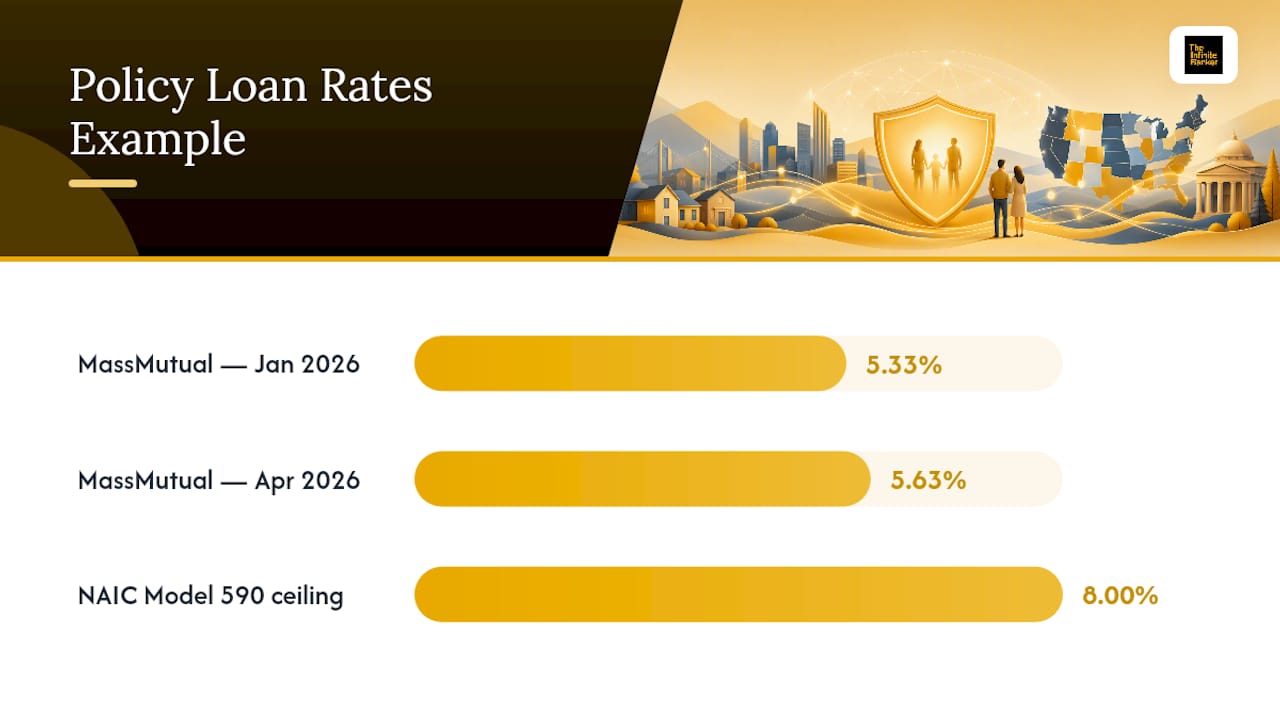
State insurance law shapes what carriers can actually charge. The NAIC Model Policy Loan Interest Rate Bill, known as Model 590, sets an illustrative ceiling of 8% per year for policies that use a fixed rate, and it permits adjustable rates tied to a published average when carriers choose that path instead. Not every state adopted Model 590 in the same form, so the practical cap and the notification rules that accompany a rate change can vary depending on where your policy was issued.
Some things to check with your carrier before you borrow include:
Whether your policy’s loan provision is fixed or adjustable, and how often an adjustable rate can reset
What index or internal calculation drives any rate change
Whether the insurer is required to notify you before a rate adjustment takes effect
Where in your contract the loan interest terms are actually written
Pro Tip: Call your carrier and ask them to point you directly to the loan provision page in your policy contract. Reading the actual language beats relying on a generic brochure, since two policies from the same company can carry different loan terms depending on issue year.
Typical Rate Ranges and What Moves Them
Consumer-facing guidance from major carriers converges on a similar number. New York Life describes typical policy loan interest rates as generally falling between 5% and 8%, and that range shows up consistently across insurer materials, though adjustable loans tied to volatile credit markets can occasionally land outside it.
Several factors explain why your rate might sit at the low or high end of that band.
Factor | How it affects your rate |
Loan provision type | Fixed rates stay constant; adjustable rates track market and carrier formulas |
Policy type | Participating whole life and universal life often price loans differently |
Loan category | A true policy loan differs from an automatic premium loan used to cover a missed premium |
Policy issue year | Older contracts may carry loan terms no longer offered on new policies |
Carrier investment returns | Some adjustable formulas reference the insurer’s own portfolio performance |
Adjustable rates tend to drift with the broader interest rate cycle. A borrower who took a loan when rates were near 5% could see that number tick upward a year or two later if the carrier’s formula responds to rising credit costs, which is exactly the pattern visible in MassMutual’s recent rate history.
How a Policy Loan Affects Cash Value and Death Benefit
A policy loan is not a withdrawal. The insurer advances you money using your cash value as collateral, and that balance accrues interest, whether you pay it or not.
You generally have a few ways to handle that interest:
Pay it out of pocket on a schedule, keeping the loan balance from growing
Let it accrue and add to the outstanding loan balance, which compounds over time
Make periodic principal payments alongside interest to shrink the balance directly
Investopedia notes that carriers typically offer interest-only payments or scheduled principal reductions, and that unpaid interest simply capitalizes onto the loan.
The risk shows up if you let the balance run. An outstanding loan, plus accrued interest, reduces the death benefit your beneficiaries would receive, and it eats into the cash value available to you later. If the loan balance ever grows large enough to exceed the policy’s cash value, the carrier can lapse the policy, and a lapse with a loan larger than what you paid into the contract can trigger a taxable event.

Dividends complicate the picture further. Participating whole life policies may pay dividends, but those dividends are never guaranteed, and some carriers factor outstanding loan balances into how dividends get credited. A policy with a large unpaid loan may see its dividend experience look different than an identical policy with no loan at all.
Pro Tip: Set a calendar reminder to review your policy’s annual statement every year you have an outstanding loan. Catching a growing balance early gives you time to make a principal payment before it threatens the policy’s standing.
How Much You Can Borrow Against Your Policy
Carriers cap policy loans as a percentage of available cash value, not the policy’s face amount, and most contracts hold back a small reserve to keep the policy from lapsing immediately if you borrow the maximum.
Check your available cash value first. This figure grows over time and is listed on your annual statement, not your original death benefit.
Apply the carrier’s loan-to-value cap. Many insurers cap loans at somewhere close to 90% to 95% of cash value, though the exact figure is set by contract.
Subtract any existing loan balance. If you already have a loan outstanding, the new available amount shrinks accordingly.
Confirm waiting periods. Some policies restrict loans in the earliest years before cash value has meaningfully accumulated.
Consider a simplified example: a policy with a $500,000 face amount might have $80,000 in accumulated cash value after several years of premium payments. Your actual numbers depend entirely on your contract, so treat any example as illustrative rather than predictive.
When a Policy Loan Makes Sense, and What Else to Consider
Policy loans often fit short-term cash needs where speed and simplicity matter more than shaving a fraction of a point off the rate. There’s no credit check, no application delay, and the rate frequently beats what you’d pay on a credit card or an unsecured personal loan.
Other options carry their own tradeoffs:
Home equity lines of credit often offer lower rates but require an appraisal, closing costs, and put your home up as collateral.
Personal loans close quickly but usually carry higher rates than a policy loan, especially for borrowers without strong credit.
Cash-value withdrawals avoid interest entirely but can permanently reduce your death benefit and may trigger tax on any gain above basis.
Before borrowing, ask yourself: What’s the loan actually for? Do you have a realistic repayment plan? How would an unpaid balance affect what your beneficiaries eventually receive? Those three questions do more to protect the policy than any rate comparison.
Questions to Ask Your Insurer Before You Borrow
Getting straight answers up front saves you from surprises two or three years into a loan.
What is the current loan interest rate, and is it fixed or adjustable?
If adjustable, how often does it reset and what index or formula drives the change?
Is interest compounded, and how often?
Will you receive written notice before any rate change takes effect?
How does an outstanding loan affect dividend crediting and nonforfeiture values?
Keep every written disclosure your carrier sends about the loan calculation, along with your most recent annual statement. If a representative can’t clearly explain how the rate resets or dodges the compounding question, treat that as a signal to get the answer in writing before you sign anything.
Pro Tip: Ask specifically for the adjustable rate’s reset history over the past three to five years, not just today’s rate. A carrier that has kept rates relatively stable tells you more than a single snapshot number.
Repayment Planning: An Authorized IBC Practitioner’s View
Structuring repayment before you borrow matters more than chasing the lowest advertised rate. Entrepreneurs using policy loans to fund a business opportunity or a real estate deal do well to match the loan’s repayment horizon to the cash flow that will actually service it.
Practical tactics include:
Scheduling periodic principal payments rather than letting interest compound indefinitely
Setting a budget trigger, a specific dollar threshold, that prompts an interest payment before the balance grows
Avoiding structural reliance on rising cash value alone to cover a large, long-term loan without any scheduled paydown
Jib Hunt, an Authorized IBC Practitioner with The Infinite Banker, emphasizes that dividends are not guaranteed and should never be treated as a repayment source on their own.
Balancing Liquidity and Policy Durability
Low-cost access to your own capital is one of the more compelling features of a properly structured whole life policy, but that access only holds value if the policy stays in force. Read our step-by-step guide if you want a more consultative path toward structuring loans you can actually manage.
— Jib Hunt
Get Help Structuring a Policy You Can Borrow Against Responsibly
Reading rate charts and NAIC language tells you what’s possible. Designing a policy and a repayment plan that fits your actual cash flow, as an entrepreneur or real estate investor, is a different exercise entirely.

Consultants help entrepreneurs, real estate investors, and high-income earners with policy design, underwriting guidance, and ongoing education about capital efficiency and cash flow management. The process aims to help you think through how a policy loan fits your broader financial picture, including realistic repayment planning before you ever borrow a dollar. If you’re weighing whether a properly structured dividend-paying whole life policy fits your situation, start by exploring Infinite Banking for entrepreneurs and requesting a strategy session to talk through your specific goals.
Where to Verify Policy Loan Rates and Rules
This article is general information, not a substitute for advice from a qualified financial advisor. Consult a qualified financial professional about your own circumstances before acting on anything here.
Sources
FAQ
How much can I borrow from a $500,000 life insurance policy?
The borrowing limit depends on accumulated cash value, not the $500,000 face amount. A policy with, say, $80,000 in cash value might allow a loan up to roughly 90% of that figure, so check your annual statement and your contract’s specific loan-to-value cap.
Is a 30% interest rate on a policy loan legal?
No. Standard whole life and universal life policy loans fall within the range described by the NAIC Model 590, which sets an illustrative maximum of 8% per year for fixed-rate provisions.
What is the maximum interest rate on a life insurance policy loan?
Most carriers in practice quote rates between 5% and 8%, depending on the product and policy year.
What is the cash value of a $1,000,000 life insurance policy?
Cash value depends entirely on the policy’s design, premium payments, dividend history, and how long it has been in force, not the face amount alone. Two high-face-amount policies from different carriers or issue years can have very different cash values, so the figure has to come from your own policy’s annual statement rather than a general rule.
Can I deduct policy loan interest on my taxes?
Interest paid on a personal life insurance policy loan is generally not deductible, since the loan is treated as personal borrowing rather than business or investment interest in most cases. Consult a tax professional about your specific situation, since deductibility can depend on how the loan proceeds are used.
This post is educational only and not financial, tax, or legal advice. Consult qualified professionals before acting.
Recommended
Comments