
$300–$1,000/mo Infinite Banking Case Study for Entrepreneurs, 7–10 yrs


COMPLIANCE NOTE: For educational purposes only. Not financial, tax, or legal advice.
Real people have used properly funded, dividend-paying whole life policies to finance cars, real estate flips, and business cash gaps by borrowing against their own cash value instead of a bank. It works, but only under specific conditions: sustained funding for years, disciplined repayment, and a policy engineered for cash value rather than pure death benefit. It suits entrepreneurs, real estate investors, and high-income earners who can commit capital for a decade, not anyone chasing a quick return. The three case studies and mechanics below show what that looks like in practice, and an available calculator lets you test the same math against your numbers.
TL;DR:
Infinite banking requires at least seven to ten years of consistent funding to build enough cash value for meaningful borrowing capacity.
Using policies with direct recognition on loans can reduce dividend growth, affecting long-term cash value accumulation.
Overfunding policies excessively can trigger MEC status, leading to unfavorable tax consequences on loans and withdrawals.
Loan repayment discipline and conservative modeling are critical to avoid policy lapses, tax issues, or underperformance.
Tailoring policy design with professional guidance enhances long-term flexibility and aligns with specific liquidity or investment needs.
Table of Contents
Three Infinite Banking Examples With Real Funding Numbers
Every credible infinite banking case study shares a pattern: years of funding before the payoff, then a loan that replaces an outside lender. Here are three versions of that pattern, each drawn from documented practitioner scenarios.
1. A family car purchase funded through a policy loan. A policyholder funded a whole life contract for several years, building cash value through premium payments and paid-up additions. When it came time to replace a vehicle, instead of financing through a bank, the policyholder borrowed against the policy’s cash value and repaid the loan on a set schedule. The lesson here is not the car itself. It is that disciplined repayment kept the policy’s death benefit intact and let compounding continue largely undisturbed, because the loan balance was retired before it could erode long-term growth.
2. A real estate flipper replacing hard-money lending. A real estate investor who had relied on private hard-money loans at roughly 14% to 16% annual interest began overfunding whole life policies specifically to self-finance flips. Over several years of consistent annual funding, the investor recaptured the interest costs that would otherwise have gone to outside lenders, using policy loans to cover acquisition and rehab costs on each project and repaying them as properties sold. The operational cycle repeated: borrow, deploy, sell, repay, repeat.
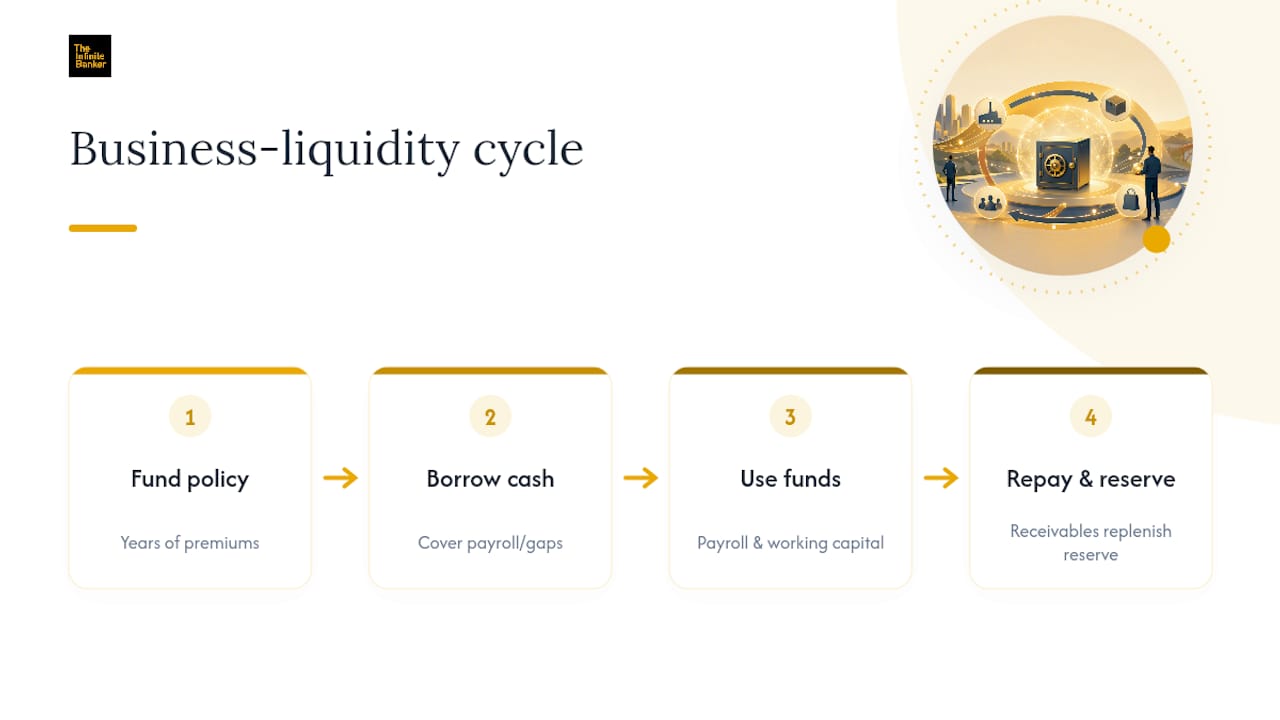
3. An entrepreneur using policy cash value for business liquidity. A business owner facing seasonal cash gaps or short-notice capital calls used policy loans as a liquidity buffer, borrowing against cash value to cover payroll or working capital, then replenishing the loan once receivables came in. Over time, this created a standing reserve outside the banking system, though the cash value backing it still needed years of funding to reach a useful size.
How the Mechanics Actually Work
Cash value is the savings-like component inside a dividend-paying whole life policy. It grows through guaranteed policy values, non-guaranteed dividends the insurer may pay (dividends are never guaranteed and can be reduced or eliminated), and paid-up additions, which are small increments of extra insurance purchased with additional premium that accelerate cash value growth. Nelson Nash outlined this approach in Becoming Your Own Banker, and most practitioners still favor mutual insurance companies that pay dividends to policyholders.
A policy loan lets the owner borrow against that cash value as collateral, without a credit check, while the insurer charges interest on the outstanding balance.
Base premium vs. PUA funding: minimizing base premium and directing more dollars into paid-up additions builds cash value faster in early years.
Direct vs. non-direct recognition: some insurers reduce the dividend on borrowed cash value; others credit the full amount regardless of loans outstanding. This affects long-term growth when loans stay open.
MEC risk: overfund a policy too aggressively relative to its death benefit, and it can become a Modified Endowment Contract, changing how loans and withdrawals are taxed.
Pro Tip: Ask any prospective carrier directly whether their policy uses direct or non-direct recognition on loans. This one design detail changes how much a loan actually costs you over a decade.
Who Should Consider This, and How Much It Takes
Funding ranges vary widely, but practitioner guidance typically points to $300 to $1,000 or more per month for individual policies, with mid-five-figure annual funding producing faster borrowing capacity for business owners and investors. The timeline unfolds in phases.
Years 1 to 3: capitalization phase, cash value builds slowly as early costs are absorbed.
Years 4 to 7: breakeven approaches as cumulative cash value catches up to premiums paid.
Years 7 to 10 and beyond: borrowing capacity becomes meaningful enough to fund real purchases or business needs.
A reasonable suitability checklist: stable, predictable cash flow; a genuine multi-year time horizon; and the discipline to repay loans on a schedule rather than let them ride. Red flags include unstable income, a need for liquidity within one to two years, or an unwillingness to fund consistently through market or business cycles.
Risks and Considerations Worth Weighing Honestly
Whole life insurance carries substantially higher costs in the early years than term insurance, and that early-year drag pushes breakeven out for years, which is exactly why the funding timeline above matters so much.
Unpaid loans reduce death benefit dollar for dollar and can cause a policy to lapse if the loan balance grows faster than cash value.
MEC tax consequences can turn what should be tax-advantaged loans into taxable withdrawals if a policy is overfunded relative to its death benefit.
Commission and fee drag in year one and two is real, and no amount of optimistic modeling erases it.
A detailed risk breakdown is worth reading before committing to a funding schedule. Mitigation comes down to conservative funding projections, strict repayment discipline, and choosing a carrier and policy design suited to banking use rather than pure protection.
Resources for Testing These Numbers Yourself
Jib Hunt, an Authorized IBC Practitioner, built tools specifically so readers can check case-study math against their own situation rather than take examples on faith.
The Infinite Banking Calculator lets you input monthly or annual funding and see projected cash value over time.
Enter a funding amount similar to one of the case studies above, then compare the projected breakeven year against your own liquidity needs.
Watch the loan capacity output closely. It tells you when borrowing becomes realistic, not just when cash value starts to appear.
Pair the calculator with a step-by-step implementation guide for the underwriting and design decisions behind the numbers.
What I’ve Learned Reviewing These Cases
Three mistakes show up again and again. Underfunding a policy relative to its death benefit stretches out the timeline unnecessarily; fix it by running the numbers before issue, not after. Ignoring MEC limits during enthusiastic early overfunding creates tax headaches; fix it by designing paid-up additions correctly at the outset. Borrowing without a repayment plan is the most common failure, and it is entirely avoidable with a written schedule.
Before moving forward, ask yourself five questions: Can I fund this for at least seven years without strain? Do I have a repayment plan for any loan I take? Have I modeled a conservative dividend scenario, not an optimistic one? Does my carrier use direct or non-direct recognition? And am I solving a real liquidity need, or chasing a concept? Model the conservative case first. It tells you more than the best case ever will.
— Jib Hunt
How The Infinite Banker Can Help You Apply This
Reading case studies is useful. Building a policy that actually performs like one requires design work most people cannot do alone, and that is where The Infinite Banker’s consulting fits. Consulting services are available to entrepreneurs, real estate investors, and high-income earners on strategy sessions, policy design, and underwriting guidance, aiming for structures that emphasize cash value growth and long-term flexibility rather than commission-heavy defaults.
This approach suits readers who recognized their own situation in the case studies above: a business owner who wants a liquidity buffer, an investor tired of paying private lenders, or a high earner looking for a capital-efficient alternative to idle cash. If any of that sounds familiar, start by reading the step-by-step guide to how these policies are structured, then request an initial consultation through The Infinite Banker to see what a properly designed policy could look like for your specific funding capacity and timeline.
Sources
For balanced, third-party explanations of the mechanics covered above, NerdWallet’s overview of infinite banking covers loan mechanics and typical drawbacks in plain language. MoneyGeek’s analysis compares whole life costs against term insurance and MEC risk. The Corporate Finance Institute’s explainer traces the concept back to Nelson Nash. For treasury-side thinking on managing cash flow risk generally, see this overview of cash flow at risk.
This article is general information, not a substitute for advice from a qualified financial advisor. Consult a qualified financial professional about your own circumstances before acting on anything here.
FAQ
Does infinite banking actually work?
It can work as designed, meaning policyholders can borrow against cash value they built through premiums and paid-up additions. It requires years of consistent funding and repayment discipline, and it is not a fast or guaranteed path to any specific financial outcome.
How much money do I need to start infinite banking?
Practitioner guidance generally points to $300 to $1,000 or more per month for an individual policy, with mid-five-figure annual funding producing faster borrowing capacity for investors and business owners. Meaningful borrowing capacity typically takes seven to ten years to develop.
Is infinite banking illegal?
No. It uses ordinary dividend-paying whole life insurance and policy loans, both long-standing, regulated financial products. The strategy carries real costs and risks, including loan interest and potential lapse, but nothing about it is unlawful.
Can you provide an example of how infinite banking works?
Yes. In one documented case, a real estate investor funded whole life policies for several years, then used policy loans to replace hard-money lending on flips, repaying each loan as properties sold and repeating the cycle.
This post is educational only and not financial, tax, or legal advice. Consult qualified professionals before acting.
Recommended
Comments