
Access Cash in 1–5 Years with Infinite Banking Basics for Entrepreneurs


COMPLIANCE NOTE: For educational purposes only. Not financial, tax, or legal advice.
Infinite Banking is a strategy built around an overfunded dividend-paying whole life insurance policy. You fund the policy heavily, let cash value accumulate, then borrow against it through policy loans to finance expenses or investments while the underlying cash value continues earning. It is a long-term approach that can provide private access to capital, though it depends heavily on policy design, funding discipline, and carrier performance.
TL;DR:
Properly funding a whole life policy with substantial paid-up additions accelerates cash value growth, making policy loans more accessible within five years.
Insurance carriers’ dividend payments are variable and not guaranteed, affecting projected cash value and dividend-related benefits over the policy’s lifespan.
Ignoring MEC limits, underfunding PUAs, or assuming dividend scales will stay consistent can significantly reduce policy effectiveness or trigger tax penalties.
Borrowing against cash surrender value instead of the death benefit reduces available loan amounts and increases the risk of policy lapse if loans go unpaid.
An effective Infinite Banking setup requires disciplined funding, careful design, and stress-testing scenarios to avoid common mistakes that undermine long-term benefits.
Table of Contents
What Are the Infinite Banking Basics You Need to Know First?
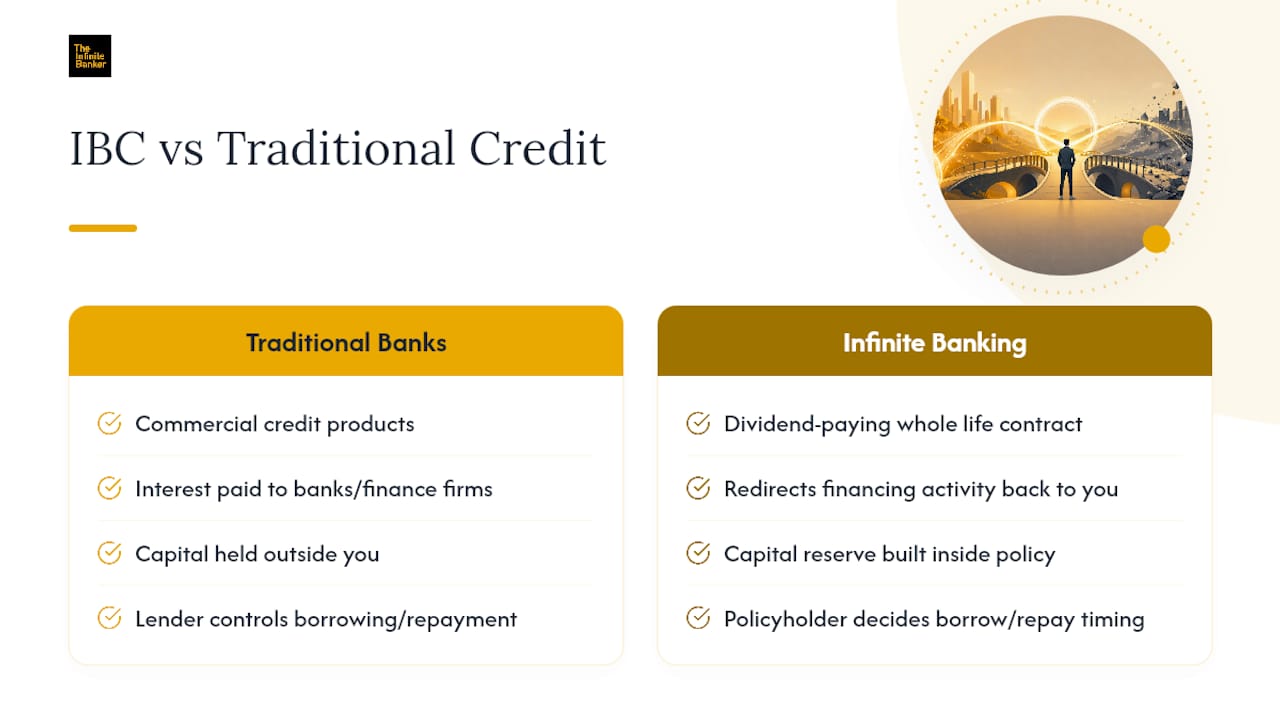
The Infinite Banking Concept, often shortened to IBC, was developed by Nelson Nash, a forester and financial professional who outlined the idea in his book Becoming Your Own Banker. Nash argued that most people route enormous amounts of interest to commercial banks and finance companies over a lifetime, and that a properly structured whole life policy could let a person redirect some of that financing activity back to themselves.
That is the entire premise. It is not a product. It is not a type of insurance policy you buy off a shelf. It is a way of using a dividend-paying whole life contract, specifically designed with paid-up additions, as a personal reserve of capital you can borrow against on your own terms. The insurance company remains the lender of record on any policy loan, but the decision to borrow, how much, and when to repay rests with the policyholder.
For entrepreneurs and real estate investors, the appeal is straightforward: instead of relying exclusively on bank credit lines, business loans, or brokerage margin, you build a capital reserve inside a contract that also carries a death benefit and, historically, a dividend from mutual insurers. Whether that reserve grows fast enough and stays accessible enough to matter comes down to how the policy is built.
How Does Infinite Banking Work Step by Step?
Understanding how infinite banking works in practice means following a policy from funding to repayment and back again. The mechanics are consistent from one properly designed policy to the next, even though the numbers vary by carrier and by how much premium a person commits.
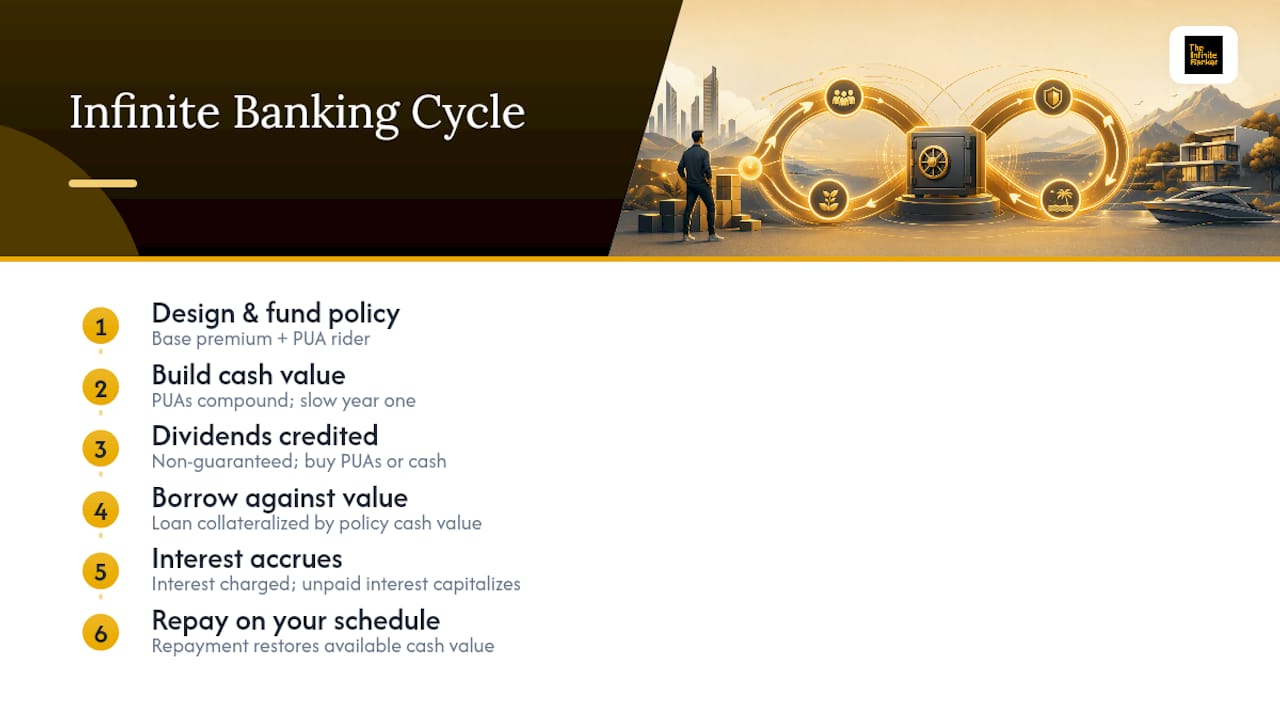
Step 1: Design and fund the policy. A dividend-paying whole life policy gets structured with a base premium plus a paid-up additions (PUA) rider. The PUA rider is what separates an infinite banking policy from an ordinary whole life contract bought for death benefit alone. It lets you direct additional premium dollars into purchasing small increments of fully paid-up insurance, which builds cash value far faster than base premium alone.
Cash value in a properly funded contract typically grows slowly in year one but accelerates as PUAs compound.
Step 3: Dividends get credited, but they are not promised. Mutual insurance companies with strong histories of paying dividends may credit a portion of company profits back to policyholders each year. Those dividends can be used to purchase more paid-up additions, taken as cash, or applied to premium. None of this is guaranteed, and a carrier can lower or suspend its dividend scale in a given year.
Step 4: Borrow against the cash value. Once there is meaningful cash value, the policyholder can request a policy loan. The insurer typically does not run a credit check or ask what the money will be used for, because the loan is collateralized by the policy’s own cash surrender value, not by the borrower’s income or credit profile. This is a genuinely different lending relationship than a bank line of credit.
Step 5: Interest accrues on the loan. Policy loans are not free money. The insurer charges interest on the outstanding balance, and if that interest is not paid, it capitals onto the loan. An unpaid policy loan balance reduces both the available cash value and the death benefit paid to beneficiaries, and a large enough unpaid balance can cause the policy to lapse.
Step 6: Repay on a self-directed schedule. The policyholder decides how and when to repay, subject to the loan continuing to accrue interest. Repaying restores available cash value that can be borrowed again for the next expense, purchase, or investment.
Practical timing matters more than most explanations suggest. Cash value in the early years of a heavily PUA-funded policy is often accessible within one to five years, depending on how the policy was structured and how much premium the person committed. A policy funded conservatively and slowly will take longer to reach a cash value large enough to matter for real financing needs. For a deeper walk through this sequence, see how infinite banking works step by step.
What Are the Key Components of an Infinite Banking Policy?
Every explanation of infinite banking eventually runs into a wall of insurance terminology. Understanding a handful of terms clearly is what separates someone who can evaluate a policy illustration from someone who is simply trusting a salesperson.
Dividend-paying whole life insurance is the chassis. Whole life carries guaranteed cash value growth and a guaranteed death benefit, set at issue and contractually locked in as long as premiums are paid. The dividend is the variable piece: a mutual insurer may distribute a portion of surplus to policyholders, but dividends are declared annually, not promised, and can rise, fall, or disappear depending on company performance.
Paid-up additions (PUA) are the accelerator. Each dollar directed into the PUA rider buys a small amount of additional, fully paid whole life insurance, which comes with its own cash value and its own future dividend eligibility. A policy funded heavily through PUAs in the early years builds accessible cash value considerably faster than one funded through base premium alone, which is why PUA design is the single biggest lever in how quickly a policy becomes useful for banking purposes.
MEC rules stand for Modified Endowment Contract, a tax classification triggered when a policy is overfunded beyond IRS limits relative to its death benefit in the first seven years. A policy that becomes a MEC loses the favorable loan tax treatment ordinary life insurance policies enjoy: loans from a MEC are treated more like taxable withdrawals. Every legitimate infinite banking design keeps funding aggressive but stays under the MEC threshold.
Loan recognition methods determine how a policy loan interacts with dividends. Under direct recognition, the insurer may credit a different dividend rate to the portion of cash value that has been borrowed against. Under non-direct recognition, the dividend rate stays the same regardless of outstanding loans. Neither method is universally better; it depends on the carrier’s overall dividend history and crediting philosophy.
Illustration assumptions are projections, not promises. Every whole life illustration shows a guaranteed column (the contractual minimum) and a non-guaranteed column that assumes a continuing dividend scale. A responsible reading of any illustration means paying far more attention to the guaranteed numbers than the illustrated ones.
Key terms at a glance:
Term | What it does |
Dividend-paying whole life | The base contract; guarantees cash value and death benefit, dividends are separate and not guaranteed |
Paid-up additions (PUA) | Rider that buys extra paid-up insurance, accelerating early cash value |
MEC threshold | IRS-defined funding limit; exceeding it changes how loans are taxed |
Direct vs. non-direct recognition | Determines whether borrowed cash value earns a different dividend rate |
Cash surrender value | The amount available to borrow against or receive if the policy is canceled |
One detail surprises most first-time policyholders: the loan collateral is the cash surrender value, not the full account value, and not the death benefit. That distinction shapes exactly how much can be borrowed at any given point.
Whole life guarantees are contractual; dividends are discretionary and can change year to year.
PUAs are the mechanism that makes early cash value usable rather than theoretical.
MEC status is a tax classification to avoid, not a design goal.
Loan recognition method affects long-term dividend outcomes on borrowed balances.
Illustrations should always be read at the guaranteed column first.
Learn more about the underlying mechanics on what is infinite banking.
What Are the Real Benefits People Look For in Infinite Banking?
The advantages commonly cited for Infinite Banking are real, but each one depends on the policy being funded correctly and used with discipline. None of them arrive automatically just because a policy exists.
Recapturing interest on recurring financing. Someone who regularly finances vehicles, equipment, or short-term real estate purchases through banks pays interest to that bank every time. Borrowing against policy cash value instead means the interest paid on the loan, at least in part, supports a system the policyholder owns, rather than exclusively enriching a third-party lender. This benefit matters most for people with genuinely recurring financing needs, not for someone who borrows once a decade.
Capital access without a credit check. Because the loan is collateralized by cash value, insurers generally do not evaluate income, credit score, or purpose of the loan. That can matter for entrepreneurs whose income is irregular or who have already stretched conventional credit lines.
Tax-deferred growth inside the policy. Cash value inside a permanent life insurance contract grows without annual taxation, and policy loans are generally not treated as taxable income as long as the policy remains in force and is not a MEC. This is not tax advice, and specific tax treatment depends on individual circumstances.
A non-market-correlated asset. Whole life cash value does not move with stock or bond markets day to day, which is why some investors treat it as a stabilizing complement to a broader portfolio rather than a replacement for one.
Legacy and death benefit planning. The death benefit remains a permanent feature of the contract, separate from whatever cash value has been borrowed against, subject to any outstanding loan balance being deducted at claim time.
Pro Tip: Run the numbers on your own recurring financing habits before assuming Infinite Banking fits. If you rarely finance anything and keep cash reserves in a savings account, the interest recapture benefit will matter far less to you than it does to someone who finances three or four vehicles or investment properties every year.
For a fuller treatment of these advantages and their limits, see benefits of infinite banking.
What Are the Risks and Disadvantages of Infinite Banking?
Every honest explanation of Infinite Banking has to sit next to its costs and failure modes, because the strategy is unforgiving of poor funding decisions.
Upfront funding burden. A heavily PUA-funded policy demands substantial premium in the early years, money that is not available for other investments during that window. This is real opportunity cost, not a rounding error.
Lapse risk. If premiums stop or an outstanding policy loan grows large enough relative to cash value, the policy can lapse. A lapsed policy with an outstanding loan can also trigger a taxable event on the amount that exceeds the policyholder’s basis.
Loan interest is a genuine expense. Borrowing against cash value is still borrowing. Interest accrues on the outstanding balance, and if it goes unpaid, it compounds onto the loan and continues to reduce both cash value and the eventual death benefit.
Dividends are not guaranteed. Independent analyses of IBC consistently caution that outcomes depend on the insurer’s dividend history and continued performance, not just on the policyholder’s funding discipline.
It is not a substitute for diversified investing. Whole life cash value is designed for stability and liquidity, not growth comparable to equities or real estate appreciation. Treating it as a primary investment vehicle rather than a liquidity and financing tool misunderstands what the strategy is built to do.
Poor fit for short time horizons. Someone who needs liquidity in the next twelve to eighteen months, or who cannot commit to steady premium for several years, generally should not fund a policy this aggressively.
More detail on these trade-offs is available on infinite banking risks and considerations. A broader, carrier-neutral primer on permanent life insurance benefits appears at Thrivebg.
How Do You Start With Infinite Banking Setup?
Starting an infinite banking setup is less about picking a product and more about assembling the right policy structure with the right funding commitment behind it.
Assess your fit first. Infinite Banking tends to suit people with a long time horizon, stable and sufficient income to sustain premium for years, and enough recurring financing activity, business capital needs, or real estate purchases to make interest recapture meaningful. If none of that describes your situation, the strategy likely is not worth pursuing right now.
Prioritize mutual carrier structure and dividend history. Mutual insurance companies are owned by policyholders and have historically paid dividends consistently over long periods, though not every year and not at a fixed rate. Ask any advisor directly whether the carrier is mutual or stock-owned and request the company’s dividend history for the past two decades.
Insist on a PUA-heavy design. Ask specifically how much of your premium goes to base premium versus the PUA rider. A design with little or no PUA allocation will take far longer to build usable cash value, undermining the entire point of the strategy.
Confirm the policy stays under MEC limits. Your practitioner should be explicit about how funding levels relate to the seven-pay MEC test and should design the policy with headroom, not right at the edge.
Ask for both guaranteed and non-guaranteed illustration columns. A trustworthy practitioner walks you through the guaranteed numbers first and explains what has to happen for the illustrated, non-guaranteed numbers to materialize.
Model realistic funding timelines. Depending on premium size and PUA allocation, meaningful accessible cash value can appear within the first one to five years, but a smaller or slower-funded policy may take considerably longer. Ask for year-by-year cash value projections, not just a single number at year twenty.
Vet the advisor. Confirm licensing and check for any disclosed complaints through FINRA BrokerCheck before committing to a design or a carrier.
Pro Tip: Request an illustration that shows what happens to cash value and death benefit if you take a policy loan and never repay any of the interest. If your advisor cannot produce that scenario clearly, that is a sign the proposal has not been stress-tested.
For the sequence of practical steps in more depth, see how infinite banking works.
What Are the Most Common Infinite Banking Design Mistakes?
Most disappointing outcomes with Infinite Banking trace back to a handful of repeated design errors, not to the strategy itself failing.
Confusing stock and mutual carrier structure. Some proposals gloss over whether the insurer is mutual or stock-owned. That distinction affects who actually receives dividends and how consistently they have historically been paid.
Underfunding the PUA rider. A policy sold mostly for death benefit, with minimal PUA allocation, will not build the early cash value that makes the strategy functional. This is one of the most cited design cautions among independent reviewers.
Treating policy loans as free cash. Borrowing without a repayment plan lets loan interest compound quietly in the background, eroding both cash value and death benefit over time.
Accepting illustrations at face value. Non-guaranteed dividend columns are projections built on the carrier’s current dividend scale. Assuming that scale holds for thirty years without sensitivity testing is a planning error, not optimism.
Ignoring how loan interest interacts with death benefit. Few first-time buyers ask what happens to the death benefit if a large loan balance is outstanding at the time of death. The answer is straightforward: it is reduced by the unpaid balance, and that math should be modeled up front, not discovered by beneficiaries later.
How Does a Practitioner Actually Design an Infinite Banking Policy?
A properly structured Infinite Banking policy is not a single decision. It is a series of smaller, deliberate choices about carrier, funding ratio, and loan strategy, each stress-tested against both guaranteed and non-guaranteed outcomes before a client signs anything.
Jib Hunt, an Authorized IBC Practitioner, works with clients to design and fund dividend-paying whole life policies structured for capital efficiency.
Design work in practice means running multiple versions of the same illustration, one at a conservative dividend scale and one closer to the carrier’s current scale, then comparing how each version handles a hypothetical policy loan taken in year five or year ten. This is where a tool like the Infinite Banking Calculator becomes useful, letting a client see cash value timing and loan effects before committing to a funding level.
COMPLIANCE NOTE: This section is educational only and does not constitute financial, tax, or legal advice. Dividends referenced are not guaranteed.
Who Should Actually Consider Infinite Banking?
Infinite Banking fits people with a long time horizon, steady income capable of sustaining premium for years, and the discipline to treat policy loans as real loans that get repaid. Entrepreneurs and real estate investors with recurring financing needs tend to get the most out of interest recapture, since they are the ones routing money to lenders repeatedly in the first place.
It fits less well for anyone chasing aggressive market-rate growth or anyone with a short time horizon who needs liquidity within a year or two. Whole life cash value is built for stability, not for outrunning equities or real estate appreciation, and comparing infinite banking vs. traditional banking or brokerage investing only makes sense once you are clear on what each is actually designed to do.
Before committing premium dollars, request a full illustration, read the guaranteed column carefully, and talk to an independent advisor who has no stake in whether you buy a policy. The strategy rewards patience and funding discipline. It does not reward impulsive commitment to whatever premium a proposal happens to suggest.
Ready to Model Your Own Infinite Banking Numbers?
Reading about infinite banking basics only gets you so far. The actual decision, how much to fund, which carrier, how aggressive the PUA allocation should be, depends on numbers specific to your income and goals. This approach includes policy design sessions, underwriting guidance, and ongoing education from an Authorized IBC Practitioner who walks through guaranteed and non-guaranteed illustration columns side by side before any premium commitment.
That practitioner-led approach matters because Infinite Banking punishes poor design far more than it rewards good intentions. Whether you are an entrepreneur weighing recurring equipment financing or a real estate investor comparing policy loans to a traditional line of credit, the right first step is testing your own scenario before signing anything. Run your numbers through the Infinite Banking Calculator to see how funding level and timing affect accessible cash value, or explore who Infinite Banking is for to see whether your situation matches the profile this strategy is designed around.
Where Can You Learn More About Infinite Banking?
Becoming Your Own Banker, Nelson Nash’s original instructional text and the foundation of the entire concept.
An introduction to the Infinite Banking Concept, a clear overview of Nash’s philosophy and loan mechanics.
What Is the Infinite Banking Concept? How It Really Works, an independent breakdown of funding and design considerations.
Infinite Banking Concept — What It Is, How It Works & Getting Started, a practical explainer covering PUA design and realistic timelines.
FINRA BrokerCheck, for vetting any advisor or practitioner before you commit.
Sources
FAQ
Does Infinite Banking Actually Work?
The mechanism itself works exactly as described: a properly funded whole life policy builds cash value you can borrow against through policy loans. Whether it works well for you specifically depends on funding discipline, carrier dividend performance, and whether you actually repay loans rather than letting interest compound.
How Much Money Do I Need to Start Infinite Banking?
There is no fixed minimum, but the strategy works best with premium capacity substantial enough to fund a meaningful PUA allocation, since PUA funding is what accelerates early cash value. A conversation with a practitioner about your income and goals, rather than a fixed dollar figure, determines the right funding level for your situation.
How Do I Start the Infinite Banking Concept?
Start by assessing whether your income and time horizon fit the strategy, then work with a licensed practitioner to design a dividend-paying whole life policy with a PUA rider that keeps you under MEC thresholds. Policy design sessions and an Infinite Banking Calculator are available to model funding and loan scenarios before you commit.
What Are the Risks of Infinite Banking?
The main risks are underfunding a policy so cash value grows too slowly to be useful, letting policy loan interest go unpaid so it erodes cash value and death benefit, and relying on dividend scales that are not guaranteed and can change. Policies can also lapse if premiums or loan balances are not managed carefully over time.
This post is educational only and not financial, tax, or legal advice. Consult qualified professionals before acting.
Recommended
Comments