
Infinite Capital Solutions for Entrepreneurs: A Practical Guide


COMPLIANCE NOTE: For educational purposes only. Not financial, tax, or legal advice.
“Infinite Capital Solutions” refers to both a specific Miami-based provider and the broader Infinite Banking strategy, which uses properly structured dividend-paying whole life insurance as a private source of capital. For entrepreneurs, real estate investors, and high-income business owners with stable cash flow and a long time horizon, this approach may be worth a serious look. The clearest next step is a strategy session with an Authorized IBC Practitioner or a run through the Infinite Banking Calculator to model your specific numbers. One caution up front: dividends are not guaranteed, and policy loans accrue interest that can reduce your cash value and death benefit if left unpaid.
Key Takeaways
Infinite Banking is a long-term capital management tool that may suit entrepreneurs and real estate investors with stable cash flow, a multi-year horizon, and the discipline to fund and repay policy loans consistently.
Point | Details |
Core mechanism | A properly structured dividend-paying whole life policy provides cash value and policy loan access; dividends are not guaranteed. |
Ideal candidate | Entrepreneurs and real estate investors with stable cash flow, a long time horizon, and most practitioners work with clients funding at least $1,000 per month. |
Primary risks | Policy loans accrue interest and reduce cash value and death benefit if unpaid; policies can lapse if premiums stop or loan balances grow unchecked. |
Regulatory protection | State Departments of Insurance regulate agents and insurers; state guaranty associations typically cover up to $300,000 in death benefits and $100,000 in cash surrender value per policy, though these limits vary by state. in cash surrender value. |
Next step with The Infinite Banker | Schedule a paid strategy session with Jib Hunt, an Authorized IBC Practitioner, or model your numbers using the Infinite Banking Calculator first. |
Table of Contents
What are infinite capital solutions, and how does Infinite Banking work?
How does the cash value and policy loan mechanism actually work?
Who is Infinite Banking actually for, and who should avoid it?
What are the realistic benefits and tradeoffs of this strategy?
How The Infinite Banker implements this strategy for clients
How does Infinite Banking differ from a company called Infinite Capital Solutions?
What regulations and consumer protections apply to these policies in the US?
How does Infinite Banking compare to other financing and savings strategies?
A practitioner’s perspective on evaluating a client for this strategy
What a paid strategy session with The Infinite Banker delivers
What are infinite capital solutions, and how does Infinite Banking work?
Infinite Banking is the practice of using a properly structured dividend-paying whole life insurance policy as your own private source of capital, rather than relying on banks or outside lenders for financing needs. The term “Infinite Capital Solutions” describes both that general strategy and, separately, a named provider operating in that space.
A few terms you will encounter repeatedly:
Cash value: The savings component inside a whole life policy that accumulates over time on a tax-deferred basis and can be accessed via policy loans.
Paid-up additions (PUAs): Optional additional premium payments that purchase small chunks of fully paid-up insurance, accelerating cash value growth beyond the base policy schedule.
Policy loan: A loan taken against the policy’s cash value, using the policy as collateral. The insurer continues crediting the full cash value as if the loan were not outstanding, but the loan itself accrues interest.
Dividend: A non-guaranteed distribution that participating whole life insurers may pay annually, based on the insurer’s mortality experience, investment returns, and operating expenses. Dividends are not guaranteed and can fluctuate.
Where does a provider like The Infinite Banker fit? An Authorized IBC Practitioner serves as the advisor and implementer: they design the policy structure, select the insurer, model the illustrations, and guide the client through underwriting and funding. The strategy itself is not a product you buy off a shelf; it is a consulting and implementation process. Capital growth, as Investopedia defines it, is the increase in an asset’s market value over time, and whole life cash value is one structured vehicle some investors use alongside equities and real estate to manage liquidity.
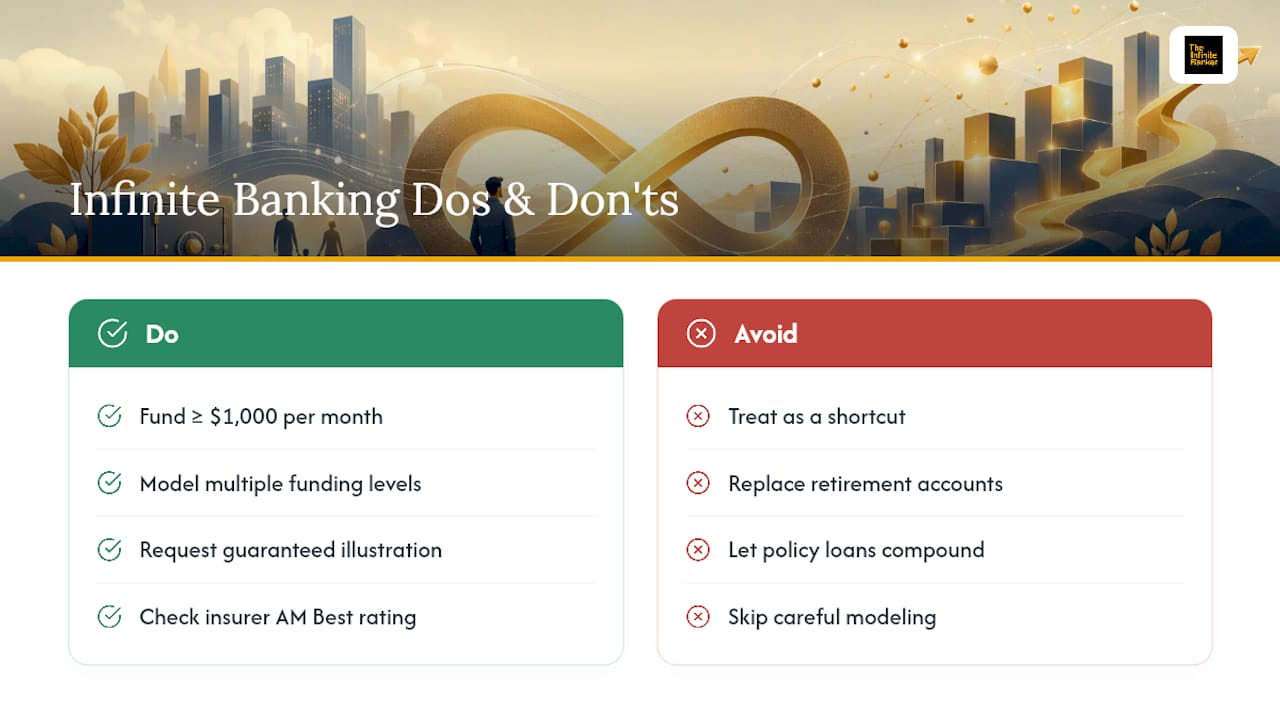
Pro Tip: When evaluating any Infinite Banking policy design, ask to see both the guaranteed and non-guaranteed columns in the illustration. The guaranteed column shows what the policy delivers if dividends are zero. The non-guaranteed column reflects current dividend assumptions. A well-designed policy should show meaningful cash value even in the guaranteed scenario, not just the optimistic one.
How does the cash value and policy loan mechanism actually work?
The core mechanic is straightforward: you fund the policy, cash value accumulates, and you can borrow against that cash value while the insurer continues crediting it as collateral. Here is the process in sequence.
Fund the policy (Year 1 onward). You pay a base premium plus optional paid-up additions. PUAs are the engine of early cash value growth; without them, the funding lag in early years is more pronounced.
Cash value accumulates. The insurer credits guaranteed growth plus any non-guaranteed dividend. Dividends, when paid, can be directed to purchase additional paid-up insurance, further compounding the cash value.
Take a policy loan. You request a loan from the insurer, using your cash value as collateral. The insurer does not liquidate your cash value; it lends from its general account. Your full cash value continues to earn dividends and guaranteed interest.
Loan interest accrues. The loan carries an interest rate set by the insurer. If you do not repay principal and interest, the outstanding loan balance grows. An unpaid loan reduces the net cash value available and, at death, reduces the death benefit by the outstanding loan amount.
Repay on your schedule. Unlike a bank loan, there is no mandatory repayment schedule. You repay when cash flow allows. However, if the loan balance grows to the point where it exceeds the cash value, the policy can lapse, triggering a taxable event.
Repeat the cycle. Once repaid, that capital is available again. This is the “infinite” concept: the same pool of capital can be recycled through multiple uses over time.
The sawtooth pattern of cash value is visible in any well-run illustration: cash value rises as premiums fund the policy, dips when a loan is taken, and rises again as the loan is repaid and dividends continue to credit. Disciplined capital allocation, as BCG research demonstrates, correlates with materially stronger returns on assets, and the same principle applies here: the discipline of funding and repaying consistently is what makes the strategy function over time.
Insurer selection matters considerably. Not all participating whole life carriers maintain the same dividend history or policy design flexibility. A practitioner’s job is to match the client’s funding capacity and time horizon to the right carrier and structure.
Pro Tip: Entrepreneurs who want to accelerate usable cash value in the early years typically use a high PUA-to-base-premium ratio, sometimes called a “blended” or “overfunded” design. This compresses the funding lag but requires the policy to stay within IRS corridor limits (the CVAT or GPT corridor) to preserve its tax treatment. Ask your practitioner to show you the funding collar and what happens to the design if you miss a PUA payment in year two or three.
Who is Infinite Banking actually for, and who should avoid it?
The ideal candidate is an entrepreneur, real estate investor, or high-income business owner who has stable, recurring cash flow and can commit to funding the policy consistently over a multi-year horizon. Specifically, the profile looks like this:
Stable cash flow: You can fund the premium reliably, even in a slow quarter, without straining operations.
Long time horizon: You are thinking in decades, not months. The strategy typically requires five to seven years before the cash value meaningfully exceeds total premiums paid, and most practitioners work with clients funding at least $1,000 per month, though the right number depends on your goals and the policy design.
High marginal tax bracket: The tax-deferred growth of cash value and the income-tax-free nature of policy loans (when structured correctly) tend to be more valuable the higher your bracket.
Interest in private lending or internal financing: Real estate investors who want to self-finance acquisitions or fund deals without bank approval find the policy loan mechanism particularly practical.
The strategy is likely a poor fit if any of the following apply:
You need liquidity within the next one to three years and cannot afford to leave capital in a policy during the early accumulation phase.
Your cash flow is irregular or unpredictable enough that missing premium payments is a realistic risk.
You are primarily seeking short-term capital appreciation rather than a long-term liquidity and financing tool.
You cannot sustain the premium commitment if a business downturn reduces income for six to twelve months.
You are looking for a product with no fees or surrender charges; whole life policies carry surrender charges in early years, and those costs are real.
Working with an Authorized IBC Practitioner matters for regulatory reasons as well. Whole life insurance in the United States is regulated at the state level, with each state’s Department of Insurance overseeing policy form approvals, insurer solvency standards, and agent licensing. A licensed, knowledgeable practitioner is not optional; it is the consumer protection layer built into the system. You can review who Infinite Banking is designed for before scheduling a consultation.
What are the realistic benefits and tradeoffs of this strategy?
Infinite Banking may offer meaningful advantages for the right client, but it also carries real costs and risks that any honest presentation must include. The short summary: the strategy can provide liquidity control and financing flexibility, but it requires patience, consistent funding, and a clear-eyed view of the loan interest and insurer risk involved.
Potential Benefit | Real Tradeoff |
Control of capital without bank approval | Premiums must be funded consistently; missing payments can lapse the policy |
Cash value grows on a tax-deferred basis | Early surrender charges reduce accessible value in the first several years |
Policy loans do not appear on credit reports | Loan interest accrues and reduces net cash value and death benefit if unpaid |
Dividends may increase cash value over time | Dividends are not guaranteed and can be reduced or eliminated |
Death benefit provides a legacy or business continuity tool | Base policy costs (mortality charges) reduce the net return vs. a pure savings vehicle |
Liquidity flexibility for private lending or deal financing | Insurer credit risk exists; carrier selection and solvency ratings matter |
Morgan Stanley notes that alternative investments can enhance diversification for some clients, with allocations up to a quarter of an efficient portfolio, while cautioning that alternatives often involve higher fees and reduced liquidity. Infinite Banking sits in a similar conceptual space: it is a capital-management tool, not a pure investment, and it works best as a complement to other allocations rather than a replacement for them.
Pension funds increased their average allocation to alternatives significantly between 2008 and 2017, according to CFA Institute data, reflecting a broader institutional recognition that liquidity and diversification tools outside public markets serve a portfolio function. For high-income business owners, a properly structured whole life policy can serve a similar function at the individual level.
One sentence to keep visible: dividends are not guaranteed, and policy loans that go unrepaid will reduce both your accessible cash value and the death benefit your beneficiaries receive.
How do you get started with an Infinite Banking strategy?
The path from interest to a funded, operational policy follows a predictable sequence. Here is what to expect at each stage.
Initial strategy session (Week 1–2). A practitioner reviews your cash flow, tax situation, time horizon, and capital goals. This is not a product pitch; it is a diagnostic conversation. You should leave with a clear sense of whether the strategy fits your situation.
Policy design and illustration modeling (Week 2–4). The practitioner builds a custom illustration using the Infinite Banking Calculator and carrier-specific software. You see both guaranteed and non-guaranteed projections, the funding collar, and loan scenarios.
Application and underwriting (Week 4–10). You submit a formal application to the chosen insurer. Underwriting typically involves a medical exam and financial review. Timeline varies by carrier and health profile; six to ten weeks is common.
Policy funding and early use (Month 3 onward). Once the policy is issued and the first premium is paid, the policy is in force. Meaningful cash value for loan purposes typically requires twelve to twenty-four months of consistent funding, depending on the design.
Before the first meeting, prepare these questions:
Which insurers do you work with, and what are their AM Best ratings?
What is the base premium versus the PUA premium in this design, and what happens if I reduce or stop PUA payments?
What loan interest rate does this carrier charge, and is it fixed or variable?
Can you show me a stress-test scenario where dividends are reduced by 20%?
What are the surrender charges in years one through five, and when do they expire?
On costs: expect to see a base premium, an optional PUA premium, and surrender charges that typically phase out over ten to fifteen years depending on the carrier. The illustration will show the internal rate of return on cash value, but that figure is only meaningful when compared against the guaranteed column, not just the current dividend assumption. Capital growth management frameworks consistently emphasize time horizon and disciplined execution as the primary levers, and that holds here: the strategy rewards patience more than any single design feature.
How The Infinite Banker implements this strategy for clients
The Infinite Banker offers consulting, policy design, underwriting guidance, and ongoing education for entrepreneurs, real estate investors, and high-income earners who want to implement Infinite Banking with precision. The service is practitioner-led, not product-led.
The typical workflow runs as follows. A client begins with a paid strategy session where Jib Hunt, an Authorized IBC Practitioner, reviews the client’s financial profile and capital objectives. From there, the team models scenarios using the Infinite Banking Calculator, producing illustrations that show both guaranteed and non-guaranteed values across multiple funding and loan scenarios. Policy structuring follows: the practitioner selects the appropriate carrier, designs the base-to-PUA ratio, and manages the corridor to keep the policy within IRS guidelines. After placement, The Infinite Banker provides post-funding support, including guidance on loan mechanics, repayment strategy, and policy reviews as the client’s situation evolves.
Service deliverables include:
Custom policy design with carrier selection rationale
Illustrated projections showing guaranteed and non-guaranteed columns
Underwriting advocacy and application management
Implementation roadmap with funding schedule and loan use guidelines
Ongoing education through workshops and blog content
Pro Tip: Before committing to any policy, request a stress-test illustration that shows the policy’s performance if dividends are reduced by 20–30% from current assumptions and if you take a policy loan in year three without repaying it for five years. A practitioner who cannot or will not produce that scenario is not giving you the full picture.
BCG’s capital allocation research found that top-performing companies invested about 50% more in capital expenditure than peers and achieved materially higher returns on assets, illustrating that disciplined, deliberate capital deployment compounds over time. The same logic applies to how The Infinite Banker approaches policy design: the structure of the funding decision matters as much as the decision to fund at all.
Common questions about Infinite Banking, answered directly
Does Infinite Banking really work? The strategy functions as described mechanically: cash value accumulates, policy loans are available, and dividends may increase the policy’s value over time. Whether it works for a specific person depends on their ability to fund consistently, their time horizon, and how well the policy is designed. It is not a shortcut; it is a long-term capital management tool.
Can you use Infinite Banking to pay off debt? Some clients use policy loans to consolidate or pay down higher-interest debt, then repay the policy loan on a structured schedule. The math works only if the loan interest on the policy is lower than the interest on the debt being replaced, and only if the client actually repays the policy loan rather than letting it compound. Alternative investment strategies, including policy-based liquidity tools, typically involve longer commitments and more complexity than straightforward debt payoff vehicles, so this use case requires careful modeling.
How much money do you need to start? Most practitioners design policies for clients funding at least $1,000 per month. The right premium level depends on your cash flow, the death benefit you qualify for medically, and the time horizon for when you want usable cash value. A practitioner can model multiple funding levels so you can see the tradeoff between a smaller, more affordable policy and one that produces meaningful loan capacity sooner.
How does Infinite Banking compare to a 401(k) or brokerage account? A whole life policy is not a substitute for a retirement account or an equity portfolio. It is a liquidity and financing tool. Capital growth from equities and real estate typically outpaces whole life cash value over long periods, but those vehicles do not offer the same loan mechanics or the same insulation from market volatility. The strongest use case for Infinite Banking is alongside other allocations, not instead of them.
What should I verify with a practitioner before applying? Ask for the guaranteed illustration, the stress-test scenario, the insurer’s AM Best rating, and a clear explanation of surrender charges and loan interest terms. PIMCO’s overview of alternative investments notes that access, liquidity, and specialized management are the key tradeoffs in any private-market strategy, and the same framework applies here.
How does Infinite Banking differ from a company called Infinite Capital Solutions?
The phrase “Infinite Capital Solutions” carries two distinct meanings that are worth separating clearly.
As a general descriptor, “infinite capital solutions” refers to the broader category of strategies, consulting services, and policy designs built around the Infinite Banking Concept (IBC) originated by R. Nelson Nash. Any practitioner or firm implementing IBC-based whole life strategies could reasonably use similar language to describe their work.
As a specific company, Infinite Capital Solutions, LLC is a Miami-based life insurance firm listed on the Better Business Bureau, accredited by the BBB since March 28, 2025. The BBB listing confirms the company’s address and accreditation status; it does not constitute an endorsement of the firm’s services or outcomes.
The distinction matters for anyone researching this topic. If you searched “Infinite Capital Solutions” looking for a specific provider, the BBB profile is the most verifiable public record available. If you searched for the strategy itself, the provider name is incidental; what matters is the policy design, the insurer, and the practitioner’s qualifications. The Infinite Banker operates as a separate consulting practice, not affiliated with Infinite Capital Solutions, LLC.
A practical note: the IBC space has attracted a range of practitioners with varying levels of training and experience. The Nelson Nash Institute maintains a directory of Authorized IBC Practitioners who have completed formal training in the concept. Verifying a practitioner’s credentials through that directory, and checking any firm’s BBB or state insurance department record, is a reasonable due-diligence step before committing to a policy.
What regulations and consumer protections apply to these policies in the US?
Whole life insurance in the United States is regulated at the state level. Each state’s Department of Insurance licenses agents, approves policy forms, and monitors insurer solvency. This structure means the consumer protections available to you depend partly on your state of residence, though the core framework is consistent nationwide.
Key protections to understand:
The insurer you choose must meet solvency requirements set by your state regulator and is typically a member of your state’s Life and Health Insurance Guaranty Association. If an insurer becomes insolvent, the guaranty association provides coverage up to state-specific limits, which vary but commonly cover $300,000 in death benefits and $100,000 in cash surrender value per policy. These limits are not a substitute for choosing a financially strong carrier, but they are a meaningful backstop.
Policy illustrations are regulated under the NAIC Illustration Model Regulation (Model 582), which requires insurers to show both guaranteed and non-guaranteed values and to include a “basic illustration” that the client signs. This regulation exists precisely because non-guaranteed projections can be misleading if presented without the guaranteed baseline.
Agent licensing is mandatory. Any person selling you a whole life policy must hold a life insurance license in your state. An Authorized IBC Practitioner designation indicates additional training in the Infinite Banking Concept, but it does not replace the state licensing requirement; both should be present.
If you have a complaint about a policy or agent, your state’s Department of Insurance is the primary regulatory body. The National Association of Insurance Commissioners (NAIC) maintains a consumer information portal where you can look up insurer complaint ratios and financial data before purchasing a policy.
How does Infinite Banking compare to other financing and savings strategies?
Placing Infinite Banking alongside other capital strategies helps clarify where it fits and where it does not.
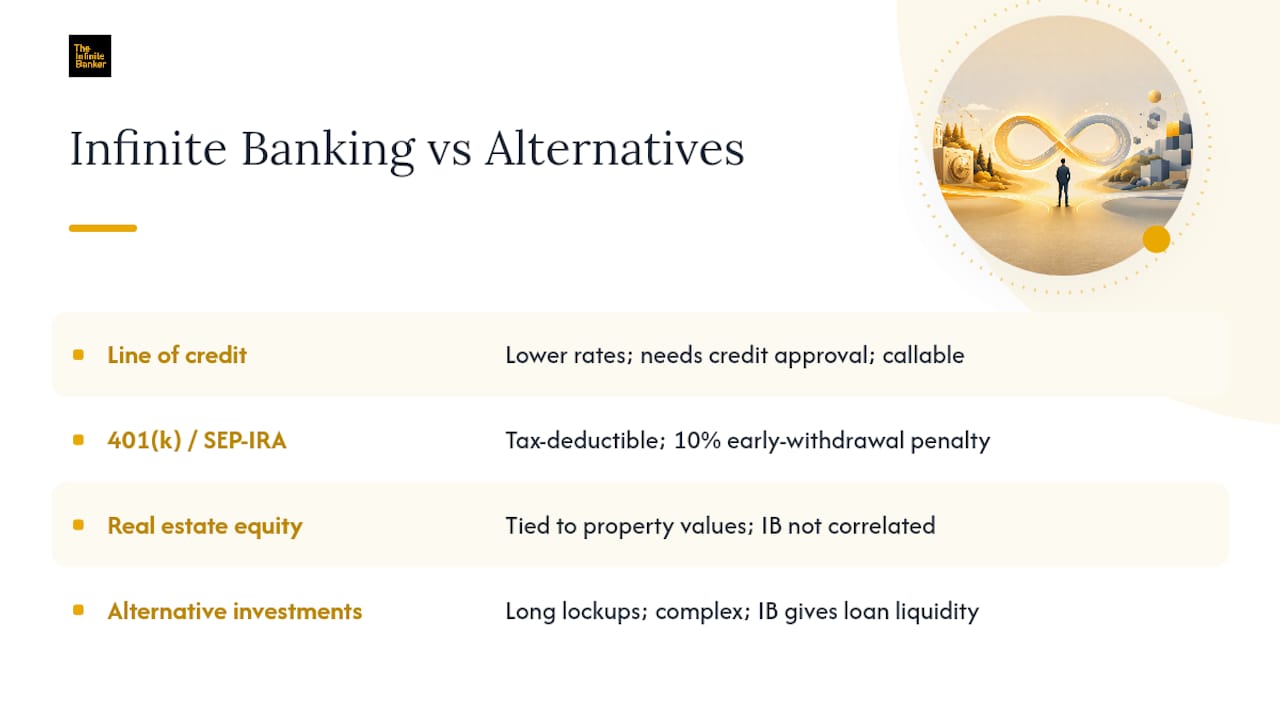
Versus a business line of credit: A bank line of credit typically offers lower initial interest rates and faster access to capital, but it requires credit approval, appears on your credit report, and can be reduced or revoked by the lender. A policy loan requires no credit check, does not affect your credit profile, and cannot be called by the insurer. The tradeoff is the multi-year commitment required to build meaningful loan capacity.
Versus a 401(k) or SEP-IRA: Qualified retirement accounts offer tax deductions on contributions and tax-deferred growth, but withdrawals before age 59½ carry a 10% penalty plus ordinary income tax. Policy loans carry no such restriction. However, the contribution limits and potential employer match in a 401(k) often make it the higher-priority vehicle for most high-income earners, with Infinite Banking serving a complementary role.
Versus real estate equity: Real estate investors often use home equity lines of credit (HELOCs) or cash-out refinances to access equity. These vehicles tie liquidity to property values and lender approval. A policy loan is not correlated to real estate market conditions, which makes it a useful diversification of liquidity sources for investors who already have significant real estate exposure. The Infinite Banker’s guide to private lending with a whole life policy covers this use case in detail.
Versus alternative investments broadly: Alternative investments, as defined by the CFA Institute, are assets outside public stocks, bonds, and cash. They typically offer diversification potential but involve longer lockups, more complexity, and specialized knowledge. Infinite Banking shares some of those characteristics: it is not liquid in the traditional sense, it requires specialized knowledge to implement correctly, and it is most useful over a long time horizon. Where it differs is in the loan mechanic, which provides a form of liquidity that most alternative investments do not.
For high-income earners thinking about diversification across asset classes, a whole life policy can serve as a stable, non-correlated liquidity reserve alongside equities, real estate, and other alternatives.
A practitioner’s perspective on evaluating a client for this strategy
The first question I ask a prospective client is not “how much do you want to put in?” It is “what problem are you trying to solve, and in what timeframe?” That question filters out most of the mismatches before we ever look at an illustration.
A representative scenario: a real estate investor with consistent rental income wants a source of capital for deal deposits and short-term bridge financing that does not require bank approval or affect their debt-to-income ratio. They have $3,000 per month available for premium funding and a fifteen-year horizon. That profile fits the strategy well. The policy is designed with a high PUA ratio to accelerate early cash value, the carrier is selected based on dividend history and loan interest terms, and the client understands from day one that the first two years will show a cash value below total premiums paid. That funding lag is not a flaw; it is the cost of building the structure.
A different scenario: a business owner with irregular income who wants to “park” cash for six months and then pull it out. That is not what this strategy does. The surrender charges in early years, combined with the funding lag, make short-term use economically punishing. I decline those engagements, because a policy that is surrendered in year two is a bad outcome for the client regardless of how well it was designed.
The honest limits of the strategy: dividends are not guaranteed, loans accrue interest, and a policy can lapse if premiums stop or loan balances grow unchecked. Those are not edge cases; they are the primary risks every client should understand before signing an application.
What a paid strategy session with The Infinite Banker delivers
A paid strategy session with The Infinite Banker is a structured working engagement, not a sales call. You leave with a clear picture of whether the strategy fits your situation, a custom illustration modeled to your cash flow and goals, and a written implementation roadmap.
Tangible outputs from a paid engagement include:
A custom policy illustration showing guaranteed and non-guaranteed values across multiple funding scenarios
A carrier comparison with AM Best ratings and dividend history context
An underwriting checklist tailored to your health and financial profile
A loan use and repayment framework aligned to your capital objectives
A timeline from application through policy funding and first loan availability
The Infinite Banker also offers workshops for business owners and investors who want to understand the mechanics before committing to a consultation. If you are ready to evaluate whether this strategy fits your situation, the clearest next step is to review who Infinite Banking is designed for and then schedule a session with Jib Hunt directly through the site.
Sources
The sources below are vetted for authority and relevance. Use them to verify claims, research insurers, and model your own scenarios before committing to any policy.
This post is educational only and not financial, tax, or legal advice. Consult qualified professionals before acting.
Recommended
Comments