
Private Lending With Whole Life Policy: A Practical Guide


COMPLIANCE NOTE: For educational purposes only. Not financial, tax, or legal advice.
Private lending using a dividend-paying whole life policy can be a practical source of repeatable, on-demand capital for entrepreneurs and investors when the policy is properly designed and actively managed. Two scenarios define most of what practitioners mean by this strategy:
Scenario A (Internal/IBC arrangement): The policyowner borrows against their own policy’s cash value, using the insurer’s loan mechanism to fund business needs, acquisitions, or bridge gaps without a credit check or external lender approval.
Scenario B (Third-party collateral assignment): A borrower assigns their whole life policy as collateral to a private lender, who advances funds secured by the policy’s cash surrender value.
Both paths require disciplined policy design, documented agreements, and active loan repayment management. Neither is passive.
Pro Tip: If recurring lending is the goal, prioritize policies with clearly defined loan provisions and paid-up additions (PUA) riders from day one. These two features do more to accelerate usable cash value than any other design element.
Table of Contents
What “private lending with whole life policy” actually means
Policy features and due diligence you must verify before proceeding
Step-by-step: how to structure a private loan using a whole life policy
Real-world use cases for entrepreneurs and real estate investors
Questions to ask your agent, tax advisor, attorney, and Authorized IBC Practitioner
How The Infinite Banker supports your private lending strategy
What “private lending with whole life policy” actually means
The phrase covers two distinct arrangements that are often conflated. A policy loan is an advance from the insurer to the policyowner, collateralized by the policy’s own cash value. No external lender is involved, no credit check is run, and the insurer does not require repayment on any fixed schedule. A collateral assignment is a legal instrument that pledges the policy (or a portion of its cash value and death benefit) to a third-party lender as security for an external loan.
The scope here is limited to dividend-paying whole life policies issued by participating carriers. Term life and non-participating designs have no cash value component and cannot support either arrangement. Universal life policies can carry cash value but lack the dividend-crediting mechanism that makes the Infinite Banking strategy function as a renewable capital reserve.
Policy loan example: An entrepreneur needs $80,000 to bridge a supplier payment cycle. She contacts her carrier, requests a loan against her policy’s $120,000 cash value, and receives funds within days, with no underwriting.
Collateral assignment example: A private investor lends $200,000 to a real estate developer. The developer assigns a whole life policy with $250,000 in cash surrender value to the investor as collateral, recorded with the carrier.
How policy loans and collateral assignments actually work
When a policyowner requests a policy loan, the insurer advances funds from its general account, using the policy’s cash value as collateral. The cash value itself continues to earn dividends (though dividends are never guaranteed) and credited interest during the loan period, which is the core economic advantage of the Infinite Banking approach. The process typically takes two to five business days and requires no credit approval.

Interest accrues on the outstanding loan balance from the date of advance. Loan interest rates vary depending on whether the policy carries a fixed or variable loan rate. Unpaid interest compounds and is added to the loan principal, which in turn accrues additional interest. That compounding effect is the primary mechanical risk of the strategy.
Outstanding loans reduce the death benefit dollar-for-dollar. If a policyowner carries a $100,000 loan balance at death, beneficiaries receive the face amount minus $100,000 plus any accrued unpaid interest.
For collateral assignments, the lender files an assignment form with the carrier. The carrier acknowledges the lender’s secured interest, which means the lender has priority over the cash surrender value and death benefit up to the loan amount if the borrower defaults or dies.
Loan Type | Typical Interest Rate | Credit Check | Funding Speed |
Policy loan (insurer) | 5% | None | 2–5 business days |
Personal loan (bank) | around 9% (Fed Reserve avg.) | Yes | Days to weeks |
Home equity line | Varies | Yes | Weeks |
Key risks, lapse consequences, and U.S. regulatory points
The most serious risk is policy lapse. If accumulated unpaid interest causes the loan balance to exceed the policy’s remaining cash value, the policy terminates. At that point, the IRS treats the accumulated gain as taxable income in the year of lapse, even though the policyowner receives no cash. For a policy held for decades with significant gain, that tax bill can be substantial.
Death benefit erosion: Unpaid loan principal plus accrued interest is deducted from the death benefit at claim time, reducing what beneficiaries receive.
Regulatory exposure for private lenders: State usury laws cap the interest rate a private lender may charge. Structures that pool loans or solicit passive investors may trigger securities regulation under federal or state law. Always involve an attorney before originating loans to multiple borrowers.
Reporting obligations: MetLife’s policy documentation confirms that when a policy lapses with an outstanding loan, the carrier reports the taxable gain to the IRS. Borrowers and lenders should both understand this obligation before structuring any arrangement.
Pro Tip: Schedule a semiannual in-force illustration review. Set a trigger: if the loan balance reaches 75% of current cash value, require the borrower (or yourself) to service interest immediately or fund additional premiums. Catching this early prevents the compounding spiral that leads to lapse.
Lapse risk is not theoretical. Practitioners consistently flag it as the most common unintended outcome for policyowners who treat loans as permanent draws rather than temporary capital deployments.
Policy features and due diligence you must verify before proceeding
Policy design features such as paid-up additions, dividend treatment, and loan provisions materially affect how suitable a policy is for repeated private lending. Before using any policy in either scenario, work through this checklist:
Current cash surrender value and available loan limit (typically up to 90% of cash value)
Loan interest rate type: fixed or variable, and the current rate
Paid-up additions rider: is it active, and what is the current PUA cash value?
Dividend history and current dividend scale (note: dividends are never guaranteed)
Surrender charge schedule and any loan restrictions in the policy contract
Whether the carrier requires consent or notification for collateral assignments
Request an in-force illustration that shows projected cash values with and without a loan scenario, loan interest accrual over 5 and 10 years, and the effect on the death benefit under each scenario. The Borrowing Against Whole Life Cash Value guide from The Infinite Banker walks through how to read these illustrations and what to flag.
Due Diligence Item | Why It Matters |
Current cash surrender value | Sets the maximum loan amount available |
Loan interest rate (fixed vs. variable) | Determines cost and compounding risk |
PUA rider status | Accelerates cash value for larger or faster loans |
Dividend scale history | Indicates policy performance trajectory |
Surrender charge schedule | Affects net value if policy must be surrendered |
Carrier assignment process | Determines timeline and documentation for collateral |
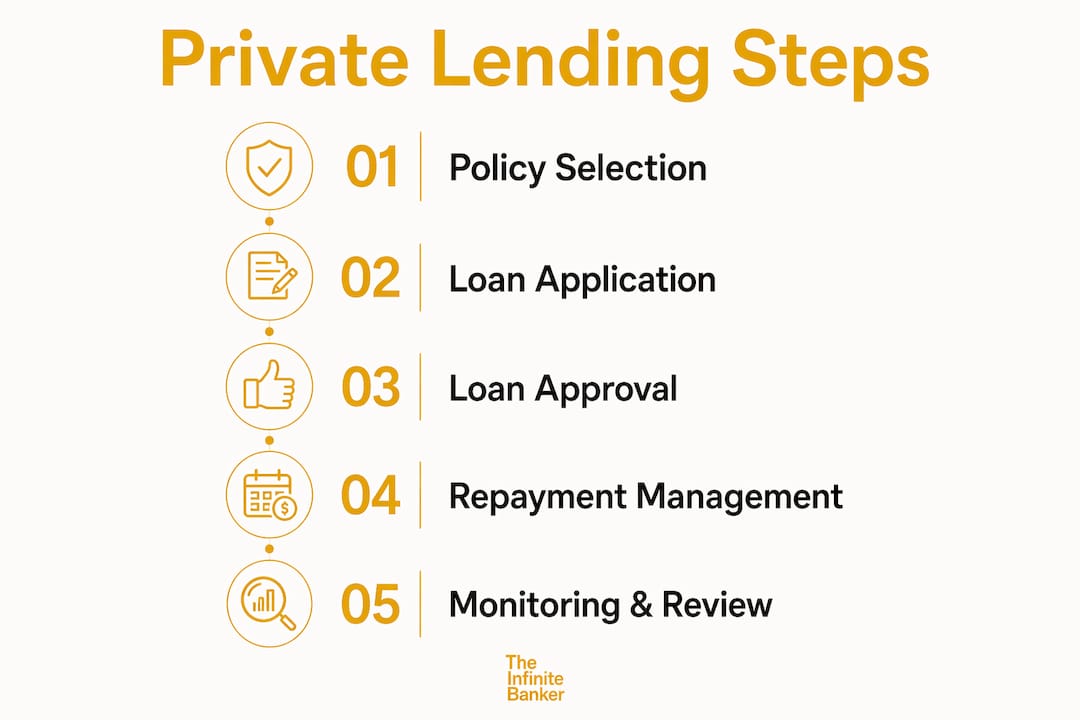
Step-by-step: how to structure a private loan using a whole life policy
Building sufficient cash value takes time, often five to ten years or more before large loans are feasible. Once the policy is ready, follow these steps:
Verify policy status. Pull the current annual statement and request an in-force illustration with loan scenarios.
Confirm loan limit and cushion. Identify the maximum loan amount and ensure a meaningful buffer remains between the loan and total cash value.
Obtain carrier documentation. For collateral assignments, request the carrier’s assignment form and confirm the acknowledgment process and timeline.
Draft the loan agreement. Include the loan amount, interest rate, repayment schedule, assignment language, and cure provisions if the borrower misses interest payments.
Record the collateral assignment. File with the carrier and retain the carrier’s written acknowledgment.
Set a monitoring schedule. Require quarterly or semiannual policy statements; define trigger points for additional premium funding or accelerated repayment.
Required documents:
Signed loan agreement with collateral assignment language
Carrier collateral assignment form and acknowledgment
Borrower representations covering premium payment status and tax standing
Insurance continuation covenant (borrower commits to keeping premiums current)
Copies of the most recent annual statement and in-force illustration
For entrepreneurs managing cash flow management alongside policy-backed lending, aligning repayment schedules with business revenue cycles reduces the risk of interest capitalization.
Real-world use cases for entrepreneurs and real estate investors
Dividend-paying whole life policies can function as a renewable capital reserve when managed with discipline. Three use cases illustrate how this works in practice:
Entrepreneur bridge financing: A business owner uses recurring policy loans to cover supplier payments during slow receivables months, then repays the loan when client payments arrive. The policy continues to earn dividends throughout, and the cycle repeats.
Real estate acquisition bridge: An investor funds a renovation on a distressed property using a policy loan, closes the deal quickly without bank underwriting delays, then refinances the property and repays the loan. The Infinite Banking for entrepreneurs framework is built around exactly this kind of capital cycling.
Intra-family private loan: A family member with a mature whole life policy assigns it as collateral to secure a loan from another family member or a private lender, formalizing the arrangement with a written agreement and carrier acknowledgment.
Each scenario has practical constraints. Policies need years of premium funding before meaningful loan capacity exists. Premium affordability matters: underfunding a policy stalls cash value growth and defeats the strategy. When capital needs exceed available cash value, traditional financing may be the more practical path.
Questions to ask your agent, tax advisor, attorney, and Authorized IBC Practitioner
Bring these questions to your advisory team before proceeding:
Agent questions:
What is the current loan interest rate, and is it fixed or variable?
Can you provide an in-force illustration showing loan scenarios over 5 and 10 years?
Are paid-up additions and settlement options available on this policy?
Tax and attorney questions:
How would a policy lapse be treated for tax purposes given my current cost basis?
Are there state-level usury or licensing requirements for this private loan structure?
Do we need a UCC financing statement filed in addition to the collateral assignment?
Authorized IBC Practitioner questions (Jib Hunt at The Infinite Banker):
Based on my capital cycling goals, how should premium funding and PUA contributions be structured to maintain adequate loan cushion?
What monitoring triggers would you recommend to prevent lapse risk given my projected loan frequency?
Key Takeaways
Private lending with a whole life policy is practical only when the policy is properly designed, loans are actively managed, and all agreements are documented.
Point | Details |
Policy design determines viability | Paid-up additions riders and clear loan provisions are the two features that most affect loan capacity. |
Unpaid interest compounds into lapse risk | Service loan interest regularly; a loan balance exceeding cash value triggers a taxable event on accumulated gain. |
Collateral assignment requires documentation | A signed assignment form, carrier acknowledgment, and written loan agreement are all required for third-party lending. |
Timelines are longer than most expect | Building meaningful cash value typically takes five to ten years of sustained premium funding. |
The Infinite Banker | Jib Hunt, an Authorized IBC Practitioner, reviews policy design and in-force illustrations to support private lending implementation. |
What practitioners actually see in the field
Most clients who approach The Infinite Banker about using their whole life policy for private lending have the right instinct but underestimate two things: how long it takes to build a loan cushion worth deploying, and how quickly unpaid interest compounds when a deal runs longer than planned.
The Infinite Banking strategy is not a shortcut to capital. It is a system that rewards patience and process. Policies designed with strong paid-up additions riders and funded consistently over years can support meaningful, repeatable lending activity. Policies that were underfunded, or where loans were treated as permanent draws rather than temporary deployments, tend to erode quietly until a lapse event forces the issue.
The practical discipline that separates successful implementations from cautionary tales is simple: treat every policy loan as a liability to be repaid, not an asset to be spent. Real estate investors who use this approach as a private deal fund report the advantage of fast, no-credit-check funding while keeping capital participating inside the policy. That advantage disappears the moment repayment discipline does.
Dividends are never guaranteed. Loan interest accrues whether or not you pay it. Policies can and do lapse. Those are not disclaimers to skim past; they are the operating constraints of the strategy.
How The Infinite Banker supports your private lending strategy
The sharpest advantage The Infinite Banker offers over a generic insurance agent or financial planner is practitioner-level policy design review combined with Authorized IBC Practitioner coaching from Jib Hunt. Most agents can issue a whole life policy. Far fewer can structure one specifically for capital cycling, evaluate whether an existing policy’s loan provisions and PUA rider are adequate for private lending, or walk you through a collateral assignment documentation process.
Services include in-force illustration analysis, policy design reviews oriented toward loan capacity and lapse risk management, collateral assignment documentation support, and one-on-one coaching sessions. To get started, bring your most recent annual statement and any existing in-force illustration to your first conversation.
Schedule a consultation or run your numbers first with the Infinite Banking calculator to model premium funding, cash value accumulation, and loan scenarios before committing to a structure. When you are ready to talk through design specifics, The Infinite Banker team is the next step.
Useful sources and next steps
The Infinite Banker resources:
Borrowing Against Whole Life Cash Value: 2026 Guide — mechanics, examples, and in-force illustration interpretation
Infinite Banking Explained: The Complete Guide — foundational strategy and capital cycling rationale
How Infinite Banking Works — service overview and calculator
External authoritative sources:
MassMutual: cash value loan mechanics, interest rate ranges, and lapse risk
Northwestern Mutual: policy loan basics and cash value timelines
MetLife Whole Life FAQs: loan impact on death benefit and tax treatment
J.P. Morgan Private Bank: collateral assignment and premium financing structures for high-net-worth clients
Professionals to involve before proceeding:
Professional | Role in This Strategy |
Life insurance agent | Policy illustration, loan provisions, assignment forms |
Tax advisor (CPA) | Lapse tax consequences, cost basis analysis, IRS reporting |
Attorney | Loan agreement drafting, UCC filings, state usury compliance |
Authorized IBC Practitioner | Policy design review, PUA structuring, monitoring protocols |
Bring your most recent annual statement, an in-force illustration, and a clear description of your capital cycling goals to every advisory meeting.
This post is educational only and not financial, tax, or legal advice. Consult qualified professionals before acting.
Recommended
Comments