
Backdating Life Insurance: What Entrepreneurs Should Know


COMPLIANCE NOTE: For educational purposes only. Not financial, tax, or legal advice.
Yes, you can backdate a life insurance policy in the United States, and in many cases it is a legitimate way to lower your premium. Insurers commonly allow you to set the effective date up to several months earlier than the issue date, usually capped around a half birthday, which locks in a younger “insurance age” and a cheaper rate for the life of the policy. The catch is that you have to pay for those extra months upfront, a lump sum sometimes called “ghost coverage.” Whether that tradeoff makes sense depends entirely on the math, not on a rule of thumb.
For entrepreneurs and investors evaluating a large whole life policy, that math often tilts favorably. For someone buying a small term policy in their twenties, it rarely does.
Backdating is typically capped at a few months or the applicant’s last half birthday, though carrier and state rules vary.
You must pay retroactive premiums for the backdated period in a single upfront payment.
The simplest first step: ask your agent for a written standard quote and a written backdated quote, side by side.
Backdating tends to matter most for older applicants, larger face amounts, and anyone sitting just past a half-birthday threshold.
Key Takeaways
Backdating a life insurance policy can lower your lifetime premium by locking in a younger insurance age, but only after the upfront ghost coverage cost is weighed against the actual savings.
Point | Details |
Main tradeoff | A lump-sum upfront payment now versus a lower premium for the rest of the term. |
Typical limit | Most carriers cap backdating at six months or the last half birthday. |
When it pays | Older applicants, larger policies, and shifts of one to two months tend to see the best return. |
What to request | Written standard and backdated quotes, plus the insurer’s own break-even calculation. |
Where to get policy-level review | The Infinite Banker reviews backdating decisions alongside full policy design for entrepreneurs and investors. |
This article is general information, not a substitute for advice from a qualified financial advisor. Consult a qualified financial professional about your own circumstances before acting on anything here.
Table of Contents
What Does Backdating a Life Insurance Policy Actually Mean?
Backdating means setting a policy’s effective date earlier than the date it is actually issued, so underwriting calculates your premium using a younger “insurance age” rather than your true age on the issue date. Insurers do not always price you by your exact birthday. Many use “nearest birthday” or a half-birthday convention, rounding your insurance age up the moment you pass the midpoint between two birthdays. That rounding point is exactly what backdating is designed to work around, and the insurance glossary definition frames it as simply moving the effective date to a prior point in time within limits set by state law.
If you are one month past your half birthday when your medical exam clears, your insurer may already be pricing you a full year older than you’d like. Backdating the effective date by even a few weeks can pull you back under that threshold and lock in the lower rate for the entire term.
People request backdating for two main reasons:
Lower premium: locking in a younger insurance age before it rounds up to the next bracket.
Billing convenience: aligning the policy’s renewal date with a preferred month, such as the start of a fiscal year.
How Does the Backdating Process Actually Work?
Once you request a backdated effective date, the insurer treats the policy as if coverage began that earlier day, and it expects premium payments starting from that date, not from the day the policy is issued. That distinction is where “ghost coverage” comes in.

Ghost coverage refers to the months between your chosen backdated effective date and the actual issue date, months during which the policy is contractually in force even though you have not yet paid for them. According to NerdWallet, if you backdate a policy by two months, you owe the premiums for those two months plus your current premium, all due in a single upfront payment when the policy issues.
Underwriting age is the other half of the equation. Most carriers use either the “nearest birthday” method or a half-birthday rule, and a shift of even one or two months can change which age bracket your premium is calculated from. Progressive notes that the primary reason people request backdating is precisely this: locking in a lower age-based rate before the next birthday rounding kicks in.
The mechanics look different from a standard issue in a few concrete ways:
Factor | Standard issue | Backdated issue |
Effective date | Date policy is issued | Earlier date chosen by applicant, within carrier limits |
First premium payment | Covers current period only | Lump sum covering backdated months plus current period |
Contestability window | Starts on issue date | Starts on the earlier backdated date |
Underwriting age used | Age at issue | Age at the backdated effective date |
A one or two month shift in effective date can be the difference between qualifying for a lower age bracket and missing it entirely, particularly for applicants near a half-birthday cutoff.
One operational wrinkle worth knowing: accelerated underwriting programs have shortened issue timelines from weeks to days for eligible applicants, which can actually reduce how many months of ghost coverage you’d need to backpay in the first place. Faster issue timing changes the calculation, sometimes in your favor.
Is Backdating Life Insurance Legal, and What Are the Limits?
Backdating life insurance is legal in the United States, but it is bounded, not unlimited. Most states and carriers cap backdating at a limited number of months or to the applicant’s last half birthday, whichever comes first, and that cap comes from a mix of state insurance law and carrier-level policy, per LegalClarity.
State insurance departments set the outer legal boundary, and the National Association of Insurance Commissioners (NAIC) provides model guidance that many states draw from. Within that boundary, individual carriers set their own, often stricter, internal limits. A carrier can legally allow less than six months even where state law would permit more, which is why a six month figure you read online is a ceiling, not a guarantee your specific carrier will honor.
The typical backdating window is commonly cited as up to six months across major carriers, but it represents a maximum allowed period, not a guaranteed offer for all.
Two things run on the backdated clock the moment you set it:
The contestability period, typically two years, during which the insurer can investigate and contest a claim, starts from the backdated effective date rather than the issue date.
The suicide exclusion clause, if the policy has one, also begins counting from that earlier date.
Regulators take improper backdating seriously. Insurance departments can audit carriers, and violations can trigger fines or corrective action against the insurer, which is part of why carriers build compliance checks into the underwriting process rather than leaving it to informal agreement between agent and applicant. Before you assume backdating is available to you, verify the allowable window with both your carrier and your state’s Department of Insurance. Rules genuinely differ by state and by company, and what worked for a colleague’s policy in another state may not apply to yours.
How Do You Calculate Whether Backdating Is Worth It?
The math is straightforward: multiply your annual premium savings by the number of years you plan to keep the policy, then subtract the upfront lump sum you’d pay for the backdated months. If the result is positive, backdating produced net savings over the policy term.
The formula, spelled out:
(Annual premium savings) × (policy term in years) − (backdated months × monthly premium) = net savings
Policygenius recommends exactly this lifetime cost comparison as the correct decision framework, rather than relying on a general sense that “backdating saves money.” It sometimes doesn’t, once you run the actual numbers for your policy size and term.
Here’s a worked example using figures from NerdWallet’s reporting on a two-month backdate:
Input | Value |
Backdated period | 2 months |
Upfront ghost coverage cost | $88 |
Estimated lifetime savings (20-year term) | $960 |
Net savings | $872 |
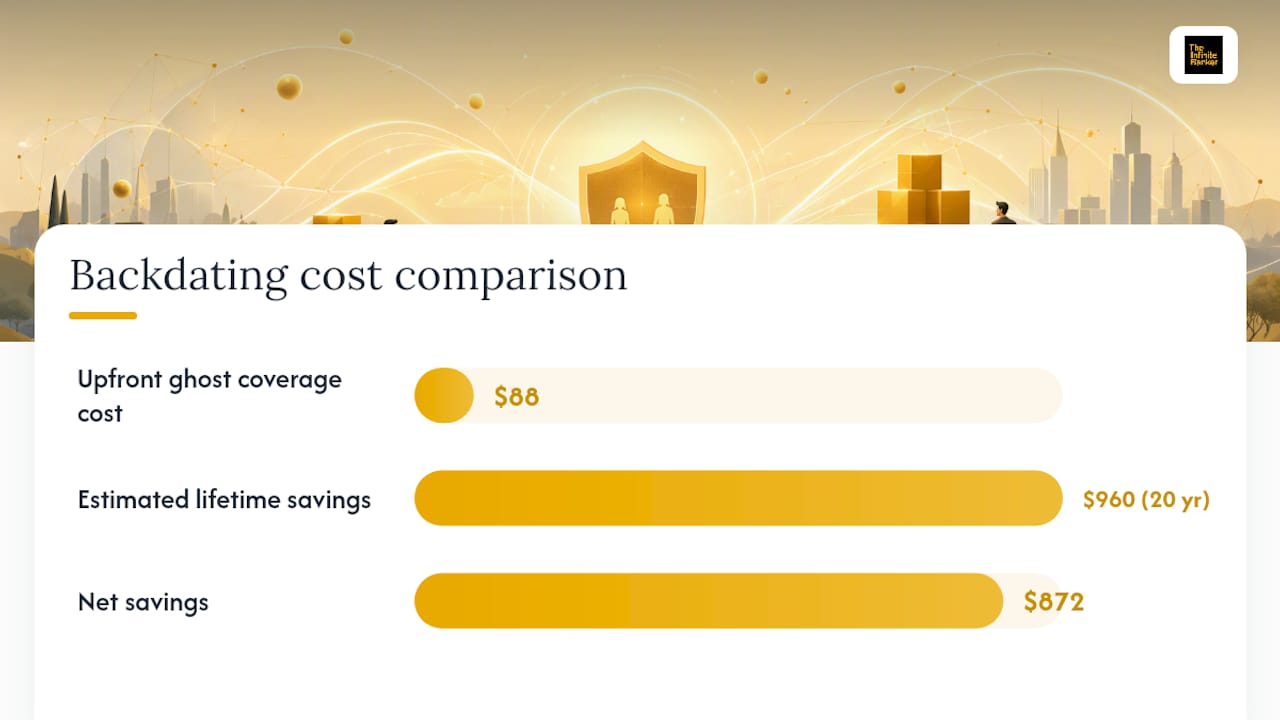
In that example, an $88 upfront cost produced roughly $960 in savings across a 20-year term, a net gain of about $872. That’s a strong ratio, but it only holds because the age shift moved the applicant into a meaningfully cheaper bracket. A smaller policy or a shift that doesn’t cross a bracket threshold could produce a far thinner margin, or none at all.
Before you run your own numbers, request the following from your insurer or agent:
A written standard premium quote at your current age.
A written backdated premium quote showing the exact lump sum due.
A full premium schedule for both scenarios across your intended term.
Written confirmation of the exact effective date the carrier will use.
Pro Tip: Ask your agent to show you the break-even point in months, not just years. If the lump-sum payback happens within the first two to three years of the policy, that’s a strong signal the backdating request is worth pursuing.
When Does Backdating Actually Pay Off?
Backdating tends to pay off when two factors line up: you’re close to an age bracket threshold, and your policy is large or long enough that a small rate difference compounds into real savings. Policygenius notes that backdating benefits older applicants and larger face amounts more than younger applicants carrying small policies, simply because the dollar impact of an age-bracket shift scales with both variables.
Scenarios that typically favor backdating:
You’ve just passed your half birthday and the rounding rule is about to push you into a higher bracket.
You’re purchasing a larger face amount, where even a small percentage rate difference translates into real dollars annually.
You’re locking in a policy with a long term, term life or permanent, giving the savings more years to compound.
The carrier only requires one or two months of backdating to secure the lower age, keeping the upfront cost modest.
Scenarios where it rarely helps:
You’re a younger applicant where age-bracket rate differences are small to begin with.
You’d need four, five, or six months of backdating to move brackets, which inflates the upfront lump sum.
Your policy face amount is modest, so the annual premium delta is only a few dollars either way.
Point | Details |
Best fit | Applicants near a half-birthday cutoff with larger policies see the biggest dollar impact. |
Poor fit | Young applicants or small policies rarely see enough savings to offset the upfront cost. |
Decisive factor | The number of months needed to shift age brackets, not just the calendar limit. |
How Do You Request Backdating From an Insurer?
Ask your agent or underwriter for both the standard and backdated quote in writing before you commit to anything. Verbal estimates or a single number without a full schedule leave you unable to verify the calculation yourself, and SelectQuote’s guidance echoes the same recommendation: get the written comparison first.
The practical sequence looks like this:
Disclose your intent to backdate at the start of the application, not after underwriting is complete.
Ask the underwriter how many months of backdating the carrier allows for your policy type and state.
Request a written premium comparison covering both the standard and backdated scenarios.
Confirm the exact lump-sum amount due and when it must be paid.
Get written confirmation of the final effective date before you sign anything.
Questions worth putting directly to your agent or insurer:
How many months will you allow for this policy type in my state?
What is the exact upfront backdated premium total, itemized by month?
How does backdating affect the contestability period and any suicide exclusion clause?
Will backdating affect any riders attached to the policy?
For permanent policies, does this change how the 7-pay test applies to my contract?
What Are the Risks and Downsides of Backdating?
Backdating carries clear downsides, an immediate cash outlay and, for permanent policies, potential contract complications, so treat it as a financial calculation rather than a sales tactic your agent is pushing on you.
Upfront cash requirement. You need the full lump sum available at issue, which can strain cash flow if you weren’t planning for it.
Earlier contestability and suicide exclusion clocks. Both periods start from the backdated date, which shortens how much time has passed by the time you might need to rely on the policy.
MEC risk on permanent policies. For whole life and universal life, cramming several months of premium into one payment can push the policy past the seven-pay test and trigger modified endowment contract status, which changes how policy loans and withdrawals are taxed. This is not a concern for term policies, which have no cash value.
Underwriting surprises. A medical exam result that changes your rate class after you’ve already committed to a backdated lump sum can undercut the whole calculation.
Carrier refusal or administrative error. Not every carrier honors backdating requests consistently, and paperwork mistakes on effective dates happen.
Pro Tip: Treat vague verbal quotes as a red flag. If an agent can’t give you an itemized, written breakdown of the backdated lump sum and the resulting premium schedule, that’s a sign to ask for it in writing before moving forward, or to look elsewhere.
What Should You Check Before Finalizing the Numbers?
A disciplined approach to backdating means verifying every assumption before you sign, not after.
Get both the standard and backdated premium schedules in writing, side by side.
Ask the insurer to show its own calculation of the break-even point, not just the final numbers.
Confirm exactly when the contestability and suicide exclusion clocks start.
Ask whether any riders (waiver of premium, accelerated death benefit, and similar) are affected by the earlier effective date.
For any permanent policy, confirm in writing whether the backdated lump sum keeps you under the 7-pay limit.
Model the break-even point in months, then compare it against how long you actually plan to hold the policy.
Pro Tip: When cash flow is tight, preserving liquidity sometimes matters more than shaving a small percentage off your premium. A lower rate that strains your available cash in year one is not automatically the better decision, even if the spreadsheet says it saves money over twenty years.
For entrepreneurs and investors structuring a whole life policy as part of a broader capital strategy, the backdating decision doesn’t happen in isolation. It connects to how the policy is funded early on and how quickly cash value begins to accumulate. Questions about premium timing, funding schedules, and 7-pay limits are the same questions that come up when structuring a policy for long-term capital efficiency, which is the kind of policy design work an Authorized IBC Practitioner reviews case by case.
Where Does Backdating Fit Into Broader Whole Life Policy Design?
Backdating is a narrow, tactical decision. Whether it’s worth pursuing on any given policy depends heavily on how that policy is funded and structured from day one, which is why the question rarely stands alone in practice. When a client is designing a dividend-paying whole life policy with capital efficiency in mind, the backdating conversation usually happens alongside decisions about premium funding schedules, paid-up additions, and how the policy is expected to perform over decades, not just in year one.
It’s worth being direct about something here: dividends on whole life policies are not guaranteed, and insurers can adjust them based on their own performance. Any projection of long-term savings, whether from backdating or from a broader policy design, should be read as an illustration, not a promise. Similarly, if a policy is used later for loans against its cash value, that loan accrues interest, and any unpaid balance reduces both the cash value and the death benefit. Policies can lapse if premiums go unfunded and cash value is insufficient to cover ongoing costs.
For most of the readers weighing backdating, the real question isn’t just “will this shave a few dollars off my premium.” It’s how that decision fits into a policy built to support liquidity and long-term flexibility. That’s a conversation worth having with an Authorized IBC Practitioner rather than deciding in isolation from a quote sheet.
How Can The Infinite Banker Help You Evaluate This Decision?
Running the backdating math correctly is only half the picture when the policy in question is meant to serve as a long-term capital tool, not just a death benefit. The Infinite Banker works through that fuller picture with entrepreneurs, real estate investors, and high-income earners who want a policy structured for capital efficiency from the start, not adjusted after the fact.

A consultation typically covers:
Reviewing standard versus backdated quotes and checking the insurer’s own break-even calculation.
Confirming whether a backdated lump sum on a permanent policy keeps you under the 7-pay limit.
Modeling how premium funding and cash value timing interact with your broader liquidity goals.
Explaining how policy loans work, including that they accrue interest and reduce cash value and death benefit if left unpaid.
This is educational guidance grounded in policy design experience, not a promise of specific savings or performance, and dividends referenced in any illustration are never guaranteed. If you’re evaluating whether a whole life policy, backdated or not, fits into your broader financial picture, start by reviewing who Infinite Banking is designed for and request a policy design conversation from there.
Sources
Recommended
Comments