
Best Alternatives After Maxing Out Retirement Accounts


COMPLIANCE NOTE: For educational purposes only. Not financial, tax, or legal advice.
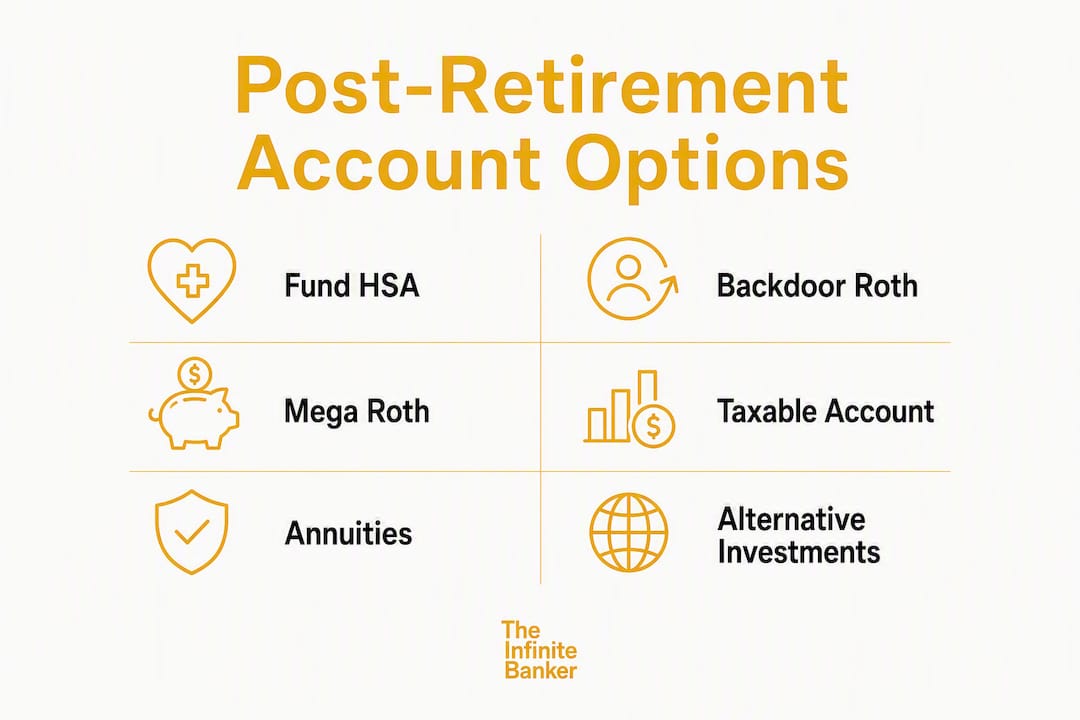
For high-income earners who have already hit the annual contribution ceiling on their 401(k) and IRA, the best next moves are: a taxable brokerage account (no limits, full flexibility), an HSA if you carry a high-deductible health plan, a backdoor Roth IRA or mega backdoor Roth if your plan permits, tax-deferred annuities for additional deferral, self-employed plans (Solo 401(k), SEP IRA, or SIMPLE) if you have business income, real estate and alternative investments for diversification, and dividend-paying whole life insurance structured for Infinite Banking as a liquidity and legacy tool. Author: Jib Hunt, Authorized IBC Practitioner.
Each option carries distinct trade-offs worth understanding before you act:
Taxable brokerage account: No contribution limits, full liquidity, but gains taxed annually at capital gains or ordinary income rates.
HSA: Triple tax benefit, but requires a high-deductible health plan and has annual contribution limits.
Backdoor Roth IRA: Roth-style tax diversification for high earners, but the pro rata rule can create unexpected tax bills.
Mega backdoor Roth: Large after-tax contributions converted to Roth, but only if your 401(k) plan specifically allows it.
Tax-deferred annuity: No IRS annual funding cap, but gains taxed at ordinary income rates on withdrawal and fees can be substantial.
Solo 401(k) / SEP IRA / SIMPLE: Materially higher contribution room for business owners, but each has distinct administrative and eligibility rules.
Real estate and alternatives: Income, diversification, or alpha potential, but longer lock-ups and higher complexity.
Dividend-paying whole life (Infinite Banking): Policy loan liquidity and potential tax-deferred cash value growth, but insurance costs, loan interest, and lapse risk require careful design.
Consult a CPA, financial advisor, and, where relevant, an Authorized IBC Practitioner before implementing any of these strategies.
Table of Contents
Why an HSA may be the smartest account you are not fully funding
Why a taxable brokerage account is usually the first stop after retirement accounts
Self-employed and owner options: Solo 401(k), SEP IRA, and SIMPLE
Real estate and alternative investments as part of a diversified strategy
Dividend-paying whole life insurance and the Infinite Banking concept
How to choose among these options: a practical decision framework
How state taxes affect your strategy if you live in multiple states
Employer stock options and ESPPs as part of your broader picture
Donor-advised funds and charitable giving as a tax-efficient wealth transfer tool
Legal and regulatory updates that affect contribution limits and eligibility
Why an HSA may be the smartest account you are not fully funding
If you are enrolled in a high-deductible health plan, the Health Savings Account is arguably the most tax-efficient savings vehicle available to any U.S. investor. Contributions are deductible, growth is tax-deferred, and qualified medical withdrawals are tax-free — a combination no other account type replicates. After age 65, non-medical withdrawals are taxed at ordinary income rates, effectively converting the HSA into a traditional IRA without required minimum distributions.

The strategic move for high earners is to pay current medical expenses out of pocket, let the HSA balance compound invested in equities, and preserve the account for future healthcare costs or as a supplemental retirement account. Contribution limits are set annually by the IRS and adjusted for inflation; confirm the current figures with your advisor or at IRS.gov before funding.
Pro Tip: Keep receipts for every out-of-pocket medical expense you pay today. The IRS does not impose a deadline on HSA reimbursements, so you can withdraw tax-free years or decades later by submitting those receipts, effectively creating a tax-free cash reserve.
The opportunity cost of skipping HSA funding is real. A high-income earner who invests the full family HSA contribution annually in a low-cost index fund and leaves it untouched for many years can accumulate a meaningful tax-advantaged pool, all without using retirement account space. The exact growth depends on contribution amounts, investment returns, and expenses, none of which can be predicted, but the structural tax advantage is clear and documented.
If you do not have access to an HDHP, the HSA is simply off the table. In that case, redirect the dollars you would have contributed toward the next priority on your list, typically the backdoor Roth or taxable brokerage.
How the backdoor Roth IRA works for high earners
Direct Roth IRA contributions phase out at income thresholds the IRS adjusts annually. Once your modified adjusted gross income exceeds those limits, the backdoor Roth becomes the standard workaround: make a nondeductible contribution to a traditional IRA, then convert it to a Roth IRA. The mechanics are straightforward, but the tax consequences require attention.
Step-by-step process:
Confirm you have no pre-tax IRA balances (traditional, SEP, or SIMPLE IRAs). If you do, the pro rata rule applies.
Make a nondeductible contribution to a traditional IRA up to the annual IRS limit (verify the current limit at IRS.gov).
Convert the traditional IRA balance to a Roth IRA. If the account held only after-tax dollars, the conversion is nearly tax-free; only earnings accrued between contribution and conversion are taxable.
File IRS Form 8606 to report the nondeductible contribution and track your basis. Skipping this step is a costly error.
Repeat annually. Timing the contribution and conversion close together reduces the earnings that become taxable.
The pro rata rule: If you hold $90,000 in pre-tax IRA funds and make a $7,000 nondeductible contribution, the IRS treats only 7.2% of any conversion as after-tax. Converting $7,000 would trigger tax on roughly $6,500. The solution for many high earners is to roll pre-tax IRA balances into a current employer’s 401(k) before executing the backdoor Roth, clearing the IRA slate. Work with a CPA before attempting this.
Roth conversions are most attractive when you expect your future tax rate to exceed your current rate, when you have a long investment horizon, or when estate planning goals favor passing tax-free assets to heirs. The IRS guidance on IRAs covers the technical rules in detail.
Does your 401(k) plan allow a mega backdoor Roth?
The mega backdoor Roth can be a significant opportunity, but it is entirely plan-dependent. Most employees never use it simply because they do not know to ask HR whether their plan supports it.
Your plan must allow all three of the following for this strategy to work:
After-tax contributions — beyond the standard elective deferral limit, up to the IRS total annual additions limit (employee plus employer contributions combined).
If your plan checks all three boxes, the after-tax contributions grow tax-deferred until converted, at which point future growth is tax-free inside the Roth. The earnings accrued before conversion are taxable, so converting frequently (even monthly if the plan allows) keeps the taxable amount minimal.
Benefits include materially larger Roth balances over time and no income limit on the strategy. Trade-offs include dependence on your employer’s plan design, potential administrative friction, and the need to track basis carefully.
Pro Tip: Contact your plan administrator in January rather than December. Some plans require election changes at the start of the plan year, and waiting until year-end can cost you an entire year of after-tax contributions.
Why a taxable brokerage account is usually the first stop after retirement accounts
For high-income earners who want flexibility and face no funding limits, a taxable brokerage account is typically the primary vehicle for additional investable dollars. There are no income restrictions, no annual caps, and no early withdrawal penalties. You can access the funds at any time for any purpose, which matters when goals evolve or opportunities arise outside a retirement timeline.

The tax treatment is favorable compared to ordinary income. Long-term capital gains (assets held more than one year) are taxed at preferential rates, and qualified dividends receive similar treatment. The account does not generate required minimum distributions, and losses can be harvested to offset gains.
Tax-aware strategies that make a material difference:
Asset location: Hold tax-inefficient assets (bonds, REITs, high-turnover funds) inside tax-advantaged accounts and place long-term equities in the taxable account. Fidelity’s guidance identifies asset location as an underused lever that reduces annual tax friction without changing your overall allocation.
Low-turnover index ETFs: Minimize capital gains distributions by using ETFs rather than actively managed mutual funds in taxable accounts.
Tax-loss harvesting: Sell positions at a loss to offset realized gains, then reinvest in a similar (not substantially identical) security to maintain market exposure.
Municipal bonds: Interest on munis is generally exempt from federal income tax and often state tax for residents of the issuing state, making them particularly efficient for high earners in top brackets.
Separately managed accounts (SMAs): For larger taxable portfolios, SMAs allow direct ownership of individual securities and tax-lot-level customization that mutual funds cannot provide.
Asset location quick reference:
Asset Type | Recommended Account Location | Reason |
Long-term equity index ETFs | Taxable brokerage | Low turnover, preferential capital gains rates |
Bonds and bond funds | Tax-advantaged (401k, IRA) | Interest taxed at ordinary income rates |
High-turnover active funds | Tax-advantaged (401k, IRA) | Frequent capital gains distributions |
Municipal bonds | Taxable brokerage | Federal (and often state) tax-exempt interest |
REITs | Tax-advantaged (401k, IRA) | Dividends taxed at ordinary income rates |
International equity funds | Taxable brokerage | Foreign tax credit available only in taxable accounts |
Qualitative guidance only. Consult a tax advisor for your specific situation.
When do tax-deferred annuities make sense for high earners?
Tax-deferred annuities accept additional dollars without IRS annual contribution limits and defer taxes on earnings until withdrawal. That deferral is the core appeal for high earners who have exhausted other tax-advantaged space. The structural limitation is that gains distributed from a deferred annuity are taxed at ordinary income rates, not the preferential capital gains rates available in a taxable brokerage account.
Fee layers are the most common reason annuities underperform their projections. A typical variable annuity carries a mortality and expense charge, investment subaccount fees, and potentially a rider charge for income or death benefit guarantees. Surrender charges can lock funds for six to ten years. Before purchasing, model the net-of-fee scenario against a comparable taxable brokerage account holding low-cost index ETFs.
Annuities tend to make sense when: you have a long time horizon before distributions begin, your current tax rate is materially higher than your projected retirement rate, you value structured lifetime income features, and you have already funded every other tax-advantaged option available to you. They are rarely the right first move after maxing a 401(k).
Self-employed and owner options: Solo 401(k), SEP IRA, and SIMPLE
Business owners have access to retirement plans that can materially increase contribution room beyond what W-2 employees can achieve. The right plan depends on your payroll structure, whether you have employees, and how much administrative complexity you are willing to manage.
Quick comparison:
Solo 401(k): For self-employed individuals with no full-time employees other than a spouse. Allows both an elective deferral (as employee) and a profit-sharing contribution (as employer), producing the highest potential total contribution among the three. Also supports a Roth option and, if the plan document allows, after-tax contributions for a mega backdoor Roth.
SEP IRA: Simpler to administer than a Solo 401(k). Contributions are employer-only, calculated as a percentage of net self-employment income. If you have employees, you must contribute the same percentage for eligible employees, which can make SEP IRAs expensive for growing businesses.
SIMPLE IRA: Designed for businesses with up to 100 employees. Requires employer contributions (either a match or a non-elective contribution). Lower contribution limits than a Solo 401(k) or SEP, but easier to administer than a full 401(k) plan.
To illustrate the contribution difference: a sole proprietor with $200,000 in net self-employment income could potentially contribute far more through a Solo 401(k) combining elective deferrals and profit-sharing than through a SEP IRA alone. The exact figures depend on net earnings calculations and current IRS limits; run the numbers with a CPA before choosing a plan structure.
Coordinate plan selection with your payroll setup, tax filing calendar, and any succession or exit planning. A plan that works well for a solo operator may create compliance obligations if you hire employees later.
Real estate and alternative investments as part of a diversified strategy
Alternatives can complement public market portfolios by providing income, diversification, or potential alpha, but they are not a uniform category. Private equity, private credit, and real estate each serve a distinct role and should be selected based on a specific investment objective rather than treated as a single bucket.
Common categories and their typical roles:
Core real estate: Income generation and inflation sensitivity; relatively lower volatility than opportunistic real estate.
Private equity: Long-term capital appreciation (alpha); typically multi-year lock-ups and high minimum investments.
Private credit: Income generation with floating-rate characteristics; less correlated to public bond markets.
Infrastructure: Stable, long-duration income; often inflation-linked.
Hedge funds: Diversification and risk management; wide variation in strategy, fees, and liquidity.
The CFA Institute notes that alternatives introduce complexity through longer lock-ups, reduced liquidity, and specialized fee structures, making them appropriate primarily for sophisticated investors who understand those trade-offs. Accredited investor status is required for many private offerings.
Pro Tip: Fund new alternative allocations by reducing public equity or low-yield fixed income, depending on whether your objective is alpha or income. Adding alternatives on top of an already-concentrated portfolio without reducing something else often increases risk rather than managing it.
For real estate specifically, direct ownership offers depreciation deductions and 1031 exchange treatment that can defer capital gains indefinitely. Real estate investment trusts (REITs) provide liquidity but lose those direct tax benefits, which is why REITs belong inside tax-advantaged accounts per the asset location table above.
Dividend-paying whole life insurance and the Infinite Banking concept
Properly structured dividend-paying whole life insurance can function as a personal finance system for liquidity and legacy purposes, but the strategy requires careful policy design and a clear understanding of how it works before committing capital. For a deeper look at how whole life fits into a broader retirement plan, see whole life’s role in retirement planning.
How the mechanics work:
Cash value accumulates inside the policy as premiums are paid. Paid-up additions (PUAs), funded on top of the base premium, accelerate cash value growth and are the engine of the Infinite Banking concept. Policy loans allow the owner to borrow against the cash value without triggering a taxable event, provided the policy remains in force. Dividends, when declared by the insurer, can be used to purchase additional paid-up additions, further compounding the cash value. Dividends are not guaranteed and depend on the insurer’s financial performance.
Advantages:
Policy loans provide liquidity without IRS annual funding limits or early withdrawal penalties.
Cash value growth is tax-deferred inside the policy.
The death benefit provides a legacy component not available in a brokerage or IRA.
No required minimum distributions.
Drawbacks and required disclosures:
Insurance costs (cost of insurance charges) reduce net returns, particularly in early policy years.
Policy loans accrue interest and reduce both cash value and the death benefit if not repaid.
Overfunding without correct design can cause the policy to become a modified endowment contract (MEC), which changes the tax treatment of loans and distributions and can harm policy viability.
Policies can lapse if premiums are not maintained or if outstanding loans exceed cash value.
The Infinite Banking Calculator at The Infinite Banker can help you model illustrative policy funding scenarios. To understand whether this approach fits your profile, review who Infinite Banking is for before scheduling a consultation.
How to choose among these options: a practical decision framework
Prioritize based on five criteria: (1) eligibility and current IRS rules, (2) liquidity needs, (3) investment control, (4) fee tolerance, and (5) estate and legacy goals. No single option is universally superior; the right sequence depends on your specific tax situation, time horizon, and cash flow.
Scenario-based decision flow:
Short horizon or bridge to retirement: Taxable brokerage with tax-efficient investments (low-turnover ETFs, munis). Avoid locking capital in vehicles with surrender charges or long lock-ups.
HDHP-eligible and long horizon: Fund the HSA fully and invest the balance. The triple tax benefit compounds over time.
401(k) plan permits after-tax contributions and in-plan conversions: Pursue the mega backdoor Roth before other options. The Roth tax-free growth is difficult to replicate elsewhere.
Business owner with payroll flexibility: Evaluate a Solo 401(k) first for maximum contribution room; layer in a SEP or SIMPLE only if the Solo 401(k) does not fit your structure.
High earner with stable cash flow and legacy goals: Explore dividend-paying whole life with an Authorized IBC Practitioner after other tax-advantaged options are addressed.
Questions to ask your advisor and plan administrator:
Am I eligible for HSA contributions this year?
Does my 401(k) plan allow after-tax contributions and in-plan Roth conversions?
What are the in-service distribution rules in my plan document?
What are the total fee layers on any annuity product I am considering?
What is the net-of-fee internal rate of return on a whole life illustration?
Red flags to watch for:
Fee structures that are not disclosed in writing before you sign.
Plan administrators who cannot confirm in-plan conversion eligibility in writing.
Insurance illustrations that imply dividends are guaranteed.
Any strategy that pushes a whole life policy into MEC territory through overfunding.
Advisors who recommend a single solution without discussing trade-offs across the full menu.
How state taxes affect your strategy if you live in multiple states
State income tax treatment of retirement income varies significantly across the U.S., and for high earners who live or work in more than one state, the differences can be material. Nine states have no income tax at all (including Florida, Texas, and Nevada), while others tax retirement distributions at rates that approach or match their top marginal income tax rate.
For multi-state residents, the sourcing rules for retirement income matter. Pension income is generally taxed by the state of residence at the time of distribution, not the state where it was earned, under federal law (4 U.S.C. § 114). However, IRA and 401(k) distributions, annuity payments, and investment income from a taxable brokerage account follow the residency rules of the state where you live when you receive the income.
Practical implications: if you plan to retire in a low-tax or no-income-tax state, deferring income into traditional pre-tax accounts may be more valuable than converting to Roth now, because the future distributions will be taxed at a lower state rate. Conversely, if you expect to remain in a high-tax state, Roth conversions and tax-free HSA withdrawals become more attractive. Municipal bonds issued by your state of residence typically offer double tax exemption (federal and state), which raises their after-tax yield for high-income residents.
Work with a CPA who understands multi-state sourcing rules before making large Roth conversions or annuity purchases, particularly if you split time between states.
Employer stock options and ESPPs as part of your broader picture
If your employer offers stock options or an Employee Stock Purchase Plan (ESPP), these can represent meaningful additional compensation that interacts directly with your retirement savings strategy. They are not retirement accounts, but they generate taxable events that affect how much you can save and where.
ESPPs typically allow employees to purchase company stock at a discount, often 15% below market price, through payroll deductions. The discount and any subsequent gain are taxed as ordinary income or capital gains depending on the holding period and whether the plan is qualified under IRS Section 423. For high earners, the ordinary income component of ESPP gains can push marginal rates higher in the year of sale, which affects the relative value of Roth conversions or HSA contributions in that same year.
Incentive stock options (ISOs) and non-qualified stock options (NSOs) carry different tax treatments. ISO exercises can trigger alternative minimum tax (AMT) exposure, a consideration that requires careful planning around exercise timing and the size of other deductions. NSO exercises generate ordinary income at the spread between exercise price and fair market value.
The key planning point: coordinate stock option exercises and ESPP sales with your broader tax picture for the year. A large option exercise in the same year as a Roth conversion can push you into a higher bracket than either event would alone. A tax advisor who models the combined impact before you act can prevent avoidable tax costs.
Donor-advised funds and charitable giving as a tax-efficient wealth transfer tool
For high earners with philanthropic intent, a donor-advised fund (DAF) is one of the most tax-efficient structures available. You contribute appreciated assets (securities, real estate, or cash) to the DAF, claim a charitable deduction in the year of contribution, and then recommend grants to qualified charities over time at your own pace. The contributed assets are sold inside the DAF without triggering capital gains tax.
The deduction for cash contributions to a DAF is generally limited to 60% of adjusted gross income (AGI), while contributions of appreciated long-term capital gain property are limited to 30% of AGI, with a five-year carryforward for excess amounts. Confirm current limits with your tax advisor, as these figures are set by the IRS and subject to change.
For high earners in peak earning years, bunching multiple years of charitable giving into a single DAF contribution can push itemized deductions above the standard deduction threshold, producing a larger tax benefit than spreading smaller annual gifts. The DAF then distributes grants to charities over several years, maintaining a consistent giving pattern without requiring a large deduction every year.
Qualified charitable distributions (QCDs) from an IRA are a separate but related tool: taxpayers aged 70½ or older can direct up to $105,000 annually (2024 IRS limit; verify the current figure) directly from an IRA to a qualified charity, satisfying required minimum distributions without the amount appearing in adjusted gross income. This is particularly valuable for high earners who do not need IRA distributions for living expenses and want to reduce their taxable income.
Legal and regulatory updates that affect contribution limits and eligibility
The SECURE 2.0 Act, signed into law in December 2022, introduced a series of changes that phase in through 2025 and 2026. Several are directly relevant to high earners pursuing the strategies in this article.
The IRS announced that the 401(k) elective deferral limit increases to $23,500 for 2025, with a catch-up contribution of $7,500 for those aged 50 and older. SECURE 2.0 introduced an enhanced catch-up contribution for participants aged 60 through 63, raising that figure to $11,250 for 2025. IRA contribution limits and income phase-out thresholds are also adjusted annually; verify the current figures at IRS.gov before funding.
SECURE 2.0 also changed the required minimum distribution (RMD) starting age from 72 to 73, with a further increase to 75 scheduled for 2033. For high earners who do not need retirement account distributions for living expenses, the extended deferral period allows more time for tax-deferred growth and more flexibility in timing Roth conversions before RMDs begin.
The rules governing mega backdoor Roth contributions and in-plan conversions have not changed materially, but plan sponsors are not required to offer these features. Congress has periodically proposed limiting or eliminating backdoor Roth strategies; no such legislation has passed as of the publication of this article, but the regulatory environment warrants monitoring. Work with a CPA who tracks legislative developments in this area.
Key Takeaways
For high-income earners, the most tax-efficient path after maxing retirement accounts combines HSA funding (if eligible), Roth strategies, a taxable brokerage account, and, for business owners, a self-employed plan, with alternatives and whole life insurance considered based on individual goals and cash flow.
Point | Details |
HSA first if eligible | Fund the HSA fully and invest the balance for long-term growth; triple tax benefit is unmatched. |
Mega backdoor Roth if plan allows | Ask HR whether your 401(k) supports after-tax contributions and in-plan Roth conversions before year-end. |
Taxable brokerage as the default | Use asset location, low-turnover ETFs, and tax-loss harvesting to reduce annual tax drag on flexible savings. |
Business owners: evaluate Solo 401(k) | A Solo 401(k) can produce the highest total contribution room for self-employed individuals; run numbers with a CPA. |
Infinite Banking for liquidity and legacy | The Infinite Banker offers strategy sessions and policy design for entrepreneurs and high earners who want a consultative review of dividend-paying whole life. |
A practitioner’s perspective on where Infinite Banking fits
The clients who tend to benefit most from a properly structured dividend-paying whole life policy share a few characteristics: they have stable, recurring cash flow from a business or professional practice; they are already funding their 401(k) and taxable accounts; and they want a capital pool they can access without triggering a taxable event or asking a lender for permission. Real estate investors, in particular, often find the policy loan mechanism useful for funding down payments or bridging capital between transactions.
That said, Infinite Banking is not appropriate for everyone. The strategy requires a long funding horizon, typically a minimum of ten years before the cash value meaningfully exceeds total premiums paid. Dividends are not guaranteed. Policy loans accrue interest and reduce both cash value and the death benefit if not repaid. A policy that is not maintained can lapse, which would trigger adverse tax consequences on any outstanding loans.
Before pursuing this strategy, consult a CPA to understand the tax implications in your specific situation and speak with Jib Hunt, an Authorized IBC Practitioner, for a full suitability review. The wealth preservation strategies checklist at The Infinite Banker is a useful starting point for understanding how whole life fits within a broader financial plan.
What The Infinite Banker offers qualified investors

The Infinite Banker works with entrepreneurs, real estate investors, and high-income earners who want a structured, consultative approach to dividend-paying whole life insurance. Services include strategy sessions to assess fit, policy design tailored to cash flow and funding capacity, underwriting guidance, and ongoing education about Infinite Banking concepts and capital efficiency.
For readers who have worked through the options in this article and want to understand whether a properly structured whole life policy belongs in their financial plan, the Infinite Banking Calculator provides a starting point for modeling illustrative scenarios. A direct consultation with Jib Hunt, Authorized IBC Practitioner, goes further: it covers policy structure, funding pace, loan mechanics, and how the strategy interacts with your existing retirement and taxable accounts.
If you are an entrepreneur, real estate investor, or high earner with stable cash flow and a long planning horizon, schedule a consultation to determine whether this approach may fit your situation.
Useful sources and references
The following primary sources informed this article. Each is linked directly for further reading.
Types of Retirement Plans | Internal Revenue Service: IRS overview of qualified plan types, including 401(k), SEP, and SIMPLE structures. Relevant to the self-employed plans section.
Individual Retirement Arrangements (IRAs) | Internal Revenue Service: IRS rules governing traditional and Roth IRAs, including contribution limits and conversion mechanics. Relevant to the backdoor Roth section.
401(k) limit increases to $23,500 for 2025 | IRS: Official IRS announcement of 2025 contribution limits and catch-up contribution changes under SECURE 2.0. Relevant to the regulatory updates section.
What to consider after you max out your 401(k) | Fidelity: Covers HSA mechanics, backdoor and mega backdoor Roth strategies, annuities, and asset location. Relevant across multiple sections.
Where to Save After Maxing Out Your 401(k) | Darrow Wealth Management: Practitioner-focused analysis of taxable brokerage accounts and self-employed plan options for high earners. Relevant to the brokerage and self-employed sections.
Maxing Out Your 401(k)? Here Are Alternatives to Consider | Western Southern: Covers HSA triple tax benefits, whole life insurance mechanics, and annuity trade-offs. Relevant to the HSA and Infinite Banking sections.
Know Your Alternatives | J.P. Morgan Asset Management: Framework for allocating among private equity, private credit, real estate, and infrastructure based on investment objective. Relevant to the alternatives section.
Alternative Investment Features, Methods, and Structures | CFA Institute: Technical overview of alternative investment structures, lock-up periods, and fee considerations for sophisticated investors. Relevant to the alternatives section.
Types of Retirement Plans | U.S. Department of Labor: DOL overview of defined contribution and defined benefit plan structures, including ERISA context. Relevant to the self-employed plans and regulatory updates sections.
This post is educational only and not financial, tax, or legal advice. Consult qualified professionals before acting.
Recommended
Comments