
Whole Life Insurance's Role in Retirement Planning


COMPLIANCE NOTE: For educational purposes only. Not financial, tax, or legal advice.
Whole life insurance functions as a supplemental layer in retirement planning, not a replacement for a 401(k) or IRA. It accumulates cash value on a tax-deferred basis, provides a permanent death benefit, and can supply liquidity when markets turn against you. For entrepreneurs, real estate investors, and high-income earners, that combination addresses risks that market-based accounts simply were not designed to handle. The role of whole life in retirement planning is most accurately described as a multi-function financial tool that sits alongside other income sources rather than competing with them.
Here is a quick summary of the roles whole life insurance can play:
Supplemental income source: Policy loans and withdrawals from cash value can fund retirement spending, particularly during market downturns.
Volatility buffer: Cash value does not lose principal during equity market declines, giving you an alternative draw source when portfolio values drop.
Estate liquidity: The death benefit is typically income tax-free for beneficiaries, covering estate taxes and debts without forcing asset sales.
Tax diversification: Cash value grows tax-deferred, and distributions structured as loans are generally not taxable income while the policy remains active.
Legacy and income replacement: A permanent death benefit supports legacy goals and can replace annuity assets for surviving family members.
Benefits of using whole life insurance in retirement planning
Tax-advantaged cash value growth
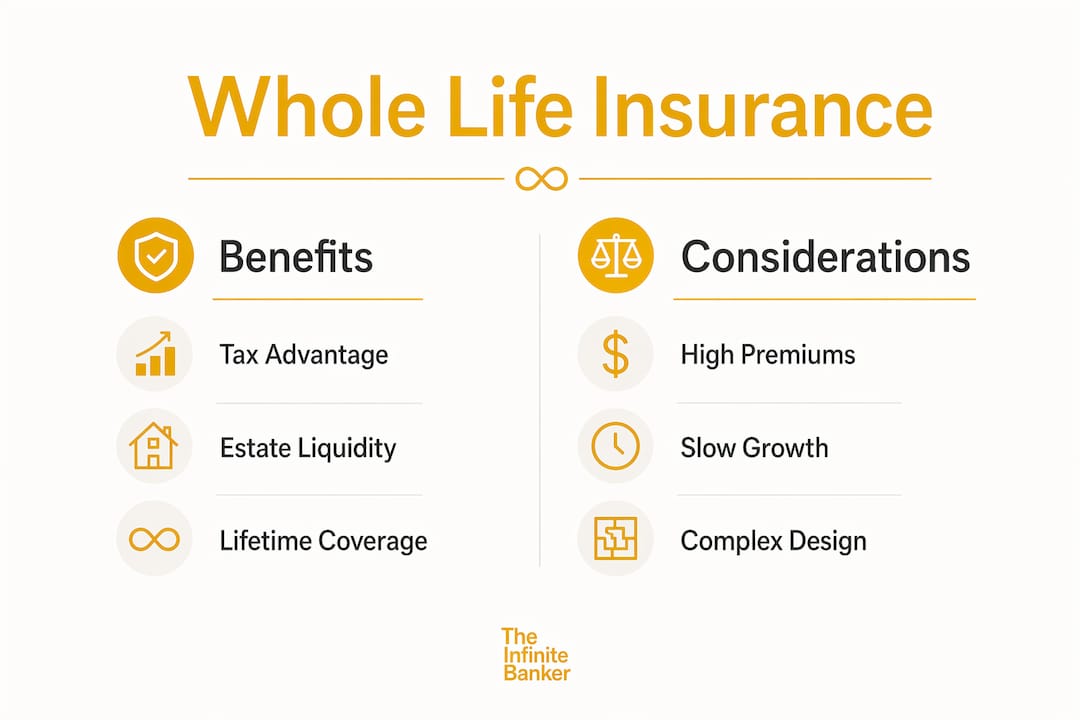
Whole life insurance allows tax-deferred cash value growth, and when structured properly, distributions can be taken in a tax-advantaged manner. Withdrawals up to your cost basis come out without triggering income tax. Beyond that threshold, policy loans are typically not taxable as income provided the policy stays in force and does not lapse. That combination creates a third tax “bucket” alongside pre-tax accounts like a traditional 401(k) and after-tax accounts like a Roth IRA, giving you more flexibility in managing taxable income during retirement.

Death benefit and estate liquidity
The death benefit of a participating whole life policy passes to beneficiaries income tax-free in most cases, and it arrives as liquid cash rather than an illiquid asset. For business owners or real estate investors whose estates are concentrated in property or a closely held company, that liquidity prevents forced sales at unfavorable prices. Proper estate planning with life insurance addresses this directly: the death benefit can cover estate taxes and outstanding debts without requiring heirs to liquidate core assets.
Supplemental retirement income during market downturns
Participating whole life policies may pay dividends, though dividends are never guaranteed. When they are credited, they add to the policy’s cash value or can be used to purchase paid-up additions, which accelerates cash value growth over time. During a prolonged market downturn, you can draw from cash value rather than selling equities at a loss. Research published by the Financial Planning Association found that whole life as a volatility buffer can support greater lifetime spending and legacy outcomes compared to a “buy term and invest the difference” approach, particularly for a couple in their 40s with combined tax rates in the 25%–32% range on qualified distributions.
Research insight: A Financial Planning Association study modeled a 40-year-old couple and found that integrating whole life insurance into a lifetime financial plan had the potential to support greater lifetime spending and a larger legacy than “buy term and invest the difference” strategies across multiple scenarios.
Key benefits at a glance:
Tax-deferred cash value accumulation with potential for tax-advantaged distributions
Permanent death benefit that passes income tax-free to beneficiaries
Cash value accessible as a volatility buffer during equity market declines
Fixed premiums that do not increase with age or health changes
Potential for participating dividends (not guaranteed) that compound over time
A third tax bucket that diversifies retirement income tax treatment
Who should consider integrating whole life insurance into retirement plans
Whole life insurance is not the right fit for everyone, and recognizing that early saves both time and money. The profile that tends to benefit most shares a few consistent characteristics.

Entrepreneurs and business owners often carry concentrated wealth in illiquid assets. A whole life policy provides liquidity at death without forcing a business sale, and the cash value can serve as a reserve during slow revenue periods. Real estate investors face a similar concentration problem: properties are not easily divided or quickly sold, and the death benefit can cover estate taxes without triggering a distressed sale. High-income earners who have already maxed out their 401(k) and Roth IRA contributions may find whole life a practical next layer for tax-deferred accumulation.
Timing matters considerably. Purchasing a policy earlier in life, ideally in your 30s or 40s, gives the cash value more time to compound. A policy started at 55 will accumulate far less cash value by retirement than one started at 40, simply because the compounding period is shorter. Premiums are also lower when you are younger and healthier, which affects the overall cost efficiency of the strategy.
Suitability factors to consider:
Long-term financial commitment: whole life premiums are fixed but ongoing, and early surrender can result in losses
Estate planning goals, particularly if your estate includes illiquid assets like real estate or a business
High marginal tax rates that make tax-deferred accumulation more valuable
A desire for income replacement or legacy funding alongside retirement income
Comfort with slower cash value growth in the early policy years relative to market investments
Existing retirement accounts that are already funded, making whole life an additive layer rather than a primary vehicle
Disadvantages and important considerations when using whole life insurance in retirement
Whole life insurance carries real costs and constraints that deserve direct attention before you commit.
High premiums are the most immediate friction point. Whole life premiums are substantially higher than term life premiums for the same death benefit, which means less capital available for other investments in the early years. Whole life insurance offers predictability but often comes with higher upfront costs and lower potential returns compared to market-based alternatives. For someone with limited cash flow, those premiums can crowd out contributions to a 401(k) or other accounts.
Slow early cash value growth is another structural reality. In the first several years of a policy, a large portion of each premium covers the cost of insurance and administrative fees. The cash value grows, but not at a pace that competes with equity markets in a strong bull run. This is not a short-term vehicle.
Policy loan risks deserve careful attention. Policy loans accrue interest, and if unpaid, they reduce both the cash value and the death benefit. If the loan balance grows large enough relative to the remaining cash value, the policy can lapse, which would trigger a taxable event on any gains. Policies structured as modified endowment contracts (MECs) face additional restrictions: MEC distributions are taxable to the extent of gain and subject to a 10% penalty if taken before age 59½.
Key drawbacks to weigh:
Premiums are significantly higher than term insurance for equivalent death benefit coverage
Cash value accumulation is slow in the early years of the policy
Policy loans accrue interest and reduce cash value and death benefit if not repaid
Policies can lapse if loan balances erode cash value, triggering potential tax consequences
MEC rules restrict tax-advantaged access to distributions if the policy is overfunded too quickly
Lower potential returns compared to equity markets over long time horizons
Pro Tip: Work with a tax professional and an estate attorney before finalizing policy ownership structure. Participating whole life policies require careful coordination with specialists because ownership and beneficiary designations directly affect tax outcomes and estate treatment.
What the research says about whole life as a lifetime financial planning tool
The Financial Planning Association published research examining three specific ways a couple, both age 40, could incorporate whole life insurance into a lifetime financial plan. The study compared these approaches against a “buy term and invest the difference” baseline. Across all three scenarios, the research found that integrating whole life had the potential to support greater lifetime spending and a larger legacy than the term-and-invest alternative.
The three scenarios examined were: using whole life to fund a legacy goal, using the permanent death benefit to justify purchasing a single-life income annuity, and using cash value as a volatility buffer to manage sequence of returns risk. The volatility buffer scenario is particularly relevant for retirees who draw from a portfolio during retirement. When markets decline, selling equities to fund living expenses locks in losses. Drawing from whole life cash value instead preserves the investment portfolio, allowing it to recover before further withdrawals are needed.
One important structural note from the research: because whole life premiums are larger than term premiums, the couple in the study had less in their 401(k) at retirement. The difference ranged from 27% less at the 10th percentile of outcomes to 4% less at the 90th percentile. The offset came partly from a more aggressive 401(k) allocation, since the cash value served as the fixed-income component of the overall portfolio.
Scenario | Strategy | Key outcome |
Legacy funding | Whole life replaces term + investment | Potential for greater after-tax legacy value |
Annuity integration | Whole life death benefit backs single-life annuity | Retiree can accept higher annuity payout with less behavioral friction |
Volatility buffer | Cash value drawn during market downturns | Reduced sequence of returns risk; greater lifetime spending potential |
Baseline | Buy term and invest the difference | Lower premiums but higher exposure to longevity and market risk |
High-net-worth individuals add another layer through irrevocable life insurance trusts (ILITs). When an ILIT owns the policy, the death benefit proceeds are excluded from the taxable estate, protecting wealth from estate taxes and creditors while allowing structured inheritance. This technique is a primary tool in estate planning for those whose estates exceed federal exemption thresholds.
How inflation affects whole life cash value and retirement income
Inflation is a genuine concern for any fixed or slow-growing asset, and whole life insurance is not immune. The cash value in a whole life policy grows at a rate determined by the insurer’s general account performance and, for participating policies, by dividend credits. In periods of high inflation, that growth rate may not keep pace with the rising cost of living, which means the purchasing power of your cash value can erode in real terms.
The death benefit faces the same pressure. A $1,000,000 death benefit purchased at age 40 will represent considerably less purchasing power by the time it is paid out decades later. Some participating policies address this partially through paid-up additions funded by dividends, which increase both the cash value and the death benefit over time. Dividends are not guaranteed, however, so this inflation hedge is not reliable.
The practical implication for retirement planning is that whole life should not be the sole income source in retirement. Pairing it with Social Security, which includes cost-of-living adjustments, and with a diversified investment portfolio provides a more complete response to inflation risk. Whole life contributes stability and liquidity; other vehicles carry the inflation-fighting load.
How to integrate whole life insurance with other retirement income sources
Whole life insurance works best as one component of a layered retirement income plan, not as a standalone strategy. The coordination between whole life and other sources requires deliberate sequencing and tax awareness.
A practical framework starts with identifying which income sources are taxable and which are not. Social Security benefits may be partially taxable depending on your combined income. Traditional 401(k) and IRA distributions are taxable as ordinary income. Roth IRA distributions are generally tax-free after age 59½. Policy loans from a whole life policy in good standing are typically not taxable. Structuring withdrawals to draw from taxable accounts first, then tax-deferred accounts, and using policy loans as a bridge during market downturns can reduce the overall tax burden across retirement.
For real estate investors, the cash value in a whole life policy can serve as a liquid reserve that complements illiquid property holdings. Rather than selling a property to cover a short-term cash need, you can take a policy loan, address the need, and repay the loan on your own schedule. The cash flow strategy behind this approach treats the policy as a personal financing mechanism alongside a broader retirement income plan. Coordinating with a financial planner who understands both insurance and investment accounts is the most direct way to build a sequencing plan that fits your specific tax situation. For those exploring how financial planning intersects with whole life insurance, the liquidity and income-layering aspects are often where the most practical value appears.
Potential risks and limitations specific to whole life in retirement planning
Beyond the general drawbacks covered earlier, a few risks are specific to how whole life policies behave inside a retirement plan.
Sequence of returns risk cuts both ways. While whole life cash value can buffer against poor early-retirement market returns, over-relying on policy loans in a prolonged downturn can erode the policy itself. If loan balances grow faster than cash value, the policy approaches lapse territory. A lapsed policy with outstanding loans triggers taxable income on all gains, at a moment when you may already be under financial stress.
Premium commitment in retirement. Whole life premiums do not stop when you retire unless the policy is fully paid up. Carrying a premium obligation into a fixed-income retirement requires planning. Some policies are structured as 10-pay or 20-pay designs, meaning premiums are completed before retirement begins. This is worth discussing with an advisor when the policy is designed, not after.
Estate planning complexity. Using whole life for legacy and estate goals, particularly through an ILIT, requires ongoing legal and tax maintenance. Crummey notices, annual gift tax exclusions, and trustee administration are not one-time tasks. The estate planning dimension of whole life ownership adds administrative overhead that some policyholders underestimate.
Policy design errors. A policy that is structured incorrectly, either overfunded into MEC status or underfunded relative to the death benefit, will not perform as intended. MEC classification permanently changes the tax treatment of all future distributions. Working with an advisor who specializes in policy design, not just insurance sales, reduces this risk considerably. The Infinite Banker’s approach to properly structured whole life strategies addresses this design question directly, because the funding structure determines whether the policy serves as an effective retirement tool or an expensive one.
Is whole life insurance right for your retirement strategy?
Whole life insurance fills a specific gap in retirement planning: it provides permanent death benefit coverage, tax-deferred cash value accumulation, and a liquid reserve that does not fluctuate with equity markets. For entrepreneurs, real estate investors, and high-income earners who have already funded their primary retirement accounts, it adds a layer of flexibility that term insurance and market investments cannot replicate. The research supports its use as a volatility buffer and legacy funding tool, particularly when integrated thoughtfully with a 401(k), annuities, and other income sources.
The strategy is not for everyone. High premiums, slow early growth, and the complexity of proper policy design mean it rewards those who plan carefully and commit for the long term. If you are considering whether this approach fits your situation, The Infinite Banker works with entrepreneurs and investors to implement properly structured whole life strategies built around capital efficiency and long-term flexibility. Who infinite banking is for covers the specific profiles and use cases in detail.

Key Takeaways
Whole life insurance plays its most effective role in retirement planning when it is structured deliberately and coordinated with other income sources, not used as a standalone savings vehicle.
Point | Details |
Volatility buffer function | Cash value can be drawn during market downturns to avoid selling investments at a loss, managing sequence of returns risk. |
Tax diversification | Policy loans from an active whole life policy are generally not taxable income, adding a third tax bucket alongside pre-tax and Roth accounts. |
Estate liquidity | The death benefit passes income tax-free to beneficiaries, covering estate taxes without forcing sales of illiquid assets like real estate or a business. |
Research-backed tradeoff | A Financial Planning Association study found whole life integration supported greater lifetime spending and legacy, though 401(k) balances at retirement were notably lower than the term-and-invest baseline. |
Policy design risk | Overfunding a policy into MEC status permanently changes tax treatment; proper structure requires specialist guidance before and during the policy’s life. |
This post is educational only and not financial, tax, or legal advice. Consult qualified professionals before acting.
Recommended
Comments