
How Policy Cash Value Grows Tax-Deferred


COMPLIANCE NOTE: For educational purposes only. Not financial, tax, or legal advice.
Tax-deferred growth in a whole life insurance policy means the cash value accumulates earnings that are not taxed as income each year, but compound inside the contract until withdrawal or policy termination. The Internal Revenue Code treats this growth as “inside buildup,” a designation that separates life insurance from ordinary investment accounts and removes the annual tax drag that erodes returns in taxable savings vehicles. Understanding how policy cash value grows tax-deferred is foundational for entrepreneurs, real estate investors, and high-income earners who want to use whole life insurance as a long-term capital management tool. The mechanics are specific, the IRS rules are precise, and the trade-offs are real.
How does cash value accumulate inside a whole life policy?
Cash value accumulation in a whole life insurance policy follows a defined process. Each premium payment splits between the cost of insurance coverage, policy fees, and the cash value account. The portion that funds cash value then earns a fixed, guaranteed interest rate set at the time of purchase, typically in the 2%–4% range. That growth compounds inside the policy without triggering annual income tax.
Dividend-paying whole life policies add another layer. Insurers may credit dividends based on their financial performance, and policyholders can direct those dividends to purchase paid-up additions, which increases both the death benefit and the cash value. Dividends are not guaranteed and depend entirely on the insurer’s experience with mortality, expenses, and investment returns. When dividends are reinvested, they compound alongside the base cash value, accelerating accumulation over time.

The early years of a whole life policy present a real cost drag. Slow cash value growth in the first 1–3 years reflects the front-loaded nature of underwriting costs, agent commissions, and mortality expenses. Meaningful compounding typically becomes significant only after a 10–20 year horizon. This is not a flaw in the structure. It is the expected behavior of a contract designed for long-term capital accumulation, not short-term liquidity.
Key mechanics of cash value accumulation:
Premium allocation: Each payment funds both the insurance cost and the cash value account.
Guaranteed interest: A fixed rate, set at issue, credits to cash value regardless of market conditions.
Dividend reinvestment: Non-guaranteed dividends, when credited, can purchase paid-up additions that compound further.
Tax-deferred compounding: No annual 1099 forms are issued for cash value growth while the policy remains in force.
Long-term tipping point: Compounding effects become pronounced after a decade or more of consistent funding.
Pro Tip: Structuring a policy with a high paid-up additions rider from the start can reduce the early-year cost drag and accelerate cash value growth. Work with an Authorized IBC Practitioner to design the policy correctly before purchase.
Why does the IRS treat cash value growth as tax-deferred?
The IRS grants tax-deferred status to life insurance cash value because of the contract’s death benefit guarantee and its life-contingent structure. This is not a loophole. The Internal Revenue Code recognizes life insurance contracts as a distinct category, treating earnings inside the policy as “inside buildup” rather than current income. Premiums increase the policyholder’s cost basis, which separates the return of capital from any taxable gain.
For this treatment to apply, the policy must meet specific IRS tests. These tests confirm the contract qualifies as life insurance rather than a disguised investment vehicle.
Insurance risk requirement: The policy must carry genuine mortality risk, meaning the death benefit must exceed the cash value by a defined margin throughout the contract’s life.
Guideline premium test or cash value accumulation test: The IRS limits how much premium can fund a policy relative to the death benefit, preventing over-funding that would convert it into a taxable investment.
Non-transferability and contract structure: The policy must function as a life insurance contract, not a transferable security.
“The IRS letter rulings and tax code recognize ‘inside buildup’ as the contractual layering of premiums and earnings, allowing growth to accumulate untaxed inside the policy, and designating premiums as return of capital until recovered. The death benefit guarantee is what distinguishes this treatment from investment vehicles.”
No annual 1099 forms are issued for cash value growth while the policy is in force. That means the IRS does not count credited interest or dividends as taxable income in the year they are earned. Tax becomes relevant only when a policyholder withdraws funds beyond their cost basis, surrenders the policy, or allows it to lapse with outstanding loans.
How does tax-deferred growth compare to taxable savings options?
The practical difference between tax-deferred cash value growth and taxable savings becomes clearest over long time horizons. Annual taxation on interest in a taxable account creates a compounding drag that reduces the effective growth rate every year. Tax-deferred growth avoids that drag entirely, allowing the full gross interest to compound inside the policy.
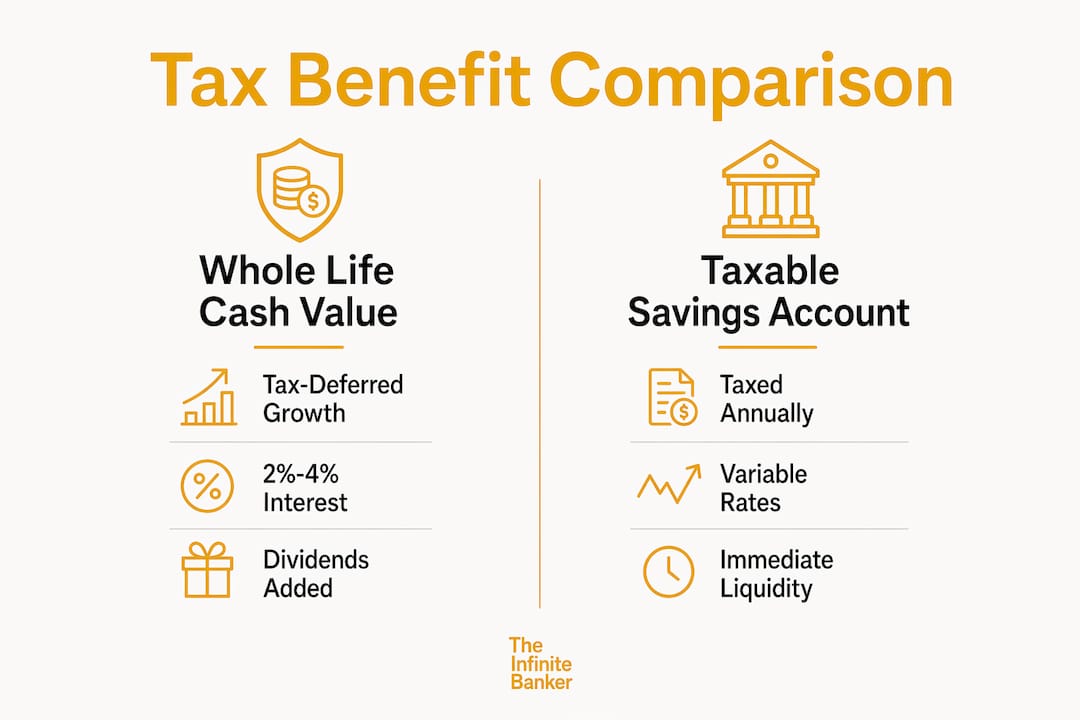
Feature | Whole life cash value | Taxable savings account |
Typical interest rate | 2%–4% (guaranteed) | 4%–5% (variable, market-dependent) |
Annual tax on growth | None while in force | Yes, taxed as ordinary income |
Market risk | None | Varies by account type |
Liquidity | Via loans or withdrawals | Direct access |
Death benefit | Yes | No |
Compounding effect | Full gross rate compounds | Net-of-tax rate compounds |
A taxable savings account may show a higher nominal rate today. However, tax drag costs can reach $14,000–$23,000 over 10 years depending on the policyholder’s tax bracket. That is real money that never compounds in a taxable account but continues working inside a whole life policy.
The liquidity trade-off is genuine. A savings account offers immediate, unrestricted access to funds. Cash value access requires either a withdrawal or a policy loan, each with its own tax and policy implications. For high-income earners in the 32%–37% federal tax brackets, the compounding advantage of tax deferral over 15–20 years can offset the liquidity difference significantly. The decision depends on time horizon, tax exposure, and how the policy fits within a broader financial plan.
How can you access cash value, and what are the tax consequences?
Policyholders have two primary methods to access cash value: withdrawals and policy loans. Each carries different tax treatment, and both require careful management to avoid unintended tax liability.
Withdrawals follow a first-in, first-out rule up to the cost basis. Withdrawals up to total premiums paid are generally income tax-free because they represent a return of capital already taxed before the premium was paid. Any amount withdrawn beyond the cost basis becomes taxable as ordinary income in the year of withdrawal.
Policy loans do not trigger income tax as long as the policy is not a Modified Endowment Contract (MEC) and remains in force. The insurer lends against the cash value as collateral, without a credit check or repayment schedule. However, policy loans accrue interest immediately and reduce the death benefit dollar-for-dollar if left unpaid. Unpaid loan balances can also cause a policy to lapse, which would trigger taxable income on any gains above the cost basis.
Key access scenarios and their tax consequences:
Withdrawal within basis: Tax-free return of capital.
Withdrawal above basis: Taxable as ordinary income.
Policy loan (non-MEC, in force): No income tax triggered.
Policy lapse with outstanding loans: Taxable gain recognized in the lapse year.
MEC status: Distributions become taxable as income first, with a 10% penalty before age 59½.
MEC status occurs when a policy is funded too aggressively in its early years, violating the IRS seven-pay test. Once a policy becomes a MEC, it cannot revert to standard treatment. This makes proper policy design critical from the start.
Pro Tip: Never allow a policy to lapse while carrying an outstanding loan balance. The tax bill arrives in the lapse year, often at a time when the policyholder has already lost the policy’s benefits. Monitor loan balances annually.
Key Takeaways
Tax-deferred cash value growth in a whole life policy compounds at the full gross rate because the Internal Revenue Code’s “inside buildup” designation removes annual income taxation, creating a compounding advantage that widens over 15–20 years compared to taxable savings accounts.
Point | Details |
IRS “inside buildup” | The tax code treats cash value growth as inside buildup, not current income, eliminating annual 1099 reporting. |
Guaranteed growth rate | Whole life cash value earns a fixed rate of 2%–4%, compounding without annual tax erosion. |
Early-year cost drag | Meaningful compounding typically begins after 10–20 years due to front-loaded insurance costs. |
Loan and withdrawal rules | Withdrawals within basis are tax-free; loans are tax-free if the policy stays in force and is not a MEC. |
Lapse risk | A policy lapse with outstanding loans triggers taxable income on gains in the lapse year. |
Tax deferral is a tool, not a guarantee of outcome
Most articles on this topic treat tax deferral as a straightforward win. My experience working with entrepreneurs and investors tells a more nuanced story. The compounding math is real. The IRS treatment is legitimate. But tax deferral is a timing mechanism, not tax elimination. Every dollar of gain inside a policy will eventually face a tax event unless it passes as a death benefit, which transfers income tax-free to beneficiaries under current law.
The early-year cost drag is the part most people underestimate. A policy funded for two or three years and then surrendered will almost certainly show a loss. Whole life insurance cash value is a long-duration asset. Treating it as a short-term savings account is a category error that leads to real financial disappointment. The policyholders who benefit most are those who hold for 15–20 years, reinvest dividends consistently, and manage loan balances with discipline.
The liquidity question also deserves honest attention. Policy loans give you access to capital without a tax event, but they are not free money. Interest accrues, and an undisciplined borrower can erode the very asset they are trying to build. The structure rewards patience and planning. It penalizes impulsive access.
Working with an Authorized IBC Practitioner matters more than most people realize. Policy design, premium structure, and dividend election choices made at issue have compounding consequences over decades. Getting those decisions right at the start is far easier than correcting them later.
— Jib Hunt
How The Infinite Banker can help you apply these concepts
Understanding the mechanics of tax-deferred cash value growth is the first step. Applying them correctly inside a properly structured whole life policy is where most people need qualified guidance.

The Infinite Banker is built specifically for entrepreneurs, real estate investors, and high-income earners who want to use dividend-paying whole life insurance as a capital management tool. Jib Hunt, an Authorized IBC Practitioner, works with clients to design policies that align with their cash flow needs, tax situation, and long-term financial goals. The site offers educational resources on Infinite Banking concepts, policy structure, and the practical realities of cash value accumulation. If you want to understand whether this strategy fits your situation, explore the resources available at The Infinite Banker.
FAQ
What does “inside buildup” mean for life insurance?
“Inside buildup” is the IRS term for earnings that accumulate inside a life insurance contract without being treated as current taxable income. The Internal Revenue Code designates this growth as separate from ordinary investment income, which removes the annual tax obligation on credited interest and dividends while the policy is in force.
How does cash value grow tax-deferred in a whole life policy?
Cash value earns a fixed guaranteed rate of 2%–4% annually, and any credited dividends compound alongside it, all without triggering a 1099 or annual income tax. The IRS treats premiums as increasing the policyholder’s cost basis, so growth above that basis is deferred until a taxable event such as a withdrawal above basis, surrender, or policy lapse.
Are policy loans from cash value taxable?
Policy loans are not taxable income as long as the policy is not a Modified Endowment Contract and remains in force. However, loans accrue interest and reduce the death benefit if unpaid, and a policy lapse with an outstanding loan balance will trigger a taxable gain in the lapse year.
What is a Modified Endowment Contract and why does it matter?
A Modified Endowment Contract, or MEC, is a life insurance policy that was funded too aggressively in its early years, violating the IRS seven-pay test. MEC status changes the tax treatment so that distributions are taxable as income first, and withdrawals before age 59½ may carry a 10% penalty, similar to a retirement account.
How long does it take for cash value to grow meaningfully?
Meaningful compounding in a whole life policy typically begins after 10–20 years because the early years absorb underwriting costs, agent commissions, and mortality expenses. Policyholders who hold for longer horizons and reinvest dividends consistently see the most pronounced compounding effects from tax-deferred accumulation.
This post is educational only and not financial, tax, or legal advice. Consult qualified professionals before acting.
Comments