
Whole Life Insurance Tax-Free Wealth Growth Guide


Whole life insurance is defined as a permanent life insurance contract that builds cash value over time, and its tax treatment makes it one of the most effective tax-free wealth growth vehicles available to high earners. The Internal Revenue Code recognizes “inside buildup,” meaning earnings compound inside the policy without triggering annual income tax. Policy loans drawn against that cash value are not reported as income as long as the policy stays in force. The death benefit passes to heirs income-tax-free. For entrepreneurs, real estate investors, and high-income earners who have already maxed out their 401(k) and IRA contributions, a properly structured whole life policy offers a fourth pillar of tax-advantaged wealth accumulation with no contribution limits and no income phase-outs.
How does whole life insurance enable tax-free wealth growth?
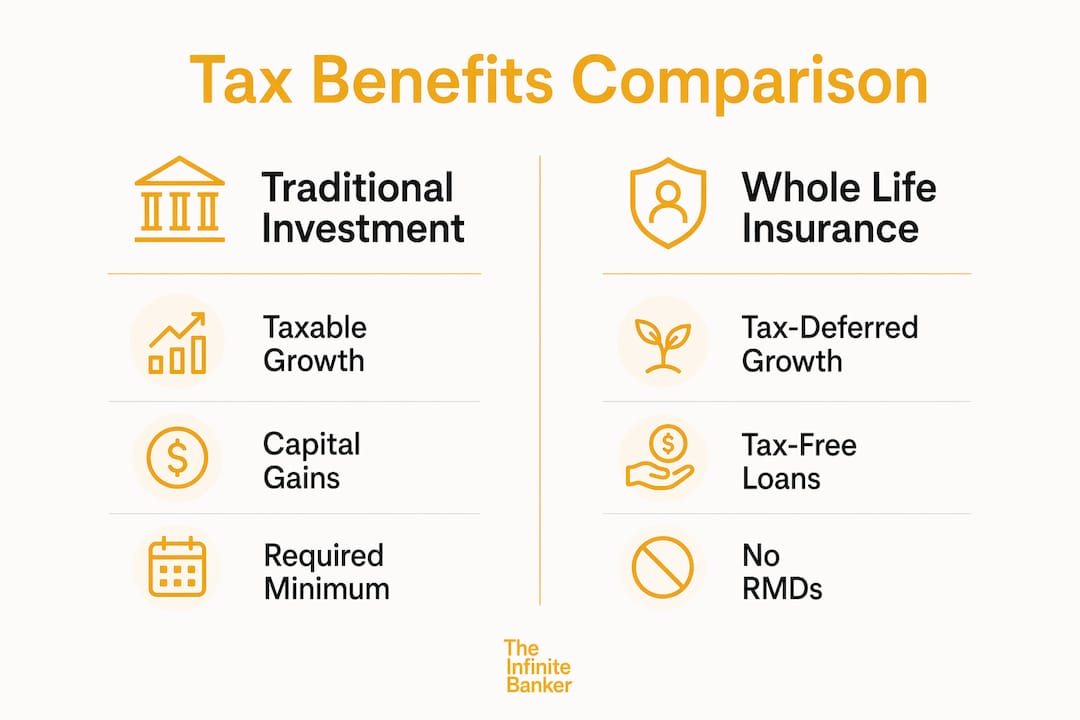
Tax-deferred growth inside a whole life policy works through a mechanism the IRS calls “inside buildup.” Policy earnings compound within insurer-managed reserves and are never distributed as current income, so no annual tax event occurs. That single feature separates whole life from a taxable brokerage account, where dividends and interest generate a tax bill every year regardless of whether you spend the money.
The practical impact is significant. A taxable bond account in a high bracket can see its effective after-tax yield drop below 3%. A cash-optimized whole life policy avoids that annual tax drag entirely, allowing the full credited rate to compound year after year. Over a 20–30 year horizon, the gap between the two accounts widens materially.
Three tax advantages work together inside a whole life policy:
Tax-deferred cash value growth. Premiums, dividends, and credited interest all compound inside the policy without triggering annual income tax.
Tax-free policy loans. You borrow against your cash value rather than withdrawing it. The IRS does not treat a policy loan as income.
Income-tax-free death benefit. Beneficiaries receive the death benefit free of federal income tax under IRC Section 101(a).
Policy design determines how much of your premium actually builds cash value versus pays for the death benefit. A traditional death-benefit-heavy design front-loads insurance costs and produces slow early cash value growth. A cash-accumulation design flips that ratio by minimizing the base death benefit and directing the maximum premium dollars into paid-up additions.
Pro Tip: Ask your agent to run an illustration showing both a traditional design and a cash-accumulation design side by side. The difference in year-five cash value is often striking and tells you immediately which structure serves your wealth goals.
What policy features are needed for tax-free accumulation?
The right policy structure is not optional. It is the difference between a policy that builds meaningful cash value in years one through five and one that takes a decade to break even.

The paid-up additions (PUA) rider is the engine of cash-accumulation design. PUAs are small, fully paid-up blocks of insurance purchased with each premium payment. They carry minimal insurance cost and convert almost entirely into cash value. Maximizing paid-up additions while keeping the base death benefit at its minimum is the standard approach for anyone using whole life as a wealth accumulation tool rather than a pure death benefit product.
Carrier selection matters as much as rider selection. Look for mutual insurance companies with a long, uninterrupted dividend history. Dividends are not guaranteed, but a carrier with a consistent 100-year track record of paying them provides a meaningful signal about financial discipline. Low internal policy loads also matter because high loads reduce the net amount credited to your cash value each year.
Feature | Purpose | What to look for |
Paid-up additions rider | Converts premium into immediate cash value | Maximum PUA funding allowed |
Base death benefit | Sets minimum insurance cost | Minimum face amount for your age |
Dividend participation | Adds non-guaranteed growth on top of guaranteed rate | Mutual carrier with long dividend history |
Waiver of premium rider | Keeps policy in force if you become disabled | Available at policy issue |
For estate planning, an Irrevocable Life Insurance Trust (ILIT) can own the policy. ILIT ownership removes the death benefit from your taxable estate entirely, meaning proceeds pass to heirs free of both income tax and estate tax. This structure is particularly relevant for high-net-worth individuals whose estates may exceed federal exemption thresholds.
Professional guidance is not a luxury here. Policy design errors made at issue are difficult to correct later. A fee-only advisor who specializes in dividend-paying whole life insurance can model multiple structures and identify the one that fits your cash flow and long-term goals.
How to execute a tax-free wealth growth strategy step by step
A whole life policy built for tax-free accumulation requires deliberate sequencing. The steps below reflect how The Infinite Banker approaches policy implementation for entrepreneurs and investors.
Assess your financial baseline. Confirm that your 401(k), IRA, and any available HSA contributions are fully funded. Whole life works best as a complement to traditional retirement accounts, not a replacement. High earners who have exhausted contribution limits gain the most from the policy’s uncapped, tax-advantaged growth.
Choose a cash-accumulation policy structure. Work with an advisor to design a policy with a minimum base death benefit and maximum PUA rider funding. Confirm the policy qualifies as life insurance under IRS guidelines and does not cross into Modified Endowment Contract (MEC) territory.
Fund the policy consistently. Pay premiums on schedule and direct the maximum allowable amount into paid-up additions each year. Consistent funding is what drives the compounding effect. Irregular or reduced payments slow cash value growth and can create a funding lag that takes years to recover.
Access cash value through policy loans, not withdrawals. When you need liquidity, borrow against the cash value rather than surrendering it. The loan is not taxable income. Your cash value continues to earn dividends and interest as if the loan had not been taken, because the insurer lends from its general account, not directly from your policy values.
Monitor the policy to prevent lapse. A lapse with outstanding loans above your cost basis triggers a taxable event. The IRS treats the excess as ordinary income in the year of lapse. Set calendar reminders to review policy values annually and confirm that loan balances remain manageable relative to total cash value.
Coordinate with estate planning. If estate tax exposure is a concern, transfer ownership to an ILIT. Pair the policy with a broader estate plan that includes updated beneficiary designations and, where appropriate, a trust structure that controls how and when heirs receive the death benefit.
Pro Tip: The SECURE Act eliminated the stretch IRA for most non-spouse beneficiaries, compressing the tax window for inherited retirement accounts. A whole life policy bypasses contribution limits and income phase-outs entirely, making it a flexible complement to an IRA-heavy estate plan.
What pitfalls should you watch for with this strategy?
Whole life insurance for tax-free wealth growth carries specific risks that are easy to avoid with proper planning but costly if ignored.
Policy lapse with outstanding loans is the most serious risk. If your policy lapses while you have loans outstanding that exceed your cost basis, the IRS treats the gain as taxable ordinary income in that year. A large loan balance built up over 20 years could produce a six-figure tax bill with no corresponding cash to pay it. Lapses with loans above basis create unexpected tax liability that can undermine years of careful planning.
Modified Endowment Contract (MEC) classification is the second major risk. The IRS imposes a seven-pay test on life insurance policies. If you fund a policy too aggressively in its first seven years, it becomes a MEC. MEC status strips the policy of its tax-free loan treatment. Withdrawals and loans from a MEC are taxed on a last-in, first-out basis and may carry a 10% penalty before age 59½.
Confirm with your advisor that annual premium payments stay below the seven-pay limit.
Never make a large lump-sum premium payment without first verifying MEC thresholds.
If you receive a policy dividend in cash rather than reinvesting it, confirm the tax treatment with your carrier.
Review loan balances annually. Overborrowing reduces the death benefit and increases lapse risk.
A whole life policy is not a set-and-forget asset. It requires the same annual attention you give to a real estate investment or a brokerage portfolio. The tax advantages are real, but they depend entirely on keeping the policy in good standing.
Working with a financial professional who specializes in dividend-paying whole life insurance is the most reliable way to avoid these pitfalls. The policy’s complexity rewards expertise and punishes guesswork.
Key takeaways
Whole life insurance delivers tax-free wealth growth through three compounding advantages: tax-deferred inside buildup, tax-free policy loans, and an income-tax-free death benefit, all of which depend on proper policy design and consistent funding.
Point | Details |
Inside buildup drives tax deferral | IRS rules allow cash value to compound inside the policy without annual income tax. |
Policy design determines performance | Maximizing paid-up additions and minimizing the base death benefit produces the strongest cash accumulation. |
Policy loans provide tax-free liquidity | Borrowing against cash value is not taxable income as long as the policy stays in force. |
MEC rules cap aggressive funding | Exceeding the seven-pay test converts the policy to a MEC and eliminates tax-free loan treatment. |
ILIT ownership adds estate tax protection | Transferring policy ownership to an ILIT removes the death benefit from your taxable estate. |
My honest assessment of whole life as a wealth-building tool
I have spent years working through the mechanics of dividend-paying whole life insurance with entrepreneurs and real estate investors, and my view is direct: this strategy works, but only for a specific type of person and only when the policy is built correctly from day one.
The premium commitment is real. Whole life costs significantly more than term insurance. For someone who has not yet maxed out a 401(k) or a Roth IRA, redirecting cash into a whole life policy is the wrong sequence. The tax advantages of those accounts are immediate and certain. Whole life’s advantages compound over decades and require patience that not every investor has.
Where whole life genuinely earns its place is for high earners who have exhausted traditional account limits and need a tax-efficient place to park additional capital. The combination of guaranteed cash value growth, dividend participation from a strong mutual carrier, and tax-free loan access creates a liquidity profile that no brokerage account can match. You can borrow against your policy to fund a real estate deal, repay the loan on your own schedule, and the cash value keeps compounding the entire time.
The estate planning angle is underappreciated. The SECURE Act changed the calculus on inherited IRAs for most beneficiaries. A properly structured whole life policy, especially one held inside an ILIT, passes wealth to the next generation free of both income tax and estate tax. That is a combination that very few financial instruments can offer.
My recommendation: work with a fee-only advisor who specializes in this area and ask to see a cash-accumulation illustration alongside a traditional design. The numbers will tell you whether the strategy fits your situation. If they do not, no amount of enthusiasm should override the math.
— Jib Hunt
The Infinite Banker approach to whole life strategy
The Infinite Banker works specifically with entrepreneurs, real estate investors, and high-income earners who want to build a personal banking system around cash flow, liquidity, and long-term financial control.
[

Properly structured whole life insurance is the foundation of that system. The Infinite Banker provides the guidance, policy design expertise, and ongoing support needed to implement a strategy that actually performs. If you have already maxed out your traditional accounts and want to understand whether this approach fits your financial profile, the infinite banking overview explains exactly who this strategy is built for and what results a well-designed policy can produce over time. The difference between a policy that builds real wealth and one that underperforms almost always comes down to structure and who helped you design it.
FAQ
What is whole life insurance tax-free wealth growth?
Whole life insurance tax-free wealth growth refers to the accumulation of cash value inside a permanent life insurance policy without annual income tax, combined with tax-free access to that value through policy loans and an income-tax-free death benefit for heirs.
How does the IRS treat cash value growth inside a whole life policy?
The IRS recognizes “inside buildup,” which allows earnings to compound inside the policy’s insurer-managed reserves without being treated as current taxable income, as long as the policy qualifies as life insurance under the Internal Revenue Code.
What is a Modified Endowment Contract and why does it matter?
A Modified Endowment Contract (MEC) is a policy that fails the IRS seven-pay test due to overfunding in the first seven years. MEC status eliminates tax-free loan treatment and subjects withdrawals to income tax and a potential 10% penalty before age 59½.
Can a whole life policy reduce estate taxes?
Yes. Placing a whole life policy inside an Irrevocable Life Insurance Trust (ILIT) removes the death benefit from your taxable estate, allowing proceeds to pass to beneficiaries free of both income tax and estate tax.
Who benefits most from using whole life insurance for tax-free growth?
High earners who have fully funded their 401(k), IRA, and other tax-advantaged accounts benefit most. Whole life insurance bypasses contribution limits and income phase-outs, making it a strong complement to traditional retirement planning for those who need additional tax-efficient capital storage.
Comments