
How High Earners Can Maximize Policy Cash Value


COMPLIANCE NOTE: For educational purposes only. Not financial, tax, or legal advice.
The most effective way high earners maximize policy cash value is through a combination of early and consistent funding, Paid-Up Additions (PUA) riders, disciplined dividend reinvestment, and careful management of policy loans. These are not passive strategies. Each requires deliberate design choices made at the outset and ongoing attention throughout the life of the policy.
Here is a concise summary of the core strategies:
Start funding early and concentrate premium payments to give compounding more runway and reduce per-dollar insurance costs.
Use a Paid-Up Additions rider to inject additional funds directly into cash value and death benefit without new underwriting.
Choose a mutual insurer with a consistent dividend history and stable financial ratings.
Reinvest dividends into paid-up additions rather than taking them as cash, allowing the compounding effect to build over time. Dividends are never guaranteed.
Manage policy loans with discipline: use them sparingly, repay interest promptly, and avoid letting unpaid balances erode cash value or risk policy lapse.
Avoid funding patterns that could trigger Modified Endowment Contract (MEC) status, which eliminates key tax advantages.
Consider limited pay policies if concentrating premiums into a shorter window aligns with your liquidity and retirement timeline.
What is whole life insurance and how does cash value accrue?
Whole life insurance is a permanent life insurance contract that provides a death benefit for the insured’s entire life, as long as premiums are paid. Unlike term insurance, which expires after a set period, whole life builds a cash value component that grows inside the policy over time. That cash value is the financial engine behind strategies like the Infinite Banking Concept.
Cash value grows through two mechanisms: a contractually guaranteed interest rate set by the insurer, and non-guaranteed dividends paid by participating mutual insurers when their financial performance exceeds actuarial expectations. You can learn more about how participating policies work and why the mutual insurer structure matters for long-term accumulation.
The timeline for meaningful cash value accumulation is longer than many high earners expect. Cash value grows slowly in the early years because most of the premium covers the cost of insurance and insurer expenses. Most whole life policies take 10 or more years before the surrender value meaningfully exceeds total premiums paid. Starting earlier materially changes this trajectory. A premium paid at a younger age buys more years of compounding, lower mortality charges, and a longer window to recover early policy costs, which together produce higher cash surrender values over time.
Key factors that shape cash value accrual:
Age at issue: Younger policyholders face lower mortality charges, leaving more of each premium to build cash value.
Premium consistency: Missed or reduced payments slow accumulation and can jeopardize policy health.
Dividend option selected: Applying dividends to paid-up additions compounds growth faster than taking them as cash.
Policy design: A policy structured for death benefit first will accumulate cash value more slowly than one designed for early cash value efficiency.
Insurer financial strength: Carriers with strong surplus and consistent dividend histories tend to credit more value over time.
Key strategies to accelerate cash value growth through policy design
Policy design is where cash value optimization either succeeds or stalls. The structure you choose at the outset determines how efficiently each premium dollar converts into accessible cash value, and how quickly that value compounds.
Use Paid-Up Additions riders aggressively
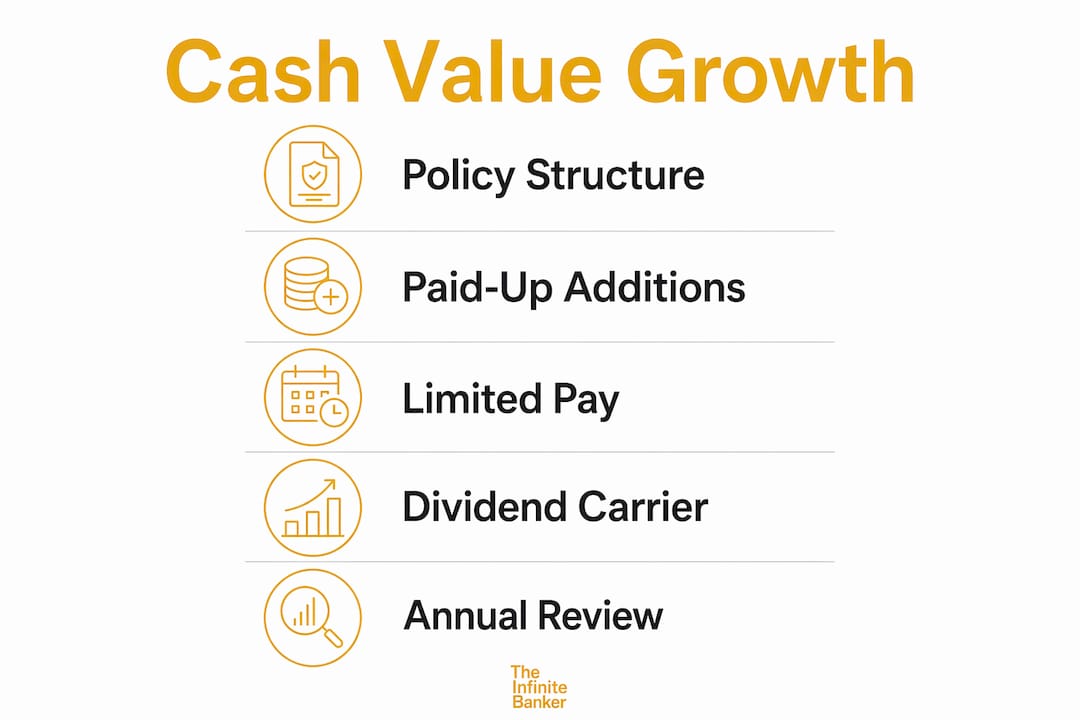
PUAs allow policyholders to make single-premium payments that immediately increase both guaranteed cash value and the death benefit, without additional underwriting. Each PUA purchase buys a small block of fully paid-up insurance, which then participates in future dividends. Over time, the cumulative effect of PUAs on dividend participation and cash value is substantial. The key is to determine an affordable PUA amount, schedule contributions consistently, and review performance annually with your advisor.

Concentrate premiums with limited pay policies
Limited pay whole life policies concentrate premiums into a shorter timeframe, such as 10 or 20 years, rather than spreading them across a lifetime. This accelerates early paid-up additions and improves long-term liquidity metrics. For high earners with strong current income who want to front-load their policy’s compounding, a limited pay structure can align well with retirement and estate planning timelines. Before committing, model scenarios with a fiduciary advisor to confirm the pay period fits your cash flow and long-term goals.
Select carriers with consistent dividend performance
The insurer you choose matters as much as the policy design. Prioritize carriers with a long track record of paying dividends, strong solvency ratios, and a conservative investment philosophy. Request policy illustrations that separate guaranteed values from non-guaranteed dividend projections so you can evaluate worst-case outcomes. Stress-test those illustrations against lower dividend scenarios before signing.
Review illustrations annually
Annual stress-testing of policy illustrations helps you spot risks early: MEC status exposure, diminished cash value growth, or a funding gap between your plan and actual performance. Treat the policy like a business asset, not a set-it-and-forget-it contract. At minimum, review current cash value versus projections, outstanding loan balances, and whether your PUA contributions still align with your goals.
Pro Tip: When reviewing illustrations, ask your advisor to run a scenario at a dividend scale 1%–2% lower than the current illustrated rate. If the policy still performs acceptably under that stress test, the design is sound. If it collapses, the structure may be too dependent on optimistic dividend assumptions.
How to prudently access and utilize policy cash value
One of the most practical features of a well-funded whole life policy is the ability to borrow against its cash value without triggering a taxable event, provided the policy remains in force. Policy loans carry annual interest rates between 5% and 8% in 2026, varying by insurer, and do not create taxable income under IRC Section 7702 as long as the policy stays active.
Loan Feature | Details |
Interest rate range | 5%–8% annually (2026, varies by insurer) |
Tax treatment | No taxable income if policy remains in force under IRC Section 7702 |
Repayment | Optional, but unpaid interest compounds and reduces death benefit |
Risk of lapse | Unpaid loan balances can cause policy lapse if they exceed cash value |
Impact on death benefit | Outstanding loan balance is deducted from death benefit at death |
The tax treatment is a meaningful advantage. Borrowing against cash value does not create a tax liability, but unpaid loans reduce the death benefit and continue to accrue interest until repaid. If the insured dies with an outstanding balance, beneficiaries receive the death benefit minus the amount owed. This is not a theoretical risk. It is a contractual reality that requires disciplined loan management.
Policy loans are actual financial liabilities. Misuse or neglecting repayment can cause policy lapse or reduced benefits. Treat loans as tactical financial tools within a disciplined plan, not as a substitute for cash flow management.
For high earners, the most productive use of policy loans tends to be time-sensitive capital deployment: a real estate acquisition, a business opportunity, or a bridge between asset sale and reinvestment. The policy’s cash value continues to earn dividends and guaranteed interest while the loan is outstanding, which is the structural advantage that makes this approach different from a standard bank loan. That said, the loan still accrues interest, and if left unmanaged, the compounding effect works against you rather than for you.
Avoiding common pitfalls that erode cash value growth
Most cash value erosion is self-inflicted. The policy design may be sound, but the behavior around it undermines the long-term result.
The single most common mistake high earners make is treating their whole life policy like a line of credit rather than a capital system. Frequent loans without repayment plans, combined with dividend withdrawals, can quietly dismantle years of compounding.
Frequent policy loans without timely repayment compound loan interest, erode cash value, reduce the death benefit, and can lead to policy lapse. This is the most acute risk for high earners who have the borrowing capacity to take large loans but lack a structured repayment discipline.
Other common pitfalls and how to avoid them:
Treating dividends as income: Dividends reinvested into paid-up additions compound over time. Dividends taken as cash stop compounding immediately. If growth is the goal, reinvestment is the default choice. Dividends are never guaranteed, but when they are paid, how you apply them has a lasting effect.
Underfunding or inconsistent premiums: Whole life rewards consistency. Stop-start funding slows accumulation and can create a funding lag that takes years to recover.
Ignoring MEC status risk: Overfunding a policy beyond IRS limits converts it into a Modified Endowment Contract, eliminating the tax advantages on loans and withdrawals. Work with your advisor to stay within the seven-pay test threshold.
Misaligning policy design with goals: A policy structured for maximum death benefit will not perform the same as one designed for early cash value efficiency. Confirm the design matches your actual priorities before the policy is issued.
Skipping annual reviews: Regular policy reviews catch problems early, including MEC exposure, lapse risk, and drift between projected and actual performance.
Adding riders that do not serve cash value: Some riders add cost without meaningfully improving cash value efficiency. Evaluate each rider on whether it directly supports your accumulation or liquidity goals.
Tax implications of maximizing cash value
The tax treatment of whole life insurance cash value is one of the primary reasons high earners consider it as part of a broader financial plan, particularly after maxing out traditional retirement accounts.
Cash value inside a whole life policy grows on a tax-deferred basis. No annual taxes are owed on gains inside the policy, which allows compounding to work without the drag of yearly tax payments. Policy loans, as noted, do not create taxable income under IRC Section 7702 as long as the policy remains in force. The death benefit passes to beneficiaries income-tax-free under IRC Section 101(a). You can explore the full picture of tax-deferred cash value growth and what it means for long-term accumulation.
The life insurance retirement plan (LIRP) concept builds on these features. Once a policy has accumulated substantial cash value, a policyholder may access funds in retirement through policy loans and withdrawals up to the policy’s cost basis without triggering income tax. This approach is most relevant for high earners who have already maxed out a 401(k) and Roth IRA and are looking for additional tax-advantaged accumulation. For a deeper look at the tax side of these strategies, working with a qualified tax planning service can help you model the after-tax outcomes accurately.
One critical boundary: MEC status. If a policy is overfunded beyond IRS limits in the first seven years, it becomes a Modified Endowment Contract. Loans and withdrawals from a MEC are taxed as ordinary income to the extent of gain, and a 10% penalty applies before age 59½. Staying below the seven-pay test limit preserves the tax treatment that makes whole life cash value strategies worth considering in the first place.
Strategies specific to high earners
For high earners with household incomes above $200,000 who have already maxed tax-advantaged retirement accounts, whole life insurance offers access to additional tax-deferred accumulation and estate planning tools that standard investment accounts cannot replicate.
Irrevocable Life Insurance Trusts (ILITs)
An Irrevocable Life Insurance Trust removes the death benefit from the taxable estate entirely. The trust owns the policy, not the insured, so the death benefit is not counted as part of the gross estate for federal estate tax purposes. For large estate holders, this can shield a meaningful amount from estate taxes while still directing proceeds to intended beneficiaries. Proper estate planning integration is essential here, as the ILIT structure involves irrevocable decisions that require careful legal drafting.
Business applications
Business owners can use whole life policies to fund buy-sell agreements or key person coverage with certainty. The cash value component provides liquidity that term insurance cannot, and the policy’s guaranteed death benefit makes it a reliable funding mechanism for business continuity planning. For a practical look at how business owners structure these arrangements, The Infinite Banker’s business financing guide covers the mechanics in detail.
Supplemental retirement income
High earners who have exhausted 401(k) and Roth IRA contribution limits can use a properly structured whole life policy as a supplemental retirement income source. Policy loans in retirement can provide income without increasing adjusted gross income, which matters for Medicare premium calculations and Social Security benefit taxation. This strategy requires a long accumulation window and a policy designed from the start with retirement income in mind.
Comparing dividend options to improve cash value
Participating whole life policies issued by mutual insurers may pay annual dividends when the insurer’s financial performance exceeds actuarial expectations. Dividends are never guaranteed, but how you apply them when they are paid has a direct and lasting effect on cash value growth.
The four standard dividend options are:
Cash: Dividends are paid out directly. Simple, but the compounding effect stops immediately.
Premium reduction: Dividends offset the next premium payment. This reduces out-of-pocket cost but does not add to cash value.
Accumulate at interest: Dividends are held by the insurer and credited with interest. The interest earned is taxable annually, which reduces the net compounding benefit.
Paid-Up Additions: Dividends purchase additional blocks of paid-up insurance, immediately increasing both cash value and death benefit. Each new PUA block then participates in future dividends, creating a compounding snowball effect.
For high earners focused on cash value optimization, the paid-up additions option is generally the most effective. It keeps dividends working inside the policy’s tax-deferred environment and accelerates the compounding trajectory. The premium reduction option may appeal to those managing cash flow, but it sacrifices long-term accumulation for short-term relief.
How to read and use policy illustrations effectively
A policy illustration is a projection of how the policy is expected to perform under a set of assumptions, including the current dividend scale and guaranteed interest rate. Reading it correctly is a skill that directly affects how well you can evaluate and manage your policy.
Every illustration separates guaranteed values from non-guaranteed values. The guaranteed column shows what the policy will do if the insurer pays no dividends at all. The non-guaranteed column shows projected performance at the current dividend scale. The gap between these two columns tells you how much of the projected cash value depends on dividend performance.
When reviewing an illustration, focus on these elements:
Year-by-year cash surrender value: Confirm when the policy breaks even on a cash-in versus cash-out basis, which typically falls somewhere between years 15 and 20 for most whole life policies.
PUA contribution impact: Model what happens to cash value if you increase or decrease PUA contributions by a meaningful amount.
Loan scenarios: Ask for an illustration that shows the effect of taking a policy loan in year 10 or 15, including the impact on cash value and death benefit if the loan is not repaid.
Stress-tested dividend assumptions: Request a version of the illustration at a dividend scale lower than the current illustrated rate to evaluate downside performance.
Annual illustration reviews are not optional for high earners using these policies as capital systems. Conditions change, goals shift, and the policy needs to be recalibrated accordingly.
How interest rates and economic conditions affect cash value growth
Whole life insurance cash value is not directly tied to stock market performance, which is one reason high earners use it as a stabilizing component in a broader portfolio. However, it is not entirely insulated from macroeconomic conditions either.
Mutual insurers invest primarily in long-duration bonds and other fixed-income instruments. When interest rates rise, insurers can reinvest maturing bonds at higher yields, which over time can support stronger dividend performance. When rates fall and stay low for extended periods, the insurer’s investment portfolio earns less, which can put downward pressure on dividend scales. This is a gradual effect, not an immediate one, because insurers hold large portfolios with staggered maturities.
The guaranteed interest rate inside a whole life policy provides a floor. Regardless of what happens in financial markets, the guaranteed cash value grows at the contractually specified rate. The non-guaranteed dividend layer is where economic conditions have their most direct influence. Choosing a carrier with a conservative investment philosophy and a strong surplus position provides a buffer against dividend scale reductions during periods of economic stress.
For high earners, the practical implication is straightforward: do not select a carrier based on the highest current dividend scale alone. A carrier that has maintained a consistent, if slightly lower, dividend scale through multiple interest rate cycles is generally a more reliable long-term partner than one with a higher scale that has fluctuated significantly.
Key Takeaways
High earners who maximize policy cash value do so by combining a well-designed policy structure, consistent funding, disciplined dividend reinvestment, and careful loan management from day one.
Point | Details |
PUAs drive early growth | Paid-Up Additions immediately increase cash value and death benefit, compounding with each dividend cycle. |
Loan rates carry real cost | Policy loans accrue interest at 5%–8% annually; unpaid balances reduce death benefit and can cause lapse. |
MEC status eliminates tax benefits | Overfunding beyond IRS seven-pay limits converts the policy to a MEC, triggering taxes and penalties on loans. |
Dividend reinvestment compounds faster | Applying dividends to paid-up additions keeps growth inside the tax-deferred environment rather than stopping it. |
The Infinite Banker | The Infinite Banker helps high-income earners structure whole life policies designed for capital efficiency and long-term flexibility. |
The Infinite Banker is built for earners who want their policy to work harder
High earners who have read this far already understand that cash value growth is a product of design, funding discipline, and ongoing management. The gap between a policy that performs and one that disappoints usually comes down to how it was structured at the outset and whether it has been actively managed since.

The Infinite Banker works specifically with entrepreneurs, real estate investors, and high-income earners to implement properly structured whole life insurance strategies. The focus is on capital efficiency: policies designed for early cash value access, PUA-heavy structures that accelerate compounding, and carrier selection based on long-term dividend consistency rather than short-term illustration appeal. This is not a product sale. It is a structured approach to using whole life insurance as a capital system within a broader financial plan.
If you want to see whether this approach fits your situation, start with who Infinite Banking is for to assess whether the strategy aligns with your income, goals, and timeline. From there, the Infinite Banking calculator can model how a properly structured policy may perform under your specific funding assumptions.
This post is educational only and not financial, tax, or legal advice. Consult qualified professionals before acting.
Recommended
Comments