
How High-Income Earners Achieve Financial Freedom


COMPLIANCE NOTE: For educational purposes only. Not financial, tax, or legal advice.
Financial freedom for high-income earners is not about the size of a paycheck. It is about designing a system where assets and income streams cover living expenses independently of earned income. The commonly cited benchmark is 25 times annual expenses, plus a 20% safety buffer, as the target wealth figure. Getting there requires more than earning well. It demands structural discipline across spending, debt, savings, investing, and mindset.
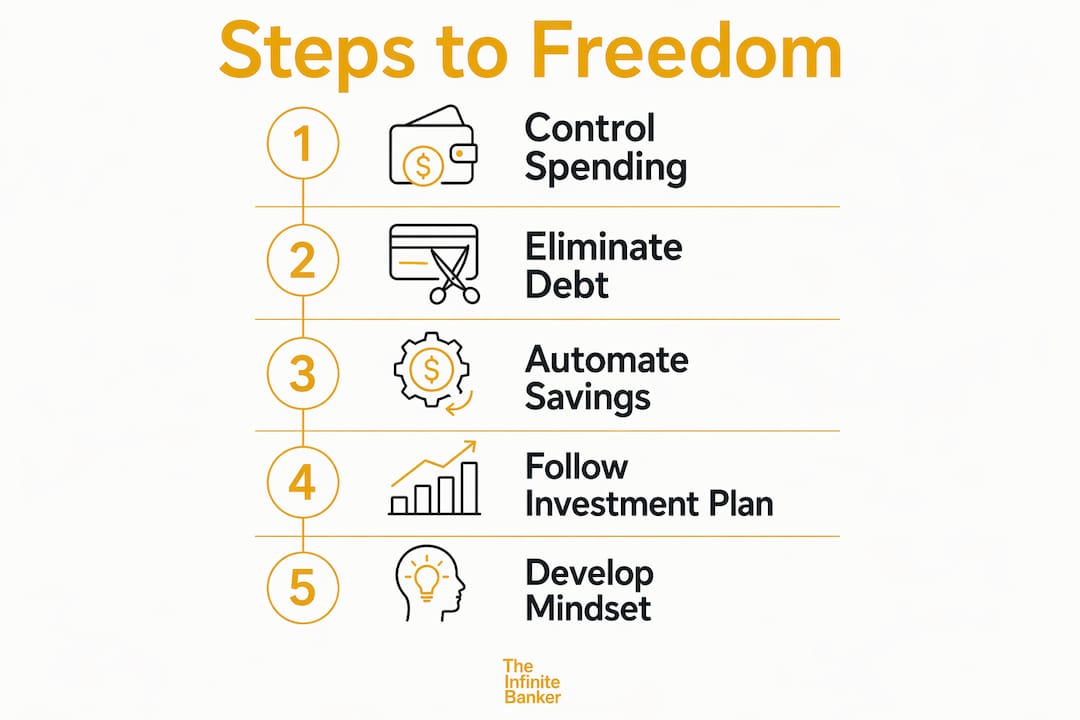
Here is what that structure looks like in practice:
Control lifestyle inflation by measuring spending as a percentage of cash flow, not in absolute dollars.
Eliminate high-interest debt before directing capital toward investment accounts.
Automate saving and investing so contributions happen before discretionary spending begins.
Build a written investment plan covering diversification, tax efficiency, and passive income targets.
Develop an investor mindset that filters out peer pressure, marketing noise, and short-term distractions.
Optimize for taxes at every stage, from asset ownership structure to retirement account selection.
Design for sustainability, meaning portfolios that function without your constant active management.
Each of these elements is explored in detail below, with practical steps and expert-informed perspective for high earners pursuing financial independence in 2026.
1. Controlling spending and avoiding lifestyle inflation
Lifestyle inflation is the single most common reason high earners still struggle to reach financial freedom despite strong incomes. As income rises, spending tends to rise in lockstep, leaving the gap between income and savings unchanged or even narrower. The result is a high standard of living with little actual progress toward independence.
The fix is a proportional mindset. Rather than asking “Can I afford this?” ask “What percentage of my monthly cash flow does this represent?” Keeping total lifestyle expenses at a low proportion of cash flow, ideally 5% or less of total net worth annually, preserves the capital needed for compounding. A $20,000 vacation feels different when it represents 0.2% of your net worth versus 40% of your annual savings capacity.
Practical steps for controlling spending:
Track expenses monthly in categories tied to cash flow percentage, not dollar amounts.
Separate wants from status signals. Luxury purchases driven by peer comparison drain capital without adding proportional value.
Set a lifestyle budget ceiling that rises only when passive income rises, not when earned income rises.
Delay large discretionary purchases by 30 days to separate impulse from genuine preference.
Review subscriptions and recurring costs quarterly, since these tend to accumulate invisibly.
Pro Tip: Measure your lifestyle cost as a percentage of your total annual cash flow each quarter. If that percentage is rising while your net worth is not, you are experiencing lifestyle creep in real time.
2. Eliminating high-interest debt effectively
High-interest debt is a direct tax on your future wealth. No investment reliably produces returns that outpace the cost of carrying credit card balances or high-rate personal loans. For high earners, the trap is subtler: the income feels large enough to service the debt comfortably, so urgency disappears. But every dollar paying 20% interest is a dollar not compounding at 7%–10% in a diversified portfolio.

Two payoff frameworks dominate financial planning practice. The avalanche method directs extra payments to the highest-interest balance first, minimizing total interest paid. The snowball method targets the smallest balance first, generating psychological momentum. For high earners with the discipline to stay the course, the avalanche method typically produces better financial outcomes.
Steps for eliminating high-interest debt:
List every liability with its balance, interest rate, and minimum payment.
Rank by interest rate and direct all surplus cash flow to the top item while maintaining minimums on the rest.
Avoid new high-interest debt during the payoff period, including store financing and buy-now-pay-later arrangements.
Redirect freed cash flow immediately once a balance is cleared, rather than absorbing it into lifestyle spending.
Set a hard payoff date for each balance and review progress monthly.
High earners also face a specific trap: using home equity lines of credit or margin accounts to fund lifestyle purchases. These carry lower rates than credit cards but still represent debt against appreciating assets. Clearing them before accelerating investment contributions is the cleaner path.
3. Automating saving and investing habits
Automation removes the single biggest obstacle to consistent wealth accumulation: the decision itself. When contributions to a 401(k), IRA, or brokerage account require a conscious monthly choice, they compete with every other spending priority. When they are automatic, they happen first, and spending adjusts around them.
The Investor.gov framework is direct on this: automate contributions to your 401(k) and IRA so wealth builds each pay period without requiring repeated decisions. For high earners, this principle extends beyond retirement accounts to taxable brokerage accounts, health savings accounts (HSAs), and real estate capital reserves.
Establishing an automation system:
Set 401(k) contributions to the maximum IRS-allowed amount at the start of each year, not as a percentage you revisit annually.
Automate IRA contributions on the first of each month, whether traditional or Roth, depending on your income and tax situation.
Fund an HSA automatically if you carry a high-deductible health plan; the triple tax advantage makes it one of the most efficient vehicles available.
Maintain a 3–6 month emergency fund in a high-yield savings account, replenished automatically after any drawdown.
Set up automatic rebalancing in taxable accounts at least annually to maintain target allocations.
The emergency fund point deserves emphasis. High earners often skip this step, assuming income continuity. But income disruption, whether from a job change, business slowdown, or health event, is precisely when forced asset liquidation destroys long-term plans. Three to six months of expenses in liquid reserves is not conservative; it is structural.
4. Creating and sticking to an investment plan
An investment plan is not a portfolio. It is a written document that defines your target asset allocation, income goals, rebalancing rules, and the conditions under which you would change course. Without it, high earners tend to chase performance, react to market noise, and accumulate a collection of positions rather than a coherent strategy.

True wealth is about cash flow, tax efficiency, and passive income, not just salary or asset appreciation. A sound investment plan reflects this by balancing growth assets (equities, real estate equity) with cash-flowing assets (rental income, dividend-paying instruments, business distributions). The goal is to reach a point where passive income covers living expenses, making earned income optional.
Key elements of a practical investment plan:
Define your financial independence number as 25 times annual expenses, then add a 20% buffer for sequence-of-returns risk.
Allocate across asset classes: equities, real estate, private equity, and tax-advantaged insurance structures, proportional to your timeline and risk tolerance.
Prioritize tax-advantaged accounts first: 401(k), Roth IRA, HSA, and 529 plans where applicable, before directing capital to taxable accounts.
Review and rebalance at least annually, or after any allocation drifts more than 5% from target.
Avoid concentration risk in employer stock or a single sector, which is a common high-earner blind spot.
Pro Tip: Design your portfolio to generate cash flow first and appreciation second. Cash flow is predictable and covers expenses; appreciation is variable and cannot be spent without selling. A portfolio that pays you monthly is more durable than one that simply grows on paper.
For high earners exploring diversification best practices, the 2026 environment rewards those who have already separated income generation from active management.
5. Developing the mindset and ignoring distractions
The investor mindset and the consumer mindset are not just different attitudes. They produce structurally different financial outcomes over a decade. A consumer mindset treats income as purchasing power. An investor mindset treats income as raw material for asset acquisition. High earners are constantly targeted by both marketing and peer behavior that reinforces the consumer frame, from luxury vehicles to premium real estate upgrades to status-driven travel.
Ignoring these distractions is not about deprivation. It is about recognizing that proportional wealth is what produces freedom, not absolute spending levels. A $500,000 earner who spends $480,000 annually has less financial freedom than a $200,000 earner who spends $100,000 and invests the rest consistently.
Mental habits that sustain focus:
Define your own financial independence number and measure progress against it monthly, not against peers’ visible spending.
Limit financial media consumption to sources that inform decisions, not ones that generate anxiety or FOMO.
Separate identity from net worth. Status purchases that require ongoing maintenance drain cash flow without building assets.
Review your investment plan quarterly to reconnect with long-term goals when short-term market noise feels loud.
Practice delayed gratification deliberately, treating it as a skill that compounds like interest over time.
This mindset also shapes negotiation and risk-taking. High earners with a clear financial independence target negotiate compensation differently, take calculated risks on business opportunities rather than speculative ones, and make lifestyle choices that reflect long-term optionality rather than short-term signaling.
6. Expert insights on overcoming pitfalls unique to high-income earners
High earners face a specific set of traps that lower-income savers rarely encounter. The proportional wealth trap is the most common: as income rises, lifestyle spending rises proportionally, leaving the savings rate flat or declining. A physician earning $600,000 who spends $550,000 is financially fragile despite an impressive income. The number looks large; the gap does not.
Tax inefficiency is the second major trap. Failure to manage asset ownership structure, depreciation, and income allocation can cost high earners millions over a decade. This is not about aggressive tax avoidance. It is about structuring ownership correctly from the start: holding real estate in entities that capture depreciation benefits, using tax-loss harvesting in taxable accounts, and selecting the right retirement account type based on current versus projected future tax rates.
The third trap is the expertise trap. Structured, diversified portfolios reduce key-person risk and sustain wealth beyond individual management. High earners who rely entirely on their own active management, whether in a business, a real estate portfolio, or a trading account, create a single point of failure. When their time or attention is unavailable, the portfolio suffers.
Common pitfalls and how to address them:
Lifestyle inflation: Set a hard lifestyle ceiling tied to passive income growth, not earned income growth.
Tax drag: Work with a qualified tax advisor to structure asset ownership and income allocation annually. Services like tax planning can help high earners model the long-term cost of inefficient structures.
Earned income dependency: Shift capital progressively toward leveraged, tax-optimized assets with predictable cash flow, such as real estate and business interests.
Concentration risk: Diversify across asset classes and geographies, not just across stocks within one sector.
No written plan: High earners without a written financial independence plan tend to drift toward consumption rather than accumulation.
Pro Tip: Design your portfolio so it could run for 12 months without your active involvement. If it cannot, you have a key-person risk problem, not a wealth problem. Structured funds, property management agreements, and automated rebalancing are the tools that solve this.
A 10-year exit blueprint frames this progression in three phases: stabilize and diversify in years one through three, accelerate cash flow in years four through seven, and reach income coverage optionality by years eight through ten. The concept of FIWO (Financial Independence, Work Optional) captures this well. The goal is not necessarily to stop working. It is to reach a point where working is a choice, not a requirement.
7. Summary and key takeaways for high-income earners pursuing financial freedom
Financial freedom for high earners is a design problem, not an income problem. The strategies that produce it are consistent across income levels, but the execution details and the traps differ significantly for those earning at the top of the income distribution.
Core strategies to apply consistently:
Control lifestyle spending by measuring it as a percentage of cash flow, not in absolute dollars.
Eliminate high-interest debt before accelerating investment contributions.
Automate savings and investments so they happen before discretionary spending begins.
Maintain a written investment plan that covers asset allocation, income targets, tax efficiency, and rebalancing rules.
Cultivate an investor mindset that filters out peer comparison and status-driven consumption.
Optimize taxes through proper asset ownership structure, retirement account selection, and income allocation.
Diversify into cash-flowing assets including real estate and private equity, not just publicly traded equities.
Design for sustainability, meaning portfolios that function without constant personal management.
The financial independence strategies checklist from The Infinite Banker offers a structured starting point for high earners who want to audit their current position against these criteria.
8. Estate planning and wealth transfer strategies
Estate planning is where financial freedom extends beyond a single lifetime. Without a clear structure, wealth accumulated over decades can be significantly reduced by estate taxes, probate costs, and family disputes. For high earners, the core tools are wills, revocable living trusts, irrevocable trusts, and beneficiary designations on retirement accounts and insurance policies.
A revocable living trust avoids probate, which can be both costly and time-consuming depending on the state. Irrevocable trusts, including irrevocable life insurance trusts (ILITs), can remove assets from the taxable estate while providing structured distributions to heirs. The federal estate tax exemption is subject to legislative change, so high earners should review their estate plan with a qualified estate attorney whenever tax law shifts.
Beneficiary designations on 401(k) accounts, IRAs, and life insurance policies override the instructions in a will. Outdated designations, such as a former spouse listed as primary beneficiary, are among the most common and costly estate planning errors. Reviewing these annually takes minutes and can prevent years of legal complications.
Wealth transfer strategies worth considering:
Annual gifting up to the IRS annual exclusion amount per recipient, which reduces the taxable estate over time.
529 plan superfunding, which allows five years of contributions in a single year for education funding.
Charitable remainder trusts (CRTs), which provide income during your lifetime and transfer the remainder to a designated charity, with potential income tax benefits.
Family limited partnerships (FLPs), which can facilitate discounted transfers of business or investment assets to heirs.
The Infinite Banker’s approach to family banking systems for high earners incorporates whole life insurance as a multi-generational wealth transfer vehicle, where the death benefit passes income-tax-free to named beneficiaries. Dividends on such policies are not guaranteed, and policy loans accrue interest that reduces cash value and the death benefit if unpaid. Policies can lapse if not properly funded.
9. Risk management including insurance and downside protection
Wealth accumulation without protection is structurally incomplete. A single uninsured event, whether a disability, a lawsuit, or a catastrophic health expense, can erase years of disciplined saving. High earners face elevated exposure in several categories: professional liability, business interruption, and the income replacement gap that standard employer disability coverage rarely fills.
Disability insurance is the most underutilized protection tool among high earners. Group disability policies through employers typically replace 60% of base salary, often capped at a level that falls well short of a high earner’s actual income. An individual own-occupation disability policy covers your specific professional duties and is not tied to employment status, making it far more reliable for physicians, attorneys, and business owners.
Umbrella liability insurance is another layer that high earners frequently skip. A $1–2 million umbrella policy sits above auto and homeowners coverage and provides broad liability protection at a relatively low annual cost. For those with significant assets, the exposure without it is disproportionate to the premium saved.
Core risk management checklist:
Disability insurance: own-occupation, individual policy, covering at least 60%–70% of gross income.
Life insurance: sufficient death benefit to replace income and cover liabilities for dependents.
Umbrella liability: $1 million minimum, scaled to net worth.
Health insurance: high-deductible plan paired with a fully funded HSA where appropriate.
Business interruption coverage: for self-employed earners and business owners.
For high earners exploring income protection strategies, dividend-paying whole life insurance can serve a dual role: providing a death benefit while accumulating cash value that may be accessed via policy loans for liquidity needs. Dividends are not guaranteed, and unpaid loans reduce both cash value and the death benefit. The Infinite Banker works with entrepreneurs and investors to structure these policies for capital efficiency, not as a replacement for term or disability coverage, but as a complementary layer in a broader protection plan.
10. Building multiple income streams beyond primary salary
Relying on a single income source, even a large one, is a structural vulnerability. Job loss, business disruption, or a health event can eliminate that source entirely. High earners who have built multiple income streams before they need them are in a fundamentally different position from those who have not.
The most durable income streams for high earners tend to be those that generate cash flow with limited ongoing time input. Rental real estate, when properly managed, produces monthly income independent of the owner’s active labor. Dividend-paying equities and index funds generate distributions that compound over time. Business equity, structured with professional management, can produce distributions without requiring the owner’s daily involvement.
Shifting from earned income to leveraged, tax-optimized assets with predictable passive cash flow is the structural move that separates high earners who achieve financial independence from those who remain dependent on their next paycheck. This shift does not happen overnight. It is a staged process, typically spanning years, where each new income stream reduces the proportion of living expenses covered by earned income.
Practical income stream options for high earners:
Rental real estate: direct ownership or syndications, generating monthly cash flow with depreciation tax benefits.
Dividend-paying equities: broad index funds and dividend-focused ETFs within taxable and tax-advantaged accounts.
Private equity or business interests: equity stakes in operating businesses with professional management.
Whole life insurance cash value: policy loans may provide liquidity for investment opportunities, though loans accrue interest and reduce cash value and death benefit if unpaid.
Royalties or licensing income: from intellectual property, patents, or content, where applicable.
The Infinite Banker’s whole life cash flow strategy is designed to help high earners use properly structured whole life policies as a capital reservoir, one that may support investment activity across multiple asset classes while maintaining a death benefit. This is not a standalone wealth strategy. It functions as one layer within a diversified income architecture.
Key Takeaways
High-income earners achieve financial freedom by designing systems around cash flow, tax efficiency, and passive income rather than relying on earned income alone.
Point | Details |
Define your freedom number | Target 25 times annual expenses plus a 20% safety buffer as your financial independence benchmark. |
Control lifestyle inflation | Measure spending as a percentage of cash flow; keeping it low preserves capital for compounding. |
Automate before you spend | Direct contributions to 401(k), IRA, and emergency fund accounts before discretionary spending begins. |
Tax efficiency by design | Structuring asset ownership and income allocation correctly can prevent significant long-term wealth erosion. |
Build for sustainability | Portfolios designed to function without constant personal management reduce key-person risk and support multi-generational wealth. |

How The Infinite Banker can support your financial independence plan
The Infinite Banker works with entrepreneurs, real estate investors, and high-income earners to implement properly structured whole life insurance strategies designed for capital efficiency and long-term flexibility. These strategies are not a replacement for a diversified investment plan. They are designed to complement one, by providing a liquidity layer that may support investment activity, business financing, and wealth transfer goals.
If you are a high earner looking to move beyond salary dependence and toward a financial independence strategy built around cash flow and structural design, The Infinite Banker offers educational resources and access to Authorized IBC Practitioners who can walk through how these structures may fit your specific situation.
Explore the Infinite Banking approach for entrepreneurs and high-income earners, and see whether a properly structured whole life policy belongs in your financial architecture.
This post is educational only and not financial, tax, or legal advice. Consult qualified professionals before acting.
Recommended
Comments