
Family Banking System for High Earners: 2026 Guide


COMPLIANCE NOTE: For educational purposes only. Not financial, tax, or legal advice.
A family banking system is a privately controlled capital structure that allows high-income earners to finance major expenses internally, reducing dependence on traditional lenders. The core engine of this system is dividend-paying whole life insurance, which accumulates cash value that policyholders can access through policy loans. During economic downturns, up to 30% of standard loan applications are denied, which means external credit is least available exactly when you need it most. A family banking system for high earners addresses that vulnerability directly by building an internal pool of capital that operates outside the traditional banking cycle. The Infinite Banker refers to this approach as the Infinite Banking Concept, or IBC, and it is the recognized industry term for what many describe informally as “becoming your own banker.”
What are the essential components of a family banking system for high earners?
The foundation of any family banking system is a properly structured dividend-paying whole life insurance policy. The policy must be designed for capital efficiency, not just death benefit coverage. That distinction matters because a policy optimized for a large death benefit grows cash value slowly, while a policy structured for IBC front-loads premium into paid-up additions, accelerating the cash value available for policy loans.
Starting with older generations promotes faster liquidity and intergenerational transfer. An older insured typically builds a larger initial cash value base, giving the family system more capital to deploy sooner. Younger family members are added over time, expanding the system’s total capacity.

Component | Function |
Dividend-paying whole life policy | Accumulates cash value; serves as the capital reservoir |
Paid-up additions rider | Accelerates cash value growth beyond base premium |
Policy loan provision | Provides access to capital without credit checks or approval delays |
Family trust or entity structure | Coordinates ownership, beneficiary designations, and estate planning |
Coordinated advisory team | Aligns tax, legal, insurance, and investment decisions |
Pro Tip: Policy design is the most consequential decision in this process. A policy built for maximum death benefit will underperform as a banking vehicle. Work with an Authorized IBC Practitioner who can structure the policy specifically for cash value efficiency from day one.
Dividends are not guaranteed. They depend on the insurer’s financial performance and are declared annually by the insurance company’s board. A well-designed policy still accumulates guaranteed cash value according to the policy contract, but the dividend component adds a variable layer that should not be counted on as fixed income.
How can high earners build and expand their family banking system?
Building a family banking system follows a clear sequence. Skipping steps or rushing the funding phase creates a “funding lag,” the period before sufficient cash value exists to support meaningful policy loans.
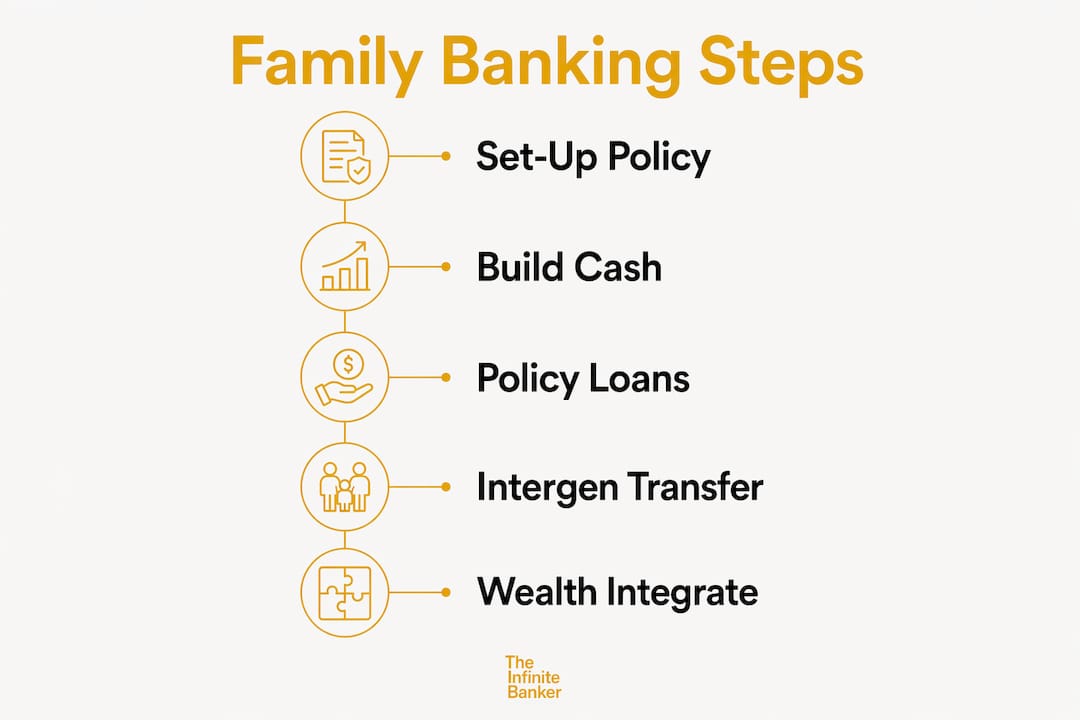
Establish the anchor policy. Place the first policy on the oldest insurable family member with the highest premium the budget supports. This creates the largest initial cash value base.
Fund consistently. Redirect a portion of monthly income into the policy premium. Consistency matters more than the size of any single payment.
Take your first policy loan. Finance a planned expense, such as a vehicle purchase, home renovation, or business equipment, using a policy loan rather than a bank loan. This keeps the interest you pay circulating within your system rather than going to a lender.
Repay the loan on a schedule. Policy loans accrue interest and reduce cash value and death benefit if unpaid. Treating repayment with the same discipline you would apply to a bank loan preserves the system’s capital base.
Add family members. Once the anchor policy is performing, add policies on children or a spouse. Each new policy expands the system’s total borrowing capacity.
Use internal financing for major life events. Family banking systems can decrease dependence on banks by internalizing financing for education, real estate purchases, and business opportunities.
Pro Tip: The most common setup mistake is treating the policy loan like a withdrawal. It is a loan against your cash value, not a reduction of it. Your full cash value continues to grow while the loan is outstanding, provided you manage repayment responsibly.
The gradual reduction of external borrowing is the clearest sign the system is working. When you finance a car through a policy loan instead of an auto lender, you pay interest to your own system. Over years, that difference compounds in your favor. You can read more about this mechanics in The Infinite Banker’s guide on becoming your own banker.
How does a family banking system integrate with wealth management for families?
A family banking system does not operate in isolation. Its effectiveness depends on how well it connects with your broader financial plan, including tax strategy, estate planning, investment allocation, and insurance coverage.
Fragmented advice is the primary threat to this integration. Independent professionals often create contradictory plans, such as mismatched estate documents or insurance gaps that undermine each other. A tax advisor who does not know your policy structure may recommend a strategy that conflicts with your trust’s beneficiary designations. That kind of conflict is preventable, but only through coordinated planning.
High-performing wealth management firms achieve 95% client retention by integrating tax, investment, estate, and insurance planning under a unified framework. That retention rate reflects client confidence, not just satisfaction. When advisors share assumptions and accountability, the family’s financial plan moves in one direction.
The benefits of coordinated planning for high-income family finance include:
Unified cash flow projections that account for policy loans, investment distributions, and business income simultaneously
Estate documents that align with policy ownership and beneficiary structures
Tax strategies that account for the policy’s treatment under the Internal Revenue Code
Investment decisions that reflect the liquidity already available through the family banking system
Insurance coverage that does not duplicate or conflict with the whole life policy’s death benefit
Pro Tip: Schedule a quarterly meeting that includes your CPA, estate attorney, and IBC Practitioner together, not separately. Families managing multiple entities benefit most from unified, cross-disciplinary planning frameworks, and a single shared meeting prevents the contradictions that separate conversations create.
What are the common pitfalls in maintaining a family banking system?
The most damaging mistakes in a family banking system come from two sources: poor policy design at setup and fragmented advice over time. Both are avoidable with the right structure from the start.
“The biggest mistake high-net-worth families make is fragmented financial advice that conflicts across tax, estate, investment, and insurance. A family banking system built on a poorly designed policy, managed by advisors who do not communicate with each other, will underperform or fail entirely.”
Common Mistake | Best Practice |
Buying a policy optimized for death benefit | Structure the policy for cash value growth using paid-up additions |
Treating policy loans as free money | Repay loans on a defined schedule to preserve cash value and death benefit |
Assuming dividends are guaranteed | Plan conservatively using only the guaranteed cash value projections |
Using advisors who work in silos | Require shared assumptions and joint accountability across your advisory team |
Adding family members too quickly | Establish the anchor policy fully before expanding to additional insureds |
Ignoring policy lapse risk | Monitor premium funding and loan balances; policies can lapse if loans exceed cash value |
Coordinated financial planning requires shared assumptions, joint evaluation of decisions, and defined roles among advisors. Without that structure, even a well-designed policy can be undermined by conflicting advice from other professionals. The high-income financial planning mistakes that derail family banking systems almost always trace back to this coordination failure.
Family dynamics also evolve. Marriages, divorces, business changes, and estate updates all affect how the system should be structured. A family banking system requires periodic review, not a set-and-forget approach.
Key Takeaways
A properly structured family banking system gives high-income earners access to internal capital, reduces dependence on traditional lenders, and integrates most effectively within a coordinated, cross-disciplinary wealth management framework.
Point | Details |
Policy design is foundational | Structure whole life policies for cash value growth, not maximum death benefit coverage. |
Start with older generations | Anchor policies on older family members to accelerate initial liquidity and capital transfer. |
Manage loans with discipline | Policy loans accrue interest and reduce cash value and death benefit if left unpaid. |
Coordinate all advisors | Integrated tax, estate, and insurance planning prevents conflicting strategies that erode results. |
Dividends are not guaranteed | Plan using guaranteed cash value projections; treat dividends as a potential supplement only. |
Why I think most families set this up backwards
I have worked with high-income earners on IBC implementation for years, and the pattern I see most often is this: families start with the youngest member. A parent wants to do something good for their child, so they open a policy on the child first. The intention is right, but the sequencing is wrong.
A child’s policy builds cash value slowly because the premium capacity is limited and the insured has decades ahead. The anchor policy belongs on the highest-earning adult, ideally the oldest insurable member of the family, because that is where the largest premium and the fastest cash value accumulation happen. You build the reservoir first, then you add tributaries.
The second thing I notice is that families treat the policy loan as a reward rather than a tool. They borrow for vacations or discretionary spending and then repay inconsistently. That behavior erodes the system’s capital base and defeats the purpose. The discipline of repayment is what separates a functioning family banking system from an expensive life insurance policy.
What I find genuinely compelling about this approach is the conversation it forces. When a family sits down to discuss how they will finance a child’s education or a real estate purchase using their own system, they are practicing financial literacy for parents in the most practical way possible. That conversation has long-term value beyond any single transaction.
The caveats are real. Policies can lapse. Dividends are not guaranteed. Estate integration requires careful legal work. None of that makes the strategy wrong. It makes it a strategy that requires professional guidance and ongoing attention, which is true of every serious wealth-building approach.
— Jib Hunt, Authorized IBC Practitioner
How The Infinite Banker helps high earners get started
High-income earners who want to establish a family banking system need more than a life insurance policy. They need a properly structured whole life policy, an advisor who understands IBC mechanics, and a planning framework that connects the policy to their broader financial picture.

The Infinite Banker specializes in exactly this. The site offers educational resources covering everything from basic IBC concepts to advanced policy structuring for entrepreneurs, real estate investors, and families managing complex assets. If you are evaluating whether this approach fits your situation, the who infinite banking is for page is the clearest starting point. For a deeper look at how the mechanics work, how infinite banking works walks through the full concept with practical detail. Consultations with an Authorized IBC Practitioner are available for those ready to move from research to implementation.
FAQ
What is a family banking system for high earners?
A family banking system is a privately controlled capital structure, typically built on dividend-paying whole life insurance, that allows high-income earners to finance major expenses internally rather than borrowing from traditional lenders.
How does a policy loan work in a family banking system?
A policy loan uses your whole life insurance cash value as collateral. The cash value continues to grow while the loan is outstanding, but unpaid loans accrue interest and reduce both the cash value and the death benefit.
Are dividends on whole life insurance guaranteed?
Dividends are not guaranteed. They are declared annually by the insurance company based on its financial performance. Policy projections should be built on guaranteed cash value figures, with dividends treated as a potential supplement.
How does a family banking system fit into broader wealth management?
A family banking system works best when integrated with tax, estate, and investment planning. Coordinated planning frameworks prevent conflicting strategies and help the system perform as intended across all areas of a family’s finances.
When should high earners start building a family banking system?
The best time to start is when you have consistent income to fund a policy and a clear use case for internal financing. Starting with the oldest insurable family member accelerates capital accumulation and creates the largest initial pool of accessible cash value.
This post is educational only and not financial, tax, or legal advice. Consult qualified professionals before acting.
Recommended
Comments