
What Is a Wealth Accumulation Strategy? A Practical Guide


COMPLIANCE NOTE: For educational purposes only. Not financial, tax, or legal advice.
A wealth accumulation strategy is a planned, disciplined process for increasing your financial assets over time through saving, investing, and managing risk in alignment with your goals and timeline. The term “wealth accumulation” is the industry-standard phrase for the growth phase of personal finance, distinct from wealth preservation, which focuses on protecting assets already built. Strategic investing drives success for 40% of wealthy Americans who credit clear goals and risk tolerance as the foundation of their approach. That figure tells you something direct: most people who accumulate meaningful wealth do it deliberately, not accidentally. For entrepreneurs, real estate investors, and high-income earners, understanding what a wealth accumulation strategy actually involves is the starting point for building lasting financial stability.
What are the essential components of a wealth accumulation strategy?
Every effective wealth accumulation strategy rests on a set of foundational practices. Without these in place, even the best investment ideas tend to underperform.
Goal setting and risk tolerance
The process starts with defining specific financial goals. Are you targeting early retirement, a real estate portfolio, or a business exit? Your goals determine your time horizon, and your time horizon shapes how much risk you can reasonably absorb. A 35-year-old business owner with a 25-year runway can tolerate more volatility than someone 10 years from retirement.

Emergency fund
Before allocating capital to investments, you need a financial buffer. A 3–6 month emergency fund covering living expenses protects your investment positions from forced liquidation during unexpected events. Without this buffer, a job loss or medical expense can force you to sell assets at the worst possible time.
Consistent saving and automated contributions
Consistency matters more than the size of any single contribution. Automating transfers to investment accounts removes the behavioral friction that causes most people to delay or skip contributions. Even modest, regular deposits compound meaningfully over a 20-year horizon.
Strategic asset allocation
Asset allocation is the process of dividing your portfolio across stocks, bonds, real estate, and other asset classes based on your time horizon and risk tolerance. Consistent, long-term investing in an asset mix matched to your goals produces more reliable outcomes than trying to time the market. Rebalancing your portfolio annually keeps your allocation from drifting as markets move.
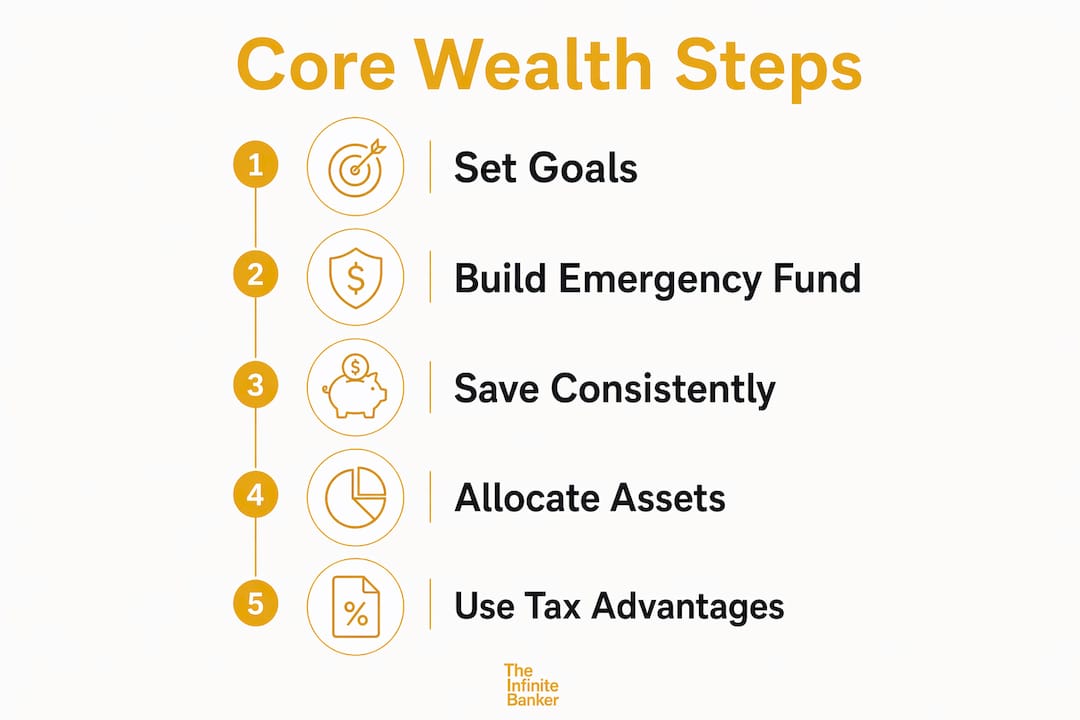
Tax-advantaged accounts
Accounts like a 401(k), IRA, and HSA defer or reduce taxes on investment gains, which directly increases the capital available to compound over time. Using these accounts is not optional for high-income earners who want to accumulate wealth efficiently. The tax savings in a maxed-out 401(k) alone can represent tens of thousands of dollars over a career.
Pro Tip: Dollar-cost averaging, investing a fixed dollar amount at regular intervals regardless of market conditions, reduces the average cost per share over time and removes the pressure of trying to pick the “right” entry point.
How can alternative investments fit into a wealth accumulation strategy?
Alternative investments are asset classes outside traditional stocks and bonds. They include private equity, private credit, hedge funds, real estate, and evergreen funds. For investors in their peak earning years, these assets can add meaningful diversification to a portfolio.
The core appeal of alternatives is their low correlation to public markets. When stock markets fall, private equity and real estate do not always follow the same pattern. This diversification can reduce overall portfolio volatility during market downturns. Alternatives also offer an illiquidity premium, meaning investors who accept reduced access to their capital may receive higher long-term returns as compensation.
Up to 30% of a portfolio can be allocated to alternative investments during the accumulation phase for a 45-year-old investor seeking enhanced diversification. That allocation range reflects a deliberate trade-off: more growth potential in exchange for reduced liquidity. Not every investor is positioned to make that trade-off comfortably.
Evergreen funds are now used by 47% of wealth managers as a way to give clients accessible exposure to alternative assets. These funds offer more frequent liquidity windows than traditional private equity structures, making them a practical entry point for investors new to alternatives.
The risks of alternatives deserve equal attention:
Illiquidity: Capital may be locked up for years, limiting your ability to respond to changing circumstances.
Complexity: These strategies require more due diligence than buying an index fund.
Higher fees: Management fees and performance fees can erode net returns significantly.
Goal alignment: Alternatives require careful alignment with your personal risk tolerance and financial goals before deployment.
Pro Tip: Deploy capital to alternative investments gradually rather than all at once. Staggering commitments across multiple years reduces the risk of concentrating too much illiquid capital in a single market cycle.
Alternative asset type | Primary benefit | Key risk |
Private equity | Higher long-term return potential | Multi-year capital lock-up |
Real estate | Inflation protection, income | Concentration and liquidity risk |
Private credit | Income premium over public bonds | Credit and default risk |
Evergreen funds | Accessible liquidity windows | Higher fees than index funds |
What role do tax strategies play in effective wealth accumulation?
Tax management is one of the most direct ways to increase the capital available for compounding. Effective wealth building involves three distinct tax components: deferring taxes, managing taxes, and reducing taxes. Each operates differently and serves a different purpose in a financial accumulation plan.
Deferring taxes
Tax-deferred accounts like a 401(k) and traditional IRA allow your investments to compound without annual tax drag. You pay taxes when you withdraw, ideally in a lower-income year. This deferral can add years of additional compounding to your portfolio.
Managing taxes
Managing taxes means making deliberate decisions about when to buy and sell assets. Holding investments for more than one year qualifies gains for the lower long-term capital gains rate. Tax-loss harvesting, selling underperforming positions to offset gains elsewhere, is another tool that reduces your annual tax bill without changing your overall market exposure.
Reducing taxes
Charitable giving through vehicles like donor-advised funds reduces your taxable income in the year of contribution. For high-income earners, a well-timed charitable contribution can move you into a lower tax bracket, producing savings that exceed the value of the gift itself.
The practical sequence looks like this:
Max out tax-advantaged accounts (401(k), IRA, HSA) before investing in taxable accounts.
Hold appreciating assets for at least one year to qualify for long-term capital gains treatment.
Use tax-loss harvesting annually to offset realized gains.
Consider charitable giving strategies when income spikes due to a business sale or large bonus.
How does a wealth accumulation strategy change over time?
Wealth accumulation and wealth preservation are not the same thing, and confusing the two is one of the most common mistakes investors make without professional guidance. Accumulation focuses on building assets. Preservation focuses on protecting them. The transition between the two requires deliberate changes to your portfolio and your risk tolerance.
During the accumulation phase, your portfolio typically carries more equity exposure because you have time to recover from market downturns. As retirement approaches, the calculus shifts. A portfolio that was 80% equities at age 40 may need to move toward 50–60% equities by age 60, with a larger allocation to income-producing and liquid assets.
Phase | Primary goal | Typical equity allocation | Liquidity priority |
Early accumulation | Asset growth | High | Low |
Peak accumulation | Growth with diversification | Moderate to high | Moderate |
Pre-retirement | Capital protection | Moderate | High |
Preservation | Income and protection | Low to moderate | Very high |
Shifting from accumulation to preservation requires gradual reallocation toward liquidity and income as retirement approaches. Doing this abruptly, or not doing it at all, both carry meaningful risks. A portfolio still positioned for aggressive growth at age 65 is exposed to sequence-of-returns risk, where a market downturn early in retirement can permanently reduce your income capacity. Professional planning is not optional at this transition point.
Key Takeaways
A wealth accumulation strategy works when it combines consistent saving, tax-efficient investing, and deliberate risk management aligned to your time horizon and financial goals.
Point | Details |
Start with a financial buffer | Build a 3–6 month emergency fund before allocating capital to investments. |
Align investments to your timeline | Asset allocation should reflect your time horizon and risk tolerance, not market sentiment. |
Use tax-advantaged accounts first | Max out 401(k), IRA, and HSA contributions before investing in taxable accounts. |
Alternatives require caution | Up to 30% in alternatives may enhance diversification, but illiquidity and fees are real costs. |
Accumulation and preservation differ | Adjust your portfolio deliberately as retirement approaches to avoid sequence-of-returns risk. |
What I’ve learned about wealth accumulation after years of working with business owners
Most business owners I work with arrive with the same blind spot: they have built a profitable business but have no structured plan for accumulating personal wealth outside of it. Their entire net worth is tied up in an illiquid asset they cannot easily access or rebalance. That is not a wealth accumulation strategy. That is concentration risk with a good income attached to it.
The investors who accumulate wealth most consistently share one habit: they treat their financial plan like a business system. They automate contributions, review allocations annually, and make tax decisions proactively rather than reactively. They do not try to time markets. They do not chase last year’s best-performing asset class.
The second pattern I see repeatedly is skipping the emergency fund because it “earns nothing.” That thinking is expensive. Forced liquidation of a real estate position or a private equity stake to cover an unexpected expense destroys years of compounding. The emergency fund is not an investment. It is insurance for your investment strategy.
Alternative investments attract a lot of attention from high-income earners, and rightly so. But the investors who use them well deploy capital gradually, understand the liquidity terms before committing, and never allocate more than they can afford to leave illiquid for five or more years. The ones who get burned are the ones who treat alternatives as a shortcut rather than a complement to a disciplined base strategy.
The transition from accumulation to preservation is where I see the most costly mistakes. People hold on to aggressive allocations too long because the portfolio is performing well. Then a market correction hits at exactly the wrong time. The shift toward liquidity and income should be gradual and planned, not reactive.
— Jib Hunt
How The Infinite Banker approach fits into a long-term wealth plan
The Infinite Banking Concept uses dividend-paying whole life insurance as a financial management tool designed for capital efficiency and long-term flexibility. Dividends are not guaranteed and depend on the insurer’s performance. Policy loans accrue interest and reduce cash value and the death benefit if unpaid. Policies can lapse if not properly funded.

For entrepreneurs and real estate investors who want a financial structure that provides liquidity, a cash value component, and a death benefit within a single vehicle, The Infinite Banker works with clients to design properly structured policies. This approach is not a replacement for the accumulation strategies covered here. It is designed to complement them by adding a layer of financial control that traditional investment accounts do not provide. Readers who want to understand whether this structure fits their situation can explore who benefits from Infinite Banking or visit The Infinite Banker directly to learn more.
FAQ
What is a wealth accumulation strategy in simple terms?
A wealth accumulation strategy is a structured plan to increase your financial assets over time through saving, investing, and managing taxes and risk. It is distinct from wealth preservation, which focuses on protecting assets already built.
How much should I allocate to alternative investments?
During peak earning years, up to 30% of a portfolio may be allocated to alternatives for diversification. The right amount depends on your liquidity needs, risk tolerance, and time horizon.
Why is tax management part of a wealth accumulation strategy?
Tax management increases the capital available to compound by deferring, reducing, or managing taxes through accounts like a 401(k), IRA, and HSA, and through strategies like tax-loss harvesting and charitable giving.
When should I shift from accumulation to preservation?
The shift should be gradual and begin well before retirement. Failing to adjust your strategy from accumulation to preservation can expose your portfolio to sequence-of-returns risk at the worst possible time.
What is the first step in a wealth accumulation plan?
Set specific financial goals and build a 3–6 month emergency fund before committing capital to investments. Without a financial buffer, unexpected expenses can force you to liquidate investment positions at a loss.
This post is educational only and not financial, tax, or legal advice. Consult qualified professionals before acting.
Comments