
How Whole Life Replaces an Emergency Fund for Entrepreneurs
- Jib Hunt

- Aug 1
- 11 min read

COMPLIANCE NOTE: For educational purposes only. Not financial, tax, or legal advice.
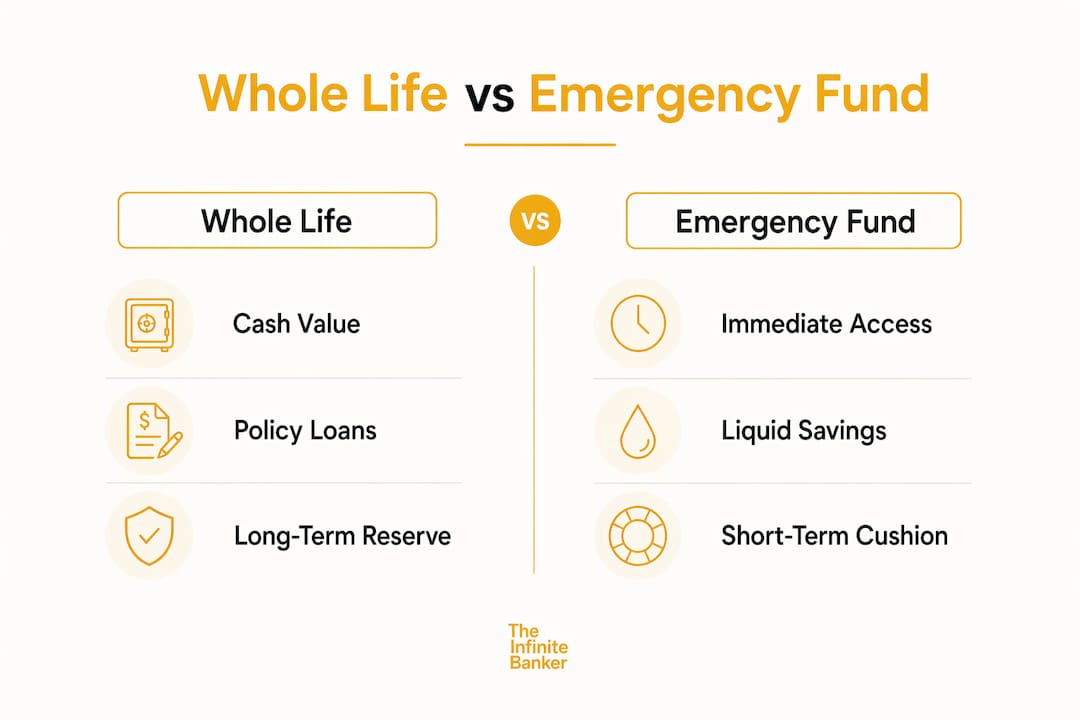
Whole life cash value can supplement a traditional emergency fund, but it usually should not fully replace one for most U.S.-based individuals. The more precise answer: a dividend-paying whole life policy works best as a secondary reserve layer, not a first-call liquidity source. Accessing cash value typically involves administrative processing time, while a savings account delivers funds the same day. That timing gap matters when a furnace fails on a Friday night or a client payment falls two weeks late.
For entrepreneurs, real estate investors, and high-income earners, the Infinite Banking Strategy offers a more capital-efficient structure than parking six months of expenses in a low-yield savings account. The IRS treats policy loans differently than withdrawals, and the National Association of Insurance Commissioners (NAIC) consumer disclosures confirm that cash value grows on a tax-deferred basis inside the policy. The practical path forward is a hybrid approach: keep a small liquid cushion in an immediately accessible account, and allocate the remainder of your emergency target to a properly structured whole life policy over time.
Read on for a full hybrid implementation plan with sample numbers.
Consult an Authorized IBC Practitioner such as Jib Hunt at The Infinite Banker, or a licensed financial advisor, before making any changes to your financial structure.
Table of Contents
What is an emergency fund and how much do you actually need?
An emergency fund is a dedicated pool of liquid cash set aside to cover unplanned expenses or income gaps without forcing you to sell assets, take on high-interest debt, or disrupt business operations. The key word is liquid: the money must be accessible within hours, not days.
Standard sizing guidance uses months of essential living expenses as the unit of measure:
3 months: Minimum baseline for a salaried employee with stable income and low fixed costs.
6 months: Standard target for most households and small-business owners with moderate income variability.
12+ months: Appropriate for entrepreneurs with irregular cash flow, real estate investors carrying significant debt service, or anyone whose income depends on a single client or contract.
A simple calculation for an entrepreneur with monthly essential expenses (housing, utilities, minimum debt payments, basic operations) results in an immediate target equal to three times that amount. That figure sets the baseline you will use when sizing the hybrid split later in this article.
Where you hold that cushion matters. High-yield savings accounts, money market accounts, and short-term Treasury bills all offer near-instant access with FDIC or government backing. These are the right vehicles for the immediate layer, precisely because whole life cash value, as you will see, cannot reliably fill that role in the early years of a policy.
How does whole life cash value accumulate and how do you access it?
Every premium payment on a dividend-paying whole life policy is split between the cost of insurance and the cash value component. The cash value portion grows at a contractually guaranteed rate set by the insurer, and participating policies may also credit non-guaranteed dividends on top of that base. Dividends are not guaranteed; they reflect the insurer’s investment performance, mortality experience, and expense management in a given year.

Three ways to access cash value
Policy loans are the primary tool in the Infinite Banking Strategy. You borrow against the policy’s cash value without a credit check, with no fixed repayment schedule. Policy loans accrue interest, and if left unpaid, that interest compounds and reduces both the remaining cash value and the death benefit. A properly designed policy can allow the underlying cash value to continue compounding while a loan is outstanding, but this requires active loan management and disciplined repayment.
Partial withdrawals reduce the policy’s cash value and death benefit permanently. Withdrawals up to your premium basis (the total premiums paid) are generally not subject to income tax, but amounts above that basis may be taxable. The IRS guidance on life insurance distributions distinguishes between loans and withdrawals in ways that affect your tax position.
Full surrender terminates the policy entirely. Any cash value above your cost basis becomes ordinary income in the year of surrender, and you lose the death benefit permanently.
The early-years limitation
Cash value accrues slowly in the first several years of a policy. Depending on policy design, premium funding level, and the use of paid-up additions riders, meaningful accessible cash value may not exist until years 2–10. This is the single most important timing constraint for anyone considering whole life as an emergency resource.
How fast can you actually access the money?
Whole life cash value is not the same as a checking account. The table below shows realistic access timelines across the three main liquidity sources.
Access Method | Typical Timeline | Key Friction Points |
High-yield savings account | Same day to next business day | None for established accounts |
Policy loan | 3–10 business days (varies by insurer) | Loan request form, insurer processing, check or wire |
Partial withdrawal | 5–10 business days | Paperwork, possible surrender charges in early years |
Full surrender | 2–4 weeks | Full paperwork, tax event, policy termination |
Policy loans do not require credit approval, which is a real advantage over bank lines of credit during a financial stress event. However, the processing window means a policy loan is not a same-day solution. Unpaid loan interest accrues and reduces the death benefit if the balance is not managed, so policy loan mechanics require active attention.
Pro Tip: Keep at least one month of essential expenses in a high-yield savings account or money market fund at all times. Use the whole life policy as the secondary layer you tap after the liquid cushion is drawn down, not before.
What are the potential advantages of using whole life as part of your reserve?
For the right profile, a dividend-paying whole life policy offers several advantages that a savings account simply cannot match.
Stable, predictable growth. The guaranteed cash value component grows at a contractually set rate regardless of stock market conditions. Dividends, when credited (and they are not guaranteed), add to that base. This stability is meaningful for an entrepreneur who already carries significant market exposure through a business or investment portfolio.
No credit approval for loans. Policy loans compare favorably to bank loans or retirement-account withdrawals because they bypass credit checks entirely. During a business downturn, when bank credit tightens, a policy loan may be one of the few accessible capital sources that does not depend on your current income or credit score.
Potential tax efficiency. Loans against cash value are generally not treated as taxable income, unlike withdrawals from a 401(k) or IRA, which trigger ordinary income tax and a potential 10% early withdrawal penalty. This comparison is not absolute; consult a tax professional for your specific situation.
Behavioral discipline. Funding a whole life policy creates a structured, recurring commitment that builds a long-term reserve. Many high earners find that liquid savings accounts are too easy to raid for non-emergencies. The policy’s structure adds a layer of friction that preserves the reserve for genuine needs.
What are the real drawbacks of relying on whole life for emergencies?
The advantages above come with meaningful trade-offs. Understanding them is what separates a well-structured strategy from a costly mistake.

Death benefit erosion and lapse risk. Unpaid policy loans and large partial withdrawals reduce the death benefit. If premium payments stop while a large loan is outstanding, the policy can lapse entirely, potentially creating a taxable event on the outstanding loan balance. The New York Department of Financial Services notes that coverage lapses early can be particularly costly.
Early-years illiquidity. A policy issued today will have limited usable cash value for the first several years. Surrender charges may apply in the early policy years depending on the insurer and product design. Whole life is a long-term asset; early withdrawals or surrender can trigger surrender charges and tax consequences, making it a poor short-term substitute for emergency savings.
Higher premium cost and opportunity cost. Whole life premiums are substantially higher than term life premiums for the same death benefit. That premium gap represents capital you could deploy elsewhere. If your immediate liquidity need is not yet met, funding a whole life policy before building a liquid cushion is the wrong sequencing.
Administrative friction. Dividends are not guaranteed, insurer processing takes days, and policy loan interest accrues whether or not you are actively monitoring it. These are manageable realities for a disciplined policyholder, but they are real friction points during a financial emergency.
Who is a reasonable candidate for the hybrid approach?
Not every entrepreneur or high earner is the right fit for using whole life as part of an emergency reserve. A few honest decision prompts help clarify the picture.
Signals that the hybrid approach may fit:
You have stable or predictable cash flow and can fund both a liquid cushion and policy premiums without strain.
Your existing emergency savings already cover 1–3 months of expenses, and you are looking to deploy the remainder more efficiently.
You carry a large, illiquid portfolio (real estate, private equity, a closely held business) and want a liquid asset that does not correlate with those holdings.
You have a planning horizon of 10+ years and understand that the policy’s value compounds over time.
A real estate investor with $5 million in properties and $40,000 in liquid savings is a classic example. The portfolio is illiquid by nature; a properly structured policy creates a borrowable reserve that does not require selling an asset or qualifying for a new loan during a market disruption. For business owners, the policy can also serve capital needs beyond personal emergencies.
Red flags that suggest sticking with cash-only reserves:
Inconsistent or seasonal cash flow that makes premium funding unreliable.
No existing liquid cushion; the policy would be the only reserve.
Day-to-day operations depend on immediate access to funds, with no tolerance for a 3–10 business day processing window.
How do you implement the hybrid approach step by step?
The practical framework combines a small immediate-access cushion with a dividend-paying whole life policy as a secondary reserve. Practitioners of Infinite Banking recommend keeping a base of immediate liquidity in a high-yield savings account and allocating the remainder of the emergency target into a policy to improve capital efficiency.
Sample hybrid split for a high-earner entrepreneur with essential expenses at a representative monthly amount
Emergency Target | Total Amount | Liquid Cushion (Savings) | Whole Life Target (Cash Value) |
3 months | Amount reflecting 3 months of expenses | Amount reflecting approximately 1 month in liquid savings | Remaining amount allocated to whole life cash value |
6 months | Amount reflecting 6 months of expenses | Amount reflecting approximately 2 months in liquid savings | Remaining amount allocated to whole life cash value |
12 months | Amount reflecting 12 months of expenses | Amount reflecting approximately 3 months in liquid savings | Remaining amount allocated to whole life cash value |
These figures are illustrative. Actual cash value accumulation depends on policy design, premium level, insurer dividend performance (not guaranteed), and years in force.
Implementation checklist
Set your liquid cushion first. Fund 1–3 months of essential expenses in a high-yield savings account or money market fund before allocating anything to a policy.
Run policy-design scenarios with an Authorized IBC Practitioner. Policy structure, paid-up additions riders, and premium funding level all affect how quickly usable cash value accumulates. The Infinite Banking concept requires a properly designed policy, not a standard off-the-shelf product.
Ladder your funding to accelerate cash value. Paid-up additions (PUAs) allow you to overfund the policy within IRS limits, accelerating cash value growth. Ask your practitioner about the maximum PUA funding level for your policy.
Document your loan terms and repayment plan before you borrow. Decide in advance how you will repay a policy loan, at what interest rate, and over what timeline. Policy loans accrue interest and reduce cash value and death benefit if unpaid; a written plan prevents drift.
Pro Tip: Ask your Authorized IBC Practitioner to run a conservative dividend illustration alongside the base illustration. Because dividends are not guaranteed, stress-testing the policy’s cash value growth with a lower dividend assumption gives you a more realistic floor for planning.
Warning: Policies can lapse if premiums stop while a large loan is outstanding. A lapse on a policy with a significant outstanding loan balance may create a taxable event equal to the loan amount minus your cost basis. Model this scenario before committing to a loan.
Key Takeaways
Whole life cash value works as a secondary emergency reserve when paired with a liquid cushion, not as a standalone replacement for immediate-access savings.
Point | Details |
Hybrid approach is the standard | Keep 1–3 months liquid in savings; allocate the remainder of your emergency target to whole life cash value over time. |
Policy loans take 3–10 business days | Whole life is not a same-day liquidity source; a liquid cushion covers the gap while a loan processes. |
Early years have limited cash value | Meaningful accessible cash value may not exist until years 2–10, depending on policy design and funding. |
Dividends and outcomes are not guaranteed | Stress-test your plan with conservative dividend assumptions; policy loans accrue interest and can cause lapse if unmanaged. |
The Infinite Banker | Helps entrepreneurs and investors structure properly designed policies for capital efficiency; consult an Authorized IBC Practitioner before acting. |
A practitioner’s perspective on what most people get wrong
Most people approach this question as a binary: either keep cash in a savings account or put it in a policy. That framing misses the point entirely. The Infinite Banking Strategy is not about replacing liquidity; it is about deploying capital more efficiently once your immediate liquidity needs are already covered.
The entrepreneurs who use this approach well are the ones who already have a liquid cushion and are asking what to do with the next dollar. They are not trying to fund a policy instead of building savings; they are building savings first and then layering a policy on top. The policy becomes a long-term capital reserve that also happens to be borrowable, not a substitute for the checking account.
What I see go wrong most often is sequencing. Someone funds a policy before they have a liquid cushion, then faces an emergency in year two when cash value is still minimal, and either surrenders the policy at a loss or takes on high-interest debt they were trying to avoid. The policy design also matters enormously. A standard whole life product sold without paid-up additions riders will accumulate cash value far more slowly than a properly structured policy. These are not minor details; they determine whether the strategy works or fails.
Dividends are not guaranteed, and any plan that depends on a specific dividend rate is a plan built on an assumption, not a fact. Model the conservative case. If the strategy still makes sense at a lower dividend, you have a durable plan.
How The Infinite Banker can help you structure this
For entrepreneurs and investors who have already built a liquid cushion and are ready to explore a properly structured dividend-paying whole life policy as a secondary reserve, The Infinite Banker offers strategy sessions, policy design guidance, underwriting support, and ongoing coaching for Infinite Banking implementations. The focus is on capital efficiency: designing a policy that accumulates usable cash value as quickly as possible within IRS limits, with a loan structure you can actually manage.

To get started, visit who Infinite Banking is for to confirm whether your profile fits the approach, then use the Infinite Banking calculator to model a preliminary funding scenario. When you are ready to run detailed policy-design numbers, request a consultation directly through the site.
Disclosure: The Infinite Banker earns commissions on policy placements. This content is educational and does not constitute financial, tax, or legal advice. Consult an independent licensed advisor for your specific situation.
Useful sources and further reading
New York Department of Financial Services: Pros and Cons of Whole Life Insurance — Primary consumer disclosure covering cash value growth, lapse risk, and premium structure.
Investopedia: How Whole Life Insurance Works — Overview of policy mechanics, dividend treatment, and loan implications.
IRS Topic 703: Basis of Assets — IRS guidance on cost basis and tax treatment relevant to policy withdrawals and surrenders.
IRS Revenue Procedure 2001-42 — IRS guidance on life insurance contract standards, including modified endowment contract rules.
The Infinite Banker: Infinite Banking Explained — Practitioner guide to the Infinite Banking concept and policy design for entrepreneurs.
Vault: Private AI Budgeting for iPhone — Budgeting tool for tracking liquid reserves and managing cash flow alongside a policy funding plan.
This post is educational only and not financial, tax, or legal advice. Consult qualified professionals before acting.
Recommended
Comments