
A Long-Term Capital Efficiency Plan for Business Owners
- Jib Hunt

- 4 days ago
- 9 min read

COMPLIANCE NOTE: For educational purposes only. Not financial, tax, or legal advice.
A long-term capital efficiency plan, in this context, is an Infinite Banking strategy built with dividend-paying whole life insurance designed to give you a personal source of liquidity and long-term flexibility with your own capital. It works by directing structured premiums, including paid-up additions (PUA), into a policy so cash value accumulates and can later be borrowed against. Entrepreneurs, real estate investors, and high-income business owners tend to consider this approach because they need repeatable access to capital without going through a bank each time. Dividends are never guaranteed, and policy loans accrue interest and reduce cash value and death benefit if left unpaid. The Infinite Banker works with clients on exactly this kind of policy design.
Key Takeaways
A long-term capital efficiency plan works by overfunding a dividend-paying whole life policy so cash value grows and can be borrowed against without third-party lenders.
Point | Details |
Definition | It’s an Infinite Banking strategy using dividend-paying whole life insurance for personal liquidity and long-term flexibility. |
PUA drives timeline | Paid-up additions accelerate accessible cash value; without them, meaningful loan capacity can take a decade or more. |
Loans carry real cost | Policy loans accrue interest and reduce cash value and death benefit until repaid, and unpaid loans can trigger MEC tax issues. |
Dividends aren’t guaranteed | Mutual carrier dividend history matters, but payouts depend on insurer performance, not a contractual promise. |
Fit depends on discipline | The Infinite Banker helps entrepreneurs and investors design policies with funding discipline and monitoring, not one-size-fits-all templates. |
Table of Contents
What Is a Long-Term Capital Efficiency Plan and How Does It Work?
The mechanism is simple to state and takes years to execute well: you overfund a dividend-paying whole life policy, cash value accumulates inside it, and you borrow against that cash value instead of going to a bank. Every part of that sentence matters, especially the word “overfund.”
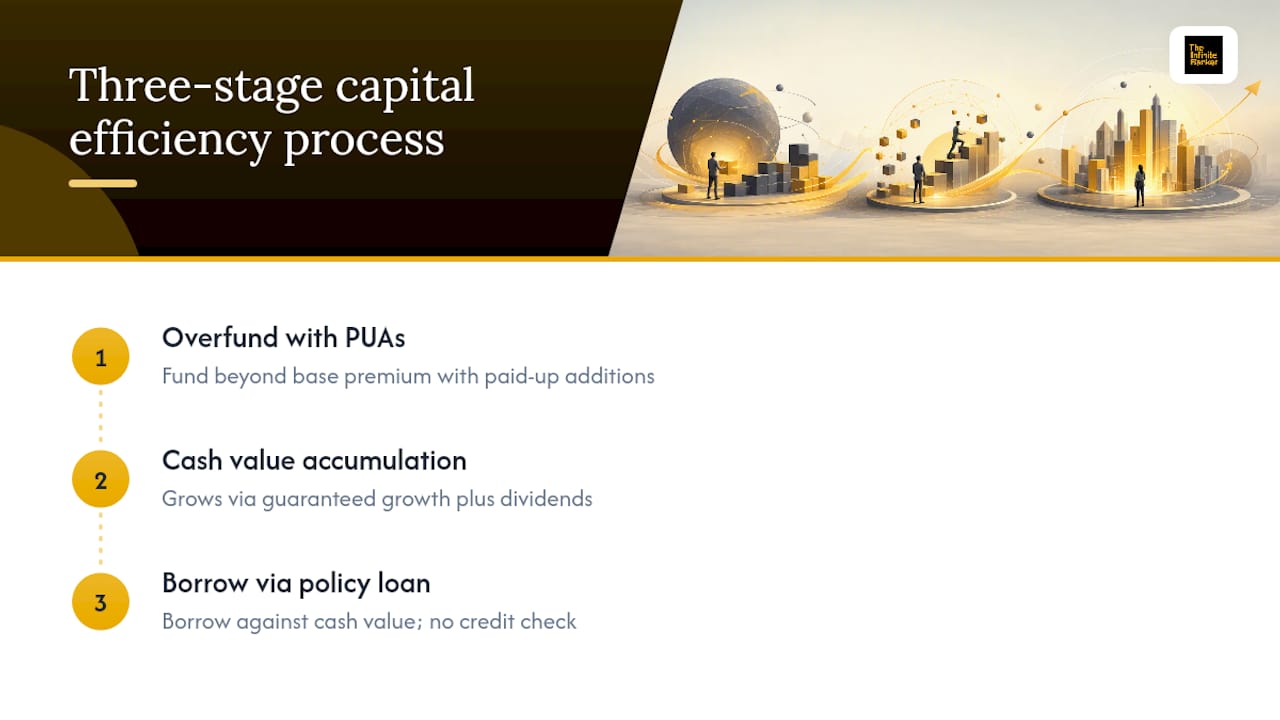
The process runs in three stages. First, you fund the policy beyond the base premium using paid-up additions, a rider that buys small increments of fully paid-up insurance and pushes more of your premium into accessible cash value faster than base premium alone. Second, that cash value accumulates through guaranteed contractual growth plus, potentially, dividends the insurer chooses to pay. Third, once there’s enough cash value, you take a policy loan against it. That loan does not involve a credit check or affect your existing bank relationships, because you are borrowing from the insurance company against your own policy value, not from a third-party lender.

Cash value inside a properly structured whole life policy grows on a tax-deferred basis, and withdrawals up to the amount of premiums paid are generally not taxed as income. Loans are typically not treated as taxable events either, but an unpaid loan on a policy that lapses or becomes a modified endowment contract can trigger a taxable event. That’s a real risk, not a footnote.
Pro Tip: Dividends are never guaranteed, and the pace of PUA funding you choose at the outset has more influence over how soon you can actually borrow than almost any other single design decision.
What Are the Key Components of an Infinite Banking Policy?
Four pieces determine whether a policy functions as intended or just sits there as expensive insurance.
Dividend-paying whole life insurance: a permanent policy issued by a mutual insurer, distinct from universal or variable life because its cash value growth and death benefit are contractually structured rather than market-linked.
Paid-up additions (PUA): a rider that converts extra premium into small blocks of paid-up coverage, accelerating cash value in the early years when it matters most for borrowing capacity.
Cash value: the accessible living-benefit portion of the policy. You can withdraw up to your basis (premiums paid) generally without tax consequence, or borrow against it while the underlying value keeps growing.
Policy loans: interest accrues to the insurer, and any outstanding balance reduces both available cash value and the death benefit until repaid.
Carrier selection is where a lot of plans succeed or fail quietly. Mutual insurers that pay dividends to policyholders (rather than shareholders) matter here because dividend history and the composition of the insurer’s general account directly affect how the policy performs over decades. Some industry commentary notes that policyholders who hold participating policies into later years may see stronger dividend allocations, since the same dividend pool gets shared among fewer remaining policyholders. Again, none of this is promised. It’s a structural tendency, not a contract term.
What Are the Benefits and Use Cases of This Strategy?
The primary appeal is a repeatable, private lending source you control, paired with a long-term liquidity plan that can complement, not replace, other holdings. That’s the whole pitch stripped of hype.
In practice, entrepreneurs and investors put this capital to work in specific ways:
Bridging business cash flow gaps between receivables and payables without a line of credit renewal.
Funding a real estate down payment or renovation without a hard-money loan.
Supplementing retirement income in a tax-aware way alongside qualified accounts.
Providing estate liquidity for heirs or business succession.
Covering capital expenditures without waiting on external lender approval.
There’s also a structural comparison worth understanding. A whole life policy’s cash value sits inside the insurer’s general account, which is invested heavily in long-duration, high-quality bonds. For high-income earners, that can behave somewhat like holding long-duration fixed income directly, but with dividend participation and tax treatment that differs from owning bonds outright. The catch: these benefits show up over long horizons, and only if funding and loan repayment stay disciplined the whole way through.
What Are the Risks and Trade-Offs of a Capital Efficiency Plan?
This plan asks for a long-term premium commitment and carries real contract and tax risks that don’t get enough attention in sales conversations.
Premiums cost more in the early years than comparable term insurance, and that gap doesn’t close quickly.
Meaningful cash value takes time to build, especially without an aggressive PUA allocation.
Overfunding too fast can push the policy into modified endowment contract (MEC) status, which strips away the favorable loan and withdrawal tax treatment that makes the strategy work.
Loan interest accrues whether or not you’re actively repaying, and unpaid balances shrink both cash value and death benefit.
Surrender charges can apply if you exit the policy early.
Agent commissions on the front end can drag down early internal rate of return.
Pro Tip: Model your MEC exposure and loan repayment scenarios before you commit to an aggressive funding pace. A policy that looks great on an illustration can lapse in real life if loans and premiums outrun cash value.
Dividends are not guaranteed. A policy can lapse if outstanding loans plus premiums exceed available cash value, and borrowing without a repayment plan can undo much of what the structure is designed to do.
Who Does This Plan Suit and How Long Does It Take?
The typical profile is someone with steady, high income, the capacity to commit discretionary premium dollars for years at a time, and a genuine need for a repeatable personal lending source rather than a quick return.
Ask yourself honestly:
Can you commit a meaningful percentage of income to premiums for a decade or more without strain?
Are you comfortable with higher insurance costs in years one through five?
Do you need a stable, private source of liquidity you control outside the banking system?
Timeline expectations matter more than most marketing admits. In years zero through three, loan capacity stays limited unless you’ve funded aggressively with PUAs. Between years three and ten, borrowing capacity grows steadily. Past year ten, policyholders with mutual carriers often see meaningful internal banking capacity and, potentially, stronger dividend participation, though exact timing depends entirely on funding pace and carrier choice. Talk to a fee-based advisor and a tax professional before locking in a design.
How Do You Implement a Long-Term Capital Efficiency Plan?
Design, carrier selection, funding pace, MEC testing, and ongoing monitoring form the critical path, in that order.
Clarify your objectives and time horizon. Are you funding real estate deals, business cash flow, or long-term estate liquidity?
Model funding scenarios against MEC risk before choosing a premium level.
Choose a carrier type (mutual, dividend-paying) and request both dividend history and loan illustrations.
Include a PUA rider with a death-benefit floor that still prioritizes early cash value.
Agree on a loan repayment policy in writing before you ever take a loan.
Set a monitoring cadence with annual stress tests against interest rate and dividend-scale changes.
Before you sign anything, bring these questions to whoever is designing your policy: What does the historical dividend scale actually look like? What does early cash value look like under a conservative illustration? How is MEC risk being modeled? What’s the loan interest rate and repayment structure? What’s the commission on this design versus a more conservative one?
Pro Tip: Insist on illustrations that show a loan scenario, not just a no-loan projection. You want to see exactly how an outstanding loan plus accrued interest affects both cash value and net death benefit over time, and get independent tax advice before you commit.
What Are the Most Common Mistakes and Red Flags?
Poor policy structure and misaligned advisor incentives cause more damage here than market conditions ever will.
Watch for advisors who push rapid overfunding without running MEC tests, illustrations that bury surrender charges or commission structure in fine print, policies written without a PUA option at all, carriers with weak or inconsistent dividend histories for participating designs, and any pitch that glosses over loan interest. A serious red flag: pressure to surrender other essential coverage or drain liquid reserves to fund premiums. Insist on transparent illustrations, independent modeling, and a written loan repayment policy before you move forward.
How The Infinite Banker Approaches Policy Design
The Infinite Banker focuses on policy design, funding discipline, and ongoing monitoring built around each entrepreneur’s or investor’s actual cash flow, not a generic template. Individual results vary based on carrier, funding pace, and market conditions, and dividends are never guaranteed. Independent tax and legal advisors should review any design before you commit.
Ready to Evaluate Your Own Capital Efficiency Plan?
The Infinite Banker provides strategy sessions, policy design, underwriting guidance, and ongoing education for entrepreneurs, real estate investors, and high-income business owners weighing this approach against other capital allocation choices.
If you’ve read this far, you already understand the mechanics better than most people who buy a policy blind. The next useful step isn’t a sales call, it’s seeing whether this structure fits your specific income pattern and capital needs. Start by reviewing who Infinite Banking is designed for to see if your situation matches the typical profile, or look at how the process actually works before requesting an illustration. If you’re comparing carriers or want quotes across multiple insurers first, East Two West offers comparative life insurance and annuity quotes worth reviewing independently. This is educational content, and any next step should include your own tax and legal advisors before you fund a policy.
Frequently Asked Questions
What is a long-term capital efficiency plan in simple terms? It’s a strategy that uses a dividend-paying whole life insurance policy, funded with paid-up additions, to build cash value you can borrow against as a personal source of liquidity over many years.
How long does it take before I can borrow from my policy? It depends heavily on funding pace and carrier design. Heavily PUA-funded policies can offer some borrowing capacity within a few years, while conservatively funded policies may take closer to a decade to reach meaningful capacity.
Is infinite banking the same as investing in a whole life policy for the death benefit? No. The strategy prioritizes early cash-value access and borrowing capacity over maximizing the death benefit, which changes how the policy should be designed from day one.
What happens if I don’t repay a policy loan? Interest keeps accruing, and the outstanding balance reduces available cash value and the death benefit. If the loan plus interest exceeds the cash value, the policy can lapse.
Do I need a financial advisor to set this up? Working with a fee-based advisor and a tax professional alongside your policy design is strongly advisable, since MEC risk, loan structuring, and funding pace all have tax and contract implications.
This post is educational only and not financial, tax, or legal advice. Consult qualified professionals before acting.
This article is general information, not a substitute for advice from a qualified financial advisor. Consult a qualified financial professional about your own circumstances before acting on anything here.
Sources
Recommended
Comments