
How High Earners Avoid Market Volatility Without Selling Low
- Jib Hunt

- 2 days ago
- 16 min read

COMPLIANCE NOTE: For educational purposes only. Not financial, tax, or legal advice.
High earners avoid destructive market volatility by coordinating tax-loss harvesting, disciplined rebalancing, a contractual stability lane, selective alternative allocations, and ready liquidity so they never have to sell into a downturn. None of these levers work in isolation. What separates a high earner’s approach from a typical retail investor’s approach is the coordination between tax bracket, account type, and cash access, since a large tax bill or a forced sale during a drawdown can do more permanent damage than the volatility itself.
Tax-loss harvesting to offset gains and reduce the drag of a high marginal rate
Rebalancing bands that force selling high and buying low on a schedule, not a hunch
A stability lane of non-correlated, contractual assets that funds spending without touching equities
Direct indexing and private-market allocations for tax customization and lower correlation
Liquidity reserves and credit lines that remove the need to sell during a downturn
Behavioral rules and automation that keep decisions consistent when markets are not
Key Takeaways
High earners avoid destructive volatility by coordinating tax-efficient harvesting, disciplined rebalancing, a contractual stability lane, selective alternatives, and standing liquidity so equities are never sold at a loss out of necessity.
Point | Details |
Harvest losses at the security level | Direct indexing enables loss harvesting throughout the year rather than once annually with a broad fund. |
Rebalance on bands, not dates | Trigger trades when an asset class drifts roughly 5 percentage points from target, using tax-advantaged accounts first. |
Size a stability lane at 12 to 36 months | Non-correlated, contractual assets fund spending during downturns so growth-lane assets are not sold at a loss. |
Add alternatives selectively | Direct indexing and private credit can reduce correlation and improve tax outcomes, but require suitability and manager due diligence. |
Sequence withdrawals and conversions deliberately | Model Roth conversions and harvesting together with an adviser before acting during a drawdown. |
Explore contractual stability options | The Infinite Banker works with entrepreneurs and high earners to design dividend-paying whole life policies as one stability-lane option. |
Table of Contents
How Does Tax-Loss Harvesting Help High Earners Avoid Market Volatility?
What Rebalancing Rules Keep High Earners’ Portfolios on Target?
Do Direct Indexing and Private Markets Actually Reduce Volatility?
How Much Cash Should High Earners Keep for Market Downturns?
How Do You Build a Behavioral System That Prevents Panic Selling?
Can Options Strategies Like Protective Puts Actually Limit Losses?
Why Does Geographic and Sector Diversification Matter More Now?
Are Structured Products Worth the Complexity for Downside Protection?
How Do You Withdraw Money Tax-Efficiently When Markets Are Down?
Why Volatility Is an Implementation Problem, Not a Timing Puzzle
How Does Tax-Loss Harvesting Help High Earners Avoid Market Volatility?
Tax-loss harvesting works by selling a security at a loss and immediately buying a similar, non-identical replacement, so the portfolio’s market exposure barely changes while the loss becomes usable against gains elsewhere. A high earner in the top federal bracket who harvests a $50,000 loss and applies it against a concentrated stock gain can meaningfully reduce that year’s tax bill without changing the underlying risk profile of the portfolio.
The IRS wash-sale rule blocks repurchasing a “substantially identical” security within 30 days before or after the sale. In practice, that means swapping one large-cap value fund for a similar but not identical one, not repurchasing the exact ticker you sold. This is where broad index funds fall short and where direct indexing has changed the math.
Broad fund harvesting captures one loss (or gain) at the fund level, once a year at best
Direct indexing holds the underlying stocks individually, so a manager can harvest losses security by security, sometimes dozens of times a year
Donor-advised fund gifting of appreciated shares avoids realizing the gain while still claiming a deduction
Statistic Callout: A 2026 report found that 86% of surveyed financial advisors view direct indexing as a critical strategy for high-net-worth portfolio construction, primarily because of the tax-loss harvesting and customization it enables.
Harvesting delivers the most value in high-bracket years, after a liquidity event, or when a concentrated stock position needs trimming. Coordinate the timing with a tax professional before executing, since the value depends heavily on your specific bracket and carryforward situation.
What Rebalancing Rules Keep High Earners’ Portfolios on Target?
Rebalancing forces you to sell what has gone up and buy what has gone down, which is the opposite of what instinct tells most investors to do during volatility. High earners with concentrated positions or multiple account types need a defined rule, not a gut check, because the tax consequences of rebalancing in a taxable account differ sharply from doing it inside a 401(k) or IRA.
Set band triggers, not calendar dates. A common approach rebalances when an asset class drifts 5 percentage points from its target, which reacts to actual volatility instead of an arbitrary date.
Rebalance inside tax-advantaged accounts first. Trades inside a 401(k), IRA, or Roth carry no tax consequence, so use those accounts to absorb most of the rebalancing work before touching taxable holdings.
Use asset location to cut tax drag. Holding tax-inefficient assets like bonds and REITs in tax-deferred accounts, and tax-efficient equity index funds in taxable accounts, can add an estimated 0.3% to 0.5% per year in after-tax return over long horizons.
Handle concentrated stock through staged sales. For executives holding restricted or appreciated employer stock, a structured 10b5-1 trading plan sells a fixed number of shares on a schedule, removing both the timing decision and any appearance of trading on inside information.
Use forced taxable events as rebalancing windows. A vesting date, an acquisition payout, or a bonus year is a natural moment to redirect new capital toward underweight asset classes instead of adding to what is already overweight.
Rebalancing discipline and smart diversification tactics work together. Neither one substitutes for the other.
What Is a Stability Lane and Why Do High Earners Use One?
A stability lane is a pool of contractual, non-correlated assets set aside specifically to fund spending during a market downturn, so equities never have to be sold at a low point. It sits apart from the “growth lane,” where the bulk of long-term equity and alternative exposure lives and where volatility is expected and tolerated. The stability lane’s job is narrower and more disciplined: provide predictable, non-market-linked access to cash when the growth lane is temporarily down.
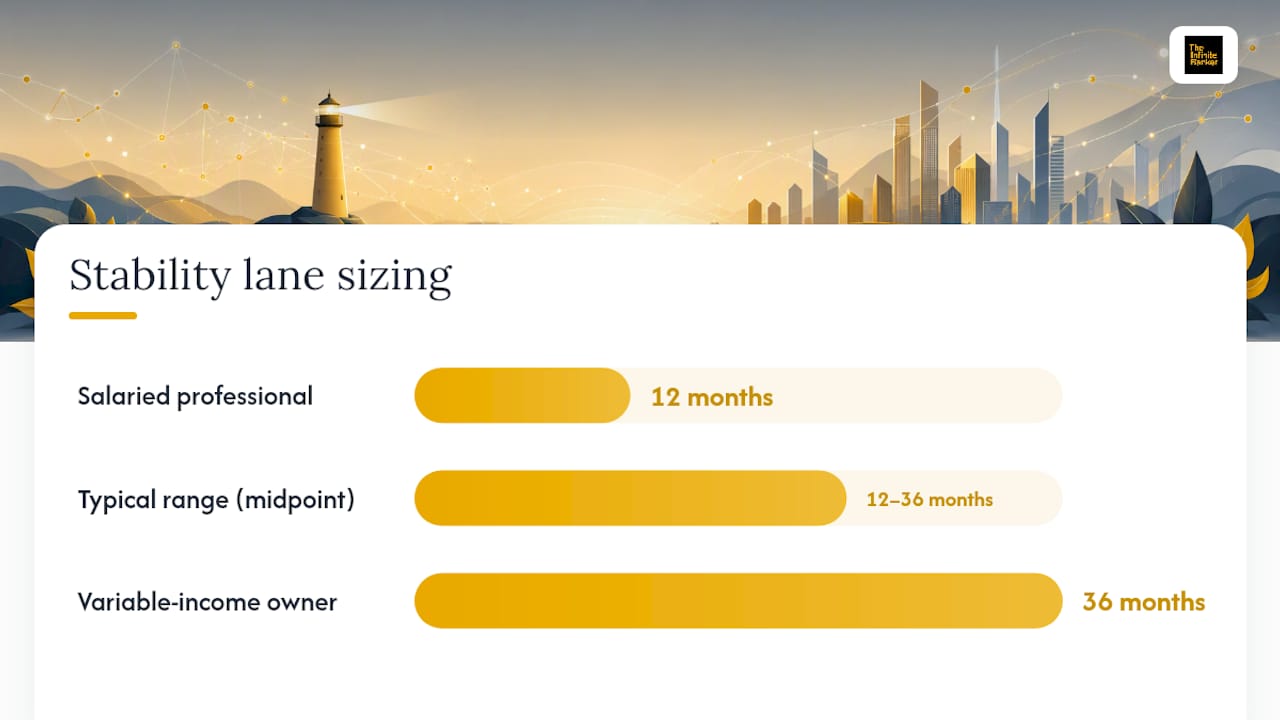
Sizing depends on income stability and how rigid your expenses are. A business owner with variable revenue and a mortgage payment that does not flex typically needs more coverage than a salaried professional with modest fixed costs. A reasonable starting range is 12 to 36 months of non-sale liquidity, scaled toward the higher end for entrepreneurs and real estate investors whose income swings with the market itself.
Several contractual vehicles can fill this role, each with distinct liquidity mechanics:
Whole life insurance cash value, accessed through a policy loan, which does not require selling an asset or realizing a taxable gain
Multi-year guaranteed annuities (MYGAs), which mature on a known schedule but carry surrender penalties if accessed early
Fixed annuity income riders, useful for a predictable income floor but generally less flexible for lump-sum access
Dividend-paying whole life insurance is one option households use to build this kind of stability lane, since how the policy’s cash value functions is designed around liquidity and contractual growth rather than market participation. Dividends on participating policies are not guaranteed and are declared annually at the insurer’s discretion. Policy loans accrue interest, and any unpaid loan balance reduces both the available cash value and the death benefit. Policies can lapse if premiums are not maintained or if a loan balance grows too large relative to cash value, so sizing this lane correctly matters as much as building it in the first place.
Pro Tip: Before assuming you have enough stability-lane coverage, add up your actual fixed monthly obligations, mortgage, insurance, taxes, and payroll if you own a business, then check that against 12 to 36 months of coverage rather than a round number pulled from memory.
Readers building this out with a professional often start with a cash value mechanics review before deciding how large a stability lane makes sense for their situation.
Do Direct Indexing and Private Markets Actually Reduce Volatility?
Direct indexing and private-market allocations do not eliminate volatility, but they change how much of it shows up on your tax return and how correlated your holdings are to public equity swings. Advisor surveys tied to recent market turbulence show rising adoption of direct indexing and private-market allocations among households with $5 million or more in investable assets, driven mainly by tax sensitivity and a desire for customization that a mutual fund cannot offer.
Private credit is the most commonly added complement. It generates income from loan interest rather than equity price appreciation, so its return stream tends to move differently than the stock market, though it comes with real tradeoffs: lower liquidity, fees that run higher than a public fund, and dependence on manager selection.
Selective active management still has a place too. Vanguard research shows that certain actively managed funds outperformed their peer-group averages in 81% of cases over a 10-year period when properly selected, which argues against writing off active management entirely in favor of pure indexing.
Before adding either complement, run through a short checklist:
Confirm suitability: private-market allocations typically require accredited or qualified-purchaser status
Vet the manager’s track record and fee structure, not just the marketing pitch
Understand minimums, since many private credit funds typically require substantial minimum investments
Cap any single alternative allocation to avoid recreating the concentration problem you are trying to solve
Readers weighing these options against a stability lane can review why alternative assets matter for high earners specifically.
How Much Cash Should High Earners Keep for Market Downturns?
Reserve sizing depends on how variable your income is and how much of your net worth sits in illiquid assets like real estate or a private business. A W-2 executive with stable income might hold several months of expenses in cash, while a real estate investor with lumpy rental income and renovation costs typically needs a larger cash buffer scaled to their variable income.
Cash held at an FDIC-insured bank is protected up to standard deposit insurance limits, which matters once reserve balances climb into six figures and spread across multiple accounts becomes worth considering.
Beyond straight cash, three liquidity tools fill the gap without forcing a sale:
Securities-backed lines of credit, which let you borrow against a taxable brokerage account without triggering a capital gain, though the lender can issue a margin call if the pledged securities drop sharply
Personal lines of credit, useful for shorter gaps but typically carrying higher rates and more underwriting scrutiny
Policy loans against whole life cash value, which do not depend on market pricing or a credit check, but which accrue interest and reduce the death benefit if left unpaid
Each tool serves a different purpose. Bank lines respond to market conditions; a policy loan generally does not, which is part of why some households treat it as a backstop rather than a first resort.
How Do You Build a Behavioral System That Prevents Panic Selling?
Rules made in advance, before markets move, outperform decisions made in the middle of a downturn. The goal is to remove judgment calls from moments when judgment is most likely to fail.
Write down rebalancing bands before volatility hits, so the trigger is mechanical rather than emotional.
Automate contributions and rebalancing wherever your custodian allows it, since automated systematic investing reduces the risk of selling near a market bottom by removing the decision entirely.
Run an annual stress test with your adviser, modeling a 20% to 30% equity drawdown against your actual spending needs and stability-lane coverage.
Set a defined trigger for adviser contact, such as a portfolio decline past a set percentage, so check-ins happen on a schedule instead of during a panic.
Pro Tip: Put your rebalancing bands and stability-lane targets in writing, dated and signed if you work with an adviser, so the plan you made in a calm market is the plan you follow in a volatile one.
When Do Roth Conversions Make Sense During a Downturn?
A market decline lowers the dollar value of a traditional IRA or 401(k), which means converting a fixed number of shares to a Roth account triggers a smaller tax bill than the same conversion would in a rising market. The shares still recover inside the Roth, tax-free growth included, but you paid tax on a depressed value rather than a peak one.
Backdoor and mega-backdoor Roth strategies extend this further for high earners who exceed the income limits for direct Roth contributions. A backdoor Roth involves a nondeductible traditional IRA contribution followed by a conversion; a mega-backdoor Roth uses after-tax 401(k) contributions, where the plan allows them, converted to a Roth account inside the plan.
Model the conversion’s tax impact against your current bracket and any harvested losses that could offset it
Sequence conversions after tax-loss harvesting is complete, not before, so losses can absorb some of the converted income
Watch for the pro-rata rule if you hold other pretax IRA balances, since it can complicate a backdoor Roth’s tax treatment
Always model the specific numbers with your tax adviser before converting. A downturn creates a window, but the math is household-specific
Can Options Strategies Like Protective Puts Actually Limit Losses?
Protective puts and collars give high earners a way to cap downside risk on a concentrated position without selling the underlying shares, which matters when a sale would trigger a large capital gain. A protective put works like insurance on a stock position: you pay a premium for the right to sell shares at a set price, so if the stock drops below that price, the put’s value rises to offset the loss.
A collar combines a purchased put with a sold call, using the premium from the call to offset, or sometimes fully cover, the cost of the put. The tradeoff is that the sold call caps how much upside you keep if the stock rises above the call’s strike price. Executives holding a large block of company stock often use collars specifically because selling outright would mean realizing a significant gain and possibly running afoul of insider-trading windows.
These strategies work best on liquid, exchange-listed stocks with an active options market. Illiquid or thinly traded positions make it harder to find fair pricing on the options themselves, which can erode the benefit.
Cost is the real constraint. Put premiums run higher during volatile markets, precisely when you are most likely to want the protection, so pricing tends to work against you at the moment protection feels most necessary. Collars solve some of that cost problem by trading away upside, which is a reasonable choice for someone who has already captured substantial gains and is prioritizing preservation over further growth.
Options strategies require a brokerage account approved for options trading and, in most cases, coordination with a tax professional, since the tax treatment of options premiums and any resulting gains or losses has its own set of rules separate from straightforward stock sales.
What Role Do Factor Tilts Play in Reducing Volatility?
Factor investing means deliberately overweighting stocks that share a specific characteristic, such as low valuation (value), strong price momentum, smaller company size, or high profitability (quality), rather than holding the market in its default capitalization-weighted proportions. The reasoning is that these factors have historically behaved somewhat differently from each other and from the broad market, so combining several can smooth out the ride even when any single factor has a rough stretch.

A portfolio tilted only toward growth stocks, for instance, tends to swing harder in both directions than one that blends value, quality, and momentum exposure alongside a core market position. No single factor outperforms in every environment. Value stocks can lag for years before a rotation moves the market back in their favor, which is exactly why diversifying across factors, rather than betting on one, is the more durable approach.
Implementation usually happens through factor-based index funds or ETFs that screen for a specific characteristic, layered on top of a core holding rather than replacing it entirely.
The tradeoff worth understanding upfront: factor tilts can underperform a plain market index for extended stretches, sometimes multiple years, before the premium shows up. High earners considering this approach need the patience to hold through those stretches, and a clear rationale for why the tilt is there in the first place, or the position tends to get abandoned right before it would have paid off.
Why Does Geographic and Sector Diversification Matter More Now?
Concentration risk is not only about individual stocks. A portfolio heavily weighted toward US large-cap technology, however well it has performed, carries region-specific and sector-specific risk that a downturn in that single area can expose all at once. Geographic diversification spreads exposure across developed international markets and emerging markets, each of which responds to different economic cycles, currency movements, and monetary policy decisions than the domestic market does.
Sector diversification works on a similar principle within a single country’s market. A portfolio dominated by a handful of mega-cap technology names, common in many index-tracking portfolios given how capitalization-weighted indexes work, can carry more sector concentration than an investor realizes until that sector has a bad year.
The practical challenge for high earners is that concentration often builds unintentionally. Stock compensation, a successful real estate market in one region, or simply years of a single sector outperforming can leave a portfolio far more concentrated than an investor set out to build. Reviewing sector and geographic weightings annually, not just asset-class allocations, catches this kind of drift before it becomes a real vulnerability.
International and emerging-market exposure also does not move in lockstep with US markets, though the correlation between global markets has increased over recent decades as economies have become more interconnected. That means geographic diversification reduces but does not eliminate the risk of a broad global downturn affecting the entire portfolio at once. It remains one of the more accessible diversification tools available, implementable through a handful of broad international and emerging-market index funds without the complexity or minimums that alternative investments require.
Are Structured Products Worth the Complexity for Downside Protection?
Structured products and volatility-targeting funds are built specifically to cap downside risk in exchange for capping some upside, packaged as a single security rather than a strategy you build yourself. A typical structured note might guarantee return of principal (subject to the issuer’s own credit risk) as long as a reference index does not fall below a set threshold, while limiting the investor’s participation in gains above a certain level.
Volatility-targeting funds work differently. They automatically shift the mix between equities and cash or bonds based on real-time volatility readings, reducing equity exposure when markets get choppy and increasing it when conditions calm down. The appeal is a smoother ride without requiring the investor to make that timing decision manually.
Both categories carry real costs that are easy to overlook. Structured notes are typically illiquid before maturity, carry the credit risk of the issuing bank, and often embed fees inside the pricing that are not disclosed as clearly as a fund’s expense ratio. Volatility-targeting funds can underperform a simple buy-and-hold approach during a fast recovery, since their defensive positioning can be slow to unwind once a rebound starts.
These products tend to fit a narrow use case best: a specific concern about a defined time horizon, such as protecting a concentrated gain ahead of a known liquidity need, rather than a permanent portfolio fixture. High earners who reach for structured products as a general-purpose solution often find the complexity and cost outweigh the protection once they compare it against a well-sized stability lane and a disciplined rebalancing rule doing similar work at a lower cost.
How Do You Withdraw Money Tax-Efficiently When Markets Are Down?
The order you pull money from during a downturn matters as much as how much you withdraw. Selling from a taxable account that has lost value can generate a tax-loss harvesting opportunity, while selling from a Roth account never generates taxable income regardless of market conditions, and selling from a traditional IRA always does.
A common sequencing approach draws first from cash reserves and the stability lane, preserving both taxable and tax-advantaged investment accounts fully invested for the eventual recovery. When a sale from the growth lane becomes unavoidable, taxable accounts sitting at a loss should generally come before tax-advantaged accounts, since the loss can offset other gains.
Required minimum distributions complicate this for anyone past the applicable age, since the IRS mandates a withdrawal from tax-deferred accounts regardless of whether the market is up or down. Modeling that requirement against a temporarily depressed account balance, with a tax professional, before the year closes helps avoid selling more shares than necessary to satisfy the same dollar requirement.
The overarching principle: never let the tax calendar force a decision that the market calendar is actively punishing. Coordinating withdrawal sequencing with harvesting and stability-lane access, rather than treating each as separate, is what keeps a drawdown from compounding into a permanent tax cost on top of a temporary market loss.
Primary Sources and Further Reading
Forbes: direct indexing adoption among top advisors, covering advisor survey data on tax-loss harvesting demand.
InvestmentNews: volatility and alternative allocation trends, covering adoption drivers among high-net-worth households.
Vanguard: actively managed fund performance data, covering the 10-year outperformance findings.
Schwab: dollar-cost averaging research, covering behavioral benefits of automated investing.
FINRA, for adviser and broker verification.
Why Volatility Is an Implementation Problem, Not a Timing Puzzle
Most conventional advice on market volatility still centers on predicting it, when to get defensive, when to get back in, which sector will hold up best. That framing misses what actually protects high earners: whether you have to sell something at a bad time. Everything in this article, tax-loss harvesting, rebalancing bands, a stability lane, liquidity reserves, comes back to removing that single forced decision.
The most overlooked piece is the stability lane. Advisors talk endlessly about asset allocation and almost never about the non-correlated buffer that keeps you from touching that allocation during the exact months it is down. A contractual asset like whole life cash value does not solve everything, and it is not a growth engine. Dividends are not guaranteed, loans carry interest, and mismanaged policies can lapse. But sized correctly, it does one job extremely well: it gives you spending money when your growth-lane assets are the last thing you want to sell.
If you take one thing from this, prioritize building that liquidity buffer before adding complexity like structured notes or options overlays. Complexity without a foundation just adds cost.
How The Infinite Banker Helps You Build a Stability Lane
A stability lane only works if it is sized correctly and funded consistently, and that is where most people building one alone run into trouble. The Infinite Banker specializes in exactly this piece of the puzzle: custom consulting and policy design for entrepreneurs, real estate investors, and high-income earners who want a properly structured, dividend-paying whole life policy built around their actual cash flow and liquidity needs, not a generic template.

The process starts with a consultation to review your income stability, expense rigidity, and existing liquidity, followed by policy design and underwriting guidance tailored to those numbers. This approach tends to fit business owners with variable revenue and real estate investors who need non-sale liquidity for deals, more than salaried employees with steady paychecks and modest fixed costs. Remember that dividends on participating whole life policies are not guaranteed, policy loans accrue interest and reduce both cash value and death benefit if left unpaid, and a policy can lapse if it is not properly funded. Review who Infinite Banking is designed for to see if your situation fits, or start a conversation with The Infinite Banker to discuss whether a stability lane makes sense for your portfolio.
This post is educational only and not financial, tax, or legal advice. Consult qualified professionals before acting.
This article is general information, not a substitute for advice from a qualified financial advisor. Consult a qualified financial professional about your own circumstances before acting on anything here.
Sources
Recommended
Comments