
Policyholder Dividends and Long-Term Wealth for IBC Users
- Jib Hunt

- 5 days ago
- 7 min read

COMPLIANCE NOTE: For educational purposes only. Not financial, tax, or legal advice.
Policyholder dividends play a supporting, not central, role in long-term Infinite Banking outcomes: they are insurer-declared distributions that can accelerate cash-value compounding when reinvested as paid-up additions, improving policy liquidity over time, but they are never guaranteed and vary by carrier and year. For entrepreneurs and investors weighing the role of dividends in long-term wealth building through participating whole life insurance, three implications matter immediately.
Reinvested dividends can shorten the runway to usable cash value, though the effect compounds gradually rather than dramatically.
The gap between what a policy loan costs and what the dividend scale credits determines much of the long-term math.
Meaningful policy funding is a multi-year process, not a same-year event.
Dividends are a return of surplus the insurer did not need for its obligations, allocated to policies through actuarial methods, not a promise of investment performance.
Key Takeaways
Dividends can accelerate cash-value compounding through paid-up additions, but the long-term outcome depends more on funding discipline and carrier selection than on any single year’s dividend scale.
Point | Details |
Dividends are not guaranteed | Scales change annually with investment returns, mortality experience, and expense savings. |
PUAs drive compounding | Reinvesting dividends as paid-up additions builds a self-reinforcing growth cycle over decades. |
Loan spread matters most | The gap between loan interest and the dividend crediting rate determines the real benefit of borrowing. |
Expect a multi-year horizon | Meaningful, loanable cash value typically takes seven or more years of disciplined funding. |
Work with a specialist | The Infinite Banker designs dividend-forward policies around your funding pace and long-term goals. |
Table of Contents
What Is the Role of Dividends in Long-Term Wealth Building?
Participating policy dividends are distributions of divisible surplus, the portion of an insurer’s earnings not required to meet its reserve and expense obligations. They are unrelated to shareholder dividends paid by public companies. A mutual or participating insurer generates this surplus from three principal sources, and understanding each one explains why dividend scales rise, fall, or hold steady from year to year.
Investment returns. When the insurer’s general account earns more than it assumed when pricing the policy, the difference feeds divisible surplus. Mortality experience. If policyholders as a group live longer than the mortality tables assumed, fewer death claims get paid out, and the savings flow back as dividends. Expense savings. When the company runs more efficiently than its pricing assumptions projected, that margin becomes surplus too.
Insurers then allocate this surplus among individual policies using the Contribution Method, an actuarial approach built on the Contribution Principle: each policy receives a dividend roughly proportional to how much it contributed to that surplus, based on its age, duration, and risk class.
A 45-year-old policyholder in year 12 of a policy contributes differently to surplus than a 30-year-old in year three.
Reserve growth, expected mortality charges, and expense loads all factor into that policy’s specific dividend allocation, without any single proprietary number determining the outcome for every policyholder alike.
How Do Dividends Affect Cash-Value Growth?
Most participating policies offer three dividend payout options: take the dividend in cash, use it to reduce the next premium, or apply it to purchase paid-up additions (PUAs). For Infinite Banking purposes, PUAs are typically the option worth prioritizing because each addition is itself a small paid-up insurance policy that generates its own future dividends. That creates a self-reinforcing cycle, since the additions purchased this year participate in next year’s dividend scale as well.

It helps to be precise about what the “dividend interest rate” actually measures. That rate applies to a calculated base, often tied to reserves, and the resulting dividend is then adjusted downward for mortality and expense charges before it is credited. A headline rate of 5% or 6% does not translate directly into a 5% or 6% cash-on-cash return on premiums paid.
Policy loans add another layer worth understanding. In many participating designs, the full cash value, including the portion borrowed against, continues to earn dividends while a loan is outstanding, which is the mechanic often cited as the compounding advantage in Infinite Banking. Whether that advantage is meaningful in practice depends entirely on the spread between the dividend crediting rate and the loan’s interest rate. A narrow or negative spread erodes the benefit quickly.
A policyholder who reinvests dividends as PUAs for 20 years typically builds a larger cash-value base than one who takes the same dividends in cash, because the PUAs compound on themselves. The gap widens with time, not with any single year’s dividend scale.
How Are Dividends Used Inside an Infinite Banking Strategy?
Entrepreneurs and real estate investors generally put dividend-funded cash value to work in a handful of recurring ways.
Real estate down payments: borrowing against accumulated cash value to move quickly on a property without waiting on a bank’s timeline.
Business working capital: using policy loans to bridge short-term cash flow gaps or fund inventory and equipment purchases.
An alternative to a traditional emergency fund: holding liquidity inside the policy rather than in a low-yield savings account.
Recurring loan cycles: borrowing, repaying, and borrowing again as opportunities arise, with dividends continuing to build the base in the background.
Each cycle depends on the same underlying steps: overfunding the policy through PUAs, taking a loan against the resulting cash value, repaying it on a schedule the policyholder controls, and letting the base keep growing in the meantime. Cash-value mechanics determine how much is actually available to borrow at any point.
Pro Tip: Before prioritizing PUAs over a premium offset, compare the policy’s current loan interest rate against its recent dividend scale. If the spread is thin, some practitioners favor building a larger guaranteed cash-value base first and revisiting PUA allocation once the spread looks more favorable.
What Risks Come With Relying on Dividends?
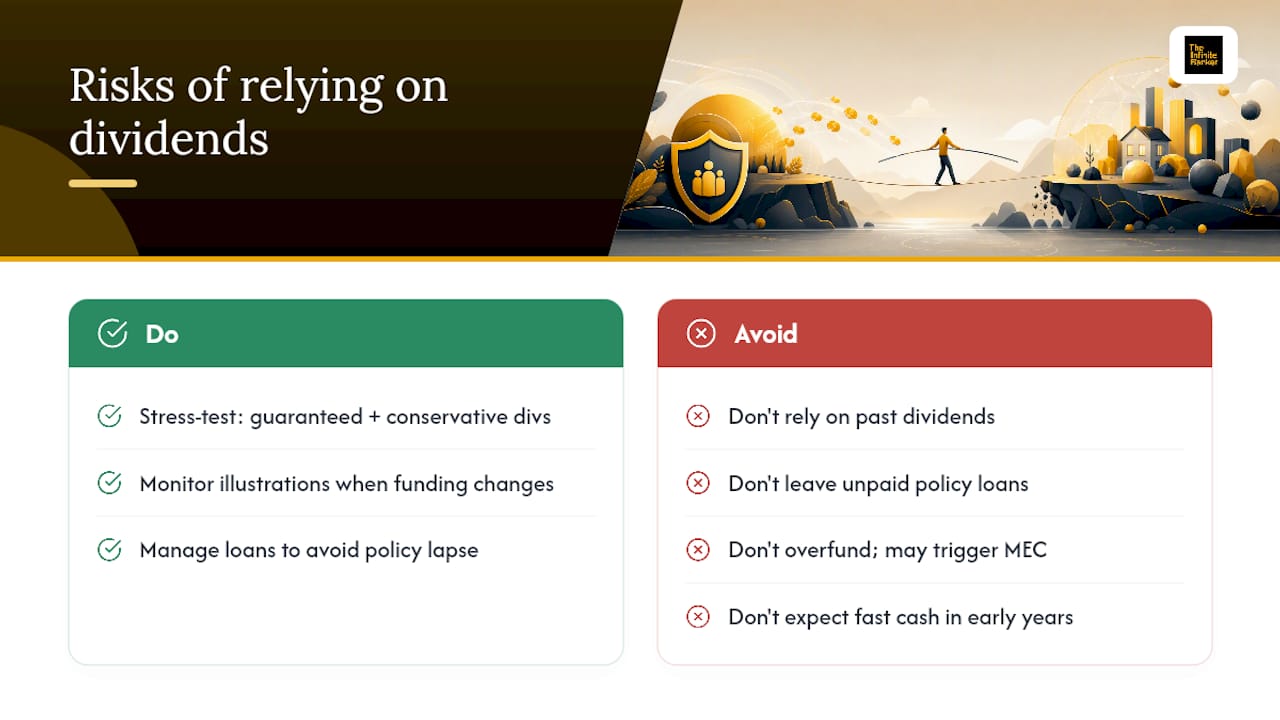
Dividend scales are declared annually and are not guaranteed. A scale that held steady for a decade can decline if investment yields fall, mortality experience worsens, or the insurer’s expenses rise. Past dividend history is informative, but it is not a predictor of future scales.
Policy loans carry their own risk profile. Interest accrues on any outstanding balance, and an unpaid loan reduces both the cash value and the death benefit. Left unmanaged, a large unpaid loan balance can cause a policy to lapse, a risk covered in more detail in Infinite Banking Risks and Considerations.
Overfunding also has a hard ceiling. Fund a policy too aggressively relative to its death benefit and it can fail the seven-pay test, becoming a Modified Endowment Contract (MEC), which changes how withdrawals and loans are taxed. Illustrations need to be monitored as funding changes.
Early years are the slowest. Surrender charges and start-up costs mean meaningful cash value typically takes several years to build, which is why Infinite Banking is framed as a long-horizon strategy rather than a short-term liquidity tool.
Pro Tip: When stress-testing an illustration, run the numbers using the guaranteed column plus a conservative, below-average dividend assumption. If the plan still makes sense under those numbers, the non-guaranteed upside becomes a bonus rather than a requirement.
How Do You Evaluate an Insurer’s Dividend Reliability?
Before committing capital, entrepreneurs and investors benefit from working through a structured checklist.
Check the insurer’s financial-strength ratings from agencies like AM Best or S&P, along with its surplus levels relative to peers.
Review the dividend scale’s consistency over 20 or more years rather than just the most recent figure.
Ask for transparency on how the dividend scale is calculated and what drove any recent changes.
Request in-force illustrations, not just at-issue projections, and compare them against actual historical performance for similar policies.
Confirm the availability and pricing of the paid-up additions rider, along with loan interest terms and the surrender schedule.
Reading the illustration itself matters as much as the checklist. Every illustration separates guaranteed values from non-guaranteed, dividend-dependent projections. Participating whole life products vary widely in how sensitive their projections are to dividend-scale assumptions.
Good signs: a carrier with a long, stable dividend payment history, an agent willing to show conservative runs, and clear answers about MEC monitoring.
Red flags: reluctance to share in-force illustrations, pressure to overfund quickly, or vague answers about how the dividend scale is set.
What’s a Realistic Timeline for Dividend-Driven Cash Value?
Implementation follows a fairly predictable sequence.
Select and design the policy, sizing premiums and the PUA rider against the death benefit to avoid MEC status.
Fund and overfund on a disciplined schedule, adjusting as illustrations are reviewed annually.
Expect years three through seven to feel slow, since surrender charges and early costs dominate this period.
Plan for years seven through fifteen and beyond as the window where loan cycles become genuinely useful for real estate down payments or business capital.
Monitor the policy annually against both guaranteed and actual dividend performance.
A real estate investor funding aggressively but carefully often sees usable loan capacity emerge faster than a business owner prioritizing near-term liquidity over long-term PUA accumulation, since the funding pace itself is the biggest variable.
What Actually Works vs. What Marketing Promises
In practice, the biggest gap isn’t between good and bad policies. It’s between clients who fund on a schedule for a decade-plus and those who chase a headline dividend rate, overfund into MEC territory, or stop repaying loans on time. None of those mistakes are exotic. They’re the same three, repeatedly. Anyone serious about this approach should work with a fee-based advisor, an independent agent, and a tax professional, especially once policy loans and business income intersect.
Work With The Infinite Banker on a Dividend-Forward Plan
Policy design is where most of the long-term outcome gets decided, long before the first dividend is ever declared. The Infinite Banker works with entrepreneurs, real estate investors, and high-income earners to structure participating whole life policies around paid-up additions, realistic funding schedules, and loan terms that fit how you actually use capital, not a generic template.

That process starts with a strategy session focused on your specific cash flow, followed by policy design, underwriting guidance, and ongoing education as your plan matures. If you want to see how funding pace and PUA allocation might play out for your situation, start with how Infinite Banking works or check who Infinite Banking is designed for to see if a consultative engagement makes sense for your goals.
Sources
This post is educational only and not financial, tax, or legal advice. Consult qualified professionals before acting.
This article is general information, not a substitute for advice from a qualified financial advisor. Consult a qualified financial professional about your own circumstances before acting on anything here.
Recommended
Comments