
The Opportunity Cost of Cash: What It Costs Entrepreneurs to Play It Safe


COMPLIANCE NOTE: For educational purposes only. Not financial, tax, or legal advice.
For an entrepreneur, the opportunity cost of cash is the return you gave up by leaving capital idle instead of deploying it into your business, the market, or another productive use. It sounds abstract until you run the numbers. Ten thousand dollars earning a 10% annual return grows to roughly $25,900 in a decade; the same amount parked at a 4% yield reaches about $14,800, a gap of more than $11,000 on a single starting balance, according to J.P. Morgan Asset Management. That gap is not a market forecast. It is arithmetic.
The rule of thumb that follows from this math is simple: hold a defined operating reserve, generally three to six months of expenses, and treat everything above that line as deployable capital that should be evaluated against a real comparison return, not left sitting because it feels safer that way.
Key Takeaways
The opportunity cost of holding excess cash grows nonlinearly with time, which means the decision to keep capital idle gets more expensive with every year it goes unexamined.
Point | Details |
Cash has a measurable cost | Ten thousand dollars at 4% versus 10% creates an $11,000 gap over ten years. |
Size your reserve deliberately | Use a two-bucket approach covering spending shocks and income shocks, generally a few months of expenses combined. |
Choose a realistic comparison rate | Match the comparison return to the actual alternative, business reinvestment, market allocation, or reserve. |
Time horizon changes the math | Compounding gaps accelerate over five, ten, and twenty years, so run the numbers for your real horizon. |
Structured alternatives exist | Cash value whole life can offer liquidity through policy loans, but loans accrue interest and dividends are never guaranteed. |
Table of Contents
What Is the Opportunity Cost of Holding Cash?
Opportunity cost is the value of the next-best alternative you give up when you choose one option over another. In a business context, holding excess cash means forgoing whatever that capital could have earned elsewhere, whether that’s a 12% return on a marketing campaign, a real estate down payment, or a diversified investment account.
The concept splits into two categories that matter for how you actually think about the decision.
Explicit costs are the direct returns you can point to and measure, like the yield difference between a checking account and a short-term Treasury bill.
Implicit costs are less visible but often larger: the owner’s time spent managing idle funds, the sale lost because inventory wasn’t restocked, or the expansion delayed a year because capital sat in reserve instead of funding it.
This is different from an accounting cost, which reflects money actually spent, and different again from a sunk cost, which is money already gone and irrelevant to future decisions. Opportunity cost lives entirely in the realm of what you could still choose to do. A business owner who keeps $200,000 in a low-yield account isn’t losing money in an accounting sense. The business isn’t recording a loss. But the owner is quietly forfeiting whatever that capital would have returned in a higher-yield alternative, a cost that never appears on a balance sheet yet compounds every year it goes unaddressed.
Why Does Cash Feel Safe When It Often Isn’t?
Businesses hold cash for three distinct reasons, a framework laid out clearly in corporate finance literature. Transactional cash covers day-to-day bills and payroll. Precautionary cash cushions against unexpected shocks, a lost client, a broken piece of equipment, a slow quarter. Speculative cash sits ready for opportunistic purchases, like buying a competitor’s equipment at a discount or acquiring a smaller business when the price is right. Firms typically park the excess above these needs in cash equivalents to capture a modest return without sacrificing liquidity, according to OpenStax’s Principles of Finance.
The trouble is that most entrepreneurs hold far more than these three motives justify, and the reason is psychological rather than financial.
Watching a balance stay flat feels safer than watching an investment account fluctuate, even when the flat balance is quietly losing purchasing power.
Deploying capital requires a decision, and decisions carry the risk of being wrong, so inaction becomes the default.
Founders who lived through a cash crunch once tend to overcorrect for years afterward, sometimes permanently.
That comfort has a measurable cost. Cash often underperforms a diversified portfolio over one-year periods and consistently over three-year periods, per J.P. Morgan’s analysis. Inflation compounds the problem. A CNBC piece on cash erosion makes the point plainly: idle cash doesn’t just underperform, it actively loses purchasing power every year prices rise faster than the yield on your account.
How Do You Calculate the Opportunity Cost of Cash?
The formula is straightforward: Opportunity Cost = (Comparison Return Rate − Cash Yield Rate) × Amount Held × Time Horizon, adjusted for compounding when the horizon runs longer than a year. The hard part isn’t the math. It’s choosing an honest comparison rate, one that reflects a return you could realistically achieve given your risk tolerance and time frame, not a best-case number pulled from a pitch deck.
Here’s how it plays out in practice.
Set your baseline. Identify how much cash sits above your operating reserve. Say a business holds $50,000 in excess of its working needs.
Pick a realistic comparison rate. A conservative option might be a short-term Treasury bill yielding around 4%. A moderate-growth alternative, like a diversified investment portfolio, might target 8% to 10% historically, though returns are never assured.
Compare over one year. At 4%, $50,000 earns $2,000. If the cash sat in a checking account yielding near 0.5%, the account earned $250. The one-year opportunity cost of choosing the checking account is $1,750.
Extend the horizon and compound. Run the same $10,000 example over ten years: at 10%, it grows to about $25,900; at 4%, about $14,800, a difference exceeding $11,000, per J.P. Morgan. Scale that to $100,000 and the gap moves into six figures.
Adjust the comparison rate to the decision at hand. Evaluating a business reinvestment calls for a rate close to your expected project return. Evaluating a market allocation calls for a rate closer to historical diversified portfolio performance, understanding that past results never guarantee future ones.
The comparison rate you choose changes everything, which is why step two deserves more scrutiny than most owners give it. A rate that’s too optimistic makes holding cash look irrational when it isn’t; a rate that’s too conservative masks a real cost that’s been quietly accumulating for years. Run your own numbers using Investor or a similar tool like the ZENRG Finance compound interest calculator before committing to a comparison rate for a major decision.
Which Cash Decisions Do Entrepreneurs Actually Face?
The formula above only matters once you apply it to a real decision. Three scenarios come up repeatedly for business owners weighing cash against action.
Reinvesting in operations or expansion. If a new hire, a marketing push, or additional inventory carries an expected internal rate of return above what cash could otherwise earn, the reinvestment usually wins on paper. The catch is that projected ROI is a forecast, not a fact, so weigh it against the reserve you’d be drawing down and how quickly you could rebuild it.

Investing in public markets or private deals. Here liquidity and time horizon dominate the decision. Public market allocations offer flexibility to exit; private deals often lock up capital for years. Match the comparison rate to the asset class and be honest about how long you can go without touching that money.
Holding cash for optional acquisitions. Sometimes a larger reserve is the rational choice, not the fearful one. A business anticipating a competitor’s exit, a distressed asset sale, or a bolt-on acquisition benefits from optionality that a fully invested balance sheet can’t provide. The St. Louis Fed’s examples of opportunity cost illustrate how scarcity forces exactly this kind of trade-off in everyday decisions, not just corporate ones.
Expected return and confidence level of the alternative use
Time horizon before capital is needed again
Liquidity requirements and how quickly you could exit if plans change
Reserve level remaining after the deployment
Pro Tip: Before deploying any excess cash, run the math on your worst realistic outcome, not your best one. If the downside still leaves your operating reserve intact, the decision gets a lot easier.
Where Should Excess Cash Actually Sit?
Not all cash needs to earn the same return, because not all cash serves the same purpose. Matching the vehicle to the need is the difference between smart liquidity management and simply avoiding the decision.
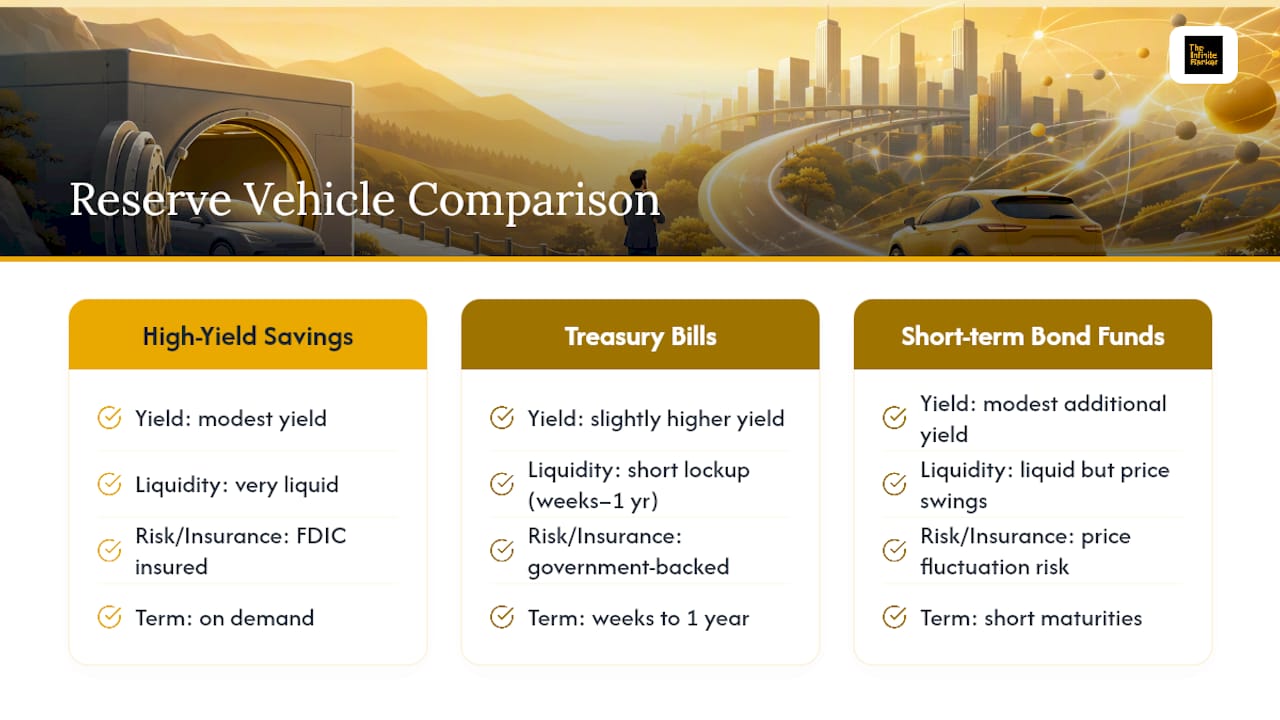
High-yield savings accounts offer the most flexibility with modest yield and typically carry FDIC deposit insurance up to standard limits, a meaningful factor when deciding where an emergency reserve should live. Treasury bills offer government backing and slightly higher yields in exchange for a short lockup, often a few weeks to a year. Short-term bond funds add modest additional yield with slightly more price fluctuation. Laddering, staggering maturities across several of these instruments, lets you capture higher short-term rates while keeping a portion always coming due for access.
A two-bucket approach works well in practice: one bucket sized for immediate spending shocks (payroll gaps, equipment failure), typically three months of expenses, and a second sized for broader income shocks (a lost major client, a recession-driven slowdown), often extending the total reserve toward six months. This structure, detailed in The Infinite Banker’s guidance on entrepreneur cash reserves, makes it psychologically easier to deploy the excess above both buckets since the safety net is already clearly defined.
Liquidity beats yield whenever a known, near-term obligation is coming due. Yield wins when the money genuinely has no claim on it for a year or more.
How Much Does Cash Really Cost Over Time?
The gap between cash and invested capital doesn’t grow in a straight line. It compounds, and the curve steepens the longer the money sits. By year ten, they’re over $11,000 apart. By year twenty, the divergence more than triples again, since each year’s gain is now earning a return on a much larger base, a dynamic J.P. Morgan’s research describes as accelerating with time horizon rather than staying flat.
Inflation adds a second layer. Cash that earns less than the inflation rate loses real purchasing power every single year, even while the nominal balance stays unchanged or grows slightly. And the order in which returns arrive, the sequence-of-returns risk familiar to anyone drawing down an investment account, matters far less for cash sitting on the sidelines than for capital already deployed, which is itself an argument for having a clear reinvestment plan rather than open-ended hesitation.
A Four-Step Framework for Deciding What to Do With Excess Cash
Define your time horizon and liquidity needs. Know when you’ll actually need this money before deciding where it goes.
Size your reserve using two buckets. Cover immediate spending shocks separately from broader income shocks, generally landing in the three to six month range combined.
Estimate a comparison return and calculate the gap. Use the formula above with a realistic rate for the specific alternative you’re considering.
Decide based on runway, risk tolerance, and optionality. A business with long runway and low near-term risk can justify deploying more; one anticipating a major opportunity may rationally hold more.
Pro Tip: Revisit this framework every time your business crosses a new revenue threshold. The reserve that made sense at $500,000 in annual revenue is rarely the right reserve at $2 million.
How Does Structured Cash Value Fit Into This Picture?
Some entrepreneurs look beyond savings accounts and Treasury bills toward structured vehicles designed to hold capital while keeping it accessible. Dividend-paying whole life insurance is one such vehicle, and it’s worth understanding on its own terms rather than as a promise of outperformance. Dividends on these policies are not guaranteed, and a policy’s design, funding level, and carrier all affect outcomes.
The mechanics matter more than the pitch. Cash value inside a properly structured policy is designed to grow over time and can be accessed through a policy loan, but that loan accrues interest, and if it goes unpaid, it reduces both the cash value and the death benefit. Policies can also lapse if they aren’t funded appropriately, which would undermine the liquidity the strategy is meant to provide in the first place. These trade-offs are laid out in detail in The Infinite Banker’s explanation of cash value mechanics.
Cash value growth is generally more predictable than market-based accounts, though it depends on policy design and insurer performance.
Policy loans offer liquidity without liquidating the underlying asset, an important distinction from selling investments to raise cash.
Liquidity timelines and lapse risk both require ongoing attention, not a set-and-forget mindset.
Entrepreneurs weighing this option against a Treasury ladder or a brokerage account often want to model both side by side, which is exactly what The Infinite Banker’s Infinite Banking Calculator is designed to help with.
Jib Hunt, an Authorized IBC Practitioner with The Infinite Banker, works with entrepreneurs to evaluate whether a properly structured policy fits alongside their existing reserve strategy, based on their specific liquidity needs and risk tolerance. If you’re carrying excess cash and wondering whether a structured alternative deserves a place in your capital stack, The Infinite Banker’s guide on who Infinite Banking is designed for is a reasonable starting point before any consultation.
What Most Advice on Cash Reserves Gets Wrong
Most guidance on business cash reserves stops at a single number, keep six months of expenses, and treats that as the end of the conversation. That advice isn’t wrong, but it’s incomplete. It tells you how much to protect without ever asking what the rest of your capital should be doing, which is the more expensive question by far.
The bigger error I see is treating the reserve decision as permanent. A three to six month cushion sized for a business at $30,000 in monthly expenses becomes wildly oversized once that business reaches $150,000 in monthly expenses without a corresponding revisit of the underlying risk. Entrepreneurs default to comfort because comfort doesn’t require a decision, and the math above shows exactly what that comfort costs over a decade.
What deserves priority is simpler than most frameworks suggest: define the reserve honestly, hold it in something insured and liquid, and treat literally everything above it as capital that owes you an answer for why it’s still sitting.
— Jib Hunt
This post is educational only and not financial, tax, or legal advice. Consult qualified professionals before acting.
This article is general information, not a substitute for advice from a qualified financial advisor. Consult a qualified financial professional about your own circumstances before acting on anything here.
Sources
Recommended
Comments