
Cash Value Compounding While Borrowing: What Investors Know


COMPLIANCE NOTE: For educational purposes only. Not financial, tax, or legal advice.
Cash value in a properly structured dividend-paying whole life policy generally continues to compound while a policy loan is outstanding. Your net position, however, depends on three variables: the policy’s crediting rate, the loan interest rate, and whether you actively manage repayment. To illustrate: a $50,000 cash value growing at roughly 4.5% annually generates approximately $2,250 in new value per year, while a $30,000 policy loan at a typical 7.4% rate accrues about $2,220 in annual interest. In that scenario, the math nearly breaks even on the borrowed portion, but the unborrowed $20,000 continues compounding unimpeded. The Infinite Banker’s Infinite Banking Calculator is designed to model exactly these scenarios so you can see net outcomes before committing to a loan.
Key implications to understand before reading further:
Cash value continues to grow on the full policy value, not just the unborrowed portion, in most whole life structures.
Outstanding loan interest accrues and, if unpaid, is added to the loan principal, which can compound against you.
The death benefit is reduced by any outstanding loan balance at the time of death.
Policies can lapse if the loan balance approaches or exceeds the cash value.
Dividends are not guaranteed and may fluctuate, affecting the net compounding outcome.
Pro Tip: Pay at least the annual loan interest out of pocket rather than letting it capitalize. That single habit prevents the loan balance from compounding against your policy’s equity.
Table of Contents
How whole life cash value actually compounds, and how policy loans work
Cash value in a whole life policy grows through two distinct mechanisms. The first is a guaranteed crediting rate, a fixed percentage the insurer applies to the policy’s accumulated value each year. The second is dividends, which are non-guaranteed distributions of the insurer’s surplus. Dividends depend on the insurer’s mortality experience, investment returns, and operating expenses. When dividends are declared, policyholders can direct them into Paid-Up Additions (PUAs), which purchase increments of additional paid-up insurance. PUAs increase both the death benefit and the cash value base, giving the policy a larger principal on which future compounding can operate. This compounding effect gives the policy more runway before a loan is ever taken.

Cash value growth is generally not immediately taxable while the policy remains in force. The IRS treats inside buildup as tax-deferred, meaning you do not recognize income on the annual crediting or dividends unless the policy lapses or is surrendered in a way that produces a taxable gain. For a deeper look at how this works mechanically, The Infinite Banker’s guide on tax-deferred cash value growth walks through the key rules.
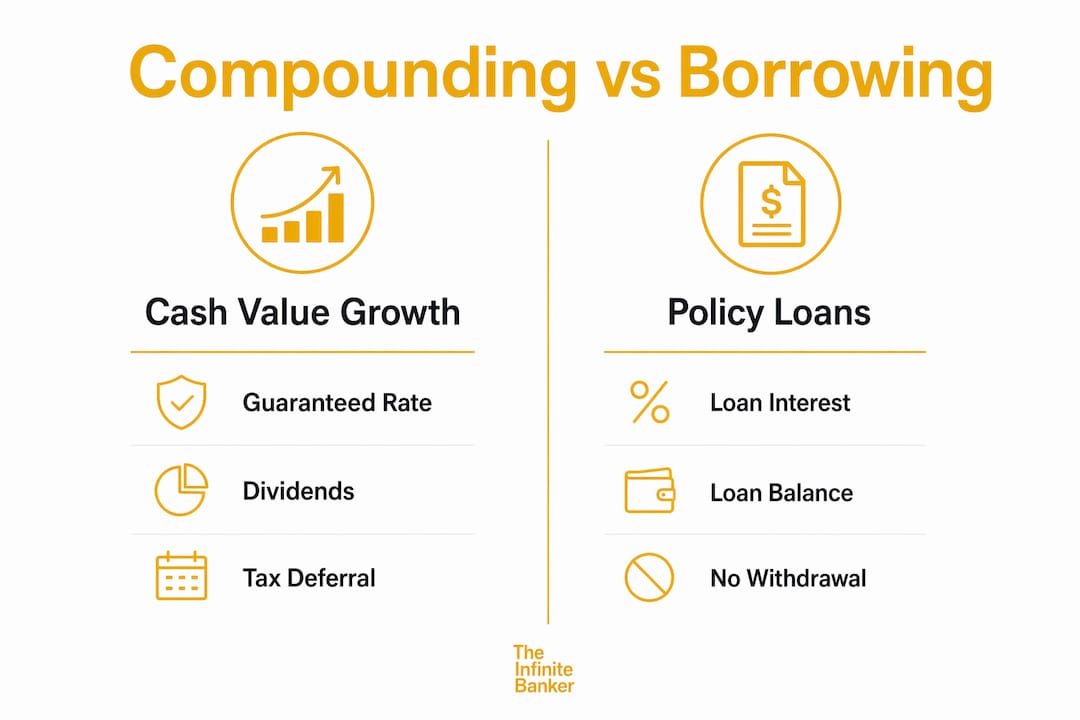
Policy loans work differently from conventional bank loans. The insurer does not actually withdraw your cash value; instead, it lends from its general account and uses your cash value as collateral. Loans require no credit check and carry flexible repayment terms, which is part of their appeal for entrepreneurs and investors managing irregular cash flows. Most insurers allow borrowing up to roughly 90% of the accumulated cash value, though the practical ceiling for responsible borrowing is considerably lower. Many policies begin accruing cash value in 2–5 years, but significant loanable amounts may not be available until 10 years or more into the policy.
Loan interest is a separate charge that accrues on the outstanding balance. It may be fixed or variable depending on the policy. Unpaid interest is added to the loan principal, which means the loan balance itself begins to compound if you do not service it. This is the core tension in cash value compounding while borrowing: the policy’s cash value compounds upward, while an unmanaged loan balance compounds in the opposite direction.
Rate Component | Typical Range | Direction of Effect |
Policy guaranteed crediting rate | 3%–4.5% | Increases cash value |
Dividend rate (not guaranteed) | 1%–2% additional | Increases cash value (variable) |
Policy loan interest rate | 5%–7% | Increases loan balance |
Net position (crediting minus loan rate) | Varies | Positive, neutral, or negative |
Indexed universal life and variable universal life policies have different crediting structures and loan mechanics. The scenarios below focus on dividend-paying whole life, which is the policy type used in the Infinite Banking concept.
Worked examples: what the net math looks like year by year
The three scenarios below use consistent assumptions so you can compare them directly. All figures are illustrative; actual results depend on your specific policy, insurer, and dividend declarations.
Shared assumptions: Starting cash value: $100,000. Policy loan taken at the start of Year 1: $40,000. Loan interest rate: 7%. Timeline: 5 years. Tax basis: $80,000 (cost basis in the policy).
Scenario A: Crediting rate exceeds loan interest (net positive) Assumed total crediting rate (guaranteed + dividend): 5.5%. Loan interest is paid annually out of pocket.
Scenario B: Near-breakeven Assumed total crediting rate: 4.5%. Loan interest is paid annually out of pocket.
Scenario C: Loan interest outpaces crediting (net negative) Assumed total crediting rate: 3.5%. Loan interest is not paid; it capitalizes annually.
Step-by-step calculation method
Start of year cash value: Prior year cash value plus annual crediting (cash value × crediting rate).
Loan balance: Prior loan balance plus unpaid interest (if capitalizing) or unchanged (if interest is paid).
Net surrender value: Cash value minus outstanding loan balance.
Death benefit impact: Original death benefit minus outstanding loan balance at any point.
Year | Scenario A Cash Value | Scenario A Loan Balance | Scenario A Net Surrender Value | Scenario B Cash Value | Scenario B Net Surrender Value | Scenario C Cash Value | Scenario C Loan Balance | Scenario C Net Surrender Value |
— | $100,000 | $40,000 | $60,000 | $100,000 | $60,000 | $100,000 | $40,000 | $60,000 |
1 | — | $40,000 | — | — | — | — | — | — |
2 | — | $40,000 | — | — | — | — | — | — |
3 | — | $40,000 | — | — | — | — | — | — |
4 | $123,882 | $40,000 | $83,882 | $119,252 | $79,252 | $115,060 | $52,432 | $62,628 |
5 | $130,695 | $40,000 | $90,695 | $124,618 | $84,618 | $119,287 | $56,102 | $63,185 |
In Scenario A, paying loan interest annually and maintaining a 5.5% crediting rate produces a net surrender value that grows from $60,000 to $90,695 over five years. Scenario B, at 4.5% with interest paid, still produces meaningful growth to $84,618. Scenario C is the cautionary case: even though the cash value grows modestly, the capitalizing loan balance erodes the net position, and the gap narrows each year. Over a longer horizon, Scenario C’s loan balance would eventually threaten the policy.
Run your own numbers with the Infinite Banking Calculator or request an in-force illustration from your insurer to see how your specific policy’s crediting history and loan rate interact.
Risks you need to understand before borrowing long-term
The most common misconception about policy loans is that they are free capital. They are not. Long-term outstanding loans can compound interest and erode equity, and the consequences of mismanagement extend beyond a reduced account balance.
Warning: A policy loan is not free money. If loan interest capitalizes unchecked, the loan balance can grow faster than the cash value, eventually causing the insurer to lapse the policy to recover the outstanding balance. A lapse with a loan exceeding your cost basis creates a taxable event: the IRS treats the gain as ordinary income in the year of lapse, even though you received no cash at that moment. This is one of the most financially damaging outcomes in life insurance planning.
How the lapse pathway unfolds: The insurer monitors the loan-to-cash-value ratio. When the loan balance approaches the cash value, the insurer typically sends a warning requiring additional premium payments or partial loan repayment. If neither occurs, the policy lapses. At that point, the surrender may create taxable income on any gains above your cost basis, and the death benefit disappears entirely.
Effect on beneficiaries: Any outstanding loan balance is deducted from the death benefit paid to your beneficiaries. A $500,000 death benefit with a $120,000 outstanding loan pays $380,000. If the loan has been growing unchecked for years, the reduction can be substantial.
Red flags that the loan is becoming dangerous:
Loan balance exceeds 60%–70% of current cash value.
You have missed or reduced premium payments.
Dividends have declined for two or more consecutive years while the loan remains outstanding.
The insurer has sent a lapse-warning notice.
Net surrender value is declining year over year despite continued premium payments.
Practical strategies to keep compounding working in your favor
Managing a policy loan is not passive. The investors and entrepreneurs who use the Infinite Banking concept most effectively treat loan management as a recurring financial discipline, not a set-and-forget arrangement.
Core management practices:
Pay loan interest annually, at minimum, to prevent capitalization. This single action keeps the loan balance flat and preserves the net compounding advantage.
Direct dividends toward loan repayment or toward PUAs, depending on which produces the better net outcome in a given year. When dividends are strong, applying them to the loan can reduce the balance without touching external cash flow.
Set a personal loan-to-cash-value ceiling, typically 50%–60%, and treat it as a hard limit. Borrowing beyond that threshold leaves little buffer if dividends decline or if the policy’s crediting rate softens.
Avoid taking new loans during periods of low dividend declarations, when the net spread between crediting and loan interest is already compressed.
Maintain premium payments consistently. Skipping premiums reduces the policy’s death benefit and slows cash value accumulation, both of which weaken the policy’s ability to absorb an outstanding loan.
For entrepreneurs managing irregular income, the whole life cash flow strategy framework from The Infinite Banker addresses how to schedule premium payments and loan repayments around business cash cycles.
Monitoring practices:
Request an in-force illustration from your insurer annually. This document projects future cash values, loan balances, and death benefits under current assumptions, giving you a forward-looking view of where the policy is headed.
Run scenario stress tests: ask your insurer or practitioner to model what happens if dividends drop by 1% or if the loan remains outstanding for an additional five years. Annual in-force illustrations and stress testing are the standard of care recommended by experienced practitioners.
Pro Tip: Fund PUAs aggressively in the early years of the policy, before you ever take a loan. A thicker capital base means a larger crediting pool, which produces more annual growth to offset future loan interest. Early PUA funding is the structural move that separates well-designed Infinite Banking policies from underfunded ones.
Red flags requiring immediate action:
Loan balance has crossed 70% of cash value.
Net surrender value has declined for two consecutive years.
You have received a lapse-warning letter from the insurer.
Premium payments have been skipped or reduced.
How to model your own borrowing scenarios with the Infinite Banking Calculator
The Infinite Banking Calculator is designed to give you a year-by-year picture of how a policy loan interacts with cash value compounding. It is not a replacement for an insurer-provided in-force illustration, but it is a fast, accessible way to stress-test a borrowing decision before committing.
What you will need to run a useful scenario:
Current cash value and death benefit.
Your policy’s guaranteed crediting rate (from your policy contract).
The most recent dividend rate declared by your insurer (and a conservative downside assumption).
The loan amount you are considering and the applicable loan interest rate.
Your intended repayment timeline or repayment amount per year.
What the calculator produces:
Year-by-year cash value projections with and without the loan.
Loan balance trajectory, showing whether interest payments keep the balance flat or whether capitalization causes it to grow.
Net surrender value over time.
An indication of how the loan affects the projected death benefit.
A five-minute run through the calculator with conservative dividend assumptions often changes the borrowing decision. A loan that looks manageable at a 5% crediting rate can look materially different at 3.5%, which is a realistic scenario if the insurer reduces dividends. Seeing that gap in a table, rather than estimating it mentally, tends to sharpen the decision.
Pro Tip: Run two versions of every scenario: one using the insurer’s current dividend rate and one using a rate 1.5 percentage points lower. The gap between those two outputs is your dividend-risk exposure on the loan.
After running the calculator, the next step is a review with an Authorized IBC Practitioner who can cross-reference your calculator output against an actual in-force illustration from your insurer. The calculator models the concept; the in-force illustration reflects your specific policy’s actual contract terms and current values.
For real estate investors using policy loans to bridge acquisitions, the BRRRR strategy guide from The Infinite Banker covers how loan timing and repayment interact with property refinancing cycles.
Key Takeaways
Cash value in a dividend-paying whole life policy generally continues to compound while a loan is outstanding, but the net outcome depends entirely on whether loan interest is managed, dividends hold, and the loan-to-cash-value ratio stays within a safe range.
Point | Details |
Cash value keeps compounding | The policy credits the full cash value, not just the unborrowed portion, while a loan is outstanding. |
Loan interest is the primary risk | Unpaid loan interest capitalizes and compounds against equity, potentially triggering lapse and a taxable event. |
Net outcome varies by scenario | At 5.5% crediting with interest paid, net surrender value grows; at 3.5% with capitalizing interest, it narrows year over year. |
Dividends are not guaranteed | Dividend reductions compress the net spread and can turn a manageable loan into an erosion risk. |
The Infinite Banker provides modeling tools | Use the Infinite Banking Calculator and request a practitioner review to stress-test loan scenarios before borrowing. |
The tradeoff most borrowers underestimate
Most people who ask whether cash value keeps compounding while they borrow are really asking a simpler question: “Is this safe?” The honest answer is that it depends less on the policy structure and more on borrower behavior.
The mechanics are genuinely favorable in a well-funded whole life policy. Cash value does continue to grow on the full policy value while a loan is outstanding, which is a structural advantage over, say, liquidating an asset to access capital. The problem is not the structure. The problem is that the same flexibility that makes policy loans appealing, no required repayment schedule, no credit check, no external accountability, also makes it easy to let loan management drift.
Three client profiles come up repeatedly in practitioner conversations. The entrepreneur needing short-term liquidity for a business opportunity is the strongest use case: the loan is taken with a clear repayment source in mind, interest is serviced from business cash flow, and the loan is retired within 12–24 months. The real estate investor bridging a property acquisition is similar, provided the refinancing event that repays the loan actually materializes on schedule. The high-earner seeking general capital efficiency is the most variable case. Without a defined repayment trigger, loans tend to persist, interest capitalizes quietly, and the policy’s net position erodes in ways that only become visible on an annual in-force illustration.
The practitioner’s job is to model all three trajectories before the loan is taken, not after. That means running the calculator at current dividend rates and at a conservative downside, setting a loan-to-value ceiling in writing, and scheduling an annual policy review. Borrowing against cash value can make economic sense when the deployed capital is expected to produce a return that exceeds the loan cost, but that calculation requires realistic inputs and disciplined follow-through. Dividends are not guaranteed, loan interest accrues regardless of investment outcomes, and policies can lapse. None of that is a reason to avoid the strategy. It is a reason to model it carefully.
Work with The Infinite Banker to model your borrowing strategy
The difference between a policy loan that works and one that quietly erodes your equity often comes down to whether you modeled it before you took it. The Infinite Banker offers three concrete resources for entrepreneurs, real estate investors, and high-income earners who want to borrow against cash value with clear eyes.

Start with the Infinite Banking Calculator, which lets you input your current cash value, assumed crediting rate, loan amount, and loan interest rate to produce a year-by-year projection of net surrender value and loan balance trajectory. From there, a practitioner review with an Authorized IBC Practitioner at The Infinite Banker can cross-reference your calculator output against an actual in-force illustration, stress-test your loan scenarios under conservative dividend assumptions, and provide a written set of recommended guardrails for your specific situation. For those earlier in the process, the Infinite Banking for Entrepreneurs overview explains how the strategy is structured from the ground up. Dividends are not guaranteed, and results will vary by policy and insurer. Contact The Infinite Banker to schedule a practitioner review and run your numbers before your next borrowing decision.
Useful sources for further reading
The following sources informed this article and are worth reviewing directly for additional context:
Borrowing Against Life Insurance: New York Life — Covers how policy loan interest accrues, how unpaid interest is capitalized, and what borrowers should monitor. Useful for understanding loan mechanics from an insurer’s perspective.
How to Borrow Money From Your Life Insurance Policy (Experian) — Explains loan access, the absence of credit requirements, and repayment flexibility. Good primer on the structural advantages of policy loans.
Borrowing Against Life Insurance: Pros, Cons, and How-Tos (Investopedia) — Addresses tax treatment at disbursement and the taxable-event risk if a policy lapses with an outstanding loan exceeding cost basis.
Borrowing Against Life Insurance (Northwestern Mutual) — Provides context on how long it typically takes for a policy to accumulate meaningful loanable cash value.
Bank On Yourself Review and Policy Loan Risks (Kitces) — The most rigorous independent analysis of how long-term outstanding loans can compound interest and erode policy equity. Essential reading for anyone considering extended loan periods.
How to Maximize Cash Value Growth in a Whole Life Policy (Thomas Cox) — Covers PUAs, early funding strategies, and the structural levers that create a larger compounding base before borrowing.
Whole Life Insurance Cash Value Explained for Investors (The Infinite Banker) — Foundational explainer on cash value accumulation and how it interacts with policy loans, written for investors.
Infinite Banking Calculator (The Infinite Banker) — The primary modeling tool referenced throughout this article for scenario analysis and loan stress testing.
For context on how rising interest rates affect borrowing costs across financial instruments, the Movement Mortgage resource on rate environments provides useful macroeconomic background for comparing policy loan rates against broader market conditions.
This post is educational only and not financial, tax, or legal advice. Consult qualified professionals before acting.
Recommended
Comments