
Build a Personal Banking System for Your Business


COMPLIANCE NOTE: For educational purposes only. Not financial, tax, or legal advice.
To build a personal banking system for your business, you structure a dividend-paying whole life insurance policy with a mutual or participating carrier to function as a private, self-directed capital pool. You access that capital through policy loans, repay them on your own schedule, and recycle the funds back into the policy. This is the Infinite Banking Concept (IBC), and it is not a regulated bank.
Who this is best for:
Entrepreneurs, real estate investors, and high-income earners who need flexible, private access to capital outside traditional lending
Business owners who want to separate personal finance management from institutional credit dependency
Investors who can commit to multi-year premium funding and disciplined loan repayment
The immediate next step: Before funding a single premium, run a cash-flow model with an Authorized IBC Practitioner. Jib Hunt at The Infinite Banker models conservative and optimistic dividend scenarios so you can see realistic loanable amounts and break-even timelines before committing capital.
Table of Contents
How does a personal banking system differ from a real bank?
A personal banking system in the IBC context is a private financial strategy, not a chartered depository institution. The policy lives inside a whole life contract issued by a mutual or participating carrier such as MassMutual, New York Life, Northwestern Mutual, Guardian Life, or Penn Mutual. You are the policyowner. The cash value is yours to borrow against. No depositors, no regulators, no charter required.
Starting an actual bank is an entirely different undertaking. The Federal Reserve explains that de novo bank formation requires multi-agency approvals, proof of capital adequacy, management strength, and regulatory readiness across the OCC, FDIC, and state banking authorities. The FDIC’s handbook for de novo institutions requires a comprehensive business plan covering executive management, IT infrastructure, BSA/AML programs, and three-year financial projections. The OCC’s licensing manual adds charter approval conditions, capital-raising requirements, and ongoing risk management expectations.
Regulatory boundary: You may not market your policy as a banking service to the public, accept deposits from third parties, or represent the policy as a deposit account. Doing so would trigger federal and state banking laws. This strategy is for private use only.
The practical implication is straightforward. When you build a personal banking system for your business using IBC, you are creating a private capital warehouse, not a financial institution. The distinction matters legally and operationally.

How the capital cycle actually works
Three components create the private capital base: premium funding (including paid-up additions), credited dividends, and policy loans.
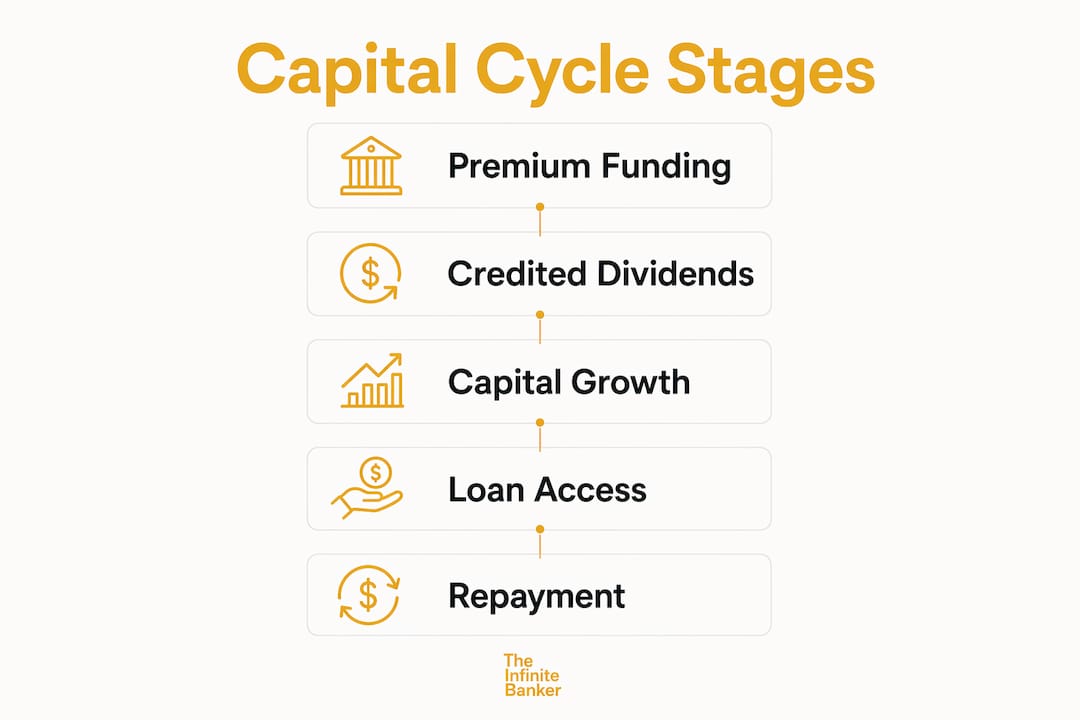
Paid-up additions (PUAs) are the engine. When you fund PUAs alongside the base premium, you purchase additional increments of paid-up insurance that carry their own cash value immediately. This accelerates early liquidity far beyond what a base-only policy produces. Dividends, credited annually by participating carriers, add to cash value and can be used to purchase more PUAs, but dividends are never guaranteed and vary with carrier performance.
The capital cycle works like this: you fund the policy, cash value accumulates, you take a policy loan for a business purpose (equipment, inventory, a real estate down payment), and you repay the loan with interest on your own schedule. The carrier charges loan interest to you as the borrower. If loans go unpaid, that interest accrues, reducing both cash value and death benefit. Excessive unpaid loans can cause the policy to lapse, which would have significant tax consequences.
Loan mechanics matter: Policy loans use the cash value as collateral but do not require credit approval or income verification. The trade-off is that the carrier’s loan interest rate applies from the day the loan is taken, and the death benefit is reduced by any outstanding loan balance.
Pro Tip: Model both a conservative dividend scenario (assuming dividends decrease) and an optimistic one before committing to a funding schedule. The gap between those two projections tells you how much outside liquidity you need to maintain as a repayment reserve.
What policy design choices determine early liquidity?
Policy design is the primary lever for how quickly you reach usable cash value. These are the decisions that matter most:
Base face amount vs. PUA allocation. A policy weighted heavily toward PUAs relative to the base premium produces higher early cash value but may require careful corridor management to maintain favorable tax treatment under IRS guidelines.
Premium schedule. A level-pay schedule over multiple years differs significantly from a single-pay or short-pay structure in terms of early liquidity and long-term cost.
Paid-up additions rider flexibility. Not all carriers offer the same PUA rider terms. Evaluate whether the rider allows variable annual contributions, which matters when business cash flow fluctuates.
Carrier dividend philosophy and track record. Carriers such as MassMutual, New York Life, Northwestern Mutual, Guardian Life, and Penn Mutual have distinct participating product features and established dividend histories. Dividends are not guaranteed, but consistency of the track record is a meaningful signal.
Internal loan terms. Carriers differ on whether loans are direct (reducing cash value directly) or collateral-based (leaving cash value intact to continue earning dividends). The latter, often called a wash loan or indexed loan, can affect long-term policy performance.
Financial strength ratings. Prefer carriers rated highly by AM Best or similar rating agencies. A mutual carrier’s financial strength directly affects its ability to pay dividends over a 20–40 year policy horizon.
Design trade-off: Prioritizing early cash value typically means accepting a higher total premium outlay relative to the death benefit. Prioritizing lower long-term cost means accepting slower early liquidity. Neither is wrong; the right choice depends on your business cash-flow timeline. A detailed guide on cash-value acceleration strategies can help you evaluate these trade-offs before carrier selection.
What timeline and costs should you expect?
The table below illustrates qualitative funding phases and corresponding liquidity milestones. Actual results depend on carrier, dividend performance, and policy design.
Funding Phase | Approximate Timeline | What to Expect |
Initial funding and underwriting | — | Policy issued; early cash value below total premiums paid due to funding lag |
Growing usable cash value | Years 2–4 | Cash value approaches and may reach break-even with premiums paid; first meaningful loan capacity |
Practical business liquidity | Years 5+ | Loanable amounts become material for business use; depends heavily on PUA funding level |
Mature capital pool | — | Cash value substantially exceeds cumulative premiums in favorable scenarios |
Key cost components to plan for:
Ongoing base premiums and PUA contributions (the primary capital input)
Carrier loan interest on any outstanding policy loans
Opportunity cost relative to other financing options, such as a bank statement loan for self-employed borrowers who need near-term capital while the policy matures
Tax advisor and practitioner fees for structuring and ongoing reviews
Conservative funding (lower premiums, minimal PUAs) extends the timeline to meaningful liquidity by several years. Aggressive funding (maximum PUAs within IRS corridor limits) compresses it, but requires sustained cash flow commitment.
Step-by-step implementation checklist
Clarify your liquidity objectives. Define how much capital you need access to, over what timeline, and for what business purposes.
Run cash-flow modeling under multiple dividend scenarios. Use The Infinite Banker’s Infinite Banking calculator to estimate loanable amounts and break-even timelines before selecting a carrier.
Compare carrier features. Evaluate MassMutual, New York Life, Northwestern Mutual, Guardian Life, and Penn Mutual on PUA flexibility, loan terms, dividend track record, and AM Best ratings.
Complete underwriting and issue the policy. Business owners may face additional underwriting scrutiny; work with an Authorized IBC Practitioner to navigate this stage.
Execute funded PUAs per your agreed schedule. Consistency here is what drives early cash value performance.
Establish a formal internal loan policy. Document each loan’s date, purpose, internal interest rate, and repayment schedule. Treat policy loans as corporate debt with proper bookkeeping entries.
Track repayments and review policy performance annually. An Authorized IBC Practitioner should review the policy illustration against actual performance at least once a year.
Pro Tip: The IRS requires that whole life policies stay within specific corridor ratios between cash value and death benefit to maintain their tax-advantaged status. Exceeding these limits converts the policy into a Modified Endowment Contract (MEC), which changes the tax treatment of loans and withdrawals. Confirm corridor compliance with your practitioner before each PUA contribution.
What risks and red flags should you monitor?
The strategy carries real risks that practitioners are direct about.
The most common failure mode is not a bad carrier. It is underfunded policies combined with unpaid loans that quietly erode cash value until the policy lapses. Lapse triggers a taxable event on any gain inside the policy.
Principal risks to monitor:
Dividend variability. Dividends are not guaranteed. A sustained reduction in carrier dividends will slow cash value growth and extend your break-even timeline.
Loan interest accrual. Every unpaid loan balance compounds against you. Carriers charge interest whether or not you repay, and that interest reduces both cash value and death benefit.
Policy lapse. If cash value falls below the amount needed to sustain the policy, it lapses. This is most likely when loans are large and premiums are missed simultaneously.
Opportunity cost. Capital locked in premiums cannot be deployed elsewhere. Model this honestly against alternative financing before committing.
Operational red flags: agents who describe dividends as guaranteed, carriers with inflexible PUA riders, and any marketing that implies the policy functions as a public deposit account. For a balanced view of IBC pros and cons, review the full analysis before proceeding.
Why work with an Authorized IBC Practitioner?
An Authorized IBC Practitioner designs the funding schedule, models realistic outcomes under multiple dividend scenarios, and matches policy features to your specific business cash-flow needs. That modeling work, done before the policy is issued, is what separates a well-structured policy from one that underperforms for years.
Practitioner tasks span the full implementation: sensitivity modeling, carrier feature comparison, underwriting navigation, internal loan-policy drafting, and annual performance reviews. Consider a scenario where a business owner’s initial policy design allocated too much to the base premium and too little to PUAs. A practitioner-led redesign, shifting the allocation toward PUAs within corridor limits, can reduce the years to meaningful liquidity by two to three years without increasing total premium outlay. The difference is entirely in the design, not the carrier.
Before committing capital, request a modeled projection from an Authorized IBC Practitioner. Seeing conservative and optimistic scenarios side by side, with your actual business cash-flow numbers, is the only way to evaluate whether the timeline and costs fit your situation.
Key Takeaways
A properly structured dividend-paying whole life policy can function as a private capital pool for business use, but the design choices, timeline, and loan management discipline determine whether it performs as intended.
Point | Details |
Policy design drives early liquidity | PUA allocation and funding cadence are the most controllable levers for reaching usable cash value sooner. |
Dividends are never guaranteed | Model conservative scenarios; carrier dividend track records inform but do not predict future performance. |
Loan management is non-negotiable | Unpaid policy loans accrue interest, reduce cash value and death benefit, and can cause lapse if unmanaged. |
Timeline requires patience | Achieving meaningful business liquidity often takes several years, depending on funding level and carrier. |
The Infinite Banker | Jib Hunt, Authorized IBC Practitioner, provides modeling, carrier matching, and implementation oversight for entrepreneurs ready to structure this strategy. |
What practitioners see that most guides miss
Most articles about IBC focus on the concept and skip the operational reality. The part that actually determines success is what happens after the policy is issued: how consistently premiums and PUAs are funded, how formally loan repayments are documented, and whether the policyowner maintains outside liquidity to cover repayments during lean business periods.
Two practical observations from working with entrepreneurs on this strategy: First, formalizing internal loan paperwork is not optional if the policy funds business activity. Recording the loan date, purpose, interest rate, and repayment schedule protects corporate governance and creates a clear audit trail. Second, the policyowners who struggle most are those who treat the policy as their only liquidity source. Maintaining a separate cash reserve outside the policy, specifically for loan repayments, is what keeps the capital cycle running through slow revenue periods.
A common implementation challenge involves entrepreneurs who fund aggressively in year one, take a large loan in year two for a business acquisition, and then face a revenue shortfall that delays repayment. The loan interest compounds, cash value growth slows, and the policy underperforms projections. The resolution is almost always the same: restructure the repayment schedule, reduce the loan balance with outside reserves, and adjust the PUA contribution for the next year. None of that is catastrophic if it is caught early in an annual review. It becomes a serious problem only when it goes unmonitored for two or three years.
How The Infinite Banker can help you model this strategy
Entrepreneurs who are serious about building a personal banking system for their business need more than a concept explanation. They need a modeled projection that shows their specific funding schedule, projected cash value by year, loanable amounts, and break-even timeline under both conservative and optimistic dividend assumptions.
The Infinite Banker provides exactly that. Jib Hunt, Authorized IBC Practitioner, works with entrepreneurs, real estate investors, and high-income earners to design policies around their actual business cash-flow needs, match carrier features to their objectives, and oversee implementation from underwriting through ongoing annual reviews. Start with the Infinite Banking calculator to run your own initial numbers, or visit The Infinite Banker to request a modeled consultation. The modeling is where the strategy either fits your situation or it does not, and that clarity is worth getting before you fund a single premium.
Useful sources for further research
Federal Reserve: How can I start a bank? — explains multi-agency approval requirements and capital adequacy standards for de novo bank formation
FDIC: Applying for Deposit Insurance, Handbook for Organizers of De Novo Institutions — covers business plan requirements, governance, IT, and BSA/AML for chartered institutions
OCC: Charters, Comptroller’s Licensing Manual — details charter approval conditions and capital requirements for national banks
The Infinite Banker: Infinite Banking Calculator — interactive tool for modeling policy funding, projected cash value, and loan capacity
The Infinite Banker: How Infinite Banking Works — foundational explainer on policy mechanics, loan cycles, and carrier selection
This post is educational only and not financial, tax, or legal advice. Consult qualified professionals before acting.
Recommended
Comments