
What Is the Banking on Yourself Strategy?

Updated: Jun 29

COMPLIANCE NOTE: For educational purposes only. Not financial, tax, or legal advice.
Banking on Yourself is defined as a personal finance strategy that uses a specially structured, dividend-paying whole life insurance policy as a private banking system. Pioneered by R. Nelson Nash in his foundational book Becoming Your Own Banker, the concept shifts financial control away from traditional lenders and places it directly in your hands. The Infinite Banker works with entrepreneurs, real estate investors, and high-income earners to implement this approach through properly designed policies built for capital efficiency. Unlike standard savings accounts or market-linked investments, dividend-paying whole life insurance has historically increased in value across every economic cycle, making it a predictable foundation for long-term wealth.
What is banking on yourself strategy: the core concept explained
Banking on Yourself is the informal name for what the financial industry formally calls the Infinite Banking Concept, or IBC. The two terms describe the same process: using a dividend-paying whole life insurance policy as the engine of a personal banking system. Understanding both terms matters because advisors, books, and financial literature use them interchangeably.
The core principle is straightforward. You fund a specially structured whole life policy, build cash value inside it, and then borrow against that cash value for personal or business needs. You repay the loan on your own schedule, and the policy continues to grow as if the loan never occurred. Over time, the system becomes self-reinforcing. Each repayment refuels the pool of capital available for the next loan.

R. Nelson Nash described this as recapturing the financing function. Every dollar you spend on a car, a business investment, or a home renovation flows through some financing channel. The question is whether that channel belongs to a bank or to you. Banking on Yourself redirects that flow into a system you own and control.
How does banking on yourself work: the financial mechanics
The mechanics depend on one critical structural element: Paid-Up Additions, commonly called PUAs. A standard whole life policy is designed to maximize the death benefit. A policy structured for IBC is designed to maximize cash value. PUAs are additional premium payments that buy small chunks of fully paid-up insurance, which convert almost entirely into cash value from day one. This is what separates an IBC-ready policy from an off-the-shelf whole life product.
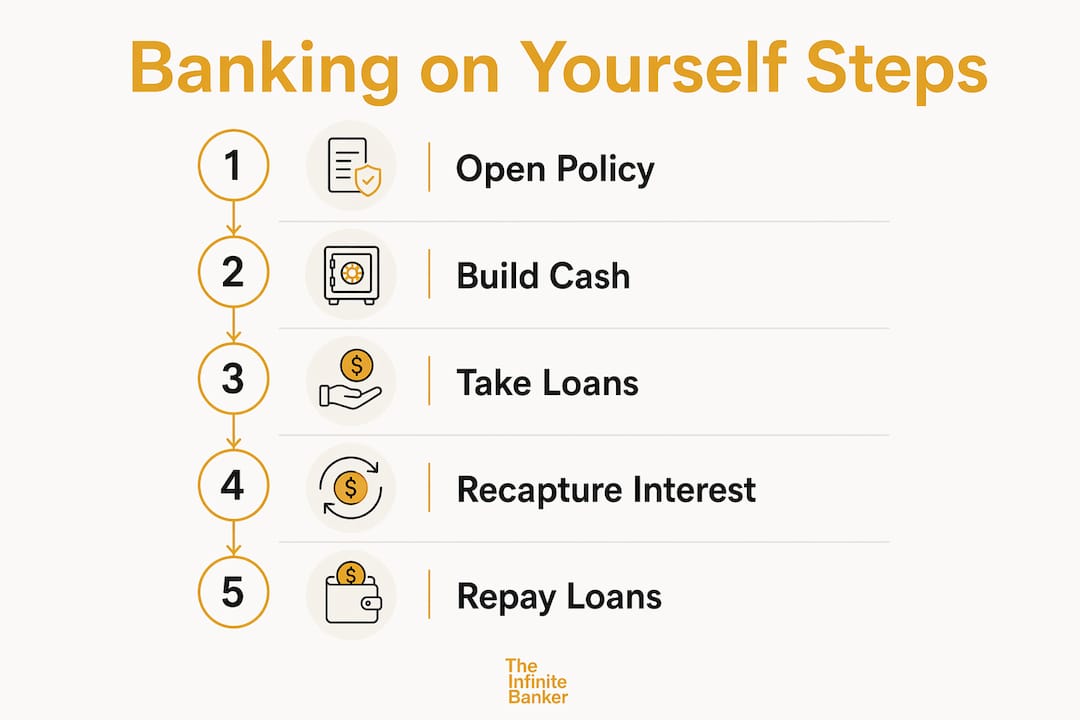
The process moves through four repeating phases:
Fund the policy. You pay premiums, including PUA contributions, into the policy. Cash value builds immediately and substantially, unlike standard whole life policies where early cash value is minimal.
Borrow against cash value. When you need capital, you request a policy loan from the insurance company. The loan is secured by your cash value, not your credit score. There are no approval processes, no hard inquiries, and no fixed repayment deadlines.
Repay on your terms. You set the repayment schedule. You pay interest back to the insurance company, but because you structured the policy correctly, you are also recapturing a portion of that interest inside your own system rather than surrendering it entirely to a lender.
Repeat the cycle. As you repay, your available cash value is restored. The policy continues earning dividends throughout, even while a loan is outstanding. That continuous compounding is what makes the system self-perpetuating.
Pro Tip: Structure your policy with the highest PUA ratio your insurer allows relative to the base premium. This front-loads cash value growth and shortens the funding lag, the period before your policy becomes a fully functional banking tool.
The cash value continues to earn dividends as if the loan never happened. That single feature is what makes the strategy fundamentally different from withdrawing money from a savings account, where the withdrawn amount stops earning interest the moment it leaves.
What are the benefits of the banking on yourself strategy?
The advantages of this method go beyond simple savings. They address the structural weaknesses most people accept as unavoidable in conventional finance.
Guaranteed, predictable growth. Historical data shows whole life insurance value increases in every economic cycle. Your cash value does not drop during a market correction the way a 401(k) or brokerage account can.
Liquidity without bank dependency. Borrowing from your policy protects your credit score and bypasses bank approval entirely. You access funds in days, not weeks.
Interest recapture. When you borrow from your own policy and repay with interest, a portion of that interest stays inside your system. You effectively pay yourself back, building wealth while accessing cash.
Tax advantages. Cash value inside a whole life policy grows tax-deferred. Policy loans are generally not treated as taxable income. Death benefits typically pass to beneficiaries income-tax-free. These features are built into the life insurance structure under current IRS treatment.
Financial control. You set the loan terms, the repayment pace, and the use of funds. No lender can call the loan, change the rate, or deny access based on economic conditions.
The combination of liquidity, guaranteed growth, and interest recapture is rare in personal finance. Most strategies force a trade-off between access and growth. Banking on Yourself is designed to provide both simultaneously.
Common misconceptions about the banking on yourself concept
The most damaging misconception is that Banking on Yourself is a standard whole life insurance policy with a different name. It is not. A properly structured IBC policy requires specific design choices, primarily the PUA rider, that most insurance agents never recommend because they reduce the agent’s commission. Buying a standard whole life policy and calling it a banking system will not produce the same results.
Other misconceptions worth addressing directly:
It is not a get-rich-quick scheme. Cash value builds meaningfully over years, not months. The strategy rewards patience and consistency, not speed.
It does not replace all banking. You will still use checking accounts, mortgages, and business credit lines. Banking on Yourself complements your existing financial structure. It does not replace it entirely.
The fees and costs are real. Premiums are higher than term insurance. The internal cost of insurance inside the policy reduces some of the cash value growth, especially in early years. These costs are the price of the guarantees and the banking functionality.
It requires a mindset shift. R. Nelson Nash was explicit on this point. Treating your policy like a bank means taking repayment seriously, just as a commercial bank would expect repayment. Borrowing without repaying collapses the system over time.
Pro Tip: Before purchasing any policy, ask the advisor to show you a policy illustration with the PUA rider clearly labeled and the projected cash value at years 1, 5, 10, and 20. If the advisor cannot produce this or discourages the question, find a different advisor.
The strategy is also not suitable for everyone. People with inconsistent income, high existing debt loads, or short time horizons may find the funding requirements difficult to sustain. Honest self-assessment before committing is not optional.
How to implement the banking on yourself strategy in your financial plan
Implementation follows a clear sequence. Skipping steps creates the policy design problems that undermine the strategy’s effectiveness.
Study the foundational material. Read R. Nelson Nash’s Becoming Your Own Banker before speaking with any advisor. This gives you the conceptual framework to evaluate whether an advisor actually understands IBC or is simply selling whole life insurance.
Find a properly trained advisor. Not every life insurance agent understands IBC policy design. Look for advisors who specialize in this structure and can demonstrate experience designing high-PUA policies. The Infinite Banker connects clients with advisors who meet this standard.
Design the policy for cash value, not death benefit. Work with your advisor to set the base premium as low as possible and the PUA contribution as high as the IRS’s Modified Endowment Contract rules allow. This ratio determines how quickly your policy becomes a functional banking tool.
Fund consistently. Consistent policy funding is the single most important factor in maximizing long-term wealth-building potential. Treat premium payments as non-negotiable, the same way you would treat a mortgage payment.
Borrow with purpose and repay with discipline. Use policy loans for purchases you would have financed anyway: vehicles, equipment, real estate down payments, or business capital. Repay on a schedule that restores your cash value within a reasonable timeframe.
Review annually. Your policy illustration will show actual versus projected cash value. Annual reviews with your advisor catch funding gaps early and allow adjustments before they compound into larger problems.
A common use case for entrepreneurs is equipment financing. Instead of taking a bank loan at a fixed rate with a hard approval process, the business owner borrows from their policy, buys the equipment, and repays the policy over 24–36 months. The policy earns dividends throughout, and the repaid interest stays within the owner’s financial system rather than flowing to a lender.
Key takeaways
Banking on Yourself works because a properly structured, dividend-paying whole life policy creates a self-replenishing capital system that grows continuously, provides tax-advantaged liquidity, and recaptures interest that would otherwise flow to outside lenders.
Point | Details |
PUAs are non-negotiable | Paid-Up Additions are what separate an IBC policy from standard whole life; without them, cash value growth is too slow to function as a banking system. |
Loans do not interrupt growth | Cash value continues earning dividends while a policy loan is outstanding, enabling simultaneous growth and liquidity. |
Mindset determines results | Treating repayment with the same seriousness as a commercial bank loan is what keeps the system sustainable over decades. |
Policy design matters more than the concept | A poorly structured policy undermines every benefit; working with a trained advisor is the most important implementation step. |
It is a long-term strategy | Meaningful cash value accumulates over years; the strategy rewards consistency and patience, not short-term thinking. |
Why I think most people misread this strategy entirely
Most people who dismiss Banking on Yourself have never seen a properly structured policy illustration. They have seen a standard whole life proposal with high premiums, low early cash value, and a death benefit that dwarfs any practical banking use. That is not IBC. That is a salesperson who learned the vocabulary without understanding the design.
What I find genuinely underappreciated is the psychological dimension R. Nelson Nash built into the concept. The discipline of repaying your own policy is not a financial technicality. It is a behavioral system. When you borrow from a bank, the bank enforces repayment through credit reporting, late fees, and legal consequences. When you borrow from yourself, only your own standards enforce repayment. Most people are not prepared for that level of self-accountability, and that is where the strategy quietly fails for people who were otherwise financially capable of making it work.
The strategy also fits some financial personalities far better than others. Entrepreneurs and real estate investors who already think in terms of capital cycles, deployment, and recapture tend to adapt quickly. Salaried employees who think in terms of monthly budgets often struggle with the variable nature of policy loan repayment. Neither group is wrong. The fit just differs.
My honest advice: evaluate the advisor before you evaluate the product. A well-designed policy with a mediocre advisor will underperform. A well-designed policy with a knowledgeable advisor who monitors your funding and loan activity will outperform almost any expectation you set in year one.
— Jib Hunt
The Infinite Banker: resources for your next step
The Infinite Banker is built specifically for entrepreneurs, investors, and high-income earners who want to implement this strategy correctly from the start.
[
The platform provides education, policy design guidance, and access to advisors who specialize in high-PUA whole life structures. Whether you are still evaluating whether this approach fits your financial goals or you are ready to design your first policy, the resources at The Infinite Banker give you a clear path forward. If you want to assess your fit before committing, the who this strategy is for page walks through the financial profiles that benefit most from this approach.
FAQ
What is the banking on yourself strategy in simple terms?
Banking on Yourself is a strategy where you use a specially structured, dividend-paying whole life insurance policy as your own personal bank, borrowing against its cash value for major purchases and repaying yourself instead of a lender.
How does banking on yourself differ from standard whole life insurance?
A Banking on Yourself policy is structured with Paid-Up Additions to maximize cash value growth from the start, while a standard whole life policy is designed to maximize the death benefit, which produces far less accessible cash value in the early years.
Is banking on yourself effective for building long-term wealth?
The strategy produces guaranteed, predictable growth and tax-advantaged liquidity, but its effectiveness depends entirely on consistent funding, proper policy design, and disciplined loan repayment over a period of years, not months.
Can you lose money with the banking on yourself strategy?
Your cash value does not decrease due to market volatility. However, failing to repay policy loans or stopping premium payments can reduce cash value and ultimately lapse the policy, which would eliminate the banking system you built.
Who is the banking on yourself concept best suited for?
The strategy works best for entrepreneurs, real estate investors, and high-income earners who have consistent cash flow, a long time horizon, and the discipline to treat their policy like a functioning financial institution rather than a passive savings account.
This post is for educational purposes only and does not constitute financial, tax, or legal advice. Individual circumstances vary. Consult with qualified professionals before making any decisions regarding insurance or capital strategy.
Comments