
Infinite Banking for Professionals: A Complete Guide

Updated: Jun 27

COMPLIANCE NOTE: For educational purposes only. Not financial, tax, or legal advice.
Infinite banking is defined as a personal finance strategy where professionals use a specially designed dividend-paying whole life insurance policy as a private reserve of capital, replacing or supplementing traditional bank financing. The formal industry term is the Infinite Banking Concept, or IBC, coined by Nelson Nash. What is infinite banking for professionals, specifically? It is the deliberate use of policy cash value and tax-advantaged policy loans to manage business cash flow, fund investments, and build long-term wealth outside the conventional banking system. The Infinite Banker works with entrepreneurs, attorneys, CPAs, and trade business owners to implement this strategy with the structural precision it requires.
What is infinite banking for professionals and how does it work?
Infinite banking uses a dividend-paying whole life policy as collateral for policy loans, while the cash value continues to earn dividends uninterrupted. That last point is the core mechanical advantage. Your money compounds inside the policy even while you borrow against it, which is not how a standard bank savings account or 401(k) loan works.
The policy structure matters enormously. A standard whole life policy builds cash value slowly because most of the premium funds the death benefit. A properly designed IBC policy uses paid-up additions (PUAs) to maximize cash value fast enough to serve as a usable lending source within the first few years. PUAs are essentially additional chunks of fully paid-up insurance purchased inside the policy, and they accelerate the growth of your accessible capital.
Here is how the loan cycle works in practice:
You pay premiums into a mutual company whole life policy structured with PUAs.
Cash value accumulates and earns dividends from the insurance company.
You request a policy loan using the cash value as collateral. No credit check. No income verification.
You use those funds for business expenses, an investment, or a cash flow gap.
You repay the loan on your own schedule, with interest that flows back into your policy system rather than to an external lender.
The cash value never stops compounding during the loan period.
Pro Tip: Ask any agent you interview to show you a policy illustration with the base premium and PUA split clearly labeled. If they cannot explain why the policy is structured that way, find a different agent.
The ramp-up period is real. The first two to five years involve a funding lag where premiums exceed accessible cash value. Professionals who understand this timeline treat the early years as the foundation phase, not a failure signal.

What are the key financial benefits of infinite banking for professionals?
The most direct benefit is tax-advantaged liquidity. Cash value grows tax-deferred, and policy loans are generally not taxable as income as long as the policy stays in force. For a CPA or attorney in a high tax bracket, that distinction is significant. A taxable withdrawal from a brokerage account or retirement plan triggers an immediate tax event. A policy loan does not.
The second benefit is speed and privacy. Policy loans bypass the delays and approval processes of traditional bank financing. For a trade business owner managing seasonal cash flow, or an attorney covering operating costs between client payments, waiting two weeks for a bank decision is a real cost. Policy loans are typically funded within days.
Tax-deferred growth. Cash value compounds without annual tax drag, unlike a taxable brokerage account.
Tax-free loans. Policy loans do not appear on credit reports and carry no required repayment schedule.
Uninterrupted compounding. The full cash value continues earning dividends even while a loan is outstanding.
No external approval. Loans require no credit check, income verification, or bank committee review.
Interest recapture. Loan interest paid returns to your policy system rather than enriching an outside lender.
Asset protection. In many states, life insurance cash value carries legal protections from creditors.
“The strategy increases liquidity and bypasses the delays and uncertainties of traditional bank financing, which is critical for business operational cash flow management.” Professionals use it as a hedge against bank volatility and seasonal cash flow challenges.
For attorneys, CPAs, and trade business owners, the ability to finance business expenses internally without income verification is a structural advantage that conventional borrowing cannot replicate.
What are the risks and drawbacks professionals should know?
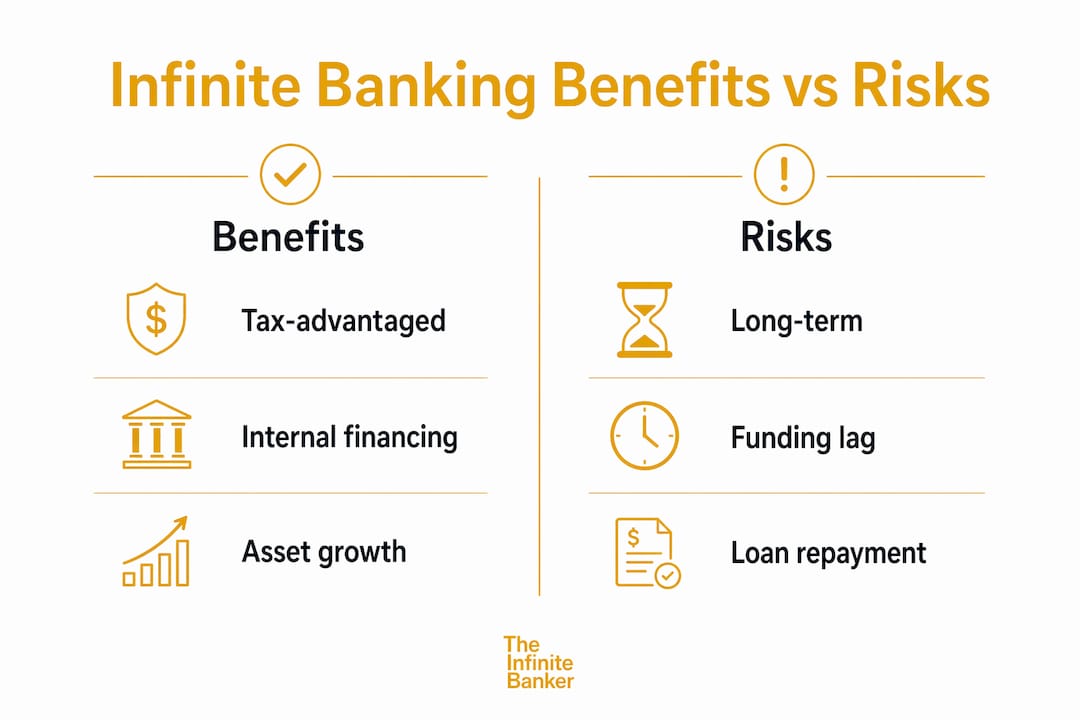
Infinite banking is not a short-term solution. A long-term commitment of 15 to 20 years or more is required for meaningful cash value accumulation. Professionals who expect quick returns will be disappointed. Early surrender charges and the funding lag in the first few years mean that exiting the policy early produces poor financial outcomes.
The loan management risk is real and often underestimated. Unpaid policy loans reduce the death benefit and cash value proportionally. If loan balances grow unchecked and interest accrues without repayment, the policy can eventually lapse. A lapsed policy triggers a taxable event on all gains, which eliminates the tax advantages that made the strategy attractive in the first place.
Key risks to understand before committing:
High early premiums. Whole life premiums are significantly higher than term insurance. The strategy requires consistent premium payments over decades.
Dividend variability. Dividends from mutual companies are not guaranteed. They have historically been paid consistently by major carriers, but projections are not promises.
Policy design dependency. A poorly structured policy, one without adequate PUAs or from a non-mutual company, will not perform as the IBC requires.
Agent expertise gap. Most life insurance agents are not trained in banking-oriented policy design. Working with the wrong agent produces a policy that looks like IBC but functions like standard whole life.
Pro Tip: Request a policy illustration showing the internal rate of return on cash value at years 5, 10, 20, and 30. Compare that to your current after-tax borrowing costs. The numbers tell the real story.
Feature | IBC whole life policy | Standard bank loan |
Credit check required | No | Yes |
Approval timeline | Days | Days to weeks |
Interest recaptured | Yes, back to policy | No, paid to bank |
Cash value growth during loan | Continues | Not applicable |
Repayment schedule | Flexible | Fixed |
Tax on loan proceeds | Generally none | Not applicable |
How can professionals implement infinite banking in their financial plans?
Implementation starts with working with specialized agents who design banking-oriented whole life policies. These policies differ structurally from standard whole life products. The agent must understand how to balance the base premium and PUA rider to maximize early cash value while keeping the policy compliant with IRS guidelines on modified endowment contracts (MECs). A MEC loses the tax-free loan benefit, which defeats the strategy entirely.
Practical use cases for professionals include:
Attorneys using policy loans to cover operating costs between case settlements, then repaying when fees arrive.
CPAs funding a practice acquisition or technology upgrade without triggering a bank approval process.
Trade business owners smoothing seasonal cash flow gaps, such as covering payroll in a slow quarter, then repaying from peak season revenue.
Real estate investors using policy loans as bridge capital for a down payment, then repaying from rental income. The Infinite Banker covers this application in depth for real estate investors.
The infinite banking strategy also integrates with estate planning. The death benefit passes income-tax-free to heirs, and the cash value accumulated over decades can supplement retirement income through tax-free policy loans. Professionals who start in their 30s or 40s build a system that serves both their working years and their retirement simultaneously.
Monitoring loan balances is not optional. Sustainable use of the system requires treating policy loans with the same discipline you would apply to a business line of credit. Set a repayment schedule. Track the outstanding balance against your cash value. Keep the loan-to-cash-value ratio at a level that preserves the policy’s long-term integrity.
Common myths about infinite banking professionals get wrong
Infinite banking is a strategy, not a product. The policy is the vehicle. The discipline and design are the engine. Many professionals hear “whole life insurance” and assume the strategy is the same as buying a standard whole life policy from a general insurance agent. It is not. The policy must be specifically designed for capital efficiency, with PUAs structured to front-load cash value accumulation.
A persistent myth is that borrowing against the policy pauses or reduces cash value growth. It does not. The cash value continues to earn dividends on the full balance while the loan is outstanding. The loan is collateralized by the cash value, but the cash value itself is not withdrawn or frozen.
Other misconceptions worth addressing:
“The interest you pay is wasted.” Loan interest paid returns to the policy system. You are effectively paying interest to yourself, which is a fundamentally different dynamic than paying a bank.
“Infinite banking is only for the wealthy.” The strategy scales to income. The Infinite Banker addresses this directly for professionals at various income levels, as covered in the accessible for many discussion.
“It’s a scam.” The skepticism is understandable given how the strategy is sometimes marketed. The mechanics are grounded in standard insurance contract law and IRS tax code. The common skepticism around IBC is addressed thoroughly for professionals who want the unfiltered view.
“You can stop paying premiums once the cash value is large enough.” Stopping premiums without a formal paid-up policy arrangement can destabilize the policy structure and reduce long-term performance.
Key Takeaways
Infinite banking for professionals works because a properly structured whole life policy builds tax-advantaged cash value that can be borrowed against privately, repeatedly, and without disrupting the compounding growth of the underlying asset.
Point | Details |
Policy design is everything | PUAs and mutual company structure determine whether the policy functions as a banking tool. |
Loans do not pause growth | Cash value earns dividends on the full balance even while a policy loan is outstanding. |
Tax advantages are conditional | Loans remain tax-free only if the policy stays in force and avoids MEC status. |
Time horizon is 15 to 20 years | Meaningful cash value accumulation requires a long-term commitment, not a short-term fix. |
Loan discipline is required | Unmanaged loan balances can cause policy lapse and trigger unexpected tax consequences. |
The liquidity edge most professionals overlook
Most professionals I work with come to infinite banking after a frustrating experience with conventional borrowing. A bank line of credit gets pulled during a slow quarter. A loan approval takes three weeks when the opportunity window is ten days. Those are not edge cases. They are predictable features of a system designed around the bank’s risk tolerance, not yours.
What I find underappreciated is the psychological shift that comes with owning a private capital reserve. When you know you can access $80,000 or $200,000 within days, without a credit committee, without income documentation, and without the loan appearing on your credit report, you make different decisions. You take the right opportunity. You cover the cash flow gap without stress. You negotiate from a position of strength.
The professionals who get the most from this strategy are not the ones with the highest incomes. They are the ones with the most discipline. Repaying policy loans consistently, funding premiums through income fluctuations, and resisting the urge to treat the policy as a piggy bank rather than a system. The compounding math only works if you let it run.
Working with an experienced agent who understands policy illustrations and MEC limits is not optional. It is the difference between a policy that performs and one that looks good on paper for the first five years and then stagnates. The Infinite Banker exists specifically to close that gap for professionals who want the strategy implemented correctly.
— Jib Hunt
Build your own banking system with The Infinite Banker
The Infinite Banker is built for professionals who want a private capital system designed around their actual cash flow needs, not a generic insurance product.

Whether you are an attorney managing irregular fee income, a CPA building practice equity, or a trade business owner navigating seasonal cash flow, the right policy structure changes what is financially possible. The Infinite Banker provides strategy education and consulting for professionals ready to implement infinite banking with precision. The resources cover policy design, loan management, tax considerations, and long-term wealth integration. Start with the foundational content and connect with a specialist who understands how to build this system for your specific professional context.
FAQ
What is infinite banking for professionals?
Infinite banking for professionals is a strategy that uses a dividend-paying whole life insurance policy as a private lending source, allowing professionals to borrow against cash value without credit checks or bank approval. The cash value continues to earn dividends while loans are outstanding.
How does infinite banking differ from a standard whole life policy?
An IBC-designed policy uses paid-up additions to accelerate cash value accumulation, making it usable as a lending tool within the first few years. Standard whole life policies are not structured for this purpose and build cash value much more slowly.
Is infinite banking worth it for attorneys and CPAs?
Infinite banking suits attorneys and CPAs who have consistent income to fund premiums over a 15 to 20 year horizon and who need flexible, private access to capital for business expenses or investments. It is not a short-term solution.
What happens if I do not repay a policy loan?
Unpaid policy loans reduce the death benefit and cash value proportionally. If loan balances grow large enough, the policy can lapse and trigger a taxable event on all accumulated gains, eliminating the tax advantages of the strategy.
Can trade business owners use infinite banking for cash flow?
Trade business owners use policy loans to cover payroll, equipment purchases, or operating costs during slow seasons, then repay from peak revenue. The flexible repayment schedule makes it well-suited to businesses with variable income cycles.
Recommended
This post is for educational purposes only and does not constitute financial, tax, or legal advice. Individual circumstances vary. Consult with qualified professionals before making any decisions regarding insurance or capital strategy.
Comments