
Factum Finance: Infinite Banking With Whole Life for Owners


COMPLIANCE NOTE: For educational purposes only. Not financial, tax, or legal advice.
Factum finance refers to the Infinite Banking concept implemented through a properly structured, dividend-paying whole life insurance policy. In plain terms, it means using a whole life policy’s cash value and policy loans as a private, disciplined capital source rather than relying solely on banks or credit lines. For entrepreneurs, real estate investors, and high-income business owners with a long time horizon and steady cash flow, this approach can be a reasonable fit. It is not a fast or low-cost strategy, and it depends heavily on policy design.
Fits best: business owners and investors with 7 to 15+ year horizons, discretionary cash to fund premiums, and a need for flexible, self-directed liquidity.
Core tradeoff: you accept higher premiums and a multi-year buildup period in exchange for later access to policy loans on your own terms.
Next step: model your numbers with the Infinite Banking Calculator and speak with The Infinite Banker before committing to a design.
This article closes with a required disclaimer. Consult a licensed advisor before acting on anything here.
Key Takeaways
Factum finance works when a dividend-paying whole life policy is designed for early cash value, funded consistently for years, and managed with the same discipline as a business line of credit.
Point | Details |
Definition matters | Factum finance means Infinite Banking implemented through a properly structured, dividend-paying whole life policy. |
Timeline is long | Meaningful cash value commonly takes 10 years or more, so patience and funding cadence outweigh premium size alone. |
Loans carry real risk | Unpaid loan interest compounds and can cause lapse or a taxable distribution if the balance outgrows cash value. |
Design drives outcomes | Riders, carrier choice, and funding level determine whether a policy supports early liquidity or sits idle for years. |
Start with The Infinite Banker | The Infinite Banker offers policy design consultations and the Infinite Banking Calculator to model your funding cadence before you commit. |
Table of Contents
How Does Factum Finance Actually Work?
A dividend-paying whole life policy becomes a usable capital source through two connected mechanics: cash value accumulation and policy loans. Every premium payment is split by the insurer between the cost of insurance, fees, and a cash value account that grows on the insurer’s declared schedule.
Dividends, when a mutual carrier declares them, can add to that cash value growth, but dividends are never guaranteed and vary by carrier performance and policy year. According to NerdWallet, infinite banking treats the policy as a personal line of credit, though cash value grows on insurer-set terms and it commonly takes 10 years or more to build meaningful value.
Policy loans work differently than a bank loan. You are not withdrawing your own cash. You are borrowing from the insurer, which uses your policy’s cash value as collateral. There is typically no credit check for a policy loan, and interest accrues on the outstanding balance. Depending on the design, cash value can continue crediting growth even while a loan is outstanding, though this varies by carrier and product.
Overfunding, meaning premiums paid above the minimum required to keep the policy in force, is the primary lever for accelerating cash value. Push funding too aggressively, though, and the policy can cross into Modified Endowment Contract (MEC) territory, which changes how distributions are taxed. MassMutual notes that distributions generally remain tax-advantaged up to cost basis, but MEC status or a lapse with an outstanding loan can trigger a taxable event.
Common design levers include:
Overfunding within IRS guidelines to avoid MEC status.
Riders that increase early cash value availability.
Choosing a financially stable mutual carrier with a consistent dividend history.
Pro Tip: Track your loan balance and accruing interest with the same discipline you’d apply to a business line of credit. A simple quarterly reconciliation prevents unpaid interest from quietly compounding against your cash value.
Who Should Consider This Strategy?
Factum finance tends to fit three overlapping profiles: entrepreneurs with recurring, predictable cash flow; real estate investors who need bridge capital for acquisitions; and high-income owners who want liquidity without liquidating other assets. The common thread is a long planning horizon and enough discretionary income to fund a policy consistently.
Typical use cases include:
Bridge financing while arranging permanent financing on a property acquisition.
Funding renovation costs or inventory purchases without applying for a new loan.
Supplementing business cash flow during seasonal gaps.
Recycling capital into recurring investments without depending on outside lenders.
Before pursuing this, run through a short self-check: Do you have consistent discretionary cash to fund premiums for years, not months? Is your time horizon 7 to 15 years or longer? Are you comfortable overfunding a policy rather than maximizing death benefit? Do you want ongoing control over your own liquidity terms?
Salaried households with tight monthly budgets, or buyers looking for capital within a year or two, are generally not strong candidates. The funding requirements simply don’t match a short horizon or thin cash flow.
What Do Premiums and Timelines Actually Look Like?
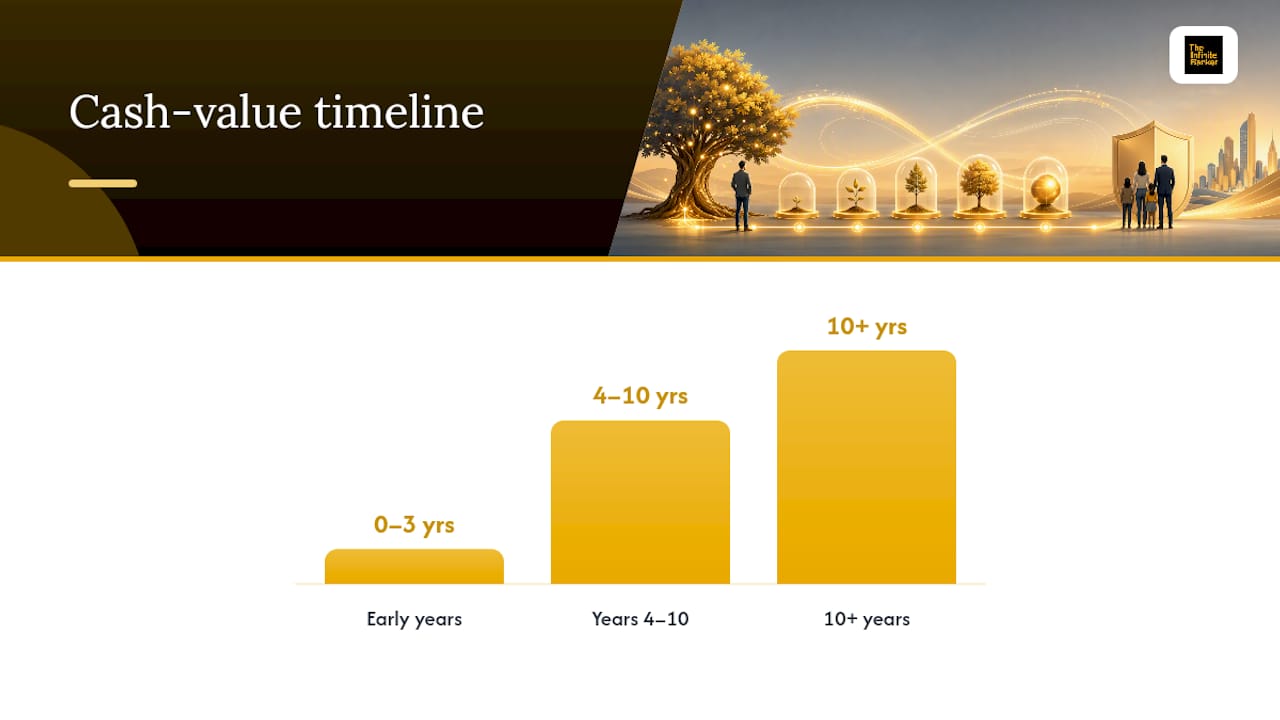
Factum finance requires a higher premium commitment than a minimum death-benefit policy, and useful cash value takes years to build, not months. In the early years, most of your premium covers insurance costs and policy fees, so cash value growth is modest. By years four through ten, meaningful cash value typically supports smaller loans. Larger funding capacity generally requires ten-plus years, consistent with NerdWallet’s observation that meaningful cash value commonly takes a decade or more to develop, though the exact pace depends heavily on your funding level and policy design.
Advisors often reference the strategy of paying above the minimum premium to accelerate this timeline, though the right percentage depends on your income stability and other obligations. Underwriting matters too: your age, health rating, and any substandard classification affect both premium cost and how quickly cash value builds. A medical exam is standard for most policies at this income and coverage level, and adverse underwriting results may require you to adjust your funding plan or coverage amount.
Statistic Callout: Building meaningful cash value inside a whole life policy commonly takes 10 years or more, which is why funding cadence and patience matter more than premium size alone.
Model your own funding scenarios with the Infinite Banking Calculator before finalizing a design.
What Are the Real Risks and Tax Consequences?
The principal risks in factum finance are policy lapse, taxable distributions triggered by lapse or MEC status, compounding loan interest, and a reduced death benefit while loans remain outstanding. None of these are hypothetical. They are the direct consequence of how policy loans and cash value interact.
Unpaid loan interest is added to your loan balance, and if that balance grows faster than your cash value, the policy can lapse.
A lapse with an outstanding loan can create a taxable distribution, according to David Kinder Financial.
Overfunding beyond IRS limits can push a policy into MEC status, changing the tax treatment of future distributions.
High premiums carry an opportunity cost if that capital could otherwise be deployed elsewhere.
Policy loans are collateralized loans from the insurer, not withdrawals of your own money. Treat unmanaged interest as a real liability, because it behaves like one.
For business owners, loan interest may be deductible when the borrowed funds are used for a legitimate business purpose, but this requires careful documentation and coordination with a CPA. Dividends are never guaranteed, and a poorly designed policy, or one where premiums lapse, can reverse the benefits the strategy is meant to provide.
How Do You Implement Factum Finance Step by Step?
Implementing factum finance responsibly is a multi-step process that runs from suitability assessment through underwriting to ongoing loan management. Skipping steps, especially policy design review, is where most poorly structured policies go wrong.
Assess suitability against your cash flow, time horizon, and liquidity goals.
Set a funding cadence, deciding how much to overfund beyond minimum premium.
Choose a carrier and riders built for early cash value, ideally a financially stable mutual company, as outlined by Kraig Strom.
Run illustrations comparing funding scenarios before applying.
Complete underwriting, including any required medical exam.
Fund and monitor the policy against your original design.
Manage loans with clear repayment rules and internal accounting.
Have your recent tax returns, cash-flow statements, and, if borrowing for business purposes, documentation tying the loan to a legitimate business expense ready before you meet a specialist. The Infinite Banking Calculator is useful for stress-testing different funding cadences before you commit.
Pro Tip: Set up a repayment schedule for every policy loan as if it were a corporate line of credit, complete with a target payoff date and a ledger entry. This single habit prevents the slow drift toward a lapsed policy.
How Do You Choose a Factum Finance Specialist?
Choose a specialist with demonstrable experience designing dividend-paying whole life policies specifically for entrepreneurs and business owners, not just general life insurance sales. Track record with early cash-value design matters more than a generic sales pitch.
Ask directly: How many policies have you designed for early liquidity? What has been your carriers’ historical dividend performance? Can you show sample illustrations built on realistic, not aggressive, funding assumptions? What’s your compensation model, fee-based, commission, or both? Will you coordinate with my CPA on tax treatment?
Watch for red flags: anyone who promises specific outcomes, glosses over MEC risk, lacks underwriting experience, or can’t produce a sample illustration grounded in your actual numbers. When you’re ready to move forward, The Infinite Banker offers consultations and the Infinite Banking Calculator as starting points for that conversation.
A Practitioner’s View on Discipline
In practice, the strategy succeeds or fails on policy design and follow-through, not on the concept itself. Prioritize underwriting quality, funding consistency, and monthly monitoring of loan balances over chasing the fastest possible cash-value timeline. Coordinate with a fee-based advisor and a CPA before funding anything.

Getting Started With The Infinite Banker
The Infinite Banker works directly with entrepreneurs, real estate investors, and high-income owners who want a properly structured whole life policy built for capital efficiency rather than a generic insurance sale. That distinction, design built around early liquidity instead of minimum death benefit, is what separates a functional factum finance strategy from a policy that never generates usable cash value.

The engagement model is straightforward: a strategy session to assess fit, policy design and carrier selection guided by underwriting realities, and ongoing education as your cash value and loan capacity grow. Revenue comes from policy placement and continued advisory support, not from selling one-size-fits-all templates. If you want to see what a funding cadence could look like for your own numbers, start with the Infinite Banking Calculator, then book a session through The Infinite Banker to review your design options.
Sources
This post is educational only and not financial, tax, or legal advice. Consult qualified professionals before acting.
This article is general information, not a substitute for advice from a qualified financial advisor. Consult a qualified financial professional about your own circumstances before acting on anything here.
Recommended
Comments